Metaverse development: A comparison between consumer, customer, e-commerce (V-commerce) and industrial metaverse – Image: Xpert.Digital
From Consumer to Industrial: An overview of the fascinating diversity of the Metaverse worlds
Metaverse Development: A Comprehensive Overview of Consumer, Customer, E-Commerce (V-Commerce) and Industrial Metaverse
The world of the metaverse has undergone rapid development in recent years, opening up new opportunities for both businesses and individuals. However, not all "metaverses" are a single entity; different areas can be distinguished, each with its own goals, technologies, and applications. This report presents a detailed overview of the developments in the Consumer Metaverse, the Customer Metaverse, the E-Commerce Metaverse (also known as V-Commerce), and the Industrial Metaverse. A comparison follows, highlighting key similarities and differences, and offering a glimpse into future developments and challenges. The focus throughout is on the opportunities this presents for businesses and users, and how the various use cases can impact the economy, society, and everyday life.
1. Definition and meaning of the metaverse
The term "metaverse" generally refers to a three-dimensional, virtual environment in which people can interact in real time using avatars or technological aids. Commonly used technologies include virtual reality (VR) and augmented reality (AR), but also other immersive concepts such as mixed reality or haptic interfaces. The metaverse is more than a simple extension of existing digital platforms. It is characterized by its comprehensive, interconnected structure, in which the physical and virtual worlds merge into a virtually seamless whole. Experts predict that these new digital realities will fundamentally transform social interaction, the world of work, and commerce in the future.
The metaverse is suitable for a wide variety of applications. Companies can optimize their production processes, improve customer experiences, develop new digital goods, or offer further training for employees. Consumers, in turn, gain the opportunity to shop, play games, attend concerts, or interact with other people in virtual worlds. This great potential and diverse range of applications mean that more and more industries are viewing the metaverse as a future growth market.
Related to this:
2. The Consumer Metaverse
The consumer metaverse primarily targets end users seeking immersive experiences in virtual worlds. While entertainment is a major focus, the term encompasses far more than just gaming and leisure. The consumer metaverse also has potential implications for retail, urban planning, and access to healthcare services.
Immersive experiences for end consumers
In the consumer metaverse, users can immerse themselves in virtual environments via VR or AR glasses, mobile devices, or traditional computer setups. Examples include virtual concerts, fashion shows, gaming events, and even entire virtual cities where users can move freely. Companies design digital spaces where they present products in engaging 3D landscapes. This often involves gamification approaches, allowing customers to interact with brands and products in a playful way.
Potential changes in urban planning and the design of physical spaces
As people spend increasing amounts of time in virtual environments, this could lead to new requirements for the design of physical buildings, public spaces, and living areas in the long term. New urban planning concepts are already taking into account the possibility of hybrid interactions in both physical and digital forms. Shopping centers, for example, could be virtually extended, allowing some customers to view and personalize products in the metaverse before picking them up later in the physical store.
Improved access to healthcare services
Virtual environments also offer new opportunities in the healthcare sector: telemedicine, virtual consultations, and digital rehabilitation programs make it easier for patients to access treatment. Special VR programs can also support psychotherapeutic applications. For example, a patient can reduce anxiety in a controlled virtual environment. As one doctor put it: "We are at the beginning of a revolution in medicine, where virtual environments will allow us to offer safe and effective treatment formats."
New forms of entertainment, education, and mental health
The consumer metaverse opens up countless avenues for people to be entertained and learn. Virtual museums, digital galleries, and online workshops bring art, culture, and education into homes in new and creative ways. Learning content can be delivered through interactive simulations, and the field of mental health also benefits from immersive options for relaxation, meditation, or therapy.
Advances in AR and VR
The rapid development of hardware and software in the AR and VR sector will further accelerate the consumer market. New AR glasses, which are lighter, more powerful, and more comfortable to wear, enable entirely new real-time experiences. In the future, it may even be possible to expand or modify buildings in the neighborhood in the real world by overlaying virtual content and sharing it with others.
Importance of large technology companies
Some of the world's largest tech companies are driving the expansion of the consumer metaverse. They are investing in research and development in VR, AR, and AI to create the most realistic digital worlds possible. A spokesperson for a well-known tech company said: "Our vision is to give users a sense of presence in virtual spaces so intense that it feels like they are actually standing in another location."
Use for internal purposes and onboarding
Companies are increasingly utilizing the consumer metaverse not only in their relationships with end consumers but also internally. For example, some companies offer virtual onboarding to integrate new employees into the team quickly and engagingly. One HR manager commented: "With our new virtual onboarding environments, we make the onboarding process an experience – and our employees get to know each other in a playful way."
Gamification and mini-games
Gamification is a key component of the consumer metaverse. By using small games, competitions, or bonus programs, companies aim to increase interaction with their brands. Users earn virtual points or discounts for successful actions, which they can redeem in online shops or brick-and-mortar stores. This conveys brand messages in an entertaining way, while consumers actively engage with the products.
Related to this:
3. The Customer Metaverse
The Customer Metaverse aims to enrich the entire customer journey through virtual touchpoints, thereby engaging customers in a new, interactive way. Unlike the Consumer Metaverse, its focus here is primarily on direct interaction between companies and customers – from the initial information search to the purchase and beyond.
Extending the Customer Journey
In the Customer Metaverse, customers can visit virtual spaces to learn about products, inspect them in 3D, or visualize them in their own environment using AR. These spaces can be digital twins of stores or special showrooms that exist only within the Metaverse.
Holistic Customer View
Companies analyze the behavior of avatars and their customers' interactions in these virtual worlds to gain a holistic understanding of what truly motivates people. This includes examining aspects such as click paths, interaction times, and preferred products. These insights are then incorporated into the personalization of offers and the fine-tuning of the customer experience.
Improved digital employee experience
The customer metaverse doesn't have to be limited to the relationship between companies and customers. Internal collaboration can also be innovatively designed using virtual environments. For example, employees can work together on concepts, test prototypes, or simulate complex tasks in digital spaces. This not only creates new opportunities for collaboration but also fosters a sense of belonging that transcends physical location.
Onboarding and training
More and more companies are using the Metaverse to onboard and train new employees. In such a virtual environment, for example, a digital factory can be recreated, allowing teams to practice processes in real time. This way, employees learn about complex machines and processes without having to be physically present. One HR manager commented: "The combination of realistic simulations and a direct feedback loop makes our training more efficient and sustainable."
New hardware and software
The devices that customers and employees use to access the Metaverse are also constantly evolving. In addition to VR headsets, several major manufacturers are working on mixed-reality glasses that seamlessly integrate digital content into the real world. These advanced glasses are designed to provide the most natural viewing and interaction experience possible.
Related to this:
4. The E-Commerce Metaverse (V-Commerce)
E-commerce has experienced massive growth in recent years, and the Metaverse is creating an even more immersive form of online shopping known as V-commerce. In the e-commerce Metaverse, customers can visit digital shopping environments where they can view, try out, and directly purchase products.
Strong market growth
The e-commerce market in the Metaverse is growing rapidly, offering companies diverse opportunities to expand their existing sales channels with virtual showrooms and shops. The immersive nature of this world attracts people. In the Metaverse, they can not only browse 3D environments but also interact directly with products and exchange information with other users.
Integration of Blockchain Technology
Trust is essential in online commerce. The metaverse therefore frequently relies on blockchain-based solutions to make transactions secure and transparent. Digital tokens, cryptocurrencies, and other blockchain-based payment methods are gaining importance so that ownership and transactions are immutably documented.
Virtual stores and showrooms
In a three-dimensional world, brands can create entirely new types of digital stores. From futuristic showrooms where avatars can try on products to realistic replicas of existing stores, anything is possible. A marketing executive at a fashion company said, "Our customers appreciate the opportunity to try on clothing using their avatars before buying it, without having to go to the store."
Social Interaction and Social Commerce
A key advantage of the metaverse compared to traditional online shopping is the direct social interaction. Users can meet up with friends in the virtual space, browse products together, or receive live advice. This creates an atmosphere reminiscent of strolling together on a shopping street. At the same time, companies can use these interactions to gather direct feedback and provide personalized recommendations.
Growth of live streaming and social commerce
Livestreams with integrated purchasing options bring the metaverse to life. Customers participate in live product demonstrations and have the opportunity to buy goods directly within the stream. This creates an event-like atmosphere that many find very appealing. Merchants thus combine entertainment with sales promotion.
The role of fast internet connections
The expansion of new mobile communication standards and broadband networks enables V-Commerce to operate more smoothly. Fast internet connections are key to fluid, real-time interactions and high-resolution displays. This allows customers, for example, to browse virtual shops seamlessly without being slowed down by long loading times.
Virtual tours
Another innovation generating interest in the e-commerce metaverse is virtual tours of digital stores, museums, or even factories. These allow customers to gain a realistic impression of products or production processes, thereby strengthening their trust in companies.
Related to this:
5. The Industrial Metaverse
While the Consumer, Customer and E-Commerce Metaverse focuses primarily on interactions with end consumers or customers, the Industrial Metaverse revolves around the optimization of processes in industrial manufacturing, logistics and other economic sectors.
Improved safety and efficiency
The Industrial Metaverse utilizes AR and VR solutions that enable employees in factories and companies to interact with virtual prototypes, visualize simulated structures, and collaborate with colleagues at remote locations in real time. The virtual replica of a production facility—often referred to as a digital twin—makes it possible to identify problems early and refine processes without interfering with actual production.
Immersive Engineering Solutions
Major corporations in the fields of industrial software and high-tech optics are collaborating on immersive engineering solutions that combine sophisticated head-mounted displays with software for product development, simulation, and process control. This allows complex systems to be virtually visualized and tested. One engineer explained: "In the Industrial Metaverse, we can thoroughly test systems weeks or even months before commissioning."
Increasing acceptance in companies
More and more companies worldwide are recognizing the advantages of the industrial metaverse. These include lower prototyping costs and faster time-to-market for new products. Maintenance and repair of existing equipment is also simplified, as technicians can access digital twins and identify potential weaknesses.
Dynamic and intelligent ecosystems
The networking of various systems and data sources creates an increasingly dynamic and intelligent ecosystem within the Industrial Metaverse. Production data flows seamlessly into software solutions that uncover bottlenecks and optimization potential in real time. If a supplier part fails, the system can automatically search for alternatives and replan production.
Wide range of application scenarios
The Industrial Metaverse covers a wide spectrum: from product development and machine operation to employee support and supply chain management. Employees can learn how to operate machines or perform complex maintenance tasks in virtual training environments. At the same time, processes can be monitored in real time and optimized using AI algorithms.
GIS technology as a basis
A key component of the Industrial Metaverse is GIS (Geographic Information System) technology, which allows data to be captured and managed within a spatial context. This enables the digital mapping of terrain, roads, factory floors, and logistics chains, for example. By combining such geographic and infrastructural data with real-time information, production processes can be precisely planned and monitored.
Related to this:
🗒️ Xpert.Digital: A pioneer in the field of Extended and Augmented Reality

Finding the right Metaverse agency, planning office, or consulting firm - Image: Xpert.Digital
🗒️ Finding the right Metaverse agency, planning office, or consulting firm – Search and search: Top Ten Tips for Consulting & Planning
More information here:
Comparison of the Metaverse areas
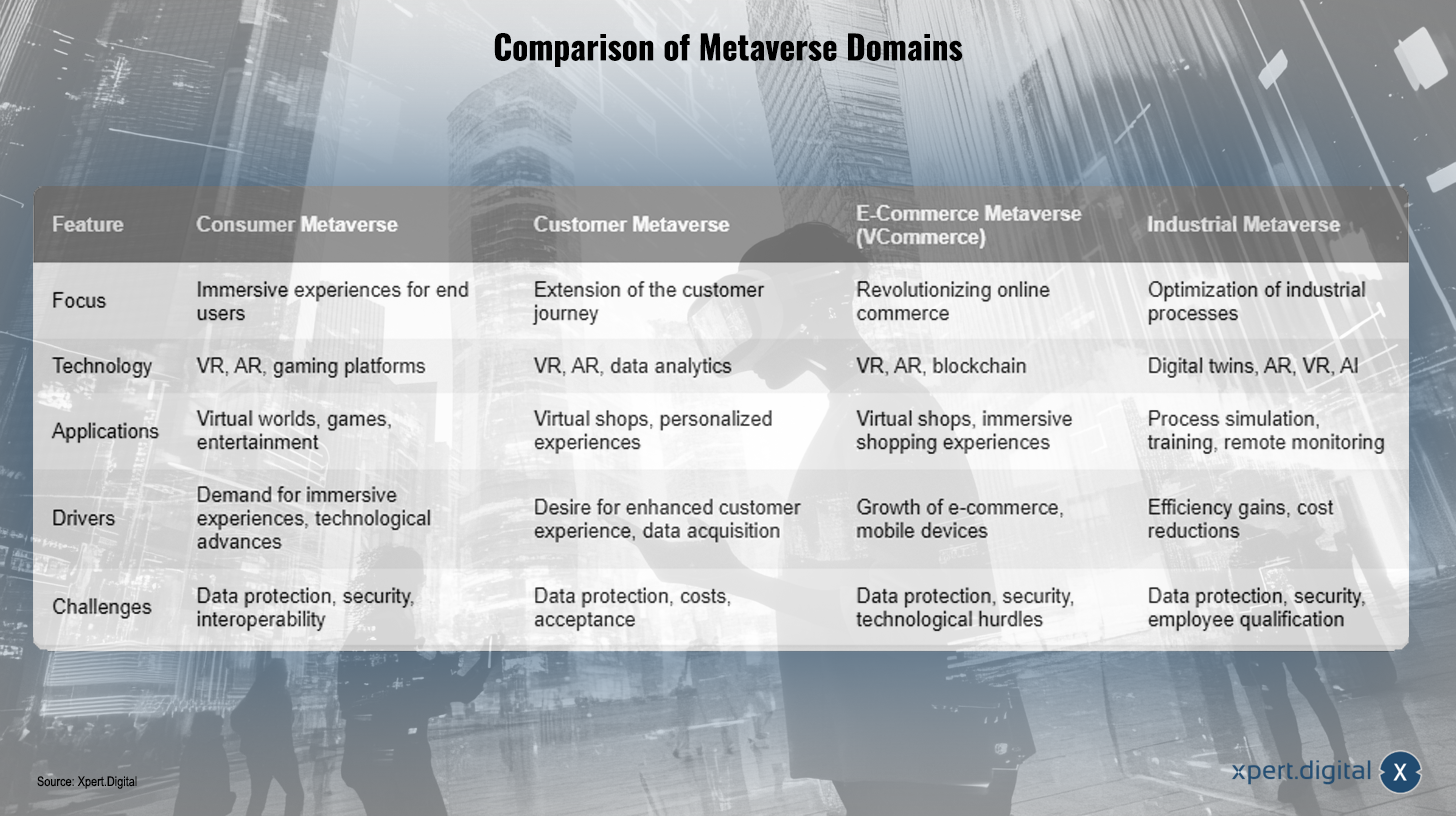
Comparison of the metaverse areas – Image: Xpert.Digital
To better understand the different orientations of the metaverse, it is helpful to compare some key points.
Differences and similarities
Target audience
- Consumer Metaverse: End consumers seeking entertainment and social interaction
- Customer Metaverse: People along the entire customer journey, with a focus on purchasing decisions
- E-commerce metaverse: Online shoppers who desire immersive shopping experiences
- Industrial Metaverse: Companies, engineers, technicians, logistics specialists and other professionals
Use cases
- Consumer Metaverse: Social gaming, virtual events, entertainment and leisure activities
- Industrial Metaverse: Increasing efficiency in production processes, digital twins, repair and maintenance optimization
Technologies
- Consumer Metaverse: Primarily immersive technologies such as VR and AR, often combined with gamification
- Industrial Metaverse: Expanded to include digital twins, IoT, and AI-powered simulation
Similarities
- Immersive technologies: All areas build on VR, AR or similar concepts to offer people the most realistic possible interaction in digital environments.
- Data analysis: User data and process data are central to personalizing experiences or making processes more efficient.
- High transformative power: In all areas there is enormous potential to revolutionize how we live, shop, communicate or produce.
Drivers and challenges
driver
- Technological advances: The increasingly powerful processors, displays and AI systems form the basis for creating convincing and lifelike simulations in the metaverse.
- Changing user needs: A growing number of people are looking for immersive experiences, virtual interactions and digital communities because the classic internet seems too passive to many.
- Economic advantages: Companies expect the metaverse to provide new revenue streams and efficiency gains. Digital goods, services, and training are available regardless of location.
- Psychological factors: Especially in the consumer market, status, self-presentation, and curiosity about innovative products play a role. Even acquiring special avatars or rare digital clothing can be appealing to people.
challenges
- Data protection and security: In virtual worlds, people interact closely, exchange data, and conduct transactions. Given the complexity of the metaverse and the increasing degree of interconnectedness, privacy and cybersecurity are particularly vulnerable.
- Interoperability: Open standards and compatible systems are needed so that users can take their avatars, digital goods or currencies from one platform to another.
- Ethical questions arise: Who owns digital assets? How can transgressions (e.g., bullying, fraud) be sanctioned in a completely virtual world? These questions have not yet been definitively answered.
- Cost and access: High-quality VR or AR hardware is often still expensive, and the necessary infrastructure is not available everywhere. This can contribute to the digital divide if certain groups are excluded from the metaverse.
- User experience: Virtual realities can overwhelm inexperienced users or even lead to so-called cyber sickness, for example, if movements in the virtual space do not exactly match body perception.
Examples of successful metaverse applications
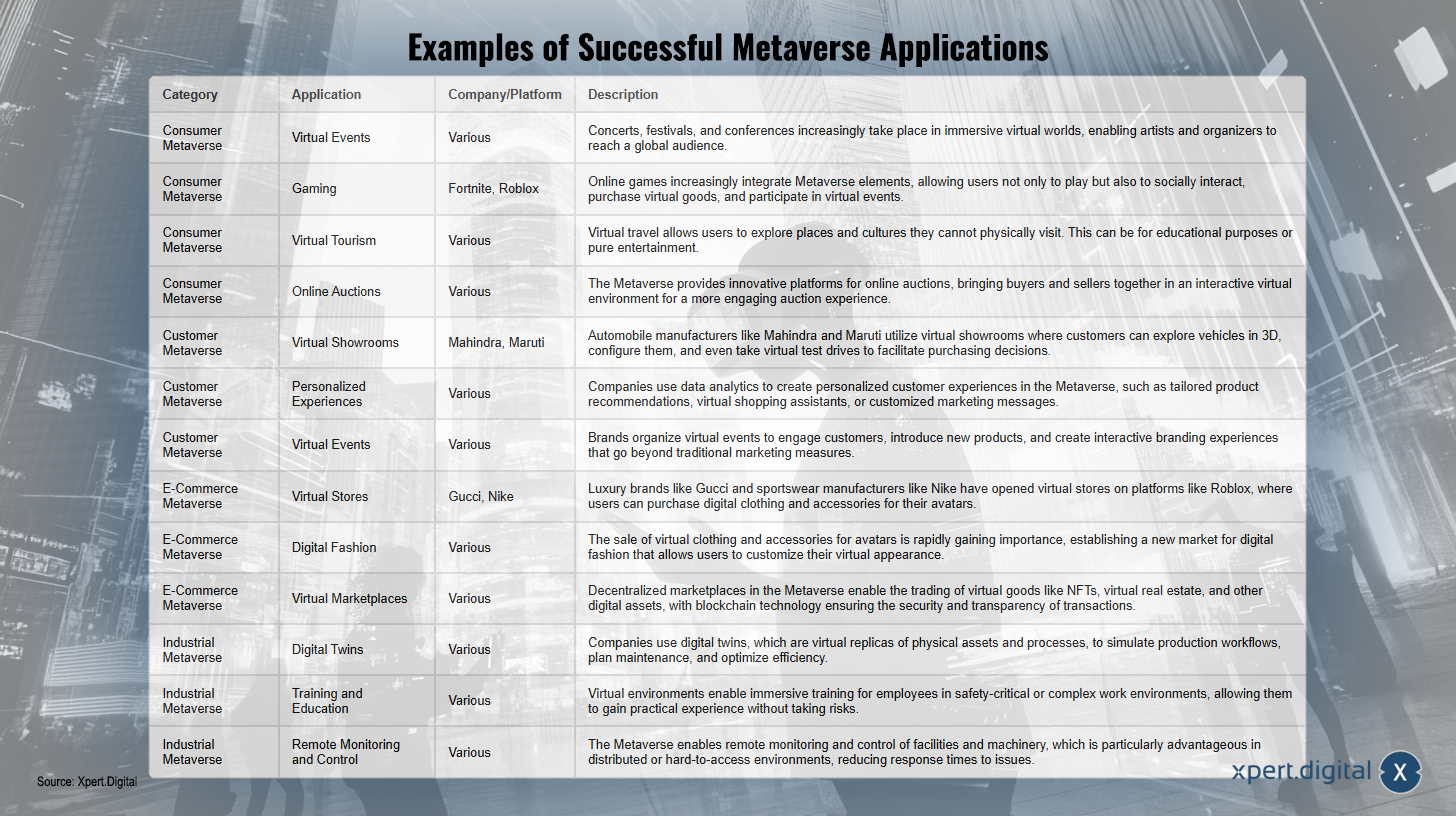
Examples of successful metaverse applications – Image: Xpert.Digital
The practical implementation of the metaverse in the aforementioned areas is already diverse. A few selected examples illustrate how deeply companies and institutions are engaging with the topic.
1. Consumer Metaverse – Virtual Events and Concerts
Large-scale events such as concerts, festivals, and trade fairs are increasingly being moved to the metaverse. Music fans enter virtual arenas, meet up with friends, buy merchandise for their avatars, and experience concerts in a way that would not be reproducible in the real world.
2. Consumer Metaverse – Gaming
Video games, such as open online worlds, integrate metaverse elements by allowing players to create their own content, trade digital goods, or influence the game in globally networked communities.
3. Customer Metaverse – Virtual Showrooms
Car manufacturers and other industrial companies are building virtual showrooms where customers can experience products like cars in realistic 3D models. Test drives take place in interactive scenarios where interested parties simulate different environments (e.g., city traffic, country roads, rainy weather).
4. Customer Metaverse – Personalized Experiences
Companies collect usage and behavioral data to create tailored offers in the metaverse. For example, a food company can automatically add an avatar's favorite products to their digital shopping cart.
5. E-Commerce Metaverse – Virtual Stores
Luxury brands and major fashion houses are opening online stores in the Metaverse. Customers stroll among virtual shelves, try on clothes using avatars, or get advice from digital assistants.
6. E-Commerce Metaverse – Virtual Marketplaces
Alongside traditional single-brand stores, marketplaces are emerging where small and large retailers offer their virtual goods. From digital art and fashion to fan merchandise, the range is virtually limitless.
7. Industrial Metaverse – Digital Twins
Machines and complex systems are virtually replicated, allowing engineers to simulate processes before expensive prototypes are built. This reduces costs and prevents potential errors.
8. Industrial Metaverse – Training and Education
Employees learn how to operate machines or perform maintenance in virtual factories. Dangerous situations can also be simulated to make safety training more realistic.
9. Industrial Metaverse – Remote Monitoring and Control
Production processes, logistics chains, or vehicles can be controlled remotely without requiring employees to be on-site. Sensor data from the physical system is fed directly into the digital twin, enabling real-time intervention when necessary.
Future development
The future of the metaverse is dynamic and multifaceted. Experts and companies agree that we are still at the beginning of a development that will permeate many areas of daily life and industry in the coming years.
Consumer Metaverse
- More immersive experiences: Advances in VR and AR will continuously increase the level of immersion. More realistic graphics, higher-quality displays, and haptic suits could make immersion in virtual worlds so believable that one physically forgets being in a digital space.
- Integration into everyday life: AR applications may become as commonplace as smartphones are today. For example, one could visualize the route home, virtually place products in one's own apartment, or connect with other people in real time.
- New business models: In addition to the sale of virtual goods, hybrid formats will become established, linking physical and digital products. For example, one might purchase an exclusive VR jacket for their avatar and simultaneously receive a limited-edition physical copy.
Customer Metaverse
- Personalization and AI: Artificial intelligence will play an increasingly important role in understanding customer behavior in the metaverse and creating tailored experiences for them. An AI assistant could guide users through the metaverse and automatically suggest products that fit their lifestyle.
- Data integration: In the future, companies will combine data from real and virtual customer behavior. This will create a more comprehensive picture, allowing for precise predictions about trends and a more seamless customer experience.
- New forms of interaction: Whether customer service, community events, or social shopping parties – virtual touchpoints are becoming diverse and personalized. There will also be formats that no one has yet foreseen, such as interactive brand worlds with role-playing elements or globally networked customer and fan communities.
E-Commerce Metaverse (V-Commerce)
- Growth and innovation: Online commerce will continue to expand strongly. Many retailers will supplement their websites or apps with metaverse shops, opening up new target groups to them.
- Integration with physical retail: The line between online and offline shopping is becoming increasingly blurred. Customers can inspect products virtually, then pick them up in-store and later digitally unlock additional features.
- New payment methods: Digital currencies and payment solutions are gaining increasing importance for mapping transactions in the metaverse. Tokenization, NFTs, and other concepts are becoming an integral part of virtual commerce.
Industrial Metaverse
- Scaling and integration: The Industrial Metaverse will find its way into more and more companies. It enables the simultaneous optimization of production, logistics, and maintenance processes, ultimately increasing competitiveness.
- AI and automation: In the future, artificial intelligence could independently adapt virtual production models and allow them to react to changes in real time. Robots and autonomous systems will be better controlled and coordinated through the Industrial Metaverse.
- Sustainability: A major advantage of digital twins and simulations is that products and processes can be perfected before resources are actually consumed. The industrial metaverse can significantly contribute to environmental protection by reducing waste, optimizing transport routes, and using energy more efficiently.
Metaverse Development
The metaverse is undergoing an exciting phase of rapid growth and technological innovation. While the Consumer Metaverse captivates end users with immersive gaming experiences, virtual events, and gamification, the Customer Metaverse shifts the interaction between businesses and customers into interactive, engaging 3D environments. The E-Commerce Metaverse (V-Commerce), in turn, unlocks new shopping experiences, social interactions, and blockchain-based transactions to fundamentally transform online retail. Finally, the Industrial Metaverse optimizes internal business processes, increases efficiency and safety in manufacturing and the supply chain, and opens up new possibilities in employee training.
Although all areas of the metaverse share some overlap, particularly in the immersive technologies they employ, they differ in target audience, primary use cases, and technological refinement. What they all have in common, however, is the potential for profound innovation. The coming years will likely reveal just how closely these areas are intertwined. For example, advances in the consumer sector can act as a catalyst for industrial applications if an innovative startup develops a VR solution that can be rapidly adapted. Conversely, industrial developments, such as sophisticated digital twins, can provide impetus for new customer experiences in the consumer or e-commerce context.
Companies that strategically engage with the metaverse early on gain a competitive advantage. However, it is crucial to consider the risks associated with the emergence of extensively networked virtual spaces. Data security and privacy protection are complex issues that are becoming increasingly important in a digitized world. Furthermore, open standards and ethical guidelines must be developed to ensure that the metaverse remains an inclusive space that fosters creativity, collaboration, and value creation.
Overall, a digital ecosystem is emerging that has the potential to transform our society in many ways – from how we learn and work to our consumer behavior. All indications suggest that the development of the metaverse is far from over and will continue to accelerate in the coming years. The foundations laid today for infrastructure, technologies, and regulations will likely be crucial in determining the form in which the metaverse permanently establishes itself. As one manager once said, "We're only at the very beginning. What we see now are just the building blocks for something that will profoundly complement or even change our familiar reality in the future."
This demonstrates that the metaverse – be it in the consumer, customer, e-commerce, or industrial sectors – has all the prerequisites to become a major driver of innovation in the digital age. The tension between fascination and caution will accompany the discourse. Businesses, governments, and society are all equally called upon to actively shape this space so that it can reach its full potential. Those who engage with the technologies, opportunities, and challenges in a timely manner will not only gain a competitive edge but also have the chance to responsibly shape the digital future.

We are here for you - Consulting - Planning - Implementation - Project Management
☑️ SME support in strategy, consulting, planning and implementation
☑️ Creation or realignment of the digital strategy and digitization
☑️ Expansion and optimization of international sales processes
☑️ Global & Digital B2B trading platforms
☑️ Pioneer Business Development

Konrad Wolfenstein
I would be happy to serve as your personal advisor.
You can contact me by filling out the contact form below or simply call me on +49 7348 4088 965 .
I'm looking forward to our joint project.
Write to me


Xpert.Digital - Konrad Wolfenstein
Xpert.Digital is a hub for industry focusing on digitalization, mechanical engineering, logistics/intralogistics and photovoltaics.
With our 360° Business Development solution, we support renowned companies from new business to after-sales.
Market intelligence, smarketing, marketing automation, content development, PR, mail campaigns, personalized social media and lead nurturing are part of our digital tools.
You can find more information at: www.xpert.digital - www.xpert.solar - www.xpert.plus
Keep in touch