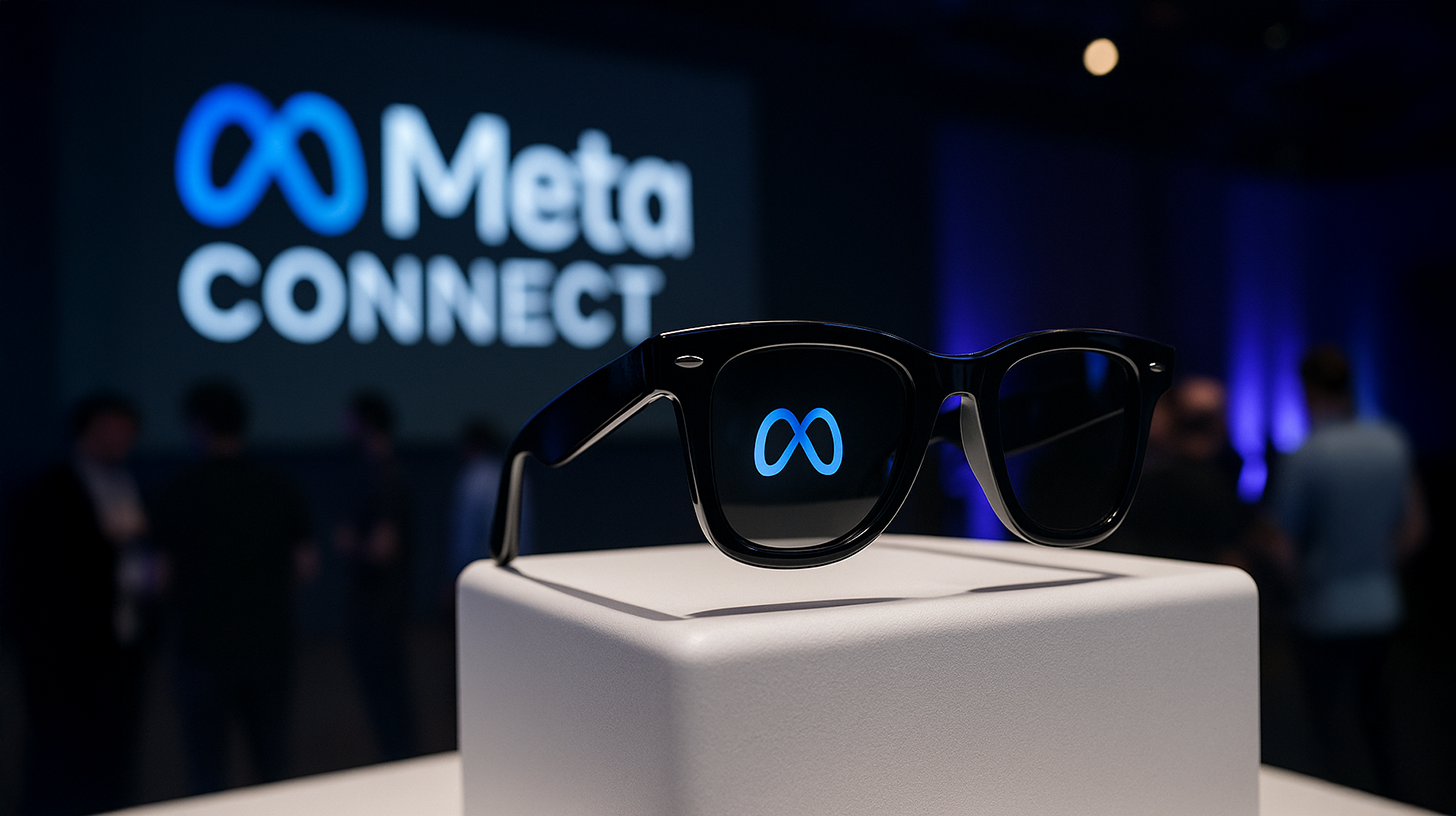
The Meta Connect conference presented the next generation of smart glasses technology: the Meta Ray-Ban Display – Creative image: Xpert.Digital
Revolution with glitches: Meta's smart glasses impress – but the live demo failed
Never look at your phone again: This is how the new display glasses from Meta and Ray-Ban work
The world of augmented reality has reached a significant turning point with Meta's latest innovations. At the Meta Connect conference, Mark Zuckerberg unveiled a revolutionary glasses technology with the potential to fundamentally change how we interact with digital information. These developments mark a crucial step toward a future where computers are seamlessly integrated into our daily lives.
The Meta Connect conference took place on September 17th and 18th, 2025, and was hosted by Meta as a key event for the latest developments in virtual reality, artificial intelligence, and XR technologies. The 2025 conference was held entirely digitally and broadcast worldwide as an online event.
Related to this:


The Meta Ray-Ban Display: First step into a new era
The first commercial product from Meta's new generation of smart glasses is called the Meta Ray-Ban Display and, for the first time, combines an integrated display with elegant eyewear aesthetics. These glasses differ fundamentally from previous smart glasses, as they feature a small but high-resolution screen integrated directly into the right lens.
The display offers a resolution of 600 by 600 pixels and allows for the presentation of a wide variety of information directly in the user's field of vision. Text messages from WhatsApp, recorded photos and videos, navigation aids, and responses from the integrated AI assistant can all be displayed without the user having to pick up their smartphone. A particularly innovative feature is the ability to transcribe conversations in real time and display them as subtitles, which is extremely useful both in noisy environments and for people with hearing difficulties.
The glasses are equipped with a 12-megapixel camera and feature integrated speakers in the temples. The battery lasts up to six hours with mixed use, and the included charging case extends the total usage time to up to 30 hours. The design is deliberately inspired by classic Ray-Ban models, yet at 69 grams, the glasses are only slightly heavier than conventional eyeglasses.
The Meta Neural Band: Control via muscle impulse instead of touch
The true innovation of the Meta Ray-Ban Display, however, lies in its control system. The so-called Meta Neural Band is a waterproof wristband that uses electromyography to detect the smallest muscle movements in the wrist and translates them into control commands for the glasses. This EMG technology allows users to operate the glasses with subtle finger movements, without having to touch them directly or use a separate input device.
The Neural Band can recognize a wide variety of gestures: pinching the thumb and forefinger to select, swiping for navigation, or writing letters by tracing them with a finger on a surface. During the presentation, Zuckerberg demonstrated how he wrote letters on a surface, which were then automatically converted into a text message. The technology is based on years of research by Meta and Carnegie Mellon University, collecting data from over 10,000 test subjects to develop a system that works without individual calibration for new users.
The Neural Band's battery lasts up to 18 hours, and all signal processing takes place locally on the device, minimizing privacy concerns. This non-invasive alternative to implanted brain chips offers a safe and convenient solution for controlling digital devices.
The Meta Orion Project: A Look into the Future
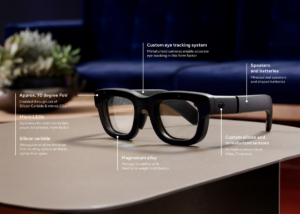
While the Ray-Ban Display is already commercially available, Meta offered a fascinating glimpse into the future of augmented reality with the Orion prototype. These true AR glasses, on which Meta has worked for a decade, represent the world's most advanced AR display and weigh less than 100 grams.
At the heart of Orion technology are micro-LED projectors that, in combination with revolutionary silicon carbide lenses, project holographic 3D images directly into the user's field of vision. Silicon carbide was chosen because it has a refractive index 50 percent higher than glass while also being lighter and more durable. This material property enables an exceptionally wide field of view of 70 degrees, significantly exceeding what other AR glasses currently offer.
The lenses are made of synthetically produced silicon carbide, a material also used in space telescopes and military radar systems. The complex manufacturing and processing of this material makes the display the most expensive component of the glasses, accounting for approximately 90 percent of the estimated production cost of $10,000 per device.
Related to this:

Revolutionary control concepts
The Orion glasses use a combination of different input methods: speech recognition, eye and hand tracking, and the aforementioned EMG wristband. This multimodal control enables natural and intuitive operation, allowing users to select objects with simple gestures such as pinching their thumb and forefinger together or to navigate using swipe movements.
Particularly impressive is the integration of Meta AI, which acts as a central assistant and interprets both hand gestures and voice commands. The AI can recognize objects in the real-world environment, suggest recipes based on available ingredients, perform real-time translations, and answer complex questions.
Technical Innovation in Detail
The Orion glasses feature seven integrated cameras and sensors, as well as a number of specialized chips developed by Meta specifically for these AR glasses. The sophisticated system uses waveguide technology to precisely direct light from the uLED projectors into the eye. These projectors are located in the temples and shine light into the lenses, which are equipped with nanostructured 3D elements.
The frame is made of magnesium, a super-lightweight metal known for its strength and heat dissipation. This material property is crucial because the compact electronics generate considerable heat. To keep the glasses as light as possible, some of the computing power is offloaded to an external handheld computer, the so-called Compute Puck. This smartphone-sized device communicates wirelessly with the glasses and performs complex calculations.
Applications and practical benefits
The applications for both types of glasses are diverse and forward-looking. With Ray-Ban Display, users can seamlessly switch between the physical and digital worlds without taking their eyes off their surroundings. Navigation aids are displayed directly in the field of vision, incoming messages can be read and answered discreetly, and the integrated AI can analyze and explain visual information in real time.
The Orion glasses go a step further, enabling the display of life-size holograms of people, working with multiple virtual screens in a room, and immersive entertainment experiences such as cinema-sized virtual displays. During video calls, the other person can appear as a holographic avatar in your own room, allowing gestures and facial expressions to be transmitted naturally.
🎯🎯🎯 Benefit from Xpert.Digital's extensive, five-fold expertise in one comprehensive service package | BD, R&D, XR, PR & Digital Visibility Optimization

Benefit from Xpert.Digital's extensive, five-fold expertise in a comprehensive service package | R&D, XR, PR & Digital Visibility Optimization - Image: Xpert.Digital
Xpert.Digital possesses in-depth knowledge across various industries. This allows us to develop tailored strategies precisely aligned with the requirements and challenges of your specific market segment. By continuously analyzing market trends and monitoring industry developments, we can act proactively and offer innovative solutions. The combination of experience and expertise generates added value and provides our clients with a decisive competitive advantage.
More information here:
Meta-glasses: Will Ray-Ban and Orion replace the smartphone?
Market launch and availability
The Meta Ray-Ban Display is already available in the US for $799 and comes in black and sand. The package includes both the glasses and the Neural Band. Information regarding availability in Germany and other European markets is still pending.
The Orion glasses, on the other hand, are currently only available as a prototype and are used exclusively by Meta employees and selected testers. Meta plans to use the insights gained from this prototype to develop a significantly more affordable consumer version. The second generation, codenamed Artemis, is slated for release in 2027, but will feature less advanced technology for cost reasons.
Related to this:


Challenges and technical hurdles
However, technical difficulties also arose during the live demonstration, showing that the technology is not yet fully mature. Zuckerberg was unable to answer a video call, and a chef joining live had problems with the AI's voice control. These glitches were attributed to poor Wi-Fi connections and illustrate that the seamless integration of such systems into everyday life still presents challenges.
The manufacturing costs of advanced technologies are also a significant factor. The silicon carbide lenses of the Orion glasses are produced in the USA because export restrictions make international manufacturing difficult. These geopolitical and technological hurdles lead to high production costs and initially limit availability.
The role of artificial intelligence
Meta AI plays a central role in both glasses systems, functioning as an intelligent assistant that understands the context of its surroundings. The AI can identify objects, translate text, answer questions, and even perform creative tasks. Particularly noteworthy is its ability to remember context, which allows for natural, multi-stage conversations without having to re-enter the context.
The integration of Meta AI with the Llama 4 model brings significant improvements in image understanding and document analysis. The AI can now not only see what the user sees, but also interpret complex visual information and provide relevant support. This development transforms the glasses into more than just display devices – they become intelligent companions in everyday life.
Impact on society and everyday life
The introduction of glasses with integrated displays and AI assistants could have far-reaching societal implications. Meta views this technology as the next step after the smartphone and as a way to achieve personal superintelligence. The vision is to support people in remaining more present and attentive in their physical environment while simultaneously providing them with access to digital information and services.
For people with disabilities, EMG technology opens up entirely new possibilities for computer interaction. Because the system records nerve signals before any actual movement occurs, even people with limited mobility can use the technology. This could lead to a significant improvement in digital inclusion.
Competition and market development
The market for smart glasses is developing rapidly, and various technology companies are investing heavily in this future technology. Besides Meta, Apple, Google, Samsung, and even Amazon are working on their own AR glasses projects. Alibaba has already unveiled the Quark AI glasses with the Qwen AI assistant, which focuses particularly on business applications.
Apple is reportedly planning to launch its own version of smart glasses in 2026, compatible with the VisionOS ecosystem. Samsung is developing glasses codenamed Moohan, designed as an Android version of Apple's Vision Pro. This development suggests intense competition that could accelerate innovation and drive down prices.
Market forecasts and growth potential
Market research companies predict significant growth in the smart glasses sector. The global smart glasses market is expected to increase from fewer than 3 million units sold in 2024 to considerably higher figures in the coming years. Annual growth rates vary between 14.5 and 29.4 percent, depending on the source and market segment.
Meta itself is already reporting impressive sales figures: Sales of Ray-Ban Meta Smart Glasses tripled last year, and a total of over 2 million units have been sold since their market launch in October 2023. Monthly active users have quadrupled compared to the previous year, indicating strong acceptance of the technology.
Technological breakthroughs and innovations
The glasses presented by Meta represent several significant technological breakthroughs. The development of functional EMG control for consumer products, the integration of high-resolution displays into eyeglass-like form factors, and the use of silicon carbide for optical applications are all remarkable engineering achievements.
The miniaturization of the necessary electronics, the development of efficient cooling systems, and the creation of seamless wireless communication between the glasses and external computing units demonstrate the high level of technical sophistication that has gone into these projects. These innovations will likely also find application in other areas of electronics and wearable computing.
Data protection and security aspects
Data privacy and security play a central role in the development of smart glasses. Meta emphasizes that the processing of EMG signals takes place entirely on the device and no biometric data is transmitted to external servers. The glasses feature LED indicators that activate when photos or videos are taken, ensuring transparency for other users.
However, the integration of AI assistants raises new privacy concerns, particularly regarding the continuous analysis of the environment and the storage of contextual information. Meta must strike a balance between functional performance and data privacy to gain consumer trust and meet regulatory requirements.
Related to this:

Meta-glasses: The start of an era that could replace smartphones
The eyewear technologies presented by Meta may mark the beginning of a new era of computing, in which the boundaries between physical and digital reality are increasingly blurred. The combination of advanced hardware, artificial intelligence, and intuitive control methods could indeed have the potential to replace smartphones as the primary computer interface.
The next decade will likely see rapid advancements in these technologies, with improved battery life, higher resolution, enhanced AI capabilities, and broader societal acceptance. Diversification into various application areas—from consumer electronics to professional applications and specialized medical or industrial uses—will further drive the market.
The transformation of smart glasses from experimental prototypes to everyday tools is only just beginning. With continuous technological improvements, decreasing costs, and growing developer support, these devices could become as commonplace as smartphones are today in the not-too-distant future. The vision of a seamlessly integrated digital reality that augments our physical world without replacing it is moving closer to reality with every technological innovation.
We are here for you - Consulting - Planning - Implementation - Project Management
☑️ SME support in strategy, consulting, planning and implementation
☑️ Creation or realignment of the AI strategy
☑️ Pioneer Business Development

Konrad Wolfenstein
I would be happy to serve as your personal advisor.
You can contact me by filling out the contact form below or simply call me on +49 7348 4088 965 .
I'm looking forward to our joint project.
Write to me


Xpert.Digital - Konrad Wolfenstein
Xpert.Digital is a hub for industry focusing on digitalization, mechanical engineering, logistics/intralogistics and photovoltaics.
With our 360° Business Development solution, we support renowned companies from new business to after-sales.
Market intelligence, smarketing, marketing automation, content development, PR, mail campaigns, personalized social media and lead nurturing are part of our digital tools.
You can find more information at: www.xpert.digital - www.xpert.solar - www.xpert.plus
Keep in touch