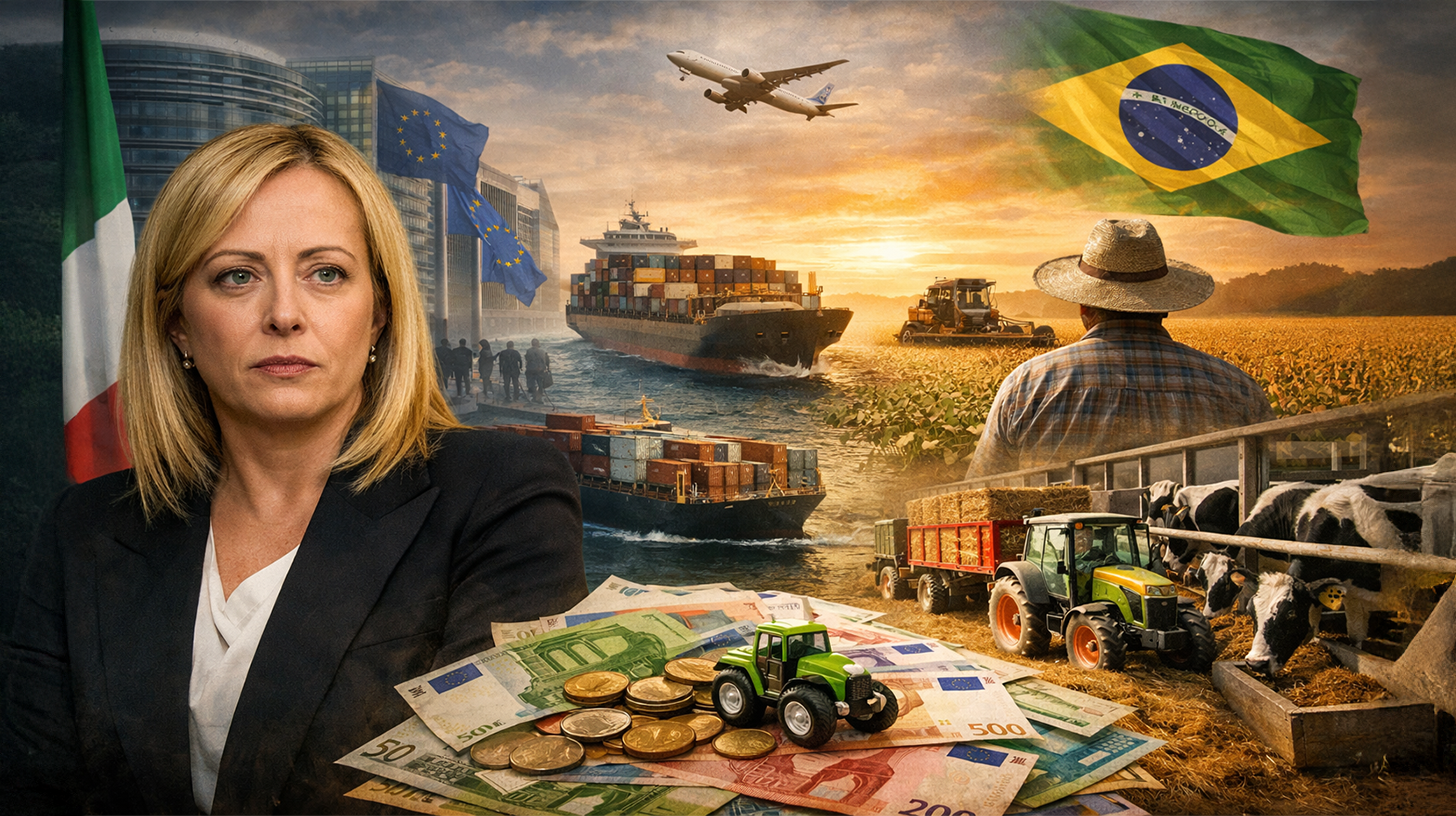
Meloni's veto in the Mercosur agreement – The truth about agricultural subsidies: Why Europe is not a victim of free trade – Image: Xpert.Digital
The strategic instrumentalization of trade dissonance: Between legitimate protection interests and geopolitical power strategies
A deeper look at Meloni's blockade of the Mercosur agreement and its economic and political dimensions
December 2025: While the global economy forges new alliances, Europe risks becoming trapped in a self-imposed dead end. The blocking of the Mercosur agreement by Italy's Prime Minister Giorgia Meloni is far more than just a dispute over beef quotas and tariffs – it reflects the EU's fundamental disorientation between old protectionist reflexes and new geopolitical necessities.
At a time when the US administration under Donald Trump is increasing pressure on transatlantic trade and China is cementing its dominance of raw materials in Latin America, the European debate seems strangely detached. While Chancellor Friedrich Merz insists on the strategic importance of the South American market, Meloni is portraying herself as the patron saint of a farming tradition that has long been economically dependent on state subsidies.
But what is really behind the veto from Rome? Is it truly about protecting against "unfair competition" from hormone-treated meat and lax pesticide laws in Brazil? Or are we witnessing a complex power struggle in which Brussels is caught between the interests of its own agricultural lobby, pressure from Washington, and the fear of losing global relevance?
The following analysis looks behind the scenes of the heated debate. It exposes the double standards of European trade policy, illuminates the true economic costs of the failure, and shows why the current farmers' protests, while emotionally understandable, are economically on shaky ground. A deep dive into the anatomy of a missed opportunity.
Europe's structural wealth distribution in the global governance arena
The contemporary global economy is undergoing a period of fundamental restructuring, with its centers shifting from the transatlantic axis toward multipolar power centers. European trade policy has established itself not only as a regulatory instrument but also as a direct tool for geopolitical positioning. In this context, the Mercosur agreement represents far more than an average free trade agreement. For the European Union, it represents a strategic attempt to consolidate its economic presence and political spheres of influence in a region that is increasingly becoming the hub of global commodity and agricultural production chains.
Mercosur presents itself as the world's fifth-largest economy, with a combined gross domestic product of approximately €2.9 trillion and around 210 million inhabitants in Brazil alone. This makes the South American trade union a market whose strategic importance lies not primarily in its consumer potential, but in its role as a supplier of raw materials and energy, as well as an important sales market for European industrial products. The negotiations for the Mercosur agreement have spanned four decades, which already hints at the complex conflicts of interest that arise in any substantial trade agreement.
The geopolitical dimension is significantly influenced by the current trade policy of the United States. In contrast to the transatlantic solidarity of past decades, the Trump administration 2.0 is pursuing a decidedly unilateralist trade policy that puts European security interests under pressure. A truce agreement between Trump and Brussels in August stipulates a base tariff of 15 percent on most EU goods, coupled with American demands for the purchase of fossil fuels and investments in strategic sectors. This development underscores the need for a diversified trade architecture with respect to both China and the US.
For the EU, the Mercosur agreement is therefore an essential means of reducing the risks associated with its economic dependencies. It would offer European companies access to critical raw materials, stable energy sources, and expanded sales markets, which are gaining in value in a world of increasing geopolitical fragmentation. Estimates from the European Commission put the potential export increases at around 39 percent, which could correspond to approximately €49 billion in additional exports per year, as well as the creation of over 440,000 jobs.
The agricultural mythology and the reality of European agricultural policy
Giorgia Meloni, in her obstructionist stance, presents herself as a defender of Italian farmers against the destructive forces of a neoliberal free trade system. This narrative has deep emotional roots in European societies, and particularly in peripheral countries like Italy, where agrarian tradition still holds cultural and symbolic significance. Italian agriculture contributes approximately three percent to the gross domestic product, a figure that rises to 15 percent when agrarian-related sectors such as food retail, logistics, and gastronomy are included. However, this economic reality contradicts the image of an agricultural sector gaining in importance; rather, it is a sector that is steadily declining in significance as a result of globalization and structural changes.
European agriculture, understood in its modern form, is not the product of free markets or natural competitiveness. Instead, it is an artificial construct, built on four decades of massive state subsidies and protectionist trade policies. The EU's Common Agricultural Policy represents one of the world's most stringent protectionist systems for agricultural production. Average import tariffs on agricultural products are around 11.7 percent, while the corresponding rates for industrial goods are only 4.1 percent. The peak tariffs are particularly dramatic: in some categories, tariffs reach 104 to 157 percent, especially on fruit and animal products.
The historical irony lies in the fact that the EU built its current competitiveness as an agricultural exporter, which has made it a global power in this sector, precisely through those protectionist and subsidy mechanisms that systematically disadvantage developing countries. Europe successfully exports dairy products, meat, and grain not because these products are intrinsically cheaper to produce, but because European farmers have been decoupled from world market prices through tariffs and subsidies. This led to artificial overproduction, which could only be reduced through export subsidies, thus depressing world market prices for agricultural products.
The recent protests by European farmers against the Mercosur agreement must be interpreted in this light: they represent an interest group that sees its historical privileges threatened, without reflecting on the fact that these privileges were built at the expense of farmers in developing countries. In Ghana, local agricultural structures and traditional production disappeared when European poultry flooded the market. In Cameroon, European agricultural exports destroyed local production systems, even though formal trade agreements were supposed to protect precisely these countries. The farmers' protests in Brussels, in which thousands demonstrated against the Mercosur agreement, are therefore morally ambiguous: they represent interests that can only be secured by maintaining global asymmetric structures.
Our EU and German expertise in business development, sales and marketing

Our EU and German expertise in business development, sales and marketing - Image: Xpert.Digital
Industry focus areas: B2B, digitalization (from AI to XR), mechanical engineering, logistics, renewable energies and industry
More information here:
A thematic hub offering insights and expertise:
- Knowledge platform covering global and regional economies, innovation and industry-specific trends
- A collection of analyses, insights, and background information from our key areas of focus
- A place for expertise and information on current developments in business and technology
- A hub for companies seeking information on markets, digitalization, and industry innovations
Mercosur agreement: How unequal agricultural standards undermine Europe's competitiveness
Mercosur's agricultural reality and the question of standards
The substantial economic concerns regarding the agreement focus on a few, but empirically significant, product groups. Beef, poultry, sugar, and ethanol are at the heart of the discussion, as the Mercosur countries enjoy genuine cost advantages with these products. Brazil has climatic conditions that allow cattle farming at significantly lower costs than in Europe. However, the central issue is not simply the fact of cost differences, but rather the question of differing production standards.
European livestock farming is subject to substantially stricter regulatory requirements regarding antibiotic use, hormone treatment, animal welfare, and hygiene than comparable production in Brazil, Argentina, and Paraguay. German livestock farmers systematically document antibiotic treatments and are subject to strict monitoring requirements aimed at reducing antibiotic use. In South America, such regulations are less stringent, and the preventive use of growth-promoting antibiotics and hormones remains common practice. This leads to genuine distortions of competition, not because the South American agricultural sector is inherently less productive, but because South American production conditions externalize what must be internalized in Europe.
The situation is similar with pesticide herbicides. Germany banned atrazine in the 1990s due to groundwater contamination, forcing German farmers to switch to more expensive alternatives. Brazil's agricultural sector continues to produce successfully with atrazine; the substance is legal and widely used. Therefore, if Mercosur agricultural products now enter the EU duty-free, South American producers will achieve cost savings that do not result from higher productivity or efficiency, but rather from lower regulatory requirements. This is indeed a case of unfair competition that goes beyond a simple price difference.
However, the irony of the European position lies in the fact that the EU itself has consciously maintained these asymmetrical standards for decades. The European Union is not a poor, vulnerable region suddenly flooded with low-standard products. It is a super-rich trading alliance that has deliberately set high standards for itself and pays accordingly. The Mercosur countries are far less wealthy economies whose citizens simply cannot afford such expensive standards. To present the agreement as a problem because it does not eliminate this inequality, while simultaneously being unwilling to lower one's own standards or finance substantial technology and know-how transfers, is conceptually inconsistent.
The strategic maneuvers of the blockade policy
Meloni's actions in December 2025, however, reveal the true dynamics of this confrontation. The Italian Prime Minister did not raise her concerns only in the final days before the planned signing. Instead, she announced her opposition only after the EU had already negotiated extensive safeguard clauses. These safeguard clauses are substantial: they allow the EU to quickly suspend tariff preferences if imports from Mercosur countries are found to be market-distorting. Monitoring has been intensified on critical products such as beef, poultry, rice, honey, eggs, garlic, ethanol, citrus fruits, and sugar, with reporting at least every six months.
This raises the question: What exactly is Meloni demanding in addition? Her public statements suggest that she is waiting for a package of additional measures that needs to be explained to and discussed with farmers. This is a vague and practically unlimited demand: Any government can claim that farmers were not sufficiently informed or consulted. Diplomatic sources offer two alternative explanations: first, that Meloni is exerting pressure on EU budget negotiations to obtain financial concessions; second, that she is under pressure from Washington, from the Trump administration, which opposes such a free trade agreement.
The latter seems plausible. A Mercosur-EU trade zone would bind Latin America more closely to European interests, thereby weakening American hemispheric dominance. A progressive US administration might have an interest in this. A Trump administration, on the other hand, systematically tried to undermine or delay major European trade agreements in order to keep European resources available for bilateral American-European negotiations.
Brazil, under Lula da Silva, announced that it would cease negotiations without a swift signature. This is not mere rhetoric: Lula's presidency ends in January 2026. The subsequent Mercosur chairmanship will be held by Paraguay, a country with a significantly more critical stance toward the agreement. This means that the window of opportunity is indeed limited. Brazil has negotiated for 26 years. Further delays could mean the failure of the agreement and long-term damage to the entire structure of South American-European cooperation.
The French dimension and the heterogeneous European structure
What's more curious is that France also voted against the agreement, without receiving the same attention as Meloni. France has fewer agricultural exports to fear than Brazil, but greater security interests in West Africa and a strategic tradition of subordinating trade policy to political and security objectives. For France, the blockade could be a way to strengthen its own geopolitical role in Europe or to influence other negotiating issues.
Germany, under Chancellor Friedrich Merz, actively supported the agreement and sharply criticized the obstructionist policies. This reflects differing economic structures: Germany stands to benefit significantly from the reduction of Mercosur's high tariffs on industrial products. Mercosur currently levies tariffs of 35 percent on cars, 14 to 20 percent on machinery, and up to 18 percent on chemicals. German automakers would directly benefit from such reductions. The Italian economy has different priorities and weaker positions in those industries that would benefit from Mercosur tariff reductions.
This illustrates a fundamental problem of the EU: it is an association of 27 states with often antagonistic economic interests. A blockade by one or two countries means that the entire Union is paralyzed, even though the majority of countries may support an agreement. This is not merely a technical regulatory problem; it is a structural problem of weakening European capacity to act in a world of increasingly aggressive geopolitical competition.
The long-term impact on European strategic capability
The failure or further delay of the Mercosur agreement would have substantial implications beyond individual trade. It would signal internationally that the EU is incapable of acting, even if a majority in the Council supports an agreement. This is precisely the signal that geopolitical rivals of China and the US least want to see. China is strategically investing in Latin America's infrastructure and raw material resources. US trade policy is attempting to bring Latin America back under its control. An EU that acts too late in this matter and becomes internally divided will lose influence.
Furthermore, the message to future trading partners would be devastating: that the EU is not fulfilling its negotiated commitments and is willing to delay them again. For India, Asia, Australia, and other regions with which the EU wishes to negotiate, this would be a warning sign of unreliability.
At the same time, the central tension remains: Europe cannot simply transfer its high standards to lower-income countries without bearing the costs itself. The agreement in its current form offers certain monitoring and safeguard mechanisms, but it does not eliminate the fundamental asymmetry. A more intellectually honest agreement would include technology, know-how, and financial transfers to help Mercosur countries raise their standards. This would increase the costs for Europe, but it would also honestly address the fact that the current disparities are part of Europe's wealth and the development lag in Latin America.
Between legitimacy and strategic theater
Meloni's delay in finalizing the Mercosur agreement represents a mixture of legitimate protectionist concerns and strategic power calculations that are not transparent to each other. The economic challenges for specific European agricultural sectors are real, but they are neither new nor surprising, and they are not as substantial as they are being dramatized. The EU has already agreed to safeguard clauses that exceed those of conventional trade agreements. The core problem lies not in the details of the agreement, but in a European inability or unwillingness to directly address structural inequalities and to see itself in such negotiations not as a victim, but as a wealthy, privileged region that can and should afford high standards.
At the same time, Meloni is instrumentalizing the legitimate concerns of farmers to pursue other political goals, ranging from the budget to geopolitical orientation. While her skill is admirable, it ultimately undermines European strategic capability. An EU that cannot implement its own majority decisions is perceived internationally as weak and has little capacity to act in a world where strategic competition with China and the US is intensifying daily. The irony is that blocking the agreement prevents precisely the diversification of European foreign economic relations that is crucial for a European risk mitigation strategy.
Consulting - Planning - Implementation

Konrad Wolfenstein
I would be happy to serve as your personal advisor.
You can contact me at wolfenstein∂xpert.digital or
Just call me on +49 7348 4088 965 .
🎯🎯🎯 Benefit from Xpert.Digital's extensive, five-fold expertise in one comprehensive service package | BD, R&D, XR, PR & Digital Visibility Optimization

Benefit from Xpert.Digital's extensive, five-fold expertise in a comprehensive service package | R&D, XR, PR & Digital Visibility Optimization - Image: Xpert.Digital
Xpert.Digital possesses in-depth knowledge across various industries. This allows us to develop tailored strategies precisely aligned with the requirements and challenges of your specific market segment. By continuously analyzing market trends and monitoring industry developments, we can act proactively and offer innovative solutions. The combination of experience and expertise generates added value and provides our clients with a decisive competitive advantage.
More information here: