Mass company closures: Germany doesn't have too few people, but the wrong jobs – Image: Xpert.Digital
49 billion euros in damages: The true cause of the German economic crisis is systematically ignored
Red Alert: The Anatomy of a Misunderstood Crisis
In 2024, 196,100 companies across Germany ceased operations, a 16 percent increase compared to the previous year and the highest figure since 2011. The scale of this development only becomes clear when one realizes that only about 10 percent of these closures were due to insolvency. The vast majority ended their businesses in an orderly fashion for other reasons, with the shortage of skilled workers playing a key role. But while politicians and businesses reflexively call for the recruitment of foreign workers, they overlook a fundamental truth: We are trying to combat a structural problem with a short-term solution that is like trying to plug one hole while another opens up.
The figures speak for themselves. 84 percent of businesses are affected by staffing problems, 43 percent are unable to fill at least some of their vacancies, and 82 percent of survey participants expect negative consequences for their companies due to a shortage of skilled workers. 40 percent have to reduce their offerings and are losing orders, while 76 percent report productivity losses due to a lack of personnel. The economic damage is immense: €49 billion in lost value added due to a shortage of skilled workers in 2024 alone, with 1.8 to 2 million unfilled positions in the German economy.
But this crisis is more than a challenge – it is a historic opportunity. We are not simply facing a labor shortage, but the greatest social and professional transformation in history. And this is not just in Germany, but worldwide. The question is not whether this transformation will happen, but how we shape it. It is time we woke up and saw not the drama, but the diverse tasks and opportunities that lie before us.
Related to this:


The figures cited here come from two different surveys and studies by German research institutes:
IAB Establishment Panel 2024 (Institute for Employment Research)
84 percent of businesses are affected by staffing problems: This figure comes from the IAB Establishment Panel 2024, a representative survey of around 15,000 businesses of all sectors and sizes in Germany. The IAB is the research institute of the Federal Employment Agency. The study was published in May 2025 and is based on data collected in 2024.
43 percent of companies are unable to fill at least some of their open positions: This figure comes from the DIHK Skilled Workforce Report 2023/2024 (German Chamber of Industry and Commerce). For its report, the DIHK surveyed more than 22,000 companies of varying sizes and sectors as part of its economic survey. The figure of 43 percent was confirmed in December 2024.
DIHK Skilled Workers Report 2023/2024
82 percent of survey participants expect negative consequences for their company due to the shortage of skilled workers: From the DIHK Skilled Workers Report 2023/2024. The survey revealed that more than eight out of ten companies anticipate negative effects from the shortage of skilled workers.
40 percent have to restrict their services and lose orders: This is also from the DIHK Skilled Workers Report 2023/2024. Four out of ten companies stated that they have to reject orders or reduce their range of services due to staff shortages.
Stepstone study 2023
76 percent report productivity losses due to staff shortages: This figure comes from a representative study by The Stepstone Group from 2023. The survey included 10,000 respondents, among them approximately 2,800 executives and HR managers. The 76 percent figure represents an increase of 16 percentage points compared to pre-pandemic levels.
IW Study 2024 (Institute of the German Economy Cologne)
A loss of €49 billion in added value due to a shortage of skilled workers in 2024 alone: This calculation comes from a study by the German Economic Institute (IW) in Cologne, published in May 2024. The study used the Global Economic Model by Oxford Economics to calculate production potential. The IW is a research institute closely aligned with employers.
Between 1.8 and 2 million unfilled positions in the German economy: This projection also comes from the DIHK Skilled Workers Report 2023/2024. The DIHK estimated that over 1.8 million positions remain unfilled across the entire economy. The figure of 2 million was cited in earlier DIHK surveys from January 2023.
In the mirror of history: Why change does not mean destruction
To understand the scale of the current transformation, it is worthwhile to look back at economic history. The industrialization of the 18th and 19th centuries was the first major technological revolution to fundamentally change work and society. When the steam engine and the mechanical loom were invented, artisans and weavers were gripped by panic at the prospect of losing their livelihoods. The Luddites, in despair over the impending job losses, destroyed machines.
What actually happened? The transition from an agrarian to an industrial society was painful and accompanied by social upheaval. Around 1800, roughly two-thirds of the workforce was employed in agriculture; by 1850, this figure had risen to about 55 percent, and by 1870, it was still half. Yet, despite all the fears, industrialization did not lead to mass unemployment, but rather to an unprecedented rise in living standards and the emergence of entirely new professions. Factory workers, machine builders, railway workers, engineers – all these professions either did not exist before industrialization or existed only in rudimentary form.
The second industrial revolution, triggered by high-voltage technology and the assembly line, sparked similar fears. The scientific management principles of Taylor and Ford were supposed to make workers obsolete. Instead, mass prosperity and a broad middle class emerged. The third industrial revolution, based on microelectronics and automation, also led to profound changes, but also to the emergence of entirely new industries: software, IT services, telecommunications, and digital media.
The historical lesson is clear: Technological revolutions don't simply destroy jobs; they transform the world of work. Jobs disappear, but new ones are created, often on a scale that far exceeds the number lost. Crucially, however, these transformations have never been seamless. They have required massive investments in education and training, policy decisions, and societal adjustments.
Related to this:

The perfect storm: AI, robotics and demographic change
The fourth industrial revolution differs from its predecessors in its speed and complexity. It is not driven by a single technology, but by the interplay of several revolutionary developments: artificial intelligence, robotics, networked cyber-physical systems, big data, and machine learning.
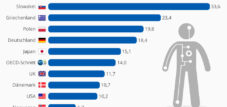
Developments in robotics are particularly impressive. In 2024, Germany recorded the installation of 27,000 new industrial robots; 40 percent of all factory robots installed in the EU are located in Germany. Robot density is 429 units per 10,000 workers, placing Germany fourth worldwide. The growth in the metalworking industry, with an increase of 23 percent, and in the chemical and plastics industry, with an increase of 71 percent, is particularly noteworthy.
But the real revolution is yet to come: humanoid robots. Humanoid robots for industrial use will be mass-produced as early as 2025. Studies predict that by 2030, 20 million humanoid robots will be in operation worldwide – a fivefold increase compared to the current 4.3 million industrial robots and cobots. The payback period for humanoid robots is estimated at less than 0.56 years, making them a highly attractive investment. Initial pilot projects already demonstrate that humanoid robots can automate up to 40 percent of tasks currently performed manually.
At the same time, artificial intelligence is transforming the world of work at a breathtaking pace. According to McKinsey, up to three million jobs in Germany could be affected by this change by 2030, representing seven percent of total employment. By 2030, almost a third of working hours in the EU could be automated, and by 2035, this figure could reach 45 percent. Crucially, however, AI doesn't simply destroy jobs; it transforms them. The World Economic Forum predicts that by 2030, 170 million new jobs worldwide will be created by AI, while 92 million will be lost – a net increase of 14 percent.
This technological transformation coincides with a demographic shift of unprecedented proportions. In 2022, the baby boomer generation comprised approximately 19.5 million people in Germany. By 2036, all of these workers will have reached retirement age or passed away. They will be joined by a new generation of young people entering the workforce during the same period, amounting to roughly 12.5 million. The workforce will shrink by almost 3 million people by 2040. Ultimately, the German economy will lose up to 6 million people of working age by 2035.
This simultaneity of technological breakthrough and demographic change is historically unique. It creates a situation in which robotics and automation are no longer optional, but have become an absolute necessity to maintain Germany's prosperity and economic performance.
Germany's breaking point: Between succession crisis and robot acceptance
The current situation is paradoxical. Despite an economic downturn and rising unemployment, the skills shortage remains at a historically high level. On average, in 2023/2024, there were 532,000 open positions for which no suitably qualified skilled workers were registered as unemployed nationwide. The situation is particularly strained in healthcare and social work professions, electrical trades, and skilled crafts. The ten professions with the largest skills shortages account for almost 30 percent of the total skills gap.
Business succession is dramatically exacerbating the situation. Between 2022 and 2026, approximately 190,000 companies will be up for transfer, averaging around 38,000 transfers per year. Already, more than half (54 percent) of medium-sized business owners are 55 years of age or older. The number of entrepreneurs seeking a succession solution is three times higher than the number of potential buyers. In the next five years, more than 250,000 companies face closure if a transfer does not occur. By the end of 2025, 231,000 companies are considering closing down – a historic high.
The situation is particularly dramatic in energy-intensive sectors, with 1,050 closures and an increase of 26 percent. Technology-intensive services, construction, and healthcare have recorded at least 34,300 closures that were directly or significantly caused or contributed to by a shortage of skilled workers – roughly 17 to 18 percent of all business closures.
At the same time, a remarkable shift is emerging in public perception: 77 percent of employees in Germany support the use of robots in the workplace. Three-quarters are convinced that robotics will counteract the shortage of skilled workers. Around 80 percent would like robots to take over dangerous, hazardous, or repetitive tasks. The vast majority see robots as an opportunity to secure the country's competitiveness. This acceptance is an essential prerequisite for the successful transformation of the working world.
However, policymakers are lagging behind technological possibilities and societal acceptance. Instead of developing a comprehensive strategy for robotization and automation, the skilled labor shortage is primarily defined as an immigration problem. This perspective is too simplistic and ignores both the ethical implications and the technological realities.
The future is already here: How automation works in practice
The successful integration of robotics and automation is already evident in numerous companies and industries. In the automotive industry, Mercedes is testing the use of the Apollo humanoid robot from Apptronik. The robot is approximately 1.73 meters tall, weighs 73 kilograms, and can lift 25 kilograms. It is intended for use in production, for example, delivering assembly kits to workers. The pilot projects show that integration into existing production processes is proceeding more smoothly than expected.
In the logistics sector, Amazon is using the Digit robot from Agility Robotics. The robot, which is approximately 1.75 meters tall, can transport loads of up to 16 kilograms and is being tested in warehouses. GXO Logistics uses similar systems to optimize its warehouse logistics. Experience shows that the robots do not replace jobs, but rather complement them and relieve employees of physically demanding tasks.
A transformation is also underway in the SME sector. Robot programming has become significantly easier. 81 percent report that operation has become simpler, enabling their use even in smaller businesses. Collaborative robots and intuitive operating concepts allow automation to be implemented even without specialized IT departments. Investment costs for humanoid robots are falling rapidly – manufacturers like Unitree are bringing models to market for around €16,000, compared to several hundred thousand euros for previous systems.
A particularly interesting example is provided by a study from the Institute for Employment Research: Between 1994 and 2014, 275,000 jobs in German industry were lost due to the use of robots – not because of layoffs, but because fewer young people were hired. At the same time, an equal number of new jobs were created in the service sector. Overall, the number of jobs hardly changed – a stark contrast to the USA, where industrial workers lost their jobs en masse due to automation.
Another study by the Centre for European Economic Research concludes that automation was responsible for 560,000 new jobs in Germany between 2016 and 2021. The energy and water supply sector recorded job growth of 3.3 percent, the electronics and automotive industries 3.2 percent, and other manufacturing sectors even 4 percent. These figures clearly refute the claim that automation inevitably leads to mass unemployment.
Our EU and German expertise in business development, sales and marketing

Our EU and German expertise in business development, sales and marketing - Image: Xpert.Digital
Industry focus areas: B2B, digitalization (from AI to XR), mechanical engineering, logistics, renewable energies and industry
More information here:
A thematic hub offering insights and expertise:
- Knowledge platform covering global and regional economies, innovation and industry-specific trends
- A collection of analyses, insights, and background information from our key areas of focus
- A place for expertise and information on current developments in business and technology
- A hub for companies seeking information on markets, digitalization, and industry innovations
Germany as a pioneer in human-centered automation
Prosperity at the expense of others: The ethics of the global competition for skilled workers
While technological solutions hold promise, the ethical dimension of recruiting workers from abroad is often underestimated or ignored. Germany and other European countries are actively recruiting skilled workers from developing and emerging economies that desperately need these professionals for their own development.
The brain drain, the emigration of highly skilled workers from developing countries, has serious consequences for the countries of origin. The health sector, education, the public sector, and science and research are particularly affected. The regions with the highest rates of skilled emigration are the Caribbean and Central America, sub-Saharan Africa, Southeast Asia, and the Pacific region – precisely those regions that most urgently need skilled workers to advance their own development.
The negative consequences for the countries of origin are significant: loss of human capital, labor shortages in strategic sectors, loss of national investment in education and training, and weakening of institutions and the country's innovative capacity. Small and poor developing countries, in particular, tend to be weakened by brain drain. The shortage of skilled workers in key sectors such as health and education negatively impacts the achievement of the UN Sustainable Development Goals.
It is ethically questionable for Germany, as one of the world's richest countries, to systematically recruit skilled workers from poorer countries, where these workers are urgently needed to build functioning healthcare systems, educational institutions, and economic structures. This policy exacerbates global inequalities and undermines the development opportunities of entire regions. While Germany may benefit from skilled immigrants in the short term, in the long term, it creates new causes of displacement and migration flows because the countries of origin lack the expertise for sustainable development.
Moreover, this strategy is ultimately unsustainable. The demographic challenges facing Germany are similar in many other countries, or will be in the foreseeable future. China, for example, has doubled its robot density within four years and, with 470 units per 10,000 workers, now surpasses Germany. The Middle Kingdom has recognized that the future lies not in the competition for labor, but in automation and productivity gains through technology.
Related to this:

The social hurdles of transformation: Between job insecurity and the skills gap
Despite all the opportunities, the transformation of the working world is fraught with significant challenges and controversies. The fear of job losses due to AI and robotics is real and justified. According to Goldman Sachs, up to 300 million full-time jobs worldwide are at risk of automation through generative AI. Approximately two-thirds of current jobs are subject to some degree of AI automation, and generative AI could replace up to a quarter of current work.
Occupations with a high proportion of routine tasks are particularly affected: office workers in administration, cashiers, accountants, bank employees, factory workers, warehouse workers, telemarketers, data entry clerks, and mail sorters. More than half of all job changes in Germany caused by AI fall into the field of office and administrative work. Germany, along with Italy, is particularly affected because these occupations represent a large share of total employment.
The social dimension of this transformation should not be underestimated. Those who fear for their jobs and their future will hardly be enthusiastic about a policy of technological modernization. This change is therefore not only an ecological and economic challenge, but also a test of social cohesion.
Another problem is the skills gap. 39 percent of current skills will be obsolete within the next five years. 59 percent of employees will require further training by 2030. However, participation in continuing education is below average, particularly among those employees with a high proportion of routine tasks, who are at the greatest risk of being affected by automation. This poses a risk of splitting the labor market into highly qualified winners and those left behind by digitalization.
The productivity gains from automation and AI are not automatically distributed fairly. Between 1994 and 2014, German companies were able to translate the increased productivity through robotics into higher profits. A large proportion of employees earned less as a result of automation. Those most affected were employees with medium qualifications, such as skilled workers. The primary beneficiaries were highly qualified workers and the companies themselves. Without political countermeasures, increasing inequality is a real threat.
Nevertheless, it would be wrong to conclude from these challenges that the transformation can or should be stopped. The course has long been set. China, the USA, and other economic powers are investing massively in robotics and AI. Europe's economy is falling behind in international competitiveness and urgently needs to catch up. Robotics and automation are key technologies for the future growth of national economies, as they increase productivity, drive innovation, and open up new opportunities.
Related to this:

The agenda for tomorrow: qualification, vision and a new social contract
The future of work will be shaped not by immigration, but by intelligent automation, comprehensive training, and a positive vision for the world of work tomorrow. The technological possibilities exist and are developing rapidly. By 2030, the technological maturity of humanoid robots will have advanced to the point where they will surpass human capabilities in speed of movement, flexibility, and fine motor skills. Acquisition costs will continue to fall, and their areas of application will expand dramatically.
At the same time, AI will not only take over repetitive tasks but will increasingly support and partially replace complex cognitive activities. New professional fields are emerging: AI trainers, prompt engineers, ethics experts for AI systems, human-machine interaction specialists, transformation mentors, robotics service technicians, and data ethicists. The World Economic Forum predicts that 58 percent of all employees will require initial or further training by 2025, with 19 percent of those needing additional education or retraining.
The key to success lies in a comprehensive approach to skills development. Lifelong learning must become the norm. This applies to both unskilled and semi-skilled workers as well as skilled tradespeople and engineers. Support for professional development for employees must be significantly expanded. Starting in April 2024, employees whose jobs are affected by transformation can receive funding for further training. A prerequisite is that the company has a works agreement or collective bargaining agreement that regulates the skills development needs resulting from structural change.
Companies must develop sustainable skills development strategies. Germany, as an industrial location, bears significant social responsibility, as the regional availability of skilled workers will play a much more important role in investment decisions. Successful companies are already implementing proactive in-house training policies to secure access to the skilled workers they need and to preserve jobs.
Retraining programs must be specifically tailored to the needs of the digitized and automated world of work. Specialists in digitalization management, IT professionals, and cyber-physical systems specialists – these professions are urgently needed. With the approval of funding agencies such as the Federal Employment Agency or job centers, retraining programs can be fully subsidized. Participants who successfully complete a retraining program receive a subsidy of up to €6,100, in addition to a monthly training allowance of €150.
Crucially, however, a positive vision for the future of work is essential. AI and robotics are not a threat, but an opportunity to make work more humane. When robots take over dangerous, unhealthy, and monotonous tasks, people are freed up for creative, social, and strategic endeavors. Increased productivity through automation can—with the right political framework—lead to shorter working hours, higher wages, and improved working conditions. The European model of the social market economy offers better conditions for this than the Anglo-Saxon model, as a comparison of the consequences of automation between Germany and the USA demonstrates.
The transformation also requires a redesign of social security systems. If productivity gains are increasingly achieved through capital rather than labor, the financing of social insurance must be reconsidered. Concepts such as a value-added tax or a tax on machinery are being discussed. Similarly, a universal basic income or a negative income tax could guarantee social security in a highly automated economy.
A call for a course correction: reinvent work instead of importing it
We are facing a pivotal moment of historic significance. The greatest professional and societal transformation of all time is not an abstract vision of the future, but is already well underway. The question is not whether this transformation will happen, but how we shape it. Attempting to solve the skills shortage primarily by recruiting foreign workers is like trying to plug one hole while another opens up. Furthermore, it is ethically questionable to poach urgently needed skilled workers from weaker economies.
The potential of robotics and artificial intelligence is still not sufficiently recognized and assessed in politics and business. The loss of jobs due to AI is primarily viewed through the negative lens of job losses, instead of being used to develop a model for retraining and transformation. But even this falls short. In reality, it's not just new jobs that are being created to replace old ones – new types of work, new forms of value creation, and new opportunities for self-realization are emerging.
Historical experience teaches us that technological revolutions have ultimately led to greater prosperity and better living conditions, even if the path there was fraught with challenges. Industrialization freed us from hard physical labor, electrification brought us light and warmth, and digitalization gave us access to knowledge and global communication. Robotization and the AI revolution can free us from monotonous, dangerous, and unhealthy tasks and create space for creative, social, and meaningful work.
The technological prerequisites are in place. Societal acceptance is present. What's lacking is the political will and the strategic vision. Instead of reflexively calling for workers from abroad, we should invest massively in robotics, automation, and the training of our own workforce. Instead of seeing the transformation as a threat, we should recognize the many tasks and opportunities that lie ahead.
Germany has the opportunity to become a pioneer in human-centered automation, where technology serves people and not the other way around. We can demonstrate that economic success and social justice, increased productivity and workplace quality, technological progress and social cohesion are not mutually exclusive, but rather interdependent. The 196,100 business closures in 2024, the loss of €49 billion in added value due to the shortage of skilled workers, the looming closure of 231,000 companies by the end of 2025 – all of this is not inevitable.
It's time we woke up. The crisis is real, but it's also a historic opportunity. We're not facing the end of work, but its greatest transformation. The question isn't whether we have enough workers, but how we redefine and reorganize work. The baby boomers are retiring—that's not the problem, that's the solution. Because it creates the necessary space for transformation without causing mass unemployment.
Focus not on the drama, but on the many challenges – that's the attitude we need now. The greatest social and professional transformation we've ever seen demands courage, vision, and a proactive approach. The alternative isn't maintaining the status quo through immigration, but economic decline in a globalized world where other countries are more consistently leveraging technological opportunities. The future doesn't belong to those who import labor, but to those who reinvent work.
Your global marketing and business development partner
☑️ Our business language is English or German
☑️ NEW: Correspondence in your native language!

Konrad Wolfenstein
I and my team are happy to be available to you as your personal advisor.
You can contact me by filling out the contact form here wolfenstein@xpert.digital:or simply call me at +49 7348 4088 965. My email address is
I'm looking forward to our joint project.
☑️ SME support in strategy, consulting, planning and implementation
☑️ Creation or realignment of the digital strategy and digitization
☑️ Expansion and optimization of international sales processes
☑️ Global & Digital B2B trading platforms
☑️ Pioneer Business Development / Marketing / PR / Trade Fairs
🎯🎯🎯 Benefit from Xpert.Digital's extensive, five-fold expertise in one comprehensive service package | BD, R&D, XR, PR & Digital Visibility Optimization

Benefit from Xpert.Digital's extensive, five-fold expertise in a comprehensive service package | R&D, XR, PR & Digital Visibility Optimization - Image: Xpert.Digital
Xpert.Digital possesses in-depth knowledge across various industries. This allows us to develop tailored strategies precisely aligned with the requirements and challenges of your specific market segment. By continuously analyzing market trends and monitoring industry developments, we can act proactively and offer innovative solutions. The combination of experience and expertise generates added value and provides our clients with a decisive competitive advantage.
More information here: