Construction industry, heat pump and photovoltaic market slump – The political reputational damage – A partial analysis of the causes – Image: Xpert.Digital
🏡🌞 Heat pump and photovoltaic market collapse - The political reputational damage - A comprehensive analysis of the causes
🌍🌱 Change of government and inexperience
The federal election on September 26, 2021, brought about a change of government in Germany. The SPD, the Greens, and the FDP agreed to form a federal government together. It wasn't until two and a half months later, on December 8, 2021, that Olaf Scholz was elected Chancellor. This delayed start already marked a bumpy beginning for the three-party coalition – a constellation unprecedented in the Federal Republic of Germany.
The coalition agreement was based on the motto "Dare to make more progress," and many hoped that the Greens, as supposed experts in renewable energies, and the FDP, as supposed financial experts, would bring about an economic upswing for Germany, leading to a more environmentally conscious and better future. However, reality painted a different picture.
It was a misconception that the real experts were not in the top positions of the parties and in the government. On closer inspection, many leading politicians turned out to be non-experts in the fields of renewable energy and finance.
🌍 Lack of expertise in government
One example of this is the Green Party, where 11.9 percent of the members of parliament dropped out of their studies . Even though dropping out of university doesn't necessarily say anything about someone's aptitude for political work, this statistic becomes increasingly prominent when success is lacking.
Finance Minister Christian Lindner, for example, cannot look back on an impressive career in the financial sector. Although he worked as a freelance management consultant for a total of four years, his start-up failed, resulting in the loss of millions in public funding.
The Federal Minister for Economic Affairs and Climate Protection, Robert Habeck, also has no professional expertise in either economics or climate protection. Before his political career, he worked with his wife as a freelance children's book writer and translator of English poetry.
These facts alone can explain quite a bit, even though there is certainly more to say. The picture that emerges here confirms Ludwig Erhard's statement: "Economics is 50% psychology." The initial optimism regarding the coalition agreement "Dare to make more progress" and the promises of the Green Deal and the energy transition was definitely present.
But then came the Corona crisis and the war in Ukraine, events that had a significant impact on the economy. Many other reasons could also be cited for the market collapse of the energy transition.
However, one undeniable fact is that the initial 50% psychological influence has now completely evaporated. What remains are the hard facts of life: economics and finance.
💼 Psychology of Economics and Political Dynamics
All the whitewashing and excuses that follow only further damage Germany's ecological and economic image. The increasing focus on the upcoming federal elections, instead of actively addressing current problems, demonstrates the helplessness and ignorance of those in political power and casts a bleak light on their performance.
While Otto von Bismarck once said: "There is never so much lying as before an election," and Franz Müntefering (SPD) added almost 100 years later: "It is unfair to judge politicians by their election promises," today's wisdom could be: "Election promises are made even though one has no coherent idea.".
Today, political direction is determined not by political thought, but by emotions and social media likes.
It's no wonder, then, that 82% of the population is currently less than satisfied or not at all satisfied with the current federal government. Chancellor Scholz is fighting to become the most unpopular chancellor in the history of the Federal Republic of Germany .
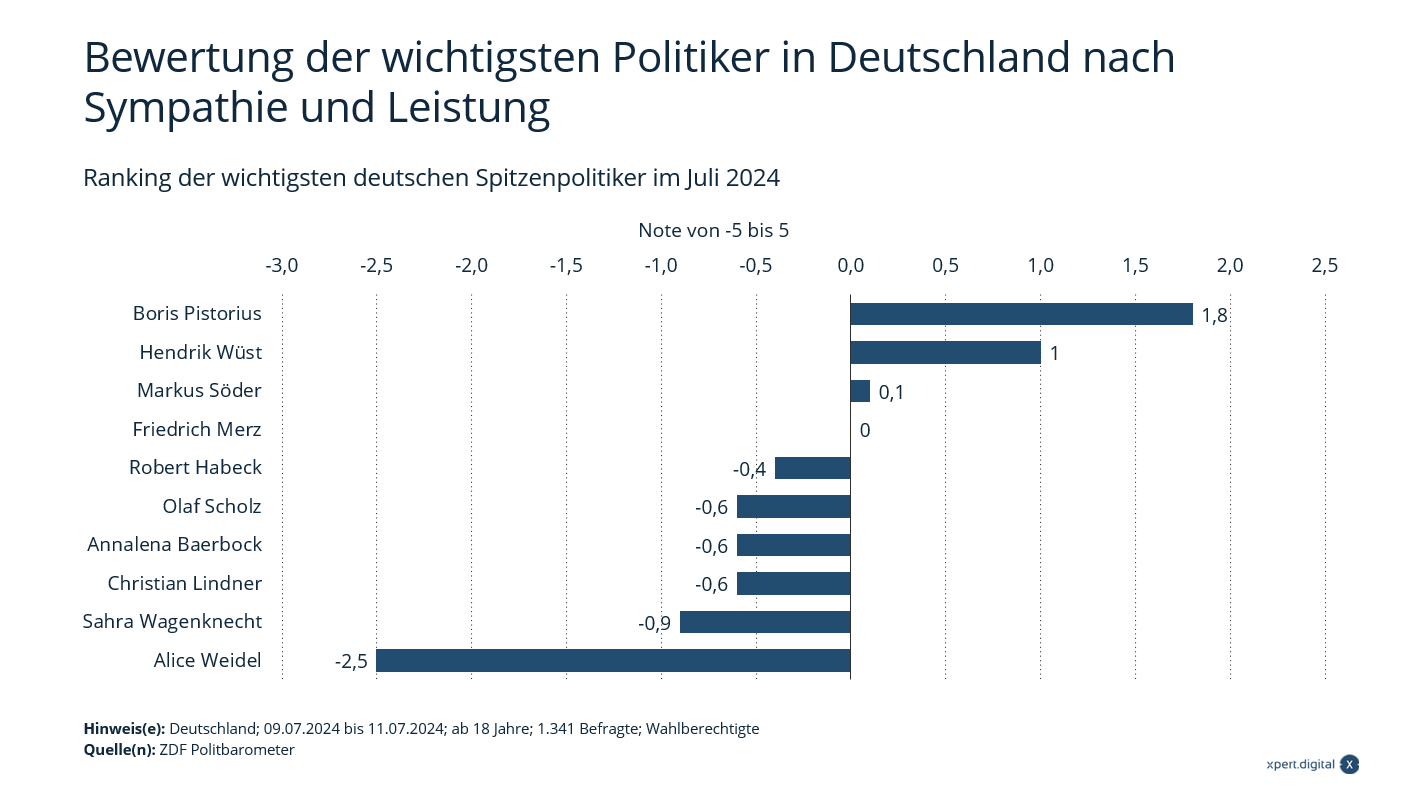
Likeability and performance: Federal Minister of Defense Boris Pistorius achieved the best rating at the time of the survey (July 2024) – Image: Xpert.Digital
🔋 Collapse in the heat pump and photovoltaic market
The collapse of the heat pump and photovoltaic market is a clear sign of a loss of confidence in political leadership. The lack of expertise and the inadequate implementation of promised measures have led to a significant decline in interest in and investment in these important technologies. The initial euphoria and enthusiasm have given way to disillusionment.
A major reason for the decline in the heat pump market is the inadequate and inappropriate support from the government. Despite the commendable goals, concrete implementation measures were lacking. Subsidies were often overly bureaucratic and difficult to access, deterring many potential users. Furthermore, rising energy prices and uncertainties in the commodity markets have reduced the attractiveness of heat pumps.
Sales of heat pumps have plummeted by 50 percent. Markus Staudt, CEO of the German Heating Industry Association (BDH), attributes this slump to a lack of planning certainty. He explains that the market cooled significantly after the strong demand in 2023. The municipal heat planning that cities will have to submit in the coming years is creating additional uncertainty, leading people to postpone modernizing their heating systems.
Related to this:
- What began exactly one year ago and hardly anyone wanted to believe ➡️ Sales slump and uncertainty: Heat pump manufacturers are suffering after the dispute over the heating law and the building energy law (GEG)
Why are so few heat pumps currently being purchased? Here are the key points:
- Few new apartments, therefore little need for heat pumps
- Oil and gas heating systems are preferred in older apartment buildings
- Uncertain consumers
- Homeowners are waiting for the municipal heat planning
- There is a shortage of installers for the installation of heat pumps
- Homeowners are hoping for more subsidies and lower prices
🌞 “Photovoltaics was all the rage, but now the industry is struggling with customer reluctance and cheap imports from China”
The photovoltaic market has also suffered from similar problems. Feed-in tariffs for solar power have been repeatedly reduced, impacting the profitability of photovoltaic systems. Added to this were uncertainties regarding legal frameworks and subsidy programs, which were constantly being adjusted or even suspended. These uncertainties impacted investments and led to a decline in the installation rate of solar power systems.
Beyond the political challenges, there are also technological and logistical hurdles that need to be overcome. The expansion of renewable energy infrastructure is lagging behind. Grids and storage technologies are not yet sufficiently developed to reliably compensate for the growing demand and fluctuations in energy production from renewable sources.
The price decline in photovoltaic (PV) modules in recent years can be largely attributed to imports from China. Chinese manufacturers have dominated the global PV market and play a key role in driving down costs. Here are some important points that explain this price drop:
economies of scale
Chinese companies have invested heavily in the production of PV modules and built up enormous production capacities. These economies of scale have significantly reduced production costs.
Technological advances
Continuous research and development in the PV industry, coupled with more efficient production methods, has led to an increase in energy efficiency and a reduction in manufacturing costs.
Government support
The Chinese government has heavily subsidized and supported the PV industry, which has increased the competitiveness of Chinese products.
Competition and market liberalization
Increased competition among Chinese manufacturers has led to price wars that have driven prices down even further. The growing liberalization of markets and the opening of international markets has also accelerated this trend.
Related to this:
- A worrying trend: 87% of imported photovoltaic systems came from China in 2022
- Despite problems with glass for solar modules: China continues to dominate all stages of photovoltaic module production
- 2024: The Smarter E Europe (Intersolar) in Munich closes with great success – for whom? A critical review
🛠 Technological and logistical hurdles
Another issue impacting the market is the shortage of skilled workers. There is a lack ofqualifiedpersonnel in both the installation and maintenance of heat pumps and photovoltaic systems – especially master electricians are in high demand. A stronger training initiative and investments in continuing education could remedy this situation and provide the necessary workforce.
Political uncertainties, a lack of expertise, insufficient funding, and technological shortcomings are therefore the main reasons for the slump in these crucial markets. The resulting environmental and economic damage to Germany is considerable and could have long-term consequences.
💡 Necessary steps to solve the problem
Solving these problems requires a holistic approach. Policymakers must act clearly and predictably to regain investor confidence. Support programs must become more accessible and less bureaucratic, and a clear, long-term strategy for expanding renewable energy is needed.
Furthermore, promoting research and development in areas such as energy efficiency and storage technologies is crucial. Only in this way can Germany master the technological challenges and make the leap to a sustainable future.
The education and training of skilled workers must also be intensified in order to meet the demand in these growth industries and to avoid innovation bottlenecks.
Strong and reliable policies, combined with technological advancements and a well-trained workforce, can not only halt the market decline of heat pumps and photovoltaic systems, but also bring about a lasting and sustainable recovery. This would not only be an environmental victory, but could also contribute to Germany's economic stability and international reputation.
📣 Similar topics
- 🌍 Slump in the heat pump and photovoltaic market: Causes and solutions
- 🏛️ Change of government and its consequences for the energy market
- 📉 Lack of expertise: How the government is destabilizing the market
- 🧠 The Psychology of Economics and Political Dynamics
- 🚧 Technological and logistical hurdles in the field of renewable energies
- ⭐️ Necessary steps to revive the market
- 💵 Funding programs: Too bureaucratic for success?
- 📊 Why the German photovoltaic market is weakening
- 📈 Chinese imports and the price drop in solar modules
- 👩🔧 Skilled worker shortage: An obstacle to the energy transition
#️⃣ Hashtags: #HeatPumps #Photovoltaics #GovernmentPolicy #TechnologicalHurdles #SkillsShortness
🏗️💡 Economic challenges: Collapse of the construction industry and the market for heat pumps and photovoltaic systems


Construction industry: Why the construction sector is so important for the German economy – Image: Xpert.Digital
🔥🔥 The economic challenges leading to the collapse of the construction industry and the markets for heat pumps and photovoltaic systems are numerous and complex. Several factors contribute to this development, from government subsidies to geopolitical tensions and growing domestic political uncertainties. A detailed examination of these aspects is necessary to understand the full extent and interrelationships of the situation.
1. 💰 Subsidies and pressure from China
A key factor in the collapse of the European market for renewable energy sources, including heat pumps and photovoltaic systems, is the massive subsidies provided by the Chinese government. These subsidies have enabled the rapid growth of Chinese companies in the solar energy, electric vehicle, and battery storage sectors. Such state support has led to a flood of cheap Chinese products on the European market.
This development is hitting Germany's renewable energy infrastructure particularly hard. German companies often cannot compete with the prices of their Chinese rivals, leading to a loss of market share or forcing them to sell under economically disadvantageous conditions. In the long term, this threatens to undermine the technological leadership and innovative strength of German companies.
Related to this:
- Background information on the current situation and developments related to China
- Global solar module crisis – Between overproduction and innovation – Challenges for the solar industry
- Market saturation and price collapse: Longi's downsizing reflects the global solar industry – thousands of jobs cut in China
2. 🕊️ The impact of the Ukraine war
Another significant factor is the war in Ukraine, whose indirect consequences have far-reaching effects on the German economy. The conflict has triggered a number of uncertainties that are impacting economic stability and making investments in renewable energies more difficult. The high energy prices driven by the war are increasing not only production costs but also the operating costs of companies in all sectors.
Political instability also negatively impacts investment activity. Businesses and individuals are hesitant to launch major projects due to high levels of uncertainty regarding future economic developments and political conditions.
3. 📈 Competition and market conditions
In addition to the factors already mentioned, intensified international competition is also a factor. German companies are not only under price pressure from Chinese products, but must also adapt to the changing conditions in global markets. High personnel and energy costs in Germany make manufacturing and operating production facilities more expensive compared to locations in countries with lower cost structures.
These competitive disadvantages are exacerbated by rising housing and utility costs in Germany. High rents and living costs are a burden on the population, leading many people to hold onto their savings rather than invest them. This reluctance particularly affects investments in renewable energies and energy-efficient technologies.
4. 🏗️ Impact on the construction industry
Uncertainty and reluctance to invest are also having a devastating impact on the German construction industry. This sector is suffering from a decline in construction activity and a rising number of bankruptcies. The reasons for this are manifold: high construction costs, a lack of materials, financial uncertainties, and a shortage of skilled workers are making the construction of new projects difficult.
The collapse of the construction industry directly impacts the expansion of renewable energies, as fewer buildings suitable for modern heating and energy systems are being constructed or renovated. Fewer new buildings also mean less potential for installing photovoltaic systems and integrating heat pumps, which in turn slows down the energy transition.
Related to this:
- Construction industry: Why the construction sector is so important for the German economy – PDF – Facts and figures on the construction industry
- The construction industry faces numerous challenges
- Construction industry 2023 – Construction sector collapses – Housing construction in free fall – Bankruptcies loom
5. 🌍 Societal impacts and the role of politics
Economic and political uncertainties are weighing on society as a whole. Many citizens are worried about rising living costs, job security, and the future of the national economy. This anxiety is leading to increasing pessimism and a reduced willingness to invest in new technologies and sustainable projects.
The role of politics is crucial here. Targeted measures and support programs are needed to relieve the burden on the population, reduce economic uncertainty, and restore the competitiveness of German companies. Subsidies and grants for renewable energies must be strategically deployed to strengthen domestic industry and mitigate import pressure.
6. 🔗 Not an isolated problem
The collapse of the heat pump and photovoltaic market is not an isolated problem, but rather a result of a combination of international subsidies, geopolitical conflicts, economic uncertainties, and national challenges. Overcoming these problems requires a comprehensive strategy that includes technological innovation, political support, and economic stabilization. Only through a cooperative effort by government, industry, and society can the energy transition be successfully implemented and the negative trends reversed.
📣 Similar topics
- 🌍 Economic challenges of the market for heat pumps and photovoltaic systems
- 🇨🇳 Chinese subsidies and their impact on the European market
- ⚡ The role of the Ukraine war in energy pricing
- 🔧 Competitive pressure due to global market conditions
- 🏗️ The crisis in the German construction industry and its consequences
- 🏠 Housing and living costs influence investments in renewable energies
- 📉 Societal impacts of economic uncertainties
- 🏦 Political measures to strengthen the national economy
- 🌲 Funding and subsidies for renewable energies in Germany
- 🤝 Cooperative strategies for a successful energy transition
#️⃣ Hashtags: #RenewableEnergy #EconomicChallenges #UkraineWar #ChineseSubsidies #GermanConstructionIndustry
🌞🔋 Photovoltaic systems: Market developments and challenges
✨🌐 Overview of current installation figures and market changes
The latest installation figures from the Federal Network Agency do not yet show a significant slump in the market for rooftop photovoltaic systems. Rather, a shift in the scale of installations is apparent. However, installation companies tell a different story – the question remains: What do the figures actually tell us?
“We are seeing a continuous increase, especially in solar power plants,” says Klaus Müller, President of the Federal Network Agency.
More information here:
The reality in the photovoltaic industry is this: Although the official installation figures from the Federal Network Agency reflect a stable market, underlying problems cannot be ignored. New orders in the photovoltaic industry are declining, indicating profound structural changes. Installations are being carried out more slowly, fueling suspicions that the industry is facing significant challenges. Demand for new projects is falling, and competition from new market entrants is increasing.
Related to this:
- pv magazine | New orders are scarce – how does that fit with the figures from the Federal Network Agency?
- pv magazine | Is there really a slump in the installation of rooftop photovoltaic systems?
🏗️📉 Challenges due to order decline and project execution
Among the challenges mentioned is the decline in new orders, which is symbolic of the current structural changes in the industry. Installation companies are under considerable strain due to slower project completion times and increased competition from new companies entering the market. This is also reflected in the market data from the Federal Network Agency, which clearly shows that many projects from previous years still need to be completed. Market professionals also emphasize that the drastic price pressure and security concerns from other providers pose an increasing challenge.
📉📈 Price trends and their effects
A key aspect of these structural changes is price development. The photovoltaic industry has experienced a massive price drop in recent years. Photovoltaic modules and systems have become significantly cheaper, making them accessible to a wider audience. However, this price decline also has its downsides. The enormous pressure with which prices are falling forces many installation companies to reduce their margins and calculate costs very precisely. This often leads to fewer new orders, as many smaller companies are forced to withdraw from the market or reduce their capacity.
🚀🏢 New market entrants and their impact
Furthermore, new players are entering the market. These new entrants bring fresh ideas and innovations, but they can also compete with established companies. The new players often come with aggressive pricing models and innovative financing solutions that increase the pressure on traditional businesses. This leads to fierce competition and forces existing companies to adapt their business models and become more efficient. However, not all businesses are able to successfully navigate this transformation.
⚖️🏛️ Influence of political framework conditions
Another factor influencing the market is the political framework. Changes in legislation and government subsidies play a crucial role in the photovoltaic sector. Politicians worldwide increasingly recognize the need for renewable energies to achieve climate goals. Nevertheless, inconsistent or uncertain regulations can destabilize the market and lead to uncertainty among investors.
🔮🚀 Future potential and technological developments
Despite these challenges, the photovoltaic industry also holds enormous potential for the future. Technological development in this field is progressing relentlessly. New technologies and improved solar module efficiencies are making photovoltaics increasingly efficient and attractive. The trend toward decentralizing energy supply is also opening up new opportunities for the photovoltaic industry. The integration of photovoltaic systems into building design, whether for residential buildings, industrial buildings, or even public infrastructure projects, is on the rise.
🏡🌍 Plus-energy houses: A model for the future?
A prime example of this are so-called "plus-energy houses." These buildings produce more energy than they consume, primarily through the use of photovoltaic systems combined with other renewable energy technologies. This concept is gaining global traction and could significantly impact the photovoltaic market, further fueling demand for solar installations.
🔋💡 Energy storage systems: The next big wave?
Another interesting area is the combination of photovoltaics with energy storage systems. Storing solar power is becoming increasingly critical for minimizing dependence on climate-related fluctuations in energy production. Advances in battery technology and decreasing costs are making energy storage systems more attractive for households and businesses. This enables more effective use of the generated energy and greater independence from the public power grid.
🌐💻 AI, digitalization and the Internet of Things
AI, digitalization, and the Internet of Things also play a crucial role in the future development of the photovoltaic industry. Smart technologies for monitoring and controlling photovoltaic systems are becoming increasingly sophisticated. These intelligent systems enable efficient management and optimization of energy generation and consumption, leading to further increases in efficiency and reductions in operating costs.
Related to this:
🚀🔮 Conclusion and Outlook
It remains to be seen how the photovoltaic industry will develop in the coming years. While the aforementioned structural changes present a challenge, they also offer opportunities. Investments in research and development, as well as the expansion of infrastructure and political support, can help overcome these obstacles and further strengthen the photovoltaic market.
🌞🔄 Photovoltaic market: Consolidation brings challenges and opportunities
🌞✨ The photovoltaic market is currently undergoing a period of consolidation, which presents both challenges and new opportunities. The increasing number of installation companies is leading to intense price competition, resulting in bankruptcies and further intensification of competition. Paradoxically, the falling prices of photovoltaic modules are not having a proportional effect on the overall cost of installations, further complicating the market.
Related to this:
- Does the decline in building permits have an impact on the photovoltaic industry?
- pv magazine | Consolidation and price war among photovoltaic installers in full swing
🌄 Changing market landscape
The consolidation of the photovoltaic market is resulting in significant changes to the competitive landscape. New market entrants are entering the market, which may provide a temporary boost, but does not increase the overall market volume. Smaller companies are particularly affected by this situation, becoming embroiled in ruinous price wars and taking on considerable financial risks. Many of these companies often sell their systems close to their purchase price, which not only reduces their own margins but also disrupts the market equilibrium.
📉 Declining demand
A key factor in the market problems is the decline in demand for photovoltaic systems. This trend is particularly evident for rooftop and balcony-mounted systems. While large solar farms and commercial applications continue to enjoy a degree of stability, providers of smaller, residential solutions are facing a significant decline. The reasons for this are manifold: from cuts in government subsidies and changes in the political framework to market saturation.
🔍 Transparency and price awareness
Increased price transparency presents the industry with additional challenges. Consumers today have easy access to price comparisons via the internet and other media, allowing them to specifically search for the most affordable offers. This puts installation companies under enormous pressure and demands a high degree of flexibility and adaptability. Price competition has intensified considerably as a result, and many companies are forced to rethink their pricing structures and business models.
🌟 Importance of Innovation and Quality
To survive in such a dynamic market environment, innovation and quality are becoming increasingly important. Companies that distinguish themselves through high-quality products and excellent customer service have a better chance of standing out from the competition and achieving long-term success. The adaptability of businesses also plays a crucial role; those who are able to react flexibly to market changes and offer innovative solutions will be able to survive in the long run.
🌱 Sustainability and long-term strategy
A key aspect for sustained success in the photovoltaic market is establishing a sustainable, long-term strategy. Short-term profit maximization through aggressive pricing may offer short-term advantages, but often leads to long-term economic problems. Companies that focus on sustainability and align their business models accordingly are better positioned to successfully navigate market changes.
Furthermore, politics also plays a crucial role. Government funding programs and political support can significantly contribute to stabilizing the market. At the same time, however, companies must be prepared to react flexibly to changes in the political landscape.
⚙️ Technological advances and developments
Technological development in the field of photovoltaics is progressing relentlessly. New materials and more efficient production processes have the potential to further reduce the cost of photovoltaic modules and increase their efficiency. These advances are a double-edged sword: On the one hand, they offer opportunities for companies that adopt new technologies early and integrate them into their product range. On the other hand, they increase the pressure on those who cannot keep pace with technological developments, which can lead to further market consolidation.
🏘️ Challenges of energy management
In addition to the production and installation of photovoltaic systems, energy management is increasingly becoming a focus for the industry. The efficient use, storage, and distribution of solar energy is playing an ever more important role. This opens up new business opportunities for innovative companies, for example in the areas of battery storage technology or intelligent grid control. However, these areas require significant investments in research and development as well as in the further training of specialists.
🌍 The global context
The photovoltaic market faces significant challenges and opportunities on a global scale. Markets like China and India are growing rapidly and offer enormous potential, while established markets such as Europe and the USA appear increasingly saturated. International trade conflicts and tariffs can further impact the market and necessitate a smart, global market strategy.
👥 Customer focus as the key to success
Ultimately, customer focus is key to sustainable success. Companies that place their customers at the heart of their business strategies and take their needs and desires seriously will be better positioned in the long run. This includes not only competitive pricing, but also comprehensive consulting, excellent service, and customized solutions.
While the photovoltaic market faces significant challenges, it also offers numerous opportunities. Companies that are flexible and innovative have a good chance of succeeding in this dynamic environment. By investing in quality, technology, and customer service, they can differentiate themselves from the competition and achieve stable market positions in the long term. In times of change, adaptability is the key to success – and the photovoltaic industry is no exception.
📣 Similar topics
- 🌞 Consolidation in the photovoltaic market: Challenges and opportunities
- 📉 Declining demand and its impact on the photovoltaic sector
- 💡 Innovations and quality: Ways to differentiate yourself in the market
- 💸 Price competition and transparency as market drivers
- ♻️ Sustainability as the key to long-term market strategy
- 🚀 Technological advances and their role in the photovoltaic market
- ⚡ Challenges of modern energy management
- 🌍 The global context of the photovoltaic market: opportunities and risks
- 📈 Customer focus as a success factor in the photovoltaic business
- 🏭 Market changes and the consolidation of the photovoltaic industry
#️⃣ Hashtags: #MarketConsolidation #TechnologicalAdvances #Sustainability #CustomerFocus #EnergyManagement
🏠📈 Rising housing costs in Germany: A growing burden for households

Housing costs, utility costs, rising costs and no end in sight – The future of housing in a price spiral – Image: Xpert.Digital
😊🏡 In Germany, housing and utility costs have risen sharply in recent years, placing a significantly greater burden on many households than just a few years ago. This trend is not only a challenge for low-income citizens but now also affects a large portion of the middle class. A look at the various factors driving these costs, as well as potential solutions, reveals just how complex and multifaceted the housing cost issue is.
More information here:
📊 The different factors influencing housing costs
A significant portion of monthly household expenses goes toward rent. In metropolitan areas and large cities, rents have risen dramatically in recent years. This trend is fueled by high demand for housing and a limited supply. Many municipalities are also facing population growth, which further intensifies the pressure on the housing market.
Besides rent, energy costs are also a significant factor. Electricity, heating, and hot water make up a considerable portion of ancillary housing costs. The energy transition and rising prices for fossil fuels contribute to this trend. Added to this are the costs for maintenance and repairs, which landlords can pass on to tenants to improve energy efficiency.
Another cost factor is municipal taxes such as property tax and garbage collection fees. Many municipalities have increased property taxes in recent years to balance their budgets. These costs are usually passed on to tenants as well.
💰 The burden on low-income households
Low-income households and those at risk of poverty are particularly affected. They have to spend a disproportionately high share of their income on housing costs. This often leaves little money for other essential expenses such as food, education, or healthcare. Studies show that for these households, housing costs often exceed 40 percent of their disposable income. This exacerbates social inequality and intensifies the problem of poverty in Germany.
📝 The challenge of utility billing
An often underestimated aspect of rising housing costs is the utility bill. Many tenants struggle to understand the complex statements and track the individual items. This frequently leads to uncertainty and distrust of landlords. Transparency and clear communication could help alleviate this problem, but these are often lacking in practice.
🌱 Energy saving measures as a solution approach
In light of rising energy costs, energy conservation is becoming increasingly important. A key approach is the energy-efficient renovation of buildings. Measures such as insulating facades, replacing old heating systems, and installing energy-efficient windows can help reduce energy costs in the long term. However, these measures involve high investment costs, which pose a challenge for many homeowners and landlords. These costs are often passed on to tenants, which also increases housing costs in the short term.
An alternative or supplement to energy-efficient building renovation is the use of renewable energies, particularly photovoltaic systems (PV systems). These can help to reduce electricity costs and decrease dependence on fossil fuels. However, high initial investments are also required here, which need to be financed.
🔋 Financing a PV system: Opportunity or additional burden?
Photovoltaic systems offer a sustainable way to reduce energy costs. They generate electricity from solar energy, which can be used directly on-site or fed into the grid. In the long term, they can not only protect the environment but also significantly reduce energy costs. However, purchasing and installing a photovoltaic system requires a considerable financial investment.
Several financing options are available. Homeowners can, for example, take advantage of subsidy programs and low-interest loans. However, these offers are often subject to certain conditions and bureaucratic hurdles. Not all households can access these resources.
Furthermore, the question arises as to how worthwhile such an investment is for tenants who have no direct influence on the building's technical systems. Here, landlords are primarily responsible for taking appropriate measures and transparently presenting the costs and benefits. One possible solution could be for landlords to pre-finance investments in photovoltaic systems and pass on some of the resulting cost savings to the tenants.
👵 Social and demographic change
Another relevant aspect in the context of housing cost development is demographic change. The aging population and the trend toward urbanization are increasing the demand for age-appropriate and affordable housing in urban areas. This puts pressure on cities to create adequate housing options, which in turn drives up costs.
Since many older people live on low pensions, they are particularly dependent on affordable housing. Municipal housing programs and social housing are important measures to meet this need. The government can contribute to promoting the construction of accessible and affordable housing through targeted subsidies and tax incentives.
💡 Transparency and efficiency as a solution approach
To get housing and utility costs under control, various solutions are needed. A key aspect is improving transparency in utility bills. Tenants must be able to understand these bills to build trust and avoid misunderstandings.
Furthermore, digital solutions and smart metering systems could help to make energy consumption more efficient and better exploit potential savings. These technologies make it possible to monitor consumption in real time and to take targeted measures to reduce energy costs.
⚖️ A balancing act between investment and savings
Rising housing costs and utility bills pose a significant challenge that requires forward-looking and sustainable planning. Energy-saving measures and the use of renewable energies, such as photovoltaic systems, offer long-term solutions for reducing costs and protecting the environment. However, high initial investments and complex billing procedures remain hurdles that must be overcome.
In this context, both political measures and individual commitment are needed. Funding programs, tax incentives, and transparent communication can help reduce the financial burden on households and facilitate sustainable investments. At the same time, all stakeholders, from policymakers and landlords to tenants, must work together to get housing cost trends under control in the long term.
📣 Similar topics
- 🏠 Rising housing costs: Challenges and solutions
- 💡 Energy efficiency and its impact on rental costs
- 📈 Rents in Germany: Why prices are exploding
- 🌞 Photovoltaic systems: A sustainable solution?
- 💸 Utility bill: Creating transparency and gaining trust
- 🌍 Counteracting social inequality: Housing costs as a factor in poverty
- 🏘️ Demographic change and the need for affordable housing
- 🔄 Energy transition and rising energy costs: What does this mean for tenants?
- 🔍 Digitalization and efficiency: Smart metering in practice
- 🌿 Sustainable living: Investments in the future
#️⃣ Hashtags: #HousingCosts #EnergyEfficiency #SocialJustice #Demographics #Transparency
🏠📈 Additional housing costs: A comprehensive overview
🏡 Utility costs are increasingly burdening many households, and it's important to be well-informed about the various factors that influence these costs. Utility costs are not just property tax, but a multitude of other factors that make living more difficult. Below, we examine the different cost drivers and provide a comprehensive overview of the current situation.
🚰 Drinking water prices
Drinking water is an essential resource and a major component of utility costs. Prices for drinking water vary considerably by region and depend on various factors, such as the costs of water extraction, treatment, and distribution. Maintaining the infrastructure is also expensive, as pipes require regular maintenance and replacement. These costs are often passed on to consumers. It is important to note that water conservation measures are not only ecologically sound but also economically viable.
🚽 Wastewater fees
Equally important are the wastewater fees, which cover the disposal and treatment of wastewater. These fees are generally fixed and based on the degree of pollution and the volume of wastewater discharged. Here, too, the maintenance of the wastewater systems plays a crucial role. Innovative approaches to wastewater treatment and more environmentally friendly technologies could lead to cost reductions in the long term.
🗑️ Waste disposal fees for organic and residual waste bins
Waste disposal fees represent another significant item in ancillary housing costs. Cities and municipalities levy these fees to cover the costs of collecting and disposing of household waste. A distinction is generally made between organic waste and residual waste. Effective waste separation can help reduce costs and protect the environment. Increasingly, municipalities are offering incentives to residents to improve waste separation and reduce waste overall.
🏠 Property tax
Property tax is a significant component of ancillary housing costs. It is levied on the value of land and buildings and flows into the municipal budgets. Recently, many regions have changed the way property tax is calculated, which can lead to substantial adjustments. The property tax checker provided by the Federation of Taxpayers is a useful tool for obtaining information. Historically, property tax rates have varied considerably, with the tax rate often being used as a tool in municipal fiscal policy.
🌧️ Stormwater fees
Less well-known, but nonetheless relevant, ancillary housing costs include stormwater fees. These are levied for the drainage and treatment of rainwater that falls on built-up or sealed surfaces. In many cities, these fees are tiered and depend on the size and degree of sealing of the area. Measures to reduce sealing, such as green roofs or the creation of infiltration areas, can help to lower these costs.
⚡ Additional cost drivers: Energy prices
In addition to the factors mentioned above, energy prices are playing an increasingly significant role in utility costs. Rising heating and electricity bills are placing an additional burden on many households. The reasons for this are manifold: from global economic developments and the energy transition to government taxes and levies. To counteract these costs, many households are investing in energy-efficient renovations and modern technologies such as solar energy or heat pumps.
🚋 Mobility and infrastructure
Another often overlooked aspect is mobility and the infrastructure surrounding the residential area. Costs for public transport, road maintenance, and traffic management indirectly contribute to ancillary housing costs. Especially in urban areas, these costs are often high and are covered by municipal taxes and fees, which in turn can impact households.
🏢 Social housing and government support
Against the backdrop of rising ancillary housing costs, social housing plays a significant role. Government programs aim to provide affordable housing and relieve the burden on low-income households. Various support measures, such as housing allowances or rent subsidies, come into play here. However, these programs are often bureaucratic and not always adequately funded to meet the entire demand.
📊 The complexity of utility costs
Housing costs are a complex interplay of diverse factors. From drinking water prices and waste disposal fees to property taxes and indirect costs such as energy prices and infrastructure improvements, these expenses represent a significant financial challenge for many households. It is therefore worthwhile to actively seek information and explore ways to optimize these costs. Both individual cost-cutting measures and social and political initiatives can play a role. A comprehensive understanding of these factors is the first step towards a more sustainable and cost-efficient living situation.
📣 Similar topics
- 💧 Drinking water prices and their impact on utility costs
- 💦 Importance of wastewater fees for household budgets
- 🚮 Waste disposal fees: Separating organic and residual waste reduces costs
- 🏡 Property tax: A significant factor in ancillary housing costs
- 🌧️ Stormwater fees and ways to reduce them
- 🔋 Rising energy prices and their impact on households
- 🚇 Mobility and infrastructure as hidden additional costs
- 🏘️ Social housing as relief for affected households
- 📝 A comprehensive understanding of housing costs
- 💡 Conclusion: Complexity and optimization of ancillary housing costs
#️⃣ Hashtags: #Utilities #DrinkingWaterPrices #EnergyPrices #PropertyTax #SocialHousing
We are here for you - Consulting - Planning - Implementation - Project Management
☑️ Industry expert, here with his own Xpert.Digital industry hub featuring over 2,500 specialist articles

Konrad Wolfenstein
I would be happy to serve as your personal advisor.
You can contact me by filling out the contact form below or simply call me on +49 7348 4088 965 .
I'm looking forward to our joint project.
Write to me


Xpert.Digital - Konrad Wolfenstein
Xpert.Digital is a hub for industry focusing on digitalization, mechanical engineering, logistics/intralogistics and photovoltaics.
With our 360° Business Development solution, we support renowned companies from new business to after-sales.
Market intelligence, smarketing, marketing automation, content development, PR, mail campaigns, personalized social media and lead nurturing are part of our digital tools.
You can find more information at: www.xpert.digital - www.xpert.solar - www.xpert.plus
Keep in touch