

Published on: June 30, 2025 / Updated on: June 30, 2025 – Author: Konrad Wolfenstein
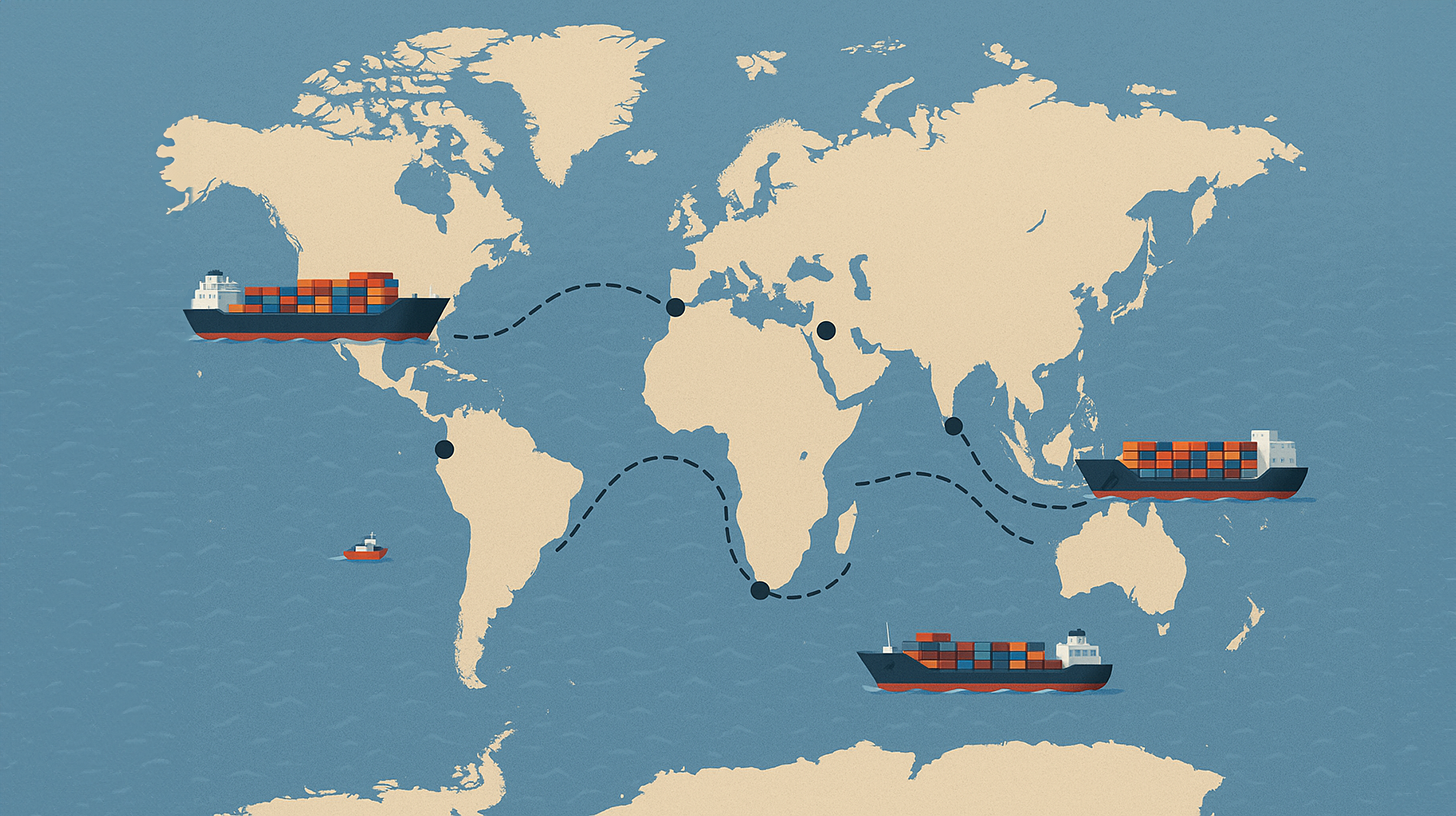
Maritime logistics bottlenecks: The critical bottlenecks of the global economy – Image: Xpert.Digital
Maritime bottlenecks threaten global supply chains: Which sea routes are critical for world trade?
Over 90 percent of world trade is by sea: These maritime bottlenecks threaten the global economy
The global economy depends more than ever on maritime trade routes, with over 90 percent of world trade conducted by sea. In addition to the well-known bottlenecks of Hormuz and Suez, other critical maritime chokepoints exist, the blockage or disruption of which could severely impact the global economy.
Suitable for:

The five most important global chokepoints
A chokepoint is a geographical, logistical, or economic bottleneck through which the flow of traffic (e.g., of goods, data, or people) is heavily restricted. It is easy to control or block.
Recent analyses show that more than 50 percent of global maritime trade is threatened by four key maritime bottlenecks. These strategic waterways concentrate massive trade volumes into a few vulnerable passages:
Strait of Hormuz – The world's most critical energy bottleneck
The Strait of Hormuz between Iran and Oman is considered the most important maritime chokepoint for global energy supplies. This narrow strait, only 55 kilometers wide – and at its narrowest point between the islands a mere 38 kilometers – controls a disproportionate share of global energy trade.
Approximately 20 million barrels of crude oil pass through the Strait of Hormuz daily, representing 20-21 percent of global oil consumption. Additionally, 20 percent of the world's liquefied natural gas (LNG) trade is transported through this strait, primarily from Qatar. Practical navigation is limited to two narrow channels, each three kilometers wide, which run through Iranian and Omani territorial waters.
For the states bordering the Persian Gulf – Saudi Arabia, Kuwait, Bahrain, Qatar, the United Arab Emirates, Iraq, and Iran – the Strait of Hormuz represents the only maritime route for exporting their energy resources. This region possesses more than half of the world's known oil reserves and 56 percent of global oil reserves.
The strategic importance of the strait makes it a preferred instrument of leverage in regional conflicts. Iran has repeatedly threatened a blockade, particularly in the context of the current escalation in the Middle East. Following the US-Israeli attacks on Iranian nuclear facilities in June 2025, the Iranian parliament approved a possible closure, although the final decision rests with the Supreme National Security Council.
The mere threat of a blockade leads to significant market reactions: The price of Brent crude oil rose within a few days from 69 to 77 dollars per barrel – an increase of about 10 percent.
Suitable for:
- The Strait of Hormuz as a global logistical bottleneck: A blockade would stop 20% of the world's oil


Suez Canal – Key route between Europe and Asia
Global trade axis: The Suez Canal connects the Mediterranean Sea with the Red Sea over a length of approximately 193 kilometers and provides the shortest sea route between Europe and Asia. Around 12 percent of global maritime trade is handled via the canal, which corresponds to roughly 30 percent of worldwide container traffic. In 2019, more than one billion tons of cargo passed through the canal; in 2020, an average of 50 ships per day transited it, carrying goods worth between three and nine billion US dollars.
A key energy axis: The Suez Canal also plays a crucial role in the global energy market. From January to October 2023, an average of 7.5 million barrels of crude oil per day were transported through the canal, representing 10 percent of global seaborne oil trade. In addition, 36 billion cubic meters of LNG, or about 8 percent of global liquefied natural gas trade, flowed through this waterway.
Vulnerability and geopolitical risks: The Suez Canal's strategic importance makes it vulnerable to regional conflicts. Following the Houthi rebel attacks in the Red Sea, daily passage initially dropped to 36–37 ships from the previous 72–75 per day. The UN Conference on Trade and Development (UNCTAD) recorded a 42 percent decline in cargo volume in the months following the start of the attacks. Additionally, the Suez Canal Authority's revenues plummeted by 60.7 percent to US$4 billion in fiscal year 2024, while the number of transiting ships fell to 13,200.
Europe's dependence on the Suez Canal is also evident in German trade flows: around 9 percent of all German imports and exports pass through this route, and 98 percent of container traffic between Germany and China uses the canal. Any disruption would lead to significant supply bottlenecks, longer transport times, and increased logistics costs in energy- and export-intensive industries.
Circumnavigating Africa via the Cape of Good Hope increases the distance by approximately 3,500 nautical miles and extends the journey time by 10–12 days, resulting in significantly higher fuel and operating costs. Pipelines such as the Sumed pipeline offer a maximum capacity of only 1.5 million barrels per day and can in no way replace the throughput of the canal. Thus, the Suez Canal remains an indispensable bottleneck for global trade and energy supply.
Strait of Malacca – The Asian Bottleneck
The Strait of Malacca between Malaysia, Singapore, and Indonesia is considered one of the world's most critical trade routes. Between 20 and 25 percent of total global trade volume is transported through this narrow strait, which is only 38 kilometers wide. Between 200 and 250 ships pass through this route daily, connecting Europe with Southeast Asia.
A blockade would be particularly dramatic for China: two-thirds of Chinese trade and 80 percent of Chinese energy imports cross the Strait of Malacca annually. This leads to the so-called “Malacca Dilemma”—China’s strategic vulnerability to a potential blockade by the US in the event of a conflict.
Approximately 10 percent of German exports and 20 percent of German imports are transported through this strait, primarily in trade with China. A disruption would immediately affect German supply chains.
Taiwan Strait – Heart of East Asian Trade
The Taiwan Strait, at its narrowest point 130 kilometers wide, is the main artery for maritime transport between China, Taiwan, Japan, and South Korea. Approximately half of all container ships in international transport use this strategic waterway.
For Taiwan, 98 percent of all total imports via sea depend on this route. China, as one of the world's largest exporting countries, is also critically reliant on this passage for its massive shipments of goods to Germany and Europe.
The geopolitical tensions surrounding Taiwan make this route particularly vulnerable, as China considers Taiwan part of its territory and makes corresponding claims to control the strait.
Panama Canal – Climate change as a new threat
The Panama Canal connects the Atlantic and Pacific Oceans and handles 5 percent of global container trade as well as 46 percent of trade between the US East Coast and East Asia. Unlike geopolitical tensions, climate change threatens its functionality.
Extreme droughts have already led to drastic restrictions: The daily number of passages has been reduced from the usual 36-38 ships to just 31 per day. Waiting times have increased to up to 20 days, and at times over 200 ships have been backed up at both ends of the canal.
The canal authority expects losses of $200 million for 2023 alone. Shipping companies are now paying millions for priority transit slots – one gas shipping company paid $2.4 million for an earlier place in the queue.
Other critical maritime bottlenecks
Turkish Straits (Bosphorus and Dardanelles)
The Turkish Straits connect the Black Sea with the Mediterranean and are considered the world's most dangerous chokepoint. With a width of only 700 meters at their narrowest point and sharp bends requiring course changes of up to 80 degrees, they present an extreme navigational challenge.
130 ships pass through this route daily, 20 percent of which are tankers. More than 3 percent of the world's oil supply crosses the Turkish Straits, making them a critical energy corridor.
Strait of Dover – Europe's transport hub
With over 400 commercial ships passing through daily, the Strait of Dover is one of the busiest shipping lanes in the world. It marks the boundary between the English Channel and the North Sea and separates Great Britain from mainland Europe.
All maritime traffic between the Atlantic Ocean on the one hand and the North and Baltic Seas on the other passes through this strait, which is only 32 kilometers wide. Alternative routes around the northern tip of Scotland are significantly longer and more dangerous.
Danish Straits – Gateway to the Baltic Sea
The Great Belt between the Danish islands is the most important connection between the Kattegat and the Baltic Sea. Approximately half of the shipping traffic between these waters uses this route. The maximum ship dimensions are limited to a draft of 15.4 meters (Baltimax class).
The Øresund strait only allows a draft of 8 meters and is therefore not an option for larger ships. These restrictions make the Danish straits a bottleneck for trade with the East.
Kiel Canal – Germany's maritime lifeline
The Kiel Canal is the world's busiest artificial waterway for seagoing vessels, with nearly 30,000 ships passing through it annually. It eliminates the need to circumnavigate the Cimbrian Peninsula and shortens routes by an average of 250 nautical miles.
These are often feeder ships that connect Baltic Sea ports with North Sea ports such as Hamburg and Bremerhaven. A blockade would severely impact German foreign trade and the supply of goods to the Baltic Sea countries.
Northern Passage vs. Suez Canal: Why 5,600 kilometers of Arctic route could revolutionize global trade
Arctic Northern Passage
The Northern Sea Route (NSR) along the Russian coast is gaining increasing importance due to climate change. At 5,600 kilometers, it is the shortest shipping route between Western Eurasia and the Asia-Pacific region.
Experts predict that by 2030, 2 percent of global shipping could be diverted to the Arctic, and by 2050, 5 percent. This would create a new geopolitical dimension, as the entire route lies within Russia's exclusive economic zone.
Bering Strait – The Arctic Bottleneck
The Bering Strait between Asia and America, with a width of 85 kilometers and a depth of only 30-50 meters, is a natural bottleneck for Arctic trade routes. With the increasing use of the Northern Passage, it is becoming strategically more important for trade between Europe and Asia.
Vulnerability of global supply chains
The high concentration of global trade on a few maritime bottlenecks creates systemic risks. The six-day blockade of the Suez Canal by the "Ever Given" alone led to a standstill of goods worth $9.6 billion daily.
The COVID-19 pandemic exacerbated this problem by:
- Production losses and port closures
- Container shortage and historical freight rates of up to USD 20,000 for a 40-foot container
- Disruptions to crew changes and logistics chains
Strategies for resilient supply chains
To reduce dependence on maritime chokepoints, experts recommend several approaches:
Diversification of routes and ports
Development of alternative transport routes and reduction of the focus on individual bottlenecks.
Nearshoring and localization
Relocating production closer to sales markets to reduce long transport routes.
Suitable for:

Digital technologies
Use of IoT, blockchain and AI for real-time tracking and predictive analytics for risk forecasting.
Flexibility through scenario planning
Simulation of worst-case scenarios such as port closures and the creation of buffers in storage.
Just-in-time deliveries under pressure: Maritime bottlenecks as the Achilles heel of globalization
The global economy's maritime infrastructure exhibits a dangerous concentration on a few critical bottlenecks. Besides the well-known chokepoints of Hormuz and Suez, other strategic straits threaten global trade security. Climate change, geopolitical tensions, and the heavy reliance on just-in-time deliveries exacerbate this vulnerability.
Diversifying trade routes, investing in resilient supply chains, and developing alternative transport pathways are essential to protect the global economy against disruptions at these maritime chokepoints. The realization that over 50 percent of global maritime trade is threatened by just four chokepoints underscores the urgency of strategic adjustments in global logistics.
Suitable for:
Your global marketing and business development partner
☑️ Our business language is English or German
☑️ NEW: Correspondence in your national language!

Konrad Wolfenstein
I would be happy to serve you and my team as a personal advisor.
You can contact me by filling out the contact form or simply call me on +49 7348 4088 965 (Munich) . My email address is: wolfenstein ∂ xpert.digital
I'm looking forward to our joint project.


