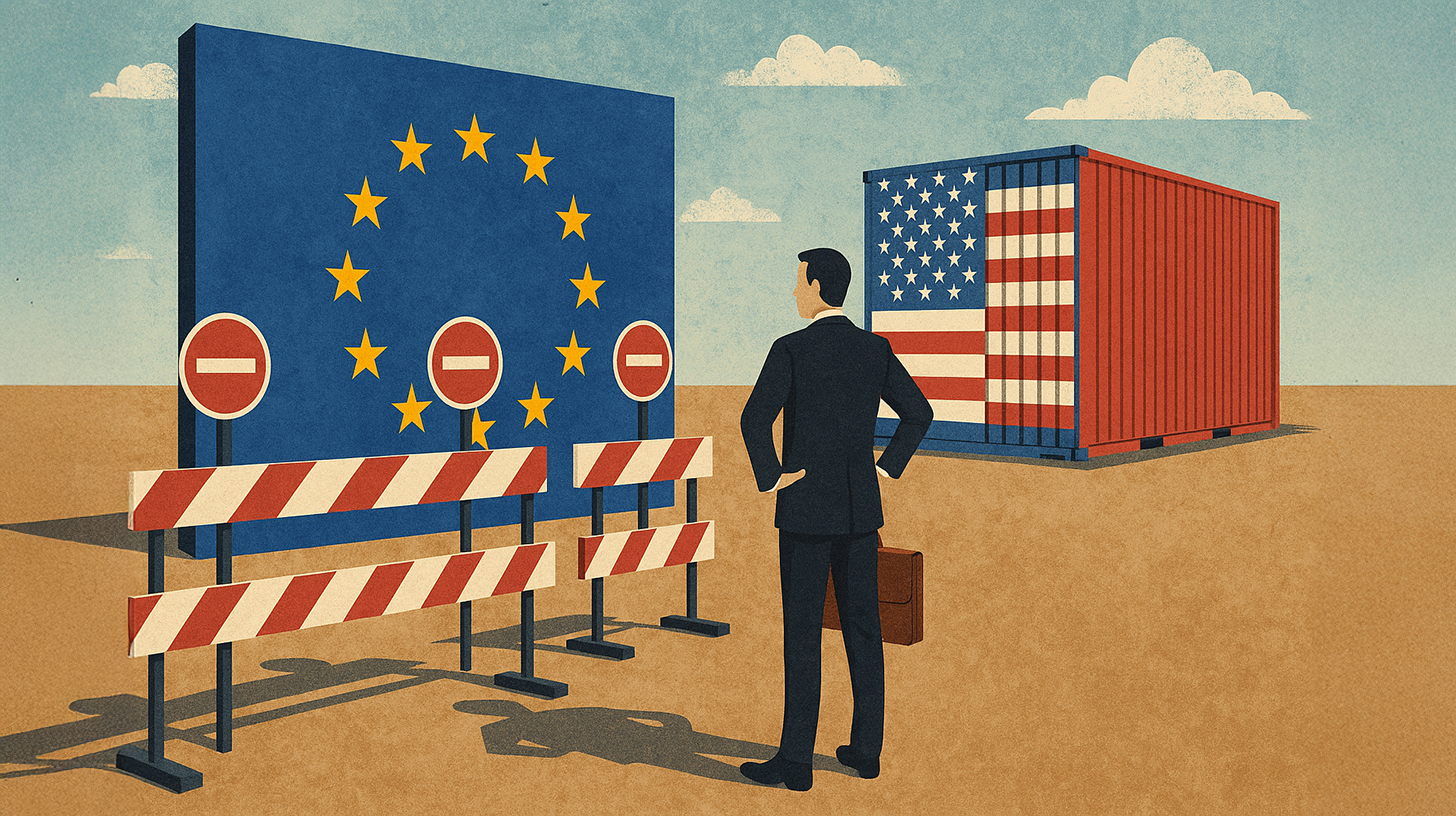
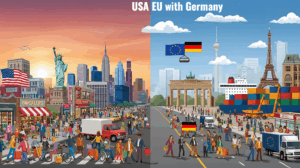
Madness in EU trade: Why German companies often face greater hurdles than when exporting overseas – Image: Xpert.Digital
Hidden EU cost trap: This “internal tariff” costs Germany 146 billion euros annually
### “The horses have run away”: How Brussels bureaucracy is strangling German trade ### A labyrinth instead of a free market: German companies are fleeing EU bureaucracy ### One rule gone, five new ones there: The shocking truth about the EU's regulatory zeal ###
The paradoxical reality of the European single market
How is it possible that German companies sometimes encounter fewer obstacles when exporting to the United States or other third countries than when trading with their European neighbors? This seemingly absurd situation is by no means an isolated case, but rather reflects a systemic problem within the EU single market, which, after more than 30 years of its existence, is still far from complete.
The European single market, originally conceived as the heart of European integration, is increasingly becoming a bureaucratic labyrinth. While customs barriers between EU member states have long since been abolished, new, often more subtle trade barriers have emerged through a web of national special regulations, differing implementations of European directives, and excessive bureaucracy. The result is a paradox: a theoretically free single market that, in practice, often causes German exporters more problems than doing business with countries outside the EU.
Related to this:

How serious is the extent of internal EU trade barriers?
The scale of the problem is made clear by recent studies from the International Monetary Fund. According to these studies, the requirements, standards, and reporting obligations existing within the EU amount to a virtual internal tariff of 44 percent on industrial goods. For services, these hidden trade barriers reach a level of 110 percent. These figures illustrate that the EU's internal trade barriers are now three times the 20 percent tariffs on EU imports imposed by US President Trump.
This situation becomes particularly dramatic when considering its development over time. While the costs of trade in services within the EU have decreased by an estimated eleven percent since the mid-1990s, the barriers to imports from third countries have fallen by 16 percent. This development has made imports into the EU increasingly attractive compared to trade between EU member states. The International Monetary Fund has calculated that these bureaucratic obstacles cost Germany up to 146 billion euros in economic output annually.
What specific problems arise during the secondment of employees?
A particularly vivid example of the problems posed by the fragmented EU single market is the posting of workers. This illustrates how well-intentioned European regulations, through differing national implementations, can become a bureaucratic nightmare. German companies wishing to post employees to other EU countries face a confusing tangle of different reporting portals, inconsistent digital procedures, and varying minimum wage calculations.
The complexity of the situation is illustrated by an example from the DIHK's (Association of German Chambers of Industry and Commerce) experience: A medium-sized machine manufacturer that installs, maintains, and repairs its machines throughout the EU has to submit around 3,500 posting declarations annually for its employees. This bureaucratic burden leads to 55 percent of companies complaining about a lack of transparency in the legislation, 52 percent reporting difficulties accessing public contracts, and 50 percent seeing local certification requirements as a problem.
The consequences of these bureaucratic hurdles are dramatic: 83 percent of companies report difficulties due to bureaucratic obstacles and uncertainties in implementing regulations such as the Supply Chain Due Diligence Act, the requirements of the Packaging Directive, and the EU carbon border adjustment mechanism. Many businesses are therefore even considering withdrawing from individual EU member states or completely foregoing exports to certain European countries.
How does the national implementation of European directives differ?
A key problem of the EU single market lies in the differing national implementation of European directives. While regulations apply directly in all EU member states, directives must be transposed into national law by each country. This flexibility, originally intended as a strength of the European legal system, is increasingly becoming an obstacle to free trade.
The problem is particularly evident with regard to the freedom to provide services. Although this is enshrined as one of the four fundamental freedoms of the EU, differing national regulations lead to significant distortions of competition. German exporters report disproportionate and sometimes even harassing bureaucratic hurdles in other EU member states. Companies are frequently confronted with administrative portals that function not in English, but only in the respective national language.
The differing application of EU law leads to a situation where German companies have to meet completely different requirements for the same product or service in different EU countries. This fundamentally contradicts the basic principle of the single market and creates costs that are often higher than in business with third countries, where at least uniform and predictable rules apply.
What role does the excessive EU bureaucracy play?
The bureaucratic burden in the EU has increased dramatically in recent years. Instead of the promised "one in, one out" principle, according to which every new regulation should be abolished by another, more and more regulations are being created. In 2021, for every law abolished at the EU level, 1.5 new ones were introduced; in 2022, the ratio was already 1 to 3.5; and in June 2024, for every law abolished, five new ones were introduced.
This flood of regulations affects all sectors of the economy. The EU chemicals regulation "REACH" creates complex approval procedures, while the medical device regulation threatens increasing documentation requirements even for standard products like disposable pipettes, which have been manufactured by the millions for 20 years. The EU taxonomy and sustainability reporting bring further bureaucratic requirements that particularly overburden small and medium-sized enterprises.
Chancellor Olaf Scholz succinctly summarized the problem when he described EU regulation as one of the major issues facing the German economy and criticized the fact that some regulations concerning the single market had "gone off the rails." As an example, he cited the 1,500 reporting points on sustainability mandated by the EU.
Why are exports to third countries often easier?
Paradoxically, German exporters often find trade with countries outside the EU less complicated than trade within the EU. This is due to several structural factors that make business with third countries more transparent and predictable.
When exporting to third countries, uniform EU-wide regulations apply. The two-stage export procedure is complex, but standardized and predictable. German companies know exactly which documents they need, which customs procedures must be followed, and which proofs of preferential origin are possible. This clarity and uniformity stands in stark contrast to the 27 different national sets of regulations within the EU.
Furthermore, many third countries have simplified and digitized their import regulations and customs procedures in recent decades to attract foreign investment. China, the USA, and other major economies often offer single, central points of contact for importers, while German companies in the EU face a variety of national authorities, portals, and procedures.
What impact will this have on German companies?
The consequences of intra-EU trade barriers are dramatic and multifaceted for German companies. More than half of all internationally active companies (58 percent) report additional trade barriers in the past twelve months. Local certification requirements (59 percent) and increased security regulations (45 percent) are particularly complicating planning and driving up costs.
Bureaucratic burdens are leading to concrete investment decisions: 56.4 percent of companies stated that they had cancelled planned investments in the last two years due to bureaucratic hurdles. Among companies complaining about bureaucracy caused by supply chain regulations, this figure rises to 65 percent. Even more significantly, 23.6 percent of the affected companies have relocated projects abroad.
The German Chamber of Industry and Commerce reports that German companies sometimes even report disproportionate and, in some cases, harassing bureaucratic hurdles. This situation is leading some companies to consider withdrawing from individual EU member states or deciding against exporting their products to certain European countries.
How is the relationship with other world regions developing?
While internal EU trade barriers are increasing, trade relations with other regions of the world are developing differently. The development of trade with the USA is particularly noteworthy, as it has traditionally been considered more complicated than intra-European trade.
Despite the tariffs and trade restrictions introduced by US President Trump, the USA remains Germany's most important export market outside the EU. In 2024, Germany exported goods worth €158 billion to the USA, achieving a trade surplus of €17.7 billion in the first quarter of 2025. This success is all the more remarkable given that German companies face clear, albeit high, tariffs in the USA, while within the EU they have to contend with an opaque web of national special regulations.
Trade relations with China are also showing interesting developments. Although German companies in China cite the requirement for regional value creation (local content) as an obstacle (44 percent of respondents), the rules there are transparent and predictable. German exporters know what to expect and can adjust their business strategy accordingly.
What solutions exist for the EU bureaucracy problem?
In light of the dramatic situation, business associations and politicians have developed various solutions. The German Chambers of Industry and Commerce have presented more than 50 concrete proposals for reducing existing and preventing future EU bureaucracy. These proposals include both short-term relief measures and structural reforms of the European legislative process.
Key demands include the harmonization of worker postings within the EU, a uniform implementation of the Packaging Directive, and the simplification of authorization procedures under the EU chemicals regulation "REACH". At the same time, business associations are calling for a fundamental reorientation of EU legislation based on the principle of "efficiency and simplification before regulation".
A promising approach is to strengthen central online portals that offer comprehensive and easily accessible information for trade within the single market. Equally important is streamlining bureaucratic processes and reducing reporting obligations. The European Commission has already launched an initiative to reduce existing reporting requirements, but at the same time, companies are constantly facing new obligations.
🔄📈 B2B trading platform support – Strategic planning and support for export and the global economy with Xpert.Digital 💡


B2B trading platforms - Strategic planning and support with Xpert.Digital - Image: Xpert.Digital
Business-to-business (B2B) trading platforms have become a critical component of global trade dynamics and thus a driving force for exports and global economic development. These platforms offer significant advantages to companies of all sizes, especially SMEs—small and medium-sized enterprises—which are often considered the backbone of the German economy. In a world where digital technologies are increasingly prominent, the ability to adapt and integrate is crucial for success in global competition.
More information here:
27 systems, one problem: Why standards for construction, mechanical engineering and electrical engineering are overdue
What role does digitalization play in problem-solving?
Digitalization offers significant potential for simplifying the EU single market, but this potential has so far been insufficiently utilized. A key problem is that each member state has developed its own digital systems and portals without paying attention to compatibility or uniform standards.
Regarding the posting of workers, the European Commission is working on a common public interface for posting declarations (e-declaration). This system has the potential to significantly reduce the administrative burden for companies. However, a critical issue is that participation by member states is voluntary. Without an EU-wide obligation to use the portal, the potential benefits of a unified platform can only be realized to a limited extent for businesses.
The digitization of administrative procedures could also bring significant improvements in other areas. Standardized digital certification processes, cross-border compatible reporting systems, and automated compliance checks could drastically reduce costs for companies. However, so far, the political will to relinquish national sovereignty in favor of European efficiency is lacking.
Related to this:
How do these problems affect small and medium-sized enterprises?
Small and medium-sized enterprises (SMEs) are particularly affected by intra-EU trade barriers. They often lack the resources to navigate complex bureaucratic procedures across 27 different member states or to establish specialized legal and compliance departments.
The Eurochambres survey shows that small and medium-sized enterprises (SMEs) face particular challenges. They are disproportionately affected by opaque legislation, differing reporting portals, and inconsistent digital procedures. While large corporations can often maintain dedicated compliance teams for each major market, SMEs must manage this complexity with limited resources.
The result is an increasing concentration of intra-European trade on large companies, while smaller businesses are excluded from the EU single market. This fundamentally contradicts the European ideal of an open and fair market economy. Studies by the Ifo Institute show that reducing trade barriers in the EU single market holds significant potential, especially for small and medium-sized enterprises (SMEs).
Which industries are particularly affected?
The impact of EU internal trade barriers varies considerably across different sectors. Sectors that rely on cross-border services or manufacture complex technical products are particularly affected.
The construction industry suffers particularly from differing national building regulations and certification requirements. Architects and engineers must provide various qualifications and adhere to different planning guidelines in each EU country. The German Federal Chamber of Architects has repeatedly pointed out that excessive deregulation is not the right approach, but rather that appropriate harmonization of professional qualifications is necessary.
While the mechanical engineering and electrical industries generally benefit from a common European market, they suffer from differing safety standards and certification procedures. Deloitte calculations show that these sectors in particular would benefit from a reduction in EU-internal trade barriers. Exports from German industry to European markets could experience significantly higher growth, in some countries twice as strong, if existing trade barriers were eliminated.
What political initiatives exist to improve the situation?
The problem of internal EU trade barriers has now reached the highest political level. EU Commission President Ursula von der Leyen has presented a new single market strategy that focuses on reducing bureaucracy and improving the enforcement of the single market.
The German Federal Government has also recognized the need for action. At the German Employers' Day, Chancellor Scholz called for "a significant reduction in bureaucracy at last" and announced plans to tackle the controversial Supply Chain Due Diligence Act before the end of 2024. Federal Minister for Economic Affairs Katherina Reiche (CDU) denounced the billions in losses caused by Brussels bureaucracy and demanded a fundamental reform of EU regulations.
At the EU level, the Commission is working on an omnibus package intended to simplify various existing directives. With this legislative package, the EU Commission aims to reduce annual bureaucratic costs for businesses by €400 million. Critics, however, argue that this sum is merely a drop in the ocean given the total burden of €65 billion per year.
What could a successful reform of the EU single market look like?
A successful reform of the EU single market must address several levels. First, a fundamental realignment of European legislation is required. The "one in, one out" principle must be effectively implemented and safeguarded by effective control mechanisms.
A key component of any reform would be the complete harmonization of important business processes. Instead of 27 different national regulations for the posting of workers, product certification, or environmental standards, uniform European standards should be established. These standards need not be based on the lowest common denominator, but can certainly guarantee high levels of protection, as long as they are uniform and transparent.
Digitalization must be used as a driver for simplification. A genuine digital single market strategy would create unified European portals for all key business processes. Companies should have access to all relevant information and procedures in all 27 member states via a central platform.
At the same time, the principle of subsidiarity must be strengthened. Not every area of economic life requires European regulation. Areas that can be better regulated at the national or regional level should remain there. This would free up resources to focus on the truly essential areas for a functioning single market.
What opportunities arise from a successful reform?
The potential of a successful EU single market reform is enormous. Studies by the Ifo Institute show that a comprehensive reduction of barriers in the EU single market for services would permanently increase gross value added by 2.3 percent, or 353 billion euros. In Germany, economic output would be permanently higher by 1.8 percent, or approximately 68 billion euros, in the long term.
The potential for German exports to European markets is particularly impressive. Deloitte calculations show that exports from German industry to France, its largest European market, could grow by an average of 3.9 percent per year until 2035 if all EU-internal trade barriers were completely eliminated. Without European deregulation, growth would be only 2.7 percent. In the Netherlands and Italy, sales growth could reach 5.2 and 4 percent, respectively – compared to 2.9 and 1.8 percent without deregulation.
These figures illustrate that the European market has the potential to more than compensate for shrinking exports to other regions of the world. Given the increasing trade conflicts with the US and growing competition from Asia, a reform of the EU single market could open up new growth opportunities for German companies right on their doorstep.
What obstacles stand in the way of reform?
Despite the obvious advantages of EU single market reform, significant political and structural obstacles stand in its way. The main problem lies in the national sovereignty of the member states, which are reluctant to cede powers to Brussels.
Any harmonization of European standards means that individual member states lose the ability to take their national specificities into account. Germany, for example, traditionally has very high environmental and occupational safety standards, which it does not want to abandon in favor of a European average solution. Other countries, in turn, fear that European standards could impair their competitiveness.
Another obstacle lies in the established administrative structures. National authorities, which have developed their own procedures and systems over decades, are often reluctant to abandon them in favor of European solutions. This applies both to the administrations themselves and to the interest groups associated with them, from law firms to consultancies, that profit from the complexity of the system.
Ultimately, there is often a lack of political will for unpopular reforms. Reducing bureaucracy sounds good, but it also means the loss of administrative jobs and the abandonment of cherished national characteristics. Politicians shy away from such decisions, especially since the benefits often only become apparent in the long term, while the costs are felt immediately.
How do companies assess the current reform efforts?
German companies have mixed opinions on the current EU reform efforts. While they welcome the general direction of the measures announced by the European Commission, many criticize the lack of pace and the limited scope of the reforms.
Ninety-five percent of the companies surveyed in the DIHK Business Barometer for the 2024 EU elections confirm that bureaucracy is hindering the German economy. For them, reducing bureaucracy is the top priority for increasing the competitiveness of Europe as a business location. However, the measures announced so far are perceived as insufficient.
Kirsten Schoder-Steinmüller, Vice President of the Association of German Chambers of Industry and Commerce (DIHK), succinctly captures the frustration of businesses: “My daily work is now dominated by checking, filling out forms, filing, and reporting. Every euro spent on fulfilling reporting obligations is no longer available for investment or innovation.” She added that business expectations are high, but a completely new approach is needed to consistently prioritize efficiency and simplification in legislation.
What impact will this situation have on Europe's competitiveness?
The paradoxical situation that German companies often face greater hurdles in intra-EU trade than in overseas exports has far-reaching consequences for Europe's competitiveness as a business location. This problem not only weakens individual companies but also undermines the entire European integration project.
Europe faces global competition for investment, innovation, and economic dynamism. While competitors like the US and China are making their markets more attractive through deregulation and digitalization, Europe is losing appeal due to its bureaucratic hurdles. Companies that can choose between different locations are increasingly deterred by the complex European regulations.
The fragmentation of the EU single market means that European companies cannot achieve the economies of scale that a truly single market of 447 million people could offer. Instead, they have to compete in 27 different national markets, which stifles innovation and growth. This situation is particularly problematic at a time when technological disruption and global challenges demand rapid and flexible responses.
Current developments clearly show that if Europe wants to maintain its position as a leading economic area, it must make the completion of the single market its absolute priority. The alternative would be a further loss of importance in global competition and the risk that European companies will increasingly seek their future outside of Europe.
Your global marketing and business development partner
☑️ Our business language is English or German
☑️ NEW: Correspondence in your native language!

Konrad Wolfenstein
I and my team are happy to be available to you as your personal advisor.
You can contact me by filling out the contact form here wolfenstein@xpert.digital:or simply call me at +49 7348 4088 965. My email address is
I'm looking forward to our joint project.