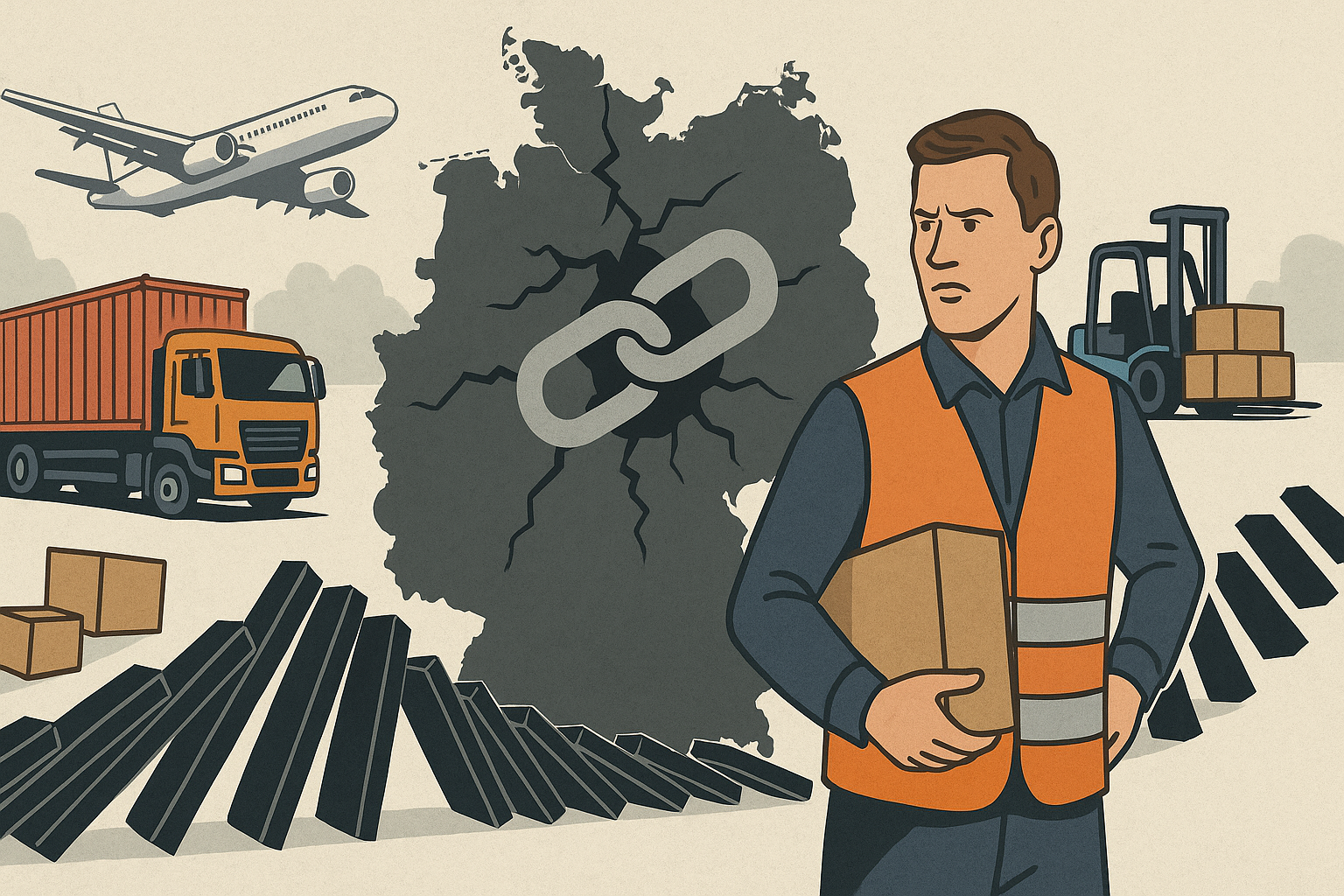
Logistics earthquake in Germany? How a mega-acquisition triggers a chain reaction – Image: Xpert.Digital
German logistics consolidation: Geis Group shows the way to strategic growth
Growth and expansion in the logistics industry – New strategies for a dynamic future
The logistics industry is undergoing a period of profound transformation and dynamic growth. Driven by technological innovations, geopolitical shifts, and changing market demands, we are currently witnessing a restructuring of established structures and the emergence of innovative business models. Current developments clearly demonstrate how companies are strengthening their market position and securing it for the future through strategic acquisitions, international expansion, and the development of specialized niches.
The wave of consolidation is hitting the German logistics market
The German logistics landscape is currently experiencing an unprecedented wave of consolidation, driven primarily by medium-sized companies. A particularly striking example of this development is the Geis Group from Bad Neustadt, which has completed three significant acquisitions within just seven months.
The acquisition of the Gras Group, headquartered in Neuwied near Koblenz, marked the beginning of the 2025 merger. With 470 employees at five locations in Rhineland-Palatinate, North Rhine-Westphalia, and Baden-Württemberg, this acquisition significantly strengthened the company's regional presence. Just a few months later, in April 2025, the two Göttingen locations of the Krüger freight forwarding company, with 230 employees, were acquired; these now operate as Geis Krüger Internationale Spedition.
The acquisition of agotrans Logistik GmbH in Rodgau near Frankfurt on July 1, 2025, marked the provisional high point of this expansion strategy. The family-owned company, established in 1972 with around 120 employees, offers a broad range of services, including general cargo transport throughout Germany and Europe, part and full loads, contract logistics, and specialized automotive solutions.
These strategic acquisitions are no coincidence, but follow a clear pattern. The economically strong Frankfurt region has long been of particular interest to the Geis Group, as it ideally complements its existing road network. With agotrans, the company has not only found a suitable partner to strategically expand its presence in this region, but also a player that shares the same corporate values such as reliability, customer focus, responsibility, and sustainable growth.
Strategic reorganization of general cargo cooperations
The acquisitions by the Geis Group have far-reaching implications for the German general cargo landscape, particularly for the IDS network (International Freight Forwarders). With 13 of the 54 depot areas in the future, Geis is among the strongest partners within this cooperation. The integration of agotrans also means that Geis will take over the IDS depot area in Aschaffenburg, while the Krüger locations in Göttingen will replace the former DSV depot in Baunatal.
This development is part of a larger restructuring in the German general cargo market, triggered by DSV's acquisition of DB Schenker. The Danish logistics group thus secures a strong presence in the German market with nearly 50 locations and an almost nationwide network. This merger is causing significant change in the industry: IDS Logistik is losing DSV as a shareholder, and cooperative ventures are having to reorganize.
Experts speak of a domino effect accelerating consolidation in the general cargo sector. The question of how many general cargo networks will be able to survive in the future, and whether medium-sized companies can remain competitive with large corporations, is becoming increasingly pressing. However, current market dynamics show that medium-sized companies like Geis can strengthen their position and act as market stabilizers through targeted acquisitions.
Asia as a growth engine of global logistics
While consolidation is progressing in Europe, many logistics companies are increasingly turning their attention to Asia. The Asia-Pacific logistics market is showing impressive growth figures: from a market volume of US$4.56 trillion in 2024, an increase to US$8.28 trillion is expected by 2034, corresponding to an annual growth rate of 6.1 percent.
A prime example of strategic expansion in this region is the Militzer & Münch Group, which established a new subsidiary in Singapore in July 2025. The Swiss logistics provider, headquartered in St. Gallen, is thus continuing its consistent growth strategy in Asia. Singapore is considered one of the world's most important logistics and economic hubs, with the logistics sector contributing around seven percent to the city-state's gross domestic product.
The choice of Singapore as a location is a strategically sound one. Its geostrategic position between the economic regions of Asia, Europe, and Oceania makes the city a major hub for international freight flows. The port is among the five largest container ports in the world, and more than 5,000 logistics companies are officially based in the city-state.
Abdul Razzak, Managing Director of the new company, and Director Asheeq Morris are responsible for setting up and managing the site. Their stated goal is to develop the local market, build a strong team on the ground, and establish Singapore as a regional logistics hub for Southeast Asia. With the new branch, customers will benefit from a full range of services, including land transport, air and sea freight, project logistics, and comprehensive customs services.
The expansion into Singapore complements Militzer & Münch's existing network in Asia, which includes companies in China, Malaysia, Indonesia, Vietnam, India, Sri Lanka, Taiwan, Mongolia, and New Zealand. This broad geographic presence enables the company to offer cross-border logistics services in one of the world's most dynamic economic regions.
Digitalization and technological innovation as growth drivers
Expansion into new markets and the consolidation of existing structures are significantly supported by technological innovations. Digitalization has become one of the most important growth drivers in the logistics industry. Artificial intelligence, the Internet of Things, and advanced data analytics are revolutionizing the way logistics companies design and optimize their processes.
The use of artificial intelligence, in particular, is driving far-reaching change. AI systems analyze traffic data in real time and optimize routes, while IoT sensors monitor the condition of vehicles and other means of transport, enabling proactive maintenance. The networking of data leads to greater productivity and transparency throughout the entire logistics process.
Automated warehouses and robotics enable companies to increase their efficiency and minimize error rates. Autonomous systems such as robots and drones are revolutionizing warehouse logistics and delivery. Warehouses are expected to operate almost fully automatically in the near future, leading to a significant reduction in operating costs.
Blockchain technology increases transparency in supply chains, helps prevent counterfeiting, and enables real-time tracking of transport routes. This technology is becoming an integral part of modern supply chains and contributes significantly to increased security.

Expert partner in warehouse planning and construction

Geopolitical risks threaten global supply chains: This is how the logistics industry is reacting
Sustainability as a strategic competitive advantage
In addition to digitalization, sustainability is increasingly shaping the growth strategies of the logistics industry. External pressure from legal requirements for CO₂ reduction, particularly from the EU, as well as the global goal of net zero by 2050 at the latest, make the transition to sustainable logistics solutions unavoidable.
A key element of this development is the electrification of vehicle fleets. Zero-emission electric trucks will increasingly form the backbone of modern delivery fleets. At the same time, hydrogen is gaining importance as an alternative fuel in long-distance logistics, enabling environmentally friendly long-distance transport. However, due to infrastructural challenges, a multi-pronged energy strategy is needed that combines electricity, hydrogen, and other technologies.
The circular economy is also gaining traction in logistics. Companies are increasingly focusing their packaging materials and transport units on recyclability and sustainability to minimize waste and reduce costs. Green supply chain management is becoming a competitive advantage, and companies that can offer a green supply chain are preferred by their customers.
Specialized niches and innovative transport solutions
Alongside the major consolidation and expansion trends, smaller, specialized logistics niches are also regaining importance. A particularly interesting example is the resumption of air traffic to the North Sea island of Juist.
After a hiatus of several months, Scandinavian Air Charter will resume operations between the coastal resort of Norddeich and Juist on July 14, 2025. The new route will be served at least four times daily with Cessna 206 aircraft, each capable of carrying five passengers.
What's interesting is not only the resumption of flight operations itself, but also the innovation in ground transportation. Instead of traditional horse-drawn carriages, bicycle rickshaws for up to four people will be used in the future. Alternatively, rental bikes are available. This development shows how even in specialized niches, innovative and sustainable solutions are finding their way in.
The shortage of skilled workers as a brake on growth
Despite all the positive developments and growth opportunities, the logistics industry faces a significant challenge: the shortage of skilled workers. According to a survey by the Munich-based Ifo Institute, between 44 and 59 percent of companies from various logistics sectors reported in the third quarter of 2024 that their business operations were hampered by a lack of skilled workers.
In addition to commercial staff and specialists in quality management and customs, professional drivers are particularly in demand. This situation makes it all the more important for logistics companies to retain their loyal and long-serving employees and create real added value for them. Transparent internal communication across time and location boundaries becomes a crucial task in this regard.
In response to the skills shortage, many companies are increasingly relying on automation and artificial intelligence. These technologies can not only increase efficiency but also help reduce the need for manual labor and relieve the burden on existing employees.
The future of the last mile
Last-mile logistics is a particularly dynamic growth area, driven by the ongoing e-commerce boom. The explosive growth of online retail demands efficient solutions for final delivery to the end customer. Logistics service providers are increasingly relying on innovative concepts such as drones, autonomous delivery vehicles, and smart locker solutions.
By 2025, further innovative concepts for optimizing last-mile delivery will enter the market. Autonomous delivery vehicles and drones could offer an efficient solution for last-mile delivery in urban areas. These technologies promise not only increased efficiency but also a reduction in environmental impact through optimized routes and electric propulsion.
Geopolitical challenges and resilience
The global logistics industry is increasingly having to contend with geopolitical uncertainties. Trade disputes, potential tariff increases, and changing international relations demand a high degree of flexibility and adaptability from logistics companies.
The potential impact of US trade policy on global supply chains is a particular concern for the industry. Massive tariff increases and corresponding retaliatory measures could significantly hamper the sector's growth, especially in maritime transport. Companies are responding by building more resilient supply chains and diversifying their transport routes and modes.
An industry in transition
The logistics industry faces a promising yet challenging future. The wave of consolidation in Europe, expansion into growth markets like Asia, ongoing digitalization, and a focus on sustainability will significantly shape the industry in the coming years.
Companies that react to these changes early and take proactive measures can gain a significant competitive advantage. The successful examples of the Geis Group with its targeted acquisition strategy and the Militzer & Münch Group with its expansion into Singapore demonstrate how medium-sized companies can strengthen their market position through strategic growth.
At the same time, the resumption of air traffic to Juist with innovative transport solutions demonstrates that even specialized niches offer room for growth and innovation. The industry thus proves its ability to respond flexibly to a wide variety of market demands and to develop new business models.
The challenges posed by skills shortages, geopolitical uncertainties, and increasing sustainability requirements will continue to pose demands on the industry. However, it is precisely these challenges that are driving innovation and leading to more efficient, sustainable, and customer-centric logistics solutions.
The future of the logistics industry will be shaped by companies willing to rethink traditional business models, invest in new technologies, and strike a balance between global growth and local responsibility. Current developments indicate that the industry is well on its way to successfully mastering this transformation and positioning itself for the challenges of the coming decades.

Xpert.Plus Warehouse Optimization - High-bay warehouses and pallet warehouses: Consulting and planning
We are here for you - Consulting - Planning - Implementation - Project Management
☑️ SME support in strategy, consulting, planning and implementation
☑️ Creation or realignment of the digital strategy and digitization
☑️ Expansion and optimization of international sales processes
☑️ Global & Digital B2B trading platforms
☑️ Pioneer Business Development

Konrad Wolfenstein
I would be happy to serve as your personal advisor.
You can contact me by filling out the contact form below or simply call me on +49 7348 4088 965 .
I'm looking forward to our joint project.
Write to me


Xpert.Digital - Konrad Wolfenstein
Xpert.Digital is a hub for industry focusing on digitalization, mechanical engineering, logistics/intralogistics and photovoltaics.
With our 360° Business Development solution, we support renowned companies from new business to after-sales.
Market intelligence, smarketing, marketing automation, content development, PR, mail campaigns, personalized social media and lead nurturing are part of our digital tools.
You can find more information at: www.xpert.digital - www.xpert.solar - www.xpert.plus
Keep in touch