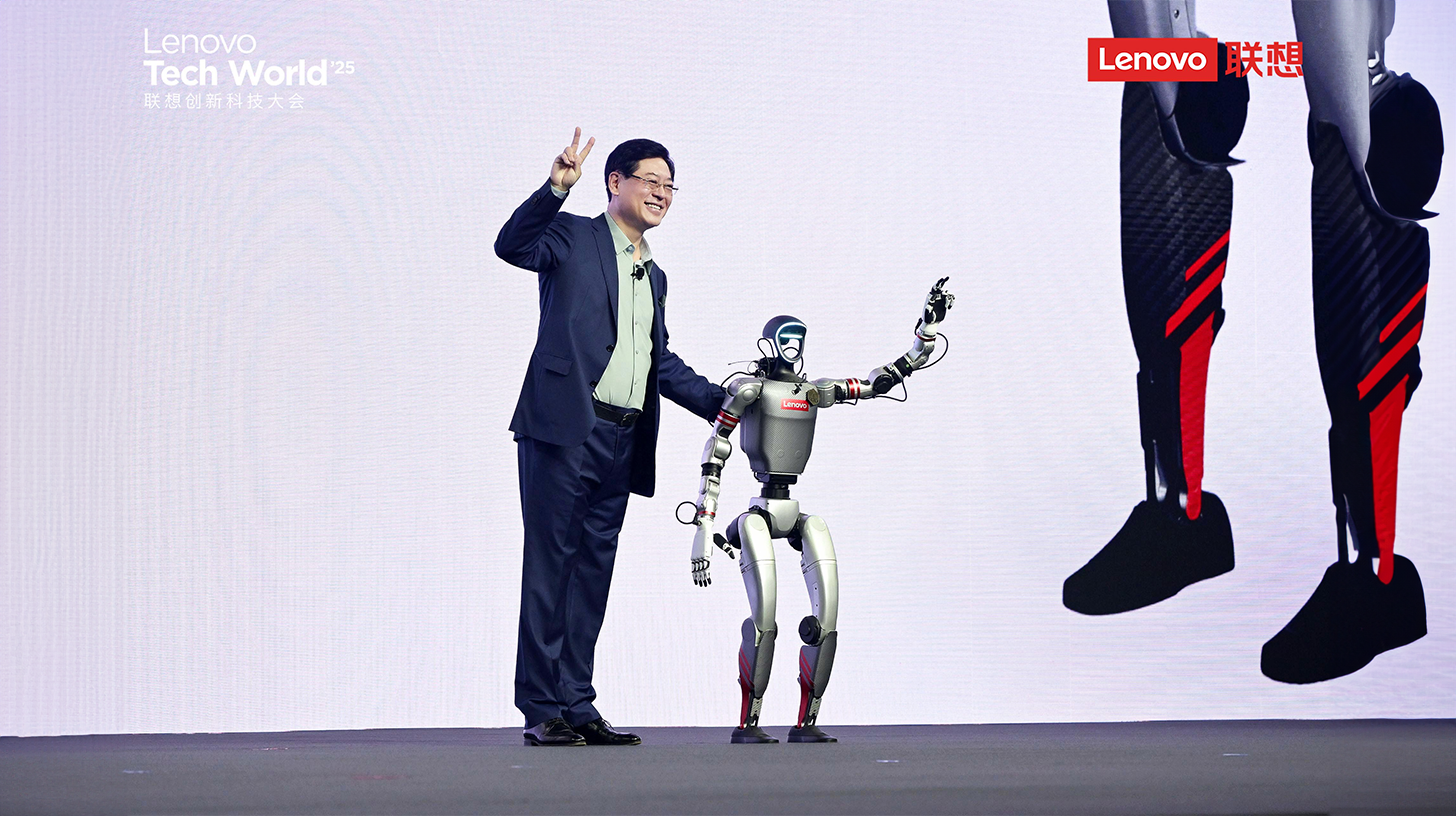
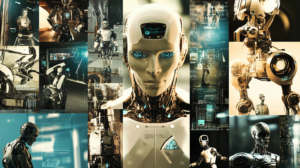
Lenovo is fully committed to AI robots with LeXiang No. 1: More than just laptops – a humanoid robot with artificial intelligence – Image: Lenovo
Lenovo presents its first humanoid robot and aims to revolutionize the service sector
Tech World 2025: Lenovo is penetrating new business areas with its intelligent robot assistant
Lenovo unveiled its first humanoid robot, the LeXiang No. 1, at Tech World 2025 (May 7, 2025) at the Shanghai Expo Center. With this launch, the Chinese technology company is taking a significant step towards embodied artificial intelligence and expanding its business beyond traditional hardware. Lenovo is specifically targeting service sector applications such as elderly care and hospitals with this intelligent assistant. The introduction of this humanoid robot marks the company's entry into a rapidly growing market and could fundamentally change the way services are delivered.
Related to this:

Presentation and technical specifications
LeXiang No. 1 was unveiled at Tech World 2025 in Shanghai as a "Silicon Employee" and impresses with its fluid movements and advanced AI capabilities. Standing approximately one meter tall, the robot demonstrated its embodied intelligence during the presentation by performing a Tai Chi exercise, a traditional Chinese martial art known for its slow, controlled movements and focus on balance.
Lenovo CEO Yang Yuanqing emphasized during the presentation: "Today, many still see Lenovo as a device company, but in the future, intelligent agents could become the core of our business." This statement underscores the company's strategic shift and the growing importance of AI technologies in its business model.
The robot's technical capabilities are enhanced by a three-layer intelligent framework that allows it to interact with various devices and utilize data within the Lenovo ecosystem. This framework includes:
- Natural multimodal interactions for proactive communication
- Integration of local knowledge across devices, platforms, and ecosystems
- Advanced task autonomy and orchestration
According to Lenovo's CTO Tolga Kurtoglu, security and data protection are fundamental design principles embedded in all three capabilities.
Advanced AI integration and application areas
During its presentation, the LeXiang No. 1 impressively demonstrated its ability to access comprehensive business data from Lenovo and answer related questions in natural language. This exemplifies the practical application of artificial intelligence in a business environment and showcases its potential for use in the service sector.
Lenovo's enterprise intelligence strategy is based on a four-tier "device-edge-cloud-network" architecture that forms a hybrid computing infrastructure. This integrates both public and private cloud platforms and supports data collection, storage, and processing with intelligent scheduling that sends data to hybrid clouds for AI model training.
Lenovo plans to initially deploy the LeXiang No. 1 in the service sector, with a particular focus on elderly care and hospitals. These areas offer enormous potential for humanoid robots to meet the increasing need for support and care. Choosing these areas of application could be a response to societal challenges such as demographic change and the shortage of skilled healthcare workers.
Performance at the Beijing Humanoid Robot Sports Competition
Before the LeXiang No. 1 enters regular service, Lenovo plans to showcase the robot's capabilities at the Beijing Humanoid Robot Sports Competition in August 2025. In this newly created competition, humanoid robots compete against each other in various disciplines such as gymnastics and soccer, demonstrating their agile abilities.
This event is part of a larger trend promoting robotics competitions. As search results indicate, China has announced it will host the World Humanoid Robot Games in August at actual Olympic venues, where robots will compete in athletics, gymnastics, and even soccer. Such events not only serve to showcase technology but also encourage the further development and optimization of robotics through competition.
Lenovo in the context of the growing market for humanoid robots
With the launch of the LeXiang No. 1, Lenovo joins a growing list of companies developing humanoid robots. The industry is currently experiencing significant growth, as demonstrated by the activities of other manufacturers
Unitree has upgraded its humanoid G1 robot with an AI system called AMO, enabling real-time, whole-body control. Priced at approximately $16,000, the Unitree G1 is slightly smaller than an average adult, standing 1.32 meters tall and weighing 35 kilograms. It is equipped with a 360-degree LiDAR scanner and an Intel RealSense D435 depth camera.
Figure AI has already delivered its humanoid robot Figure 02 to its first customer. This robot features six RGB cameras, depth cameras, and infrared sensors for a complete 360-degree view and is designed to achieve human-like precision with 16 degrees of freedom in its hands.
Lenovo itself has previous experience with robotics. In January 2025, at NRF 2025 in New York City, the company presented retail robotics solutions in partnership with Yunji Technology. These solutions offer automated delivery of food, guest amenities, and small packages to customers in hotels and shopping malls.
Related to this:
Potential and impact on the service sector
The introduction of the LeXiang No. 1 could have far-reaching implications for the service industry. Experts see humanoid robots as a way to compensate for the shortage of skilled workers while simultaneously improving the efficiency and quality of services.
The integration of embodied and artificial intelligence enables the robot to act as an "intelligent agent" in various life situations. This could be particularly valuable in areas such as elderly care and healthcare, where the need for support is constantly growing.
With the LeXiang No. 1, Lenovo is positioning itself as a pioneer in an emerging market segment that is likely to gain further importance in the coming years. CEO Yang Yuanqing indicated that intelligent agents could become the core of Lenovo's business in the future, representing a significant strategic shift for the company.
How LeXiang No. 1 could transform the service industry
Lenovo's entry into the world of humanoid robotics with the LeXiang No. 1 demonstrates how established technology companies are increasingly relying on innovative technologies to tap into new business areas and optimize existing processes. The LeXiang No. 1 combines advanced AI systems with physical capabilities and could therefore fundamentally change the way services are delivered, particularly in the healthcare and nursing sectors.
The development and integration of such robots could set new standards for efficiency and quality in the service sector. At the same time, it raises important questions about the societal impact, ethical considerations, and future human-robot interaction.
The coming years will show how well the LeXiang No. 1 and similar humanoid robots actually function in practice and how they are received by users and service recipients. Success will depend not only on their technical capabilities but also on how well these robots can be integrated into existing systems and whether they can create genuine added value in service delivery.
With the participation of LeXiang No. 1 in the Beijing Humanoid Robot Sports Competition in August 2025 and the planned deployments in elderly care and hospitals, we will soon learn more about the practical capabilities and potential of Lenovo's first humanoid robot.
Related to this:
Your global marketing and business development partner
☑️ Our business language is English or German
☑️ NEW: Correspondence in your native language!

Konrad Wolfenstein
I and my team are happy to be available to you as your personal advisor.
You can contact me by filling out the contact form here wolfenstein@xpert.digital:or simply call me at +49 7348 4088 965. My email address is
I'm looking forward to our joint project.