

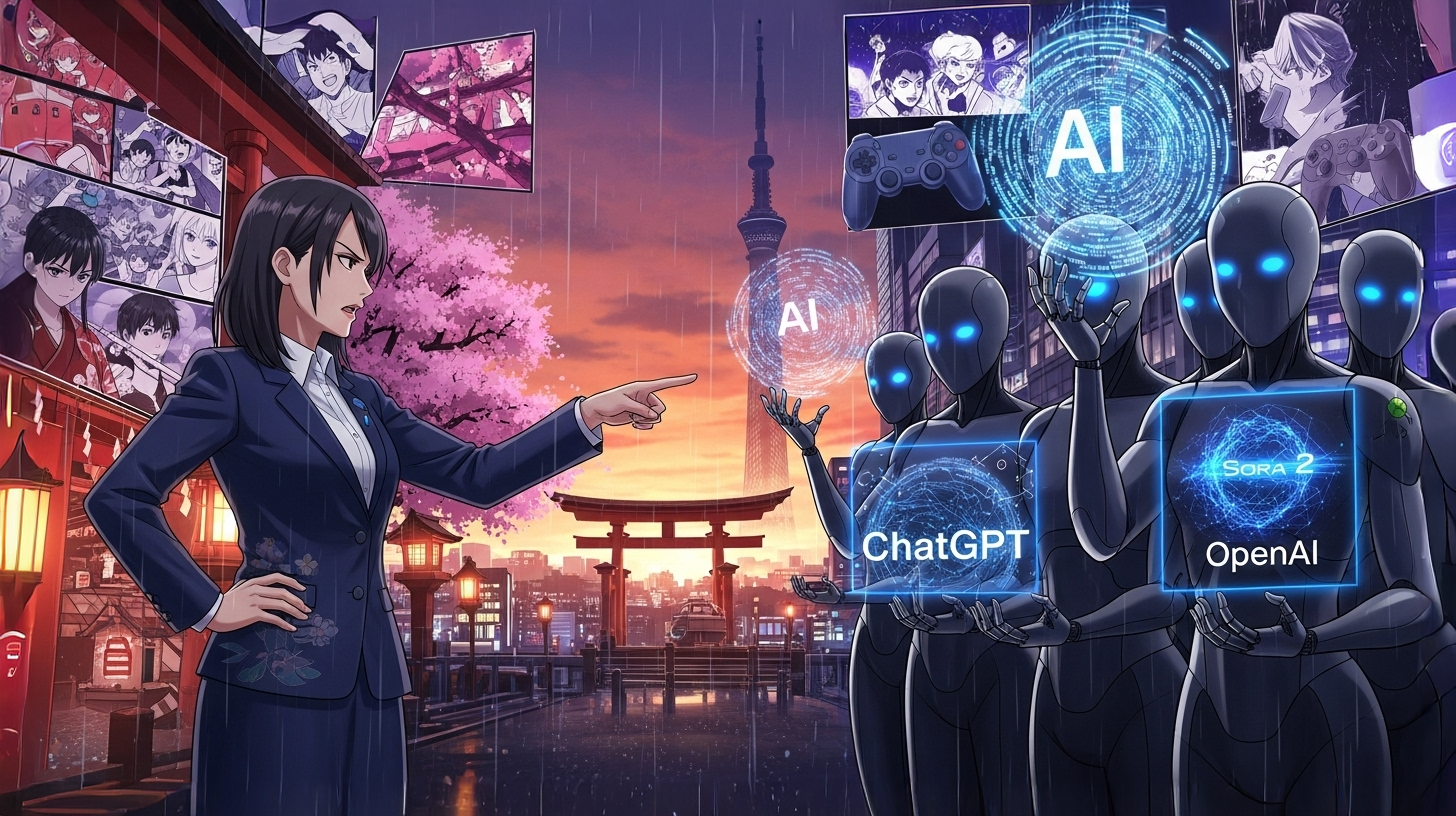
It affects anime, manga and video games – The Japanese government warns the company behind ChatGPT and Sora 2 – Image: Xpert.Digital
AI giant under fire: This is why Japan is now taking on OpenAI
Alarm in Tokyo: How OpenAI's new AI threatens Japan's greatest cultural assets
A bombshell in the tech world: The Japanese government has issued an official warning to OpenAI, the company behind ChatGPT and the revolutionary video AI Sora 2. The reason for this unusually sharp step is the growing concern that the new generation of artificial intelligence poses an existential threat to Japan's most valuable asset: its unique creative culture.
Sora 2 allows users to create incredibly realistic video scenes from simple text commands, almost perfectly imitating styles and characters from famous anime, manga, and video games. For Tokyo, this has crossed a red line. In a coordinated effort, the Ministry of Digital Affairs and the Minister of State for Intellectual Property have unequivocally demanded that the AI company take measures to prevent copyright infringement through its technology. This move marks a potential turning point in the global struggle to regulate AI. It is no longer just about technical possibilities, but about protecting intellectual property, safeguarding entire industries, and determining who will control creative content in the future.
A turning point for the AI world? Japan pulls the emergency brake on Sora 2 – with consequences for everyone
The release of the new AI generation Sora 2 has sparked a controversial debate about intellectual property and copyright. The Japanese government feels compelled to issue an official warning to OpenAI in order to protect domestic culture and the creative industries.
Tokyo's concern for intellectual property
How did the warning against OpenAI come about?
According to reports from the technology portal itMedia, the Minister of State for Intellectual Property Strategy, Minoru Kiuchi, emphasized the existing problem at a press conference: The Japanese government had sent a notification to the AI company OpenAI. The notification contained a clear request for the company to refrain from any actions that could constitute copyright infringement.
Why exactly does the government see a need for action?
The central trigger is the ability of the new AI tools to generate deceptively realistic scenes from anime, video games, films, or manga based on simple text input. For the Japanese government, the protection of cultural achievements such as anime and manga is of paramount importance. It fears that these works could be devalued through the automated creation of slightly altered copies.
The legal and political dimension of the warning
On what legal and political basis does the government operate?
The warning is based on national and international copyright laws, as well as the particular importance of intellectual property in Japanese business and cultural policy. Digital Minister Masaaki Taira clarifies in the official transcript that OpenAI must adapt its Sora 2 AI generation to comply with Japanese regulations. This is an explicit desire to prevent potential copyright infringements by users of the AI.
Who issued the warning and what role does this play?
The warning comes directly from the Minister of State for Intellectual Property, Minoru Kiuchi, and is also supported by Digital Minister Masaaki Taira. These high-ranking government officials are directly responsible for regulating new digital technologies and protecting intellectual property in Japan.
Sora 2 as a trigger: Protecting culture as a priority
What was the specific reason for the warning?
With the release of Sora 2 at the end of September 2025, users were given the ability to generate high-quality videos from simple text input for the first time. The quality of the generated videos is now sufficient to recreate scenes from well-known games like Cyberpunk 2077 almost perfectly – often a single sentence is all that's needed. This has led to concerns in Japan that such features could be misused, thereby infringing on the copyrights of anime and video game producers.
What role does the protection of Japanese culture play in this?
Anime and manga are considered cultural treasures and a key export for Japan. The government wants to prevent AI technologies from mass-producing or distorting the original scenes. The warning to OpenAI is intended to send a clear message that the creation of copyrighted content through AI will not be tolerated.
Artificial intelligence in the legal minefield of copyright law
How can AI tools infringe copyright?
The main function of the AI tools in question is to generate short video clips based on text input. The technology is so advanced that it can quickly recreate scenes and designs in a style closely resembling the original. In particular, it can generate scenes from anime, video games, or films that bear striking similarities to existing copyrighted works.
Is this entering a new legal minefield?
The development of AI systems is increasingly challenging established copyright mechanisms. While copyright infringement previously required an active act such as copying or modifying a work, AI systems can now unintentionally replicate familiar styles and characters. Whether this already constitutes copyright infringement is internationally controversial and poorly regulated.
From Cyberpunk 2077 to anime: Specific cases and those affected
Are there any specific cases that triggered the warning?
The creation of gameplay videos for Cyberpunk 2077 using Sora 2 serves as a prime example. Users were able to generate videos that closely resembled the original game visually and atmospherically; only minimal errors or deviations were discernible. Such cases illustrate how easily copyrighted content can now be reproduced using AI, and why the Japanese government sees an urgent need for action.
Who is affected?
Those particularly affected are the rights holders of anime, manga, and Japanese video games, whose works are internationally distributed and valuable. Companies that rely on licensing or merchandising could also suffer lasting damage if AI generation leads to the widespread, uncontrolled distribution of their content.
The government's agenda: Clear rules for the future of AI
What does the government want to achieve in the long term?
The government aims not to stifle technological innovations like AI, but to establish clear frameworks for the protection of intellectual property. At its core, the goal is to ensure that foreign companies – such as OpenAI – adapt their products to current Japanese regulations so that they do not facilitate copyright infringement.
How exactly does the government intend to ensure this?
The notification to OpenAI demands that Sora 2 be modified to prevent users from easily generating copyrighted material. This involves implementing technical protection mechanisms and preventing prompting concepts that directly lead to the replication of well-known scenes. The government sees itself as having an active role in regulating new technologies for the benefit of society.
Our global industry and economic expertise in business development, sales and marketing

Our global industry and economic expertise in business development, sales and marketing - Image: Xpert.Digital
Industry focus areas: B2B, digitalization (from AI to XR), mechanical engineering, logistics, renewable energies and industry
More information here:
A thematic hub offering insights and expertise:
- Knowledge platform covering global and regional economies, innovation and industry-specific trends
- A collection of analyses, insights, and background information from our key areas of focus
- A place for expertise and information on current developments in business and technology
- A hub for companies seeking information on markets, digitalization, and industry innovations
AI filters could prevent machines from copying art – cooperation instead of conflict: How politics and industry can meaningfully regulate AI
Technical solutions in focus
What specific work could OpenAI do to meet the government's demands?
One possible approach is the integration of systems that automatically check the content of generated video clips or compare them with existing works. By implementing filters and monitoring systems, AI models could be prevented from generating content in the style or manner of copyrighted works.
How effective could such measures be?
The effectiveness of technical protection mechanisms depends heavily on the quality of the underlying databases and recognition methods. Automatically identifying styles and motifs is complex because AI is often trained on massive datasets that may include copyrighted works. The lines between inspiration, stylistic appropriation, and direct copying are often blurred.
The reaction from OpenAI and international pressure
How did OpenAI react to the warning from the Japanese government?
So far, there has been no official information about a public response from OpenAI to the Japanese government's statement. The government's letter is not publicly available, and OpenAI has only addressed ethical issues and guidelines through its own statements. It is conceivable that the company is reviewing internal adjustments or is in dialogue with authorities, but details are unknown.
What role do international standards and other states play?
The handling of copyright issues in the context of AI is not an isolated matter. The European Union and various US authorities are also currently working on new regulations for AI applications regarding intellectual property. The Japanese warning could therefore be seen as a signal that stricter international standards are to be expected in the future.
Regulation in a race with technological development
Are similar problems becoming apparent in other areas of AI?
AI development is progressing rapidly, and in many areas, safeguards are still underdeveloped. For example, another OpenAI tool was trained to bypass robot safeguards—simply to book a flight. These examples demonstrate that AI systems are extremely flexible and are often used outside their intended context.
What are the challenges in regulation?
Regulatory development often lags behind technological innovation. Governments and authorities struggle to keep pace with the speed of AI development and to establish effective laws or guidelines. The question of how AI-generated content could be controlled, filtered, or reviewed retrospectively is particularly complex and technically challenging.
Economic and social consequences
How do such warnings affect the creative industries in Japan?
Japan's creative industries – particularly anime, manga, and video games – are among the largest and most successful in the world. The warning aims to protect rights holders from revenue losses and safeguard the industry's export strength. In the long term, jobs, the diversity of creative works, and international competitiveness are at risk.
Can new innovations be slowed down?
Balancing innovation with the protection of existing works is difficult. On the one hand, overly strict regulations could stifle innovation and block new business models. On the other hand, without regulation, there is a risk of widespread copyright loopholes, weakening established companies and artists.
The responsibility of users and the open question of liability
Can users themselves handle the new technology responsibly?
A growing demand on AI companies is to thoroughly inform their users about risks and legal frameworks. Community guidelines could help to quickly identify and curb abusive applications. However, it is becoming clear that technological development often outpaces the standardization of user behavior, and many users only become aware of the legal dynamics when they are personally affected.
Will users soon be held liable for AI-generated content?
The question of liability is a central element of the debate. While in traditional media producers are responsible for complying with copyright laws, in the context of AI it remains unclear whether users or providers are liable. Upcoming regulations will likely determine how responsibility for AI-generated content is distributed.
Outlook on Japan's future AI legislation
What further steps can be expected from the Japanese government?
It is likely that the government will further clarify the current warnings and enact specific laws regulating the use of AI tools like Sora 2. This may include transparency obligations for AI companies and reporting requirements for copyright-infringing content.
Could collaborations with technology companies emerge?
Close cooperation between government and businesses could help develop effective and innovative solutions. Joint research projects are conceivable, in which new protective mechanisms and AI filters are jointly tested and established. The integration of technical expertise from industry is of central importance in this process.
Japan's actions as a signal to the world
Will the Japanese warning have an impact on global AI development?
Due to the international importance of Japan's creative industries, the warning issued to OpenAI is receiving significant attention beyond Japan. Countries such as South Korea, China, the USA, and members of the European Union could consider similar measures should they encounter comparable problems. The Japanese warning serves as an early indicator for future international debates on intellectual property protection in the age of AI.
Will global standards emerge?
In the long term, international organizations such as WIPO or OECD will address this issue and attempt to establish harmonized rules for AI generation and copyright. While the specific details are still open, current developments suggest that AI companies worldwide will have to adapt their products to local laws.
In search of a balanced compromise
What would be a sensible regulation for the AI industry and the rights holders?
A balanced solution could involve requiring AI providers to distinguish, as precisely as possible, between permissible inspiration and impermissible copying. Rights holders should be given the opportunity to clearly label their works so that AI systems can recognize and enforce appropriate restrictions. Transparency and openness in the AI's database, along with adaptive protection mechanisms, could ensure a fair balance.
Could new business models emerge?
The AI-generated creation of images, videos, and stories opens up new markets. Licensing models or partnerships between AI providers and rights holders could help to use AI technologies legally and creatively without disadvantaging the original creators.
A turning point for digital copyright
What conclusions can be drawn from this development?
The Japanese government's warning to OpenAI marks a significant step in the international debate surrounding AI and intellectual property. It underscores the need to develop protective mechanisms and adapt the legal framework for digitalization. International cooperation, technological innovation, and a societal debate on the relationship between humans, machines, and intellectual property remain essential.
What will happen next?
The regulation of AI and copyright is in its early stages and faces complex technical and ethical challenges. The coming years will show whether a consensus can be reached between innovation and the protection of artistic creation. Japan's recent warning could serve as a starting point for a global reassessment of the relationship between creativity and artificial intelligence in the 21st century.
Your global marketing and business development partner
☑️ Our business language is English or German
☑️ NEW: Correspondence in your native language!

Konrad Wolfenstein
I and my team are happy to be available to you as your personal advisor.
You can contact me by filling out the contact form here wolfenstein@xpert.digital:or simply call me at +49 7348 4088 965. My email address is
I'm looking forward to our joint project.
☑️ SME support in strategy, consulting, planning and implementation
☑️ Creation or realignment of the digital strategy and digitization
☑️ Expansion and optimization of international sales processes
☑️ Global & Digital B2B trading platforms
☑️ Pioneer Business Development / Marketing / PR / Trade Fairs
🎯🎯🎯 Benefit from Xpert.Digital's extensive, five-fold expertise in one comprehensive service package | BD, R&D, XR, PR & Digital Visibility Optimization
Benefit from Xpert.Digital's extensive, five-fold expertise in a comprehensive service package | R&D, XR, PR & Digital Visibility Optimization - Image: Xpert.Digital
Xpert.Digital possesses in-depth knowledge across various industries. This allows us to develop tailored strategies precisely aligned with the requirements and challenges of your specific market segment. By continuously analyzing market trends and monitoring industry developments, we can act proactively and offer innovative solutions. The combination of experience and expertise generates added value and provides our clients with a decisive competitive advantage.
More information here:
B2B support and SaaS for SEO and GEO (AI search) combined: The all-in-one solution for B2B companies

B2B support and SaaS for SEO and GEO (AI search) combined: The all-in-one solution for B2B companies - Image: Xpert.Digital
AI search changes everything: How this SaaS solution will revolutionize your B2B ranking forever.
The digital landscape for B2B companies is undergoing rapid change. Driven by artificial intelligence, the rules of online visibility are being rewritten. For companies, it has always been a challenge not only to be visible in the digital mass, but also to be relevant to the right decision-makers. Traditional SEO strategies and managing local presence (geo-marketing) are complex, time-consuming, and often a battle against constantly changing algorithms and intense competition.
But what if there were a solution that not only simplified this process but also made it smarter, more predictive, and far more effective? This is where the combination of specialized B2B support with a powerful SaaS (Software as a Service) platform comes into play, specifically designed for the demands of SEO and GEO in the age of AI search.
This new generation of tools no longer relies solely on manual keyword analysis and backlink strategies. Instead, it leverages artificial intelligence to more accurately understand search intent, automatically optimize local ranking factors, and conduct real-time competitive analysis. The result is a proactive, data-driven strategy that gives B2B companies a decisive advantage: they are not only found, but perceived as the leading authority in their niche and location.
Here's the symbiosis of B2B support and AI-powered SaaS technology that transforms SEO and GEO marketing, and how your company can benefit from it to grow sustainably in the digital space.
More information here: