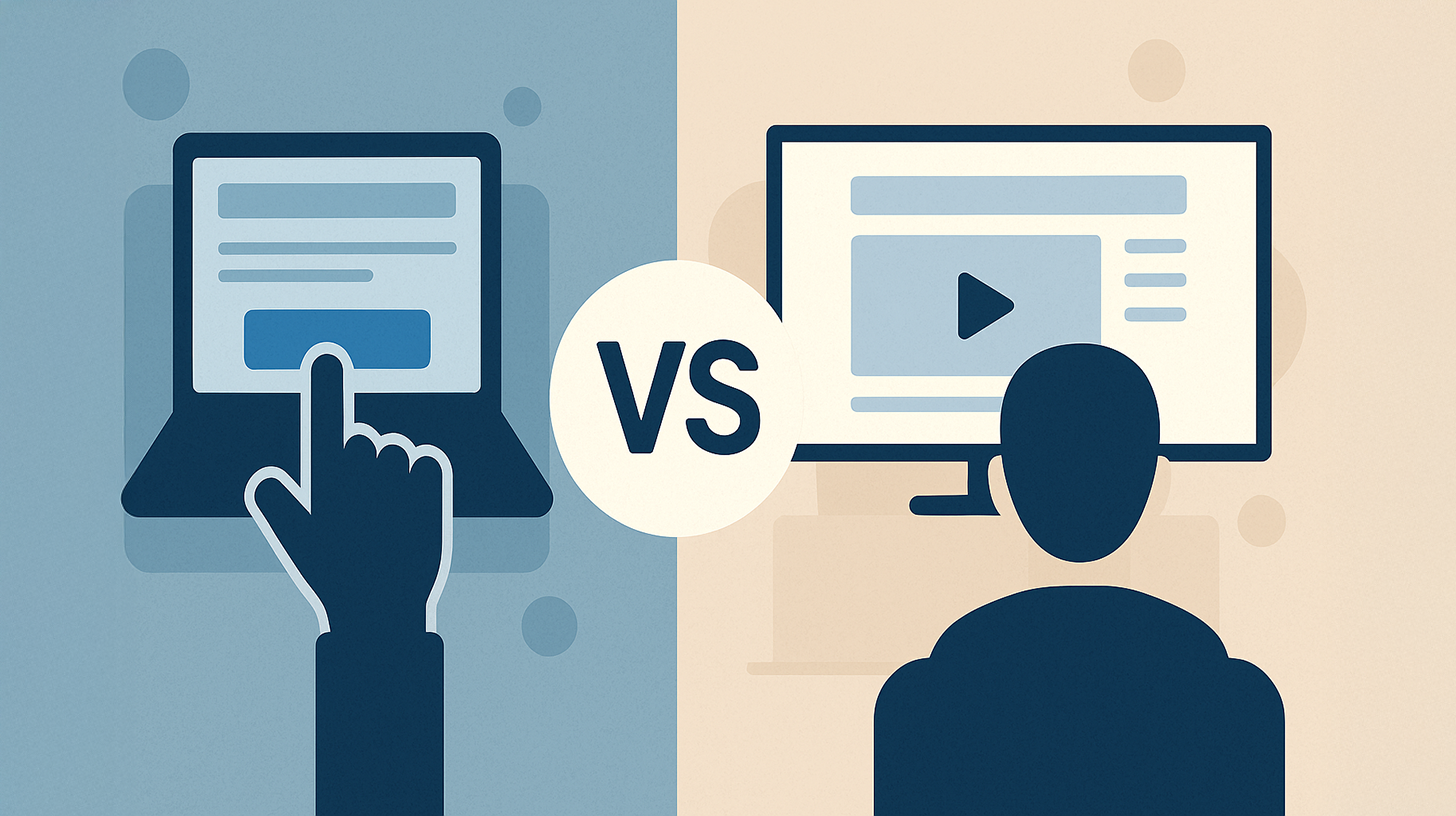
Interactive vs. Passive: Which content type really doubles your conversions? – Image: Xpert.Digital
From 60 seconds to 8 minutes: How to drastically increase your users' dwell time
More expensive, but better? The surprising truth about the cost of interactive content
In the endless flood of digital content, companies, creatives, and marketers fight daily for the most valuable commodity: the attention of their target audience. But how do you truly stand out? How do you transform fleeting visitors into engaged fans and loyal customers? The answer often lies in a fundamental strategic decision that determines the success of all subsequent measures: the choice between interactive and passive content.
On the one hand, there's tried-and-tested, passive content – the classic blog article, the informative infographic, or the explanatory video. Content that imparts knowledge and is consumed. On the other hand, there's dynamic, interactive content: quizzes that challenge us, calculators that deliver personalized results, and configurators that invite us to participate in the design process.
But this decision is far more than a question of format. It's a strategic choice that determines user engagement, customer loyalty, and ultimately, your revenue. Should you rely on tried-and-tested, cost-effective texts to demonstrate expertise, or invest in elaborate but potentially more impactful interactive experiences that actively engage users?
This comprehensive comparison provides the answer. We delve deep into the world of both content types, analyzing their strengths and weaknesses based on hard-hitting criteria such as engagement rates, conversion potential, costs, and technical effort. Ultimately, you'll receive clear guidance to develop the perfect content strategy for your goals, target audience, and budget.
A detailed comparison of interactive and passive content
The digital communication landscape is characterized by two fundamental content categories: interactive and passive content. This distinction is far more than a technical differentiation and significantly influences how companies communicate with their target groups and how users consume information.
Interactive content encompasses all digital content that requires active user participation. This includes quizzes, surveys, interactive infographics, calculators, configurators, interactive videos, and games. This type of content prompts users to take action—clicking, typing, selecting, or other means—before receiving the desired information.
Passive content, on the other hand, refers to static content that is primarily consumed without any active user interaction. This includes traditional text, images, videos, infographics, blog posts, and static web pages. This content is presented in its original form and remains unchanged, regardless of who views it.
A comparison between these two types of content is crucial for modern marketing strategies and communication approaches. The choice between interactive and passive content directly impacts factors such as user engagement, conversion rates, costs, technical requirements, and long-term scalability. Companies face the challenge of developing the optimal content strategy for their goals and target audiences, as both approaches have their specific strengths and weaknesses.
Fundamental commonalities and overarching goals
Despite their different approaches, both interactive and passive content pursue fundamental common goals in digital communication. Both types of content primarily serve to convey information and aim to reach, inform, and persuade target groups.
The overarching goal of both approaches is to create added value for the target audience. While passive content achieves this through the structured presentation of information, interactive content creates added value through personalized experiences and active participation. Both forms strive to capture users' attention and foster long-term loyalty to a brand or company.
Another shared goal is to support the target audience's decision-making process. Passive content provides comprehensive information to assist users in their decision-making, while interactive content contributes to better decisions through personalized recommendations and individualized results. Both approaches can be used equally for lead generation and customer acquisition.
Brand positioning represents another touchpoint. Both interactive and passive content can contribute to strengthening brand identity and credibility. While passive content often builds trust through expertise and well-founded information, interactive content demonstrates innovation and customer focus.
Both types of content must also meet basic quality criteria: they must be relevant to the target audience, understandable, and valuable. Regardless of interactivity, content relevance and quality are crucial for the success of any content strategy.
Detailed comparison based on defined criteria
Engagement and user interaction
Interactive content demonstrably achieves higher engagement rates than passive content. Studies show that interactive content generates 52.6 percent higher engagement rates than static content. This increased interaction results from the active participation of users, which appeals to multiple senses and leads to a more intensive engagement with the content.
The time users spend on websites increases significantly with interactive content. While passive content keeps users on a page for an average of 60 seconds, interactive elements can increase this to over eight minutes. This longer engagement time signals the value of the content to search engines, which has a positive effect on SEO rankings.
Passive content, on the other hand, offers the advantage of easy consumption. Users can quickly grasp information without having to actively participate. This is particularly suitable for information-seeking users who need specific answers quickly. Selective perception is less challenged with passive content, as no active participation is required.
Conversion rates and lead generation
Interactive content offers clear advantages in conversion optimization. Studies show that interactive content generates twice as many conversions as passive content formats. Active user participation leads to a stronger emotional connection and a greater willingness to take the desired action.
Lead quality is also higher with interactive content. Leads generated through interactive content have 40 percent better qualification scores than those from passive sources. This results from the more intensive engagement and higher involvement of users.
However, passive content can also achieve effective conversions if it is well-optimized and includes a clear call to action. Especially with complex products or services that require detailed explanations, passive content can be compelling due to its depth of information.
Costs and resource expenditure
Creating interactive content requires significantly more initial investment. Simple interactive slides start at around €99, while complex interactive content can cost up to €750 per element. Development requires specialized skills in design, programming, and user experience.
Passive content is less expensive to produce. Professional blog articles cost between €150 and €250 for approximately 500 words. Creating them primarily requires editorial skills and can be done even with limited technical resources.
In the long run, however, interactive content can achieve a higher return on investment. The higher initial investment is often recouped more quickly due to improved engagement and conversion rates. Interactive content is also shared more frequently, leading to additional organic reach.
Technical requirements
Interactive content places higher technical demands on the infrastructure. Implementation requires powerful servers, stable internet connections, and modern browser compatibility. WebGL-based applications need sufficient hardware resources for smooth rendering.
Maintaining interactive content is more complex and requires regular updates to ensure compatibility and functionality. Technical problems can significantly impact the user experience and require a rapid response.
Passive content has lower technical hurdles. Static websites load faster, require fewer server resources, and function reliably even with slower internet connections. Maintenance is limited to occasional content updates and basic security updates.
Scalability
Passive content offers significant advantages in terms of scalability. Once created, content can be delivered to an unlimited number of users without additional effort. Distribution occurs via established content distribution channels and requires no individual customization.
Interactive content is more difficult to scale because personalized experiences and individual user interactions require more server resources. Scaling requires robust technical infrastructures and well-thought-out architectural concepts.
Measurability and Analytics
Interactive content offers more detailed insights into user behavior. Every interaction can be tracked and analyzed, providing valuable data on preferences, decision-making patterns, and engagement quality. This data enables more precise optimizations and personalized follow-up actions.
Passive content offers basic metrics such as page views, time spent on page, and bounce rate. While these metrics provide important insights, detailed insights into user interaction and the consumption process are lacking.
🤖🚀 PLAROS Gamification AI Platform: Create interactive, playful elements from existing content


Innovative AI-powered platform for gamification elements to create interactive, playful elements from existing content - Image: Xpert.Digital
💹 Innovative AI-powered platform for gamification elements to create interactive, playful elements from existing content.
➡️ Core functions of the platform
Plaros' AI automatically analyzes existing website content and understands its context to generate contextual games and challenges. Instead of using generic quiz templates, the platform creates customized interactive elements that are directly tailored to the specific content.
➡️ Examples of use
- Transformation of an “About Us” page into an interactive timeline quiz about company milestones
- Transforming product catalogs into “Product Discovery Quizzes” for personalized recommendations
- Creation of spin-to-win discount games for e-commerce shops
➡️ Advantages for companies
- Increased user engagement metrics
- Longer dwell times on websites
- Improved lead generation through interactive forms
- Stronger customer loyalty through personalized experiences
- Measurable increase in conversion rates
More information here:
More engagement, more data: How to find the perfect content strategy
Strengths of interactive content
Interactive content is characterized by its ability to actively engage users and create personalized experiences. Its most significant strength lies in the considerably higher engagement rate, which leads to a more intense brand-user relationship.
Personalization options represent another crucial advantage. Interactive tools can offer individualized results, recommendations, or solutions specifically tailored to the input and preferences of individual users. This significantly increases relevance and perceived added value.
Data collection via interactive elements enables detailed user analysis and the development of more precise target group profiles. Every interaction provides insights into behavior, preferences, and decision-making patterns that can be used for future optimizations.
Interactive content has high viral potential. Users share interactive experiences more frequently on social media because they are entertaining and unique. This organic distribution increases reach without additional advertising costs.
The learning effectiveness of interactive content is demonstrably higher. People process and retain information better when they actively participate in the learning process. This makes interactive content particularly valuable for complex product explanations or training materials.
Interactive elements facilitate differentiation from the competition. In a landscape dominated by passive content, interactive formats stand out and create unique selling points that are memorable.
Weaknesses of interactive content
The higher production costs represent the most significant weakness of interactive content. Development requires specialized skills in design, programming, and user experience, which considerably increases costs compared to passive content.
The technical complexity introduces additional risks. Interactive elements are more susceptible to technical problems, browser incompatibilities, and performance issues. These problems can negatively impact the user experience and lead to frustration.
Accessibility may be limited for interactive content. Not all users have the necessary hardware, internet speed, or technical skills to fully utilize interactive elements. This can lead to the exclusion of certain target groups.
Maintaining and updating interactive content is more complex and costly. Regular updates are necessary to ensure compatibility and functionality. Outdated interactive elements can negatively impact the user experience.
Overly complex interactive elements can distract from the core message. If interactivity takes center stage, the actual message can be overlooked, and the communication goals may be missed.
Scaling interactive content is more resource-intensive and technically demanding than scaling passive content. Individual user support and personalization require robust technical infrastructures.
Strengths of passive content
Cost-efficiency is the most significant advantage of passive content. Its creation primarily requires editorial skills and can be achieved with limited technical resources. Professional texts are available from as little as 2 cents per word, enabling cost-effective content production.
The easy scalability of passive content is a crucial advantage for companies with limited resources. Content created once can be delivered to an unlimited number of users without additional effort, enabling efficient reach expansion.
The technical stability and reliability of passive content reduces the risk of technical problems. Static websites load faster, function even with slow internet connections, and are less susceptible to browser incompatibilities.
SEO optimization is well-established and understood for passive content. Search engines can easily index and evaluate static content. Optimizing for relevant keywords is straightforward and effective.
The universal accessibility of passive content ensures that all users can access the information regardless of their technical equipment or abilities. This maximizes the potential reach and excludes no target groups.
The maintenance of passive content is minimal and inexpensive. Occasional updates and basic security patches are sufficient to keep the content up-to-date and functional.
The proven method of measuring success using established metrics such as page views, dwell time and conversion rates enables clear performance monitoring and optimization.
Weaknesses of passive content
The lower engagement level is the main weakness of passive content. Users consume the information passively, without being actively involved, which leads to lower interaction rates and weaker brand loyalty.
The limited personalization of passive content reduces its relevance for individual users. The same content is presented to all users in the same way, regardless of their specific needs or preferences.
The limited data collection for passive content makes user analysis and target group optimization difficult. Basic metrics provide less detailed insights into user behavior and preferences than interactive elements.
The weaker differentiation in an oversaturated content market makes it more difficult to attract attention and stand out from competitors. Passive content must convince through exceptional quality or unique perspectives.
The lower shareability of content on social media limits organic reach. Passive content is shared less often than interactive formats, which necessitates additional investment in paid distribution.
The limited learning effectiveness of complex topics can make information transfer more difficult. Users forget passively consumed information more quickly than information with which they have actively interacted.
Use cases: When is which type of content the better choice?
Situations for interactive content
Interactive content is particularly well-suited for product configurators and consulting tools. When customers need to configure complex products with various options, interactive tools offer significant added value. Automotive manufacturers, furniture companies, and technology providers all benefit from configurable product visualizations.
Lead generation and data collection are ideal applications for interactive formats. Quizzes, self-tests, and surveys motivate users to share their contact information in exchange for personalized results. B2B companies can generate qualified leads through interactive needs assessments.
Complex explanations and training content benefit from interactive elements. Technical products, software solutions, or financial services can be conveyed more clearly through interactive demos and simulations than through static descriptions.
Target groups with a high affinity for digital media, especially Generation Z and Millennials, prefer interactive formats. These generations have grown up with interactive media and expect corresponding experiences.
Events and time-limited campaigns can be enhanced through interactive elements. Competitions, live polls, or event apps generate additional engagement and collect valuable participant data.
Situations for passive content
Information dissemination and thought leadership are classic strengths of passive content. Companies that want to demonstrate expertise and build trust benefit from well-founded articles, white papers, and studies.
SEO strategies and organic reach are effectively supported by passive content. Search engine optimized blog articles and guides can generate stable traffic and improve rankings in the long term.
Companies and startups with limited resources should focus on passive content if they lack the budget and technical expertise for interactive formats. Its cost-effective creation enables continuous content production even with limited funds.
Target groups with low technical affinity, especially older generations or conservative B2B decision-makers, often prefer passive content. These groups appreciate clear, structured information without technical complexity.
Mobile users with limited bandwidth or older devices are better served by passive content. Static content loads faster and functions reliably even under less than ideal technical conditions.
Evergreen content with long-term impact is ideal for passive formats. Basic guides, tutorials, or reference material can generate traffic for years without requiring regular updates.
Hybrid approaches
Combining both types of content can achieve optimal results. Passive basic information can be supplemented with targeted interactive elements to increase engagement without increasing complexity.
Progressive enhancement is a proven approach where passive content serves as the foundation and interactive elements are added gradually. This ensures accessibility for all users while enriching the experience for tech-savvy audiences.
Content journey strategies utilize passive content for the awareness phase and interactive elements for the consideration and decision phases of the buying process. This gradation corresponds to the different information needs in various stages of the customer journey.
Decision aid
The choice between interactive and passive content is not an either-or decision, but requires a strategic assessment based on specific business objectives, target group characteristics, and available resources.
Interactive content offers superior engagement rates, better conversion performance, and more detailed user insights, but requires higher investments in development, technology, and maintenance. It is particularly suitable for companies with sufficient resources, digitally savvy target audiences, and complex products or services that benefit from personalized experiences.
Passive content scores points through cost-efficiency, easy scalability, and proven SEO effectiveness. It is the optimal choice for resource-constrained companies, broad target groups with varying levels of technical affinity, and information dissemination that primarily relies on expertise and trust.
The most successful content strategies strategically combine both approaches. Passive content forms the foundation for SEO, thought leadership, and cost-effective reach, while targeted interactive elements are deployed at crucial points in the customer journey to maximize engagement and conversions.
The decision should be based on a thorough analysis of the target audience, available resources, and specific business objectives. Companies must honestly assess whether they can manage the technical requirements and maintenance costs of interactive content in the long term, or whether passive content can achieve their goals just as effectively.
Ultimately, the quality of the content is more important than its interactivity. Both interactive and passive content must offer relevant added value, be tailored to the target audience, and be professionally implemented to be successful. The best content strategy is the one that consistently creates high-quality experiences and contributes sustainably to the company's goals.
Your global marketing and business development partner
☑️ Our business language is English or German
☑️ NEW: Correspondence in your native language!

Konrad Wolfenstein
I and my team are happy to be available to you as your personal advisor.
You can contact me by filling out the contact form here wolfenstein@xpert.digital:or simply call me at +49 7348 4088 965. My email address is
I'm looking forward to our joint project.
☑️ SME support in strategy, consulting, planning and implementation
☑️ Creation or realignment of the digital strategy and digitization
☑️ Expansion and optimization of international sales processes
☑️ Global & Digital B2B trading platforms
☑️ Pioneer Business Development / Marketing / PR / Trade Fairs
Our global industry and economic expertise in business development, sales and marketing

Our global industry and economic expertise in business development, sales and marketing - Image: Xpert.Digital
Industry focus areas: B2B, digitalization (from AI to XR), mechanical engineering, logistics, renewable energies and industry
More information here:
A thematic hub offering insights and expertise:
- Knowledge platform covering global and regional economies, innovation and industry-specific trends
- A collection of analyses, insights, and background information from our key areas of focus
- A place for expertise and information on current developments in business and technology
- A hub for companies seeking information on markets, digitalization, and industry innovations