


The robotics wave: Why intelligent machines will dominate the global market – Image: Xpert.Digital
Future technology robotics: Opportunities, risks and ethical questions in focus - background analysis
AI meets robotics: How advanced technologies are transforming our lives
Intelligent machines are no longer just a vision from science fiction films. More and more industries are relying on advanced robots that are becoming increasingly powerful thanks to sophisticated technologies and artificial intelligence (AI). They relieve people of monotonous or dangerous tasks, increase productivity, and at the same time bring with them a host of new challenges, for example, regarding the labor market, ethics, and data protection. Nevertheless, the robotics market is more dynamic than ever before: Estimates suggest that global revenues could reach the hundreds of billions within just a few years. An average annual growth rate well into the double digits is projected. Europe plays a central role in this and is increasingly assertive. The following provides a comprehensive overview of the most important developments, application areas, and trends in robotics, supplemented by interesting facts and considerations regarding opportunities and risks.
Economic growth and market potential
The global robotics market is frequently considered by experts to be an extremely promising field for companies, investors, and research institutions. Looking ahead to 2030, estimates suggest that the total volume could exceed US$180 billion, with an average annual growth rate of 20 to 25 percent. Numerous factors are fueling this development: increasing demands for automation in industry, rising labor costs in many countries, and technological breakthroughs in artificial intelligence and sensor technology.
A key characteristic of this boom is the increasing use of robots in areas that were previously firmly in human hands. While in past decades industrial robots were primarily used in automotive production or heavy industry, manufacturers are now opening up numerous new business areas. These include logistics, healthcare, retail, the food service industry, agriculture, and service sectors of all kinds.
Related to this:
Europe at the center of development
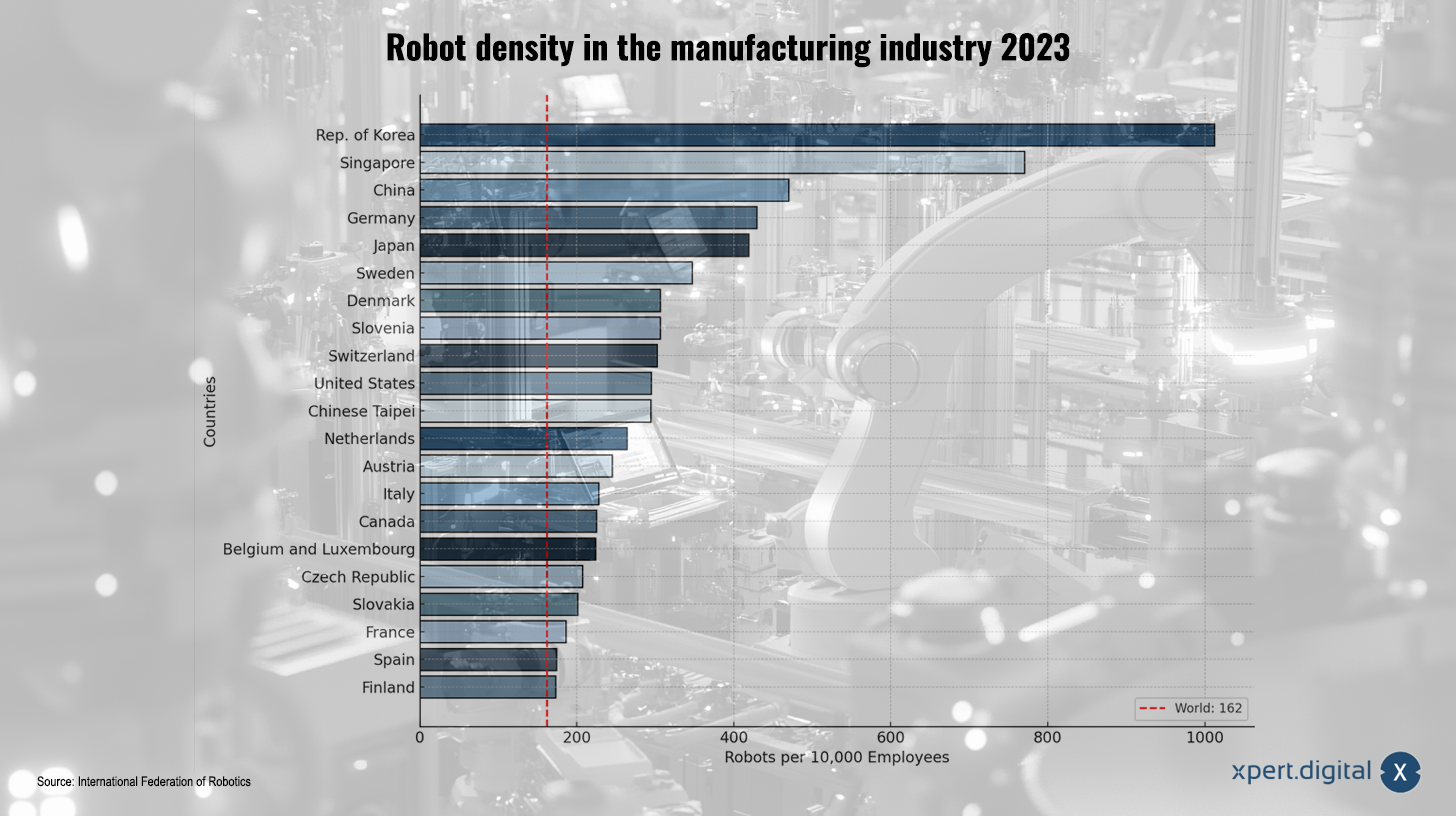
Robot density in the manufacturing industry in 2023 – Image: Xpert.Digital
Europe has long played a key role in robotics on an international scale – from research at leading institutions and the manufacturing capabilities of highly innovative companies to a vibrant start-up scene. Many European Union countries offer funding programs specifically focused on new technologies for industrial automation. At the same time, increasing demands for production quality and speed are driving companies to invest more heavily in robotics solutions.
"More and more European countries are recognizing the strategic importance of robotics for their economies," one could summarize, and accordingly, numerous initiatives and networks, operating both nationally and internationally, are searching for new solutions for a wide variety of industries. While Asia and North America were often considered pioneers in the past, Europe is now increasingly coming into focus when it comes to future-proof technologies.
Particularly noteworthy are several European companies that have managed to secure significant market shares despite intense global competition. These include established firms specializing in the production of industrial robots, as well as emerging players developing innovative service robots for everyday applications. One example is the acquisition of a European robotics division by a larger group, which expanded the range of humanoid and collaborative robots available in the region. Such mergers enhance competitiveness, strengthen innovation, and lead to an ever-increasing presence of "smart machines" in businesses and public spaces.
Growth opportunities in South America
Not only Europe, but also regions like South America are increasingly benefiting from the global wave of automation. Countries with a strong production and automation base, as well as an active assembly industry – Mexico above all – are coming into the spotlight. Through the establishment of a trade association focused on robotics, companies in this region have a solid platform for exchanging information on innovations and best practices. Given rising labor costs and the need for precise, safe manufacturing processes, industries there are also increasingly relying on robots, further stimulating global demand.
Major players in the robotics market
Although numerous small and medium-sized enterprises (SMEs) develop highly specialized robotics solutions, the global market is dominated by a few large players. These include companies with a long tradition in drive and automation technology, renowned worldwide. They focus on continuously expanding their customer base and utilize strategic partnerships to consolidate their market share and increase their profits.
Some of these companies specialize in supplying turnkey robotic systems for industrial applications. Others are increasingly focusing on service robots, for example in healthcare or the food service industry. One large robotics company recently unveiled its smallest industrial robot, suitable for delicate assembly work and particularly confined production environments. With such innovations, manufacturers are responding to the fact that electronics and other industries are producing increasingly intricate and complex products that demand millimeter-precise accuracy.
Different types of robots
Over time, a wide variety of robot types have evolved, differing in their design, application, and capabilities. Instead of a brief table, a closer look at the most important categories is worthwhile:
1. Industrial robots
These robots are traditionally used in manufacturing, performing tasks such as welding, painting, assembly, and material handling. They are often designed for high precision and speed. Modern industrial robots can now be equipped with advanced sensors to perceive their environment. This makes them significantly more flexible than their predecessors and allows them to be more easily adapted to new requirements and product variations.
2. Service robots
Service robots provide support in the service sector. In restaurants, they can serve food and drinks; in hotels, they could take over cleaning tasks; and in logistics, they assist with order picking and transport. Service robots are also increasingly found in healthcare, for example, as assistance systems for nursing staff. Through AI-powered speech recognition, gesture and facial expression processing, some service robots even become somewhat empathetic companions that, in some cases, can also perform social tasks.
3. Medical robots
In medicine, robots are used in surgical procedures, rehabilitation, and patient care. Surgical robots enable minimally invasive operations and, through highly precise movements, increase the success rate of complex procedures. Rehabilitation robots help patients regain mobility by monitoring and individually adjusting the healing process. As technology advances, the entire healthcare system will benefit from robots that relieve the burden on nursing staff and simultaneously enable higher quality care.
4. Autonomous Mobile Robots (AMR)
Autonomous mobile robots (AMRs) can navigate their environment independently using sensors and algorithms for navigation and obstacle detection. Unlike so-called driverless transport systems, AMRs do not follow a fixed route but plan their paths dynamically and adapt to changing conditions. In warehouses or production halls, they are able to autonomously transport goods between different stations. Thanks to artificial intelligence and machine learning, they are becoming increasingly flexible, enabling greater individualization and increased efficiency in logistics.
5. Driverless Transport Systems (AGVs)
Automated guided vehicles (AGVs) are suitable for clearly structured environments where they follow a defined route. While their movement patterns are more limited than those of automated guided vehicles (AGVs), their reliability makes them indispensable in many industrial sectors. They provide particularly valuable services where people and machines are separated, such as in automated high-bay warehouses.
6. Articulated robot
Articulated robots have multiple movable axes, allowing them a large range of motion and highly flexible handling. Typical applications are found in manufacturing and assembly, where diverse movement sequences are required, such as assembling electronic components or welding large metal parts. Thanks to advanced control technology, articulated robots can be very finely controlled and can exert precise forces.
7. Humanoid robots
Humanoid robots are designed to resemble humans in appearance and behavior. They often have two legs, two arms, and a head containing sensors, cameras, or microphones. These robots are used in various fields, including research, entertainment, and, in some cases, caregiving. They can serve as a platform for diverse AI experiments because their human-like anatomy and motor skills allow them to operate in human environments. Examples include humanoid robots that provide simple information or directions in department stores or at trade fairs.
8. Cobots (Collaborative Robots)
Collaborative robots are designed to work closely with humans without the need for extensive safety barriers. They are equipped with sensitive sensors that react instantly to resistance and can automatically stop upon contact to prevent injuries. Cobots are used in factories where humans and machines work hand in hand on a production line, for example, assembling parts that require precision, while humans make the more complex cognitive decisions.
9. Hybrid Systems
Hybrid robots combine several of these robot types in one system. An example would be an autonomous mobile robot with an integrated articulated arm that first moves independently within a production hall, then picks up or places components. Such multifunctional systems are gaining importance because they are particularly flexible and versatile.
Artificial intelligence as a key technology
AI gives robots the ability to adapt to changing environmental conditions, learn from experience, and make independent decisions. As a result, robots are increasingly becoming more than mere executing machines whose range of action is limited by fixed, programmed routines. AI algorithms enable them to handle complex tasks that were originally the domain of human cognitive abilities.
For navigation, many robots use methods such as machine vision, which allow them to recognize objects or people and adapt to the situation. In manufacturing plants, an AI-based robot can learn to grasp workpieces with increasing precision or adapt to new models without having to be completely reprogrammed. AI is also indispensable in robotics control: Deep neural networks can be used to generate complex movement patterns that are adapted to external influences in real time.
The diverse range of applications demonstrates that artificial intelligence gives robots a true "brain," thereby increasing not only their technical but also their economic significance many times over. However, this also makes it clear that robots and AI are closely intertwined, and it is therefore essential to consider both fields strategically together.
Related to this:
New skills through continuous learning
A significant advantage of AI-controlled robots lies in their learning ability. They can collect and analyze data from their environment and translate it into action strategies. This opens up numerous application possibilities that were previously unimaginable. In production, this means that robots can not only perform simple, repeatable tasks, but also learn in real time and adapt to new products, materials, or assembly steps.
Thanks to machine learning and reinforcement learning methods, a robot can, for example, recognize errors, optimize its movements, and benefit from each iteration to act faster and more precisely in the future. This continuous learning can also be simulated using digital twins, in which virtual robots are trained in a simulation environment before being deployed in the real production environment.
Impact on various industries
The increasing automation through robots has a tremendous impact on numerous industries. Robots have long been present in the manufacturing industry, particularly in automotive production, but increasingly sophisticated applications are now being added, for example in the fields of e-mobility and battery cell manufacturing. These areas require highly precise assembly and testing processes, which can be ideally implemented thanks to the high repeatability of robots.
In logistics, driverless transport systems and autonomous mobile robots are taking over warehouse tasks such as order picking, goods transport, and inventory management. This shortens delivery times, and companies can make just-in-time production more efficient. In healthcare, medical robots enable more precise procedures and relieve doctors of routine tasks, freeing up human resources for more intensive patient contact.
Service robots are trending in the hotel and restaurant industry. They serve meals, mix cocktails, or clean floors. It's not always just about pure efficiency: some guests also see these robots as an original attraction. In hospitals or nursing homes, service robots support staff, deliver medication or meals, measure vital signs, or assist patients with rehabilitation exercises.
Challenges and obstacles
Despite all the positive growth prospects, robotics companies and users face various challenges that need to be overcome:
Skilled worker shortage
The development, programming, and maintenance of robots require highly specialized personnel. A shortage of qualified professionals in these fields can slow growth. Companies and educational institutions must therefore invest in training and professional development to ensure a sufficient number of experts for the future.
Related to this:
High costs
Despite falling prices for certain components such as sensors and processors, the purchase and integration of robots remains costly for some companies. Added to this are the costs of retrofitting, software licenses, and potentially modifications to production halls. Small and medium-sized enterprises (SMEs) in particular must carefully consider when an investment in robotics will pay off.
Interoperability
Many companies have established, heterogeneous systems. Integrating new robots into existing production control and IT systems is a task that requires comprehensive planning and technical expertise. The respective communication protocols, controls, and interfaces must be compatible to ensure smooth operation.
Ethical and legal aspects
The use of AI-controlled robots raises numerous ethical questions. For example, who is liable if an autonomous machine causes damage? How are data protection and privacy safeguarded when robots collect and analyze data about their environment? Which tasks can be entrusted to robots at all, and which should remain in human hands to ensure empathy and social responsibility?
Acceptance in society
New technologies often provoke skepticism, especially when they intervene so profoundly in everyday life and work, as is the case with robotics. Employers, unions, associations, and political decision-makers must therefore work together to develop solutions that ensure the socially responsible use of robots and strengthen trust in these technologies.
Catalysts: AI, 5G and IoT
The increasing prevalence of high-speed networks like 5G and the Internet of Things (IoT) is opening up new dimensions for robotics. Robots can access cloud-based computing power in real time, analyze large amounts of data, and collaborate with other machines. In a networked factory, robots constantly exchange information about production processes, malfunctions, and maintenance intervals, making processes significantly more efficient and flexible.
The use of edge computing, where some data processing takes place directly at the point of action, also makes it easier for robots to react quickly and reliably to events. Especially in safety-critical areas, latency reduction through edge computing can be crucial, for example, when robots work directly alongside humans or navigate through confined spaces.
Ethical implications and social responsibility
The increasing use of robotics raises a number of ethical questions. In particular, concerns about jobs are a sensitive issue: How many manual tasks will be taken over by machines in the future, and in which areas will human workers still be needed? In the past, technological upheavals have often led to the development of new job profiles while old ones disappeared. Nevertheless, a high level of further education and retraining is needed so that people can continue to find meaningful and skilled employment in an automated world.
Another important point is data protection: Service robots with cameras and microphones can quickly intrude on personal spaces. Whether in nursing homes or private households – if robots collect data about health, habits, or conversations, it is essential to ensure that this sensitive information remains protected. Technologies such as anonymization and encryption play a central role in this.
Furthermore, the question of responsibility arises. If a robot makes decisions autonomously, who is liable if these decisions are incorrect and cause damage? Manufacturers, programmers, users, or even the robot itself? Since legal frameworks in many countries are not yet fully adapted to the new technological possibilities, action is needed. "Legislators and manufacturers are called upon to formulate and adhere to clear rules in order to prevent misuse and undesirable developments," one could demand.
The human factor
Despite all the automation, humans remain irreplaceable in many respects. Complex creativity, empathy, moral judgment, and the ability to react intuitively and appropriately in crisis situations are strengths that robots, as we currently understand them, cannot replicate to the same extent. The trend is toward closer collaboration between humans and machines: While robots fully leverage their strengths in precision and endurance, humans can contribute their problem-solving and communication skills.
One example of this is collaborative workstations in modern factories. There, cobots stand side-by-side with employees on an assembly line. The robot hands over parts, screws, or solders, while the human performs the more complex or creative steps. This close interaction, however, requires that the robots used are safe and intuitive to operate.
Related to this:
Outlook on future developments
Robotics is and will remain a dynamic field where much can change in a short time. Several trends are expected to gain importance in the coming years:
1. Further development of humanoid robots
The desire to make robots as human-like as possible is not just a gimmick for science fiction fans. Humanoid robots could work in environments designed for humans – without costly modifications. They could operate door handles, climb stairs, or use tools already designed for human ergonomics. The closer robotics gets to human anatomy, the greater its range of applications becomes, provided the technical hurdles of balance, energy supply, and control can be overcome.
2. Robotics in agriculture
Agriculture is also benefiting from increasingly intelligent robots. Whether it's automated sowing and harvesting, irrigation, weeding, or monitoring plant growth – the possibilities are manifold. Precision agriculture, in which drones and soil robots collect data and apply fertilizers or pesticides in a targeted manner, conserves resources and increases yields. This trend is likely to accelerate in the coming years, especially in regions where skilled field workers are scarce.
3. Robotics in nursing care
Given aging populations, the demand for assistive technologies in the care sector will increase. Robots can take over physically demanding tasks, such as lifting and repositioning patients. They can help people with disabilities manage their daily lives, whether by assisting with dressing or grasping objects. Furthermore, there could also be social robots that provide companionship to elderly people or remind them to take their medication.
4. Robotics and climate protection
Robots can be used in environmental protection projects, for example, for waste disposal in waterways or for monitoring nature reserves. Robots will also become increasingly important in the energy sector, for instance, for maintaining and monitoring solar or wind power plants. Since such plants are often installed in hard-to-reach locations, robots can carry out inspections and repairs more efficiently and safely.
5. Coordination and Standardization
For robots to interact seamlessly with other systems and with humans, standards and norms are needed to facilitate compatibility. Numerous organizations are working on guidelines for the safe and efficient use of robotics. In the future, even greater emphasis is expected on interoperability and ease of use to lower the barriers for companies entering the world of robotics.
6. Connection to quantum computing
In the more distant future, quantum computing could play a role in highly complex calculations and optimization tasks relevant to autonomous robots. The significantly faster processing of certain mathematical problems could enable the development of intelligent algorithms that facilitate movement sequences, environmental analysis, and resource planning at a new level of complexity. While quantum computing is still in its early stages, the robotics community is closely monitoring its progress.
Robotics is at a stage where economic opportunities and technological innovations go hand in hand
Driven by rapid growth and increasing demand for automation, robots are appearing in more and more industries, reliably performing their duties. Companies worldwide are responding to this development by making substantial investments in research and development.
At the same time, experts and policymakers agree that the rise of intelligent machines also raises social, ethical, and legal questions. Frameworks must be established to ensure a fair distribution of the benefits and mitigate disadvantages for the labor market and society. If this succeeds, robotics can make a significant contribution to creating more prosperity, automating dangerous or monotonous tasks, and placing people at the center of demanding and creative work.
Europe has the potential to take a leading role if it succeeds in fostering innovation while simultaneously prioritizing data protection and social responsibility. Initiatives jointly supported by public institutions and private companies can help ensure that research, development, and mass production go hand in hand.
While many industries are only now discovering the potential of using intelligent machines, others have already gained extensive experience with robotic solutions. In the future, we will likely see even more robots transforming our lives and work. Their ability to interact and collaborate with humans will continue to mature, enabling new work models where the strengths of humans and machines perfectly complement each other.
Robots could become an integral part of everyday life in the near future: whether they support the elderly, make cooking easier, or help in disaster areas. From automated delivery bots in major cities to high-tech assistants in hospitals and factories – one could emphatically say, "the future belongs to robotic helpers." The crucial point is to manage this transformation responsibly and make smart decisions to use the technology in a way that maximizes its benefits.
In light of these developments, it remains to be seen whether the considerable growth potential will actually be fully realized. However, unlike some past technological hype, there are many indications that robotics and AI have long since arrived in the real world and are delivering tangible added value. The increasing speed, precision, and learning capabilities of robots are creating a solid foundation that extends far beyond mere experimental fields.
Looking ahead to the next few years, we can expect new generations of robots to enter the market, featuring improved sensors, refined AI algorithms, and greater adaptability. These will be complemented by collaborative approaches where humans will continue to play a crucial role. The question is less whether robots will be integrated into everyday life, but rather how quickly and to what extent this will happen.
Robotics offers tremendous opportunities: it can help manufacture urgently needed products more efficiently, alleviate the shortage of skilled workers, and make life easier in many areas. At the same time, potential risks must not be ignored and must be actively addressed. Responsible policy, forward-looking regulation, and open public debate are essential to ensure that development proceeds in a direction that benefits everyone.
Ultimately, it's becoming clear that intelligent machines are poised to conquer the entire globe. Whether the market volume will actually reach or even exceed the projected billions in the coming years remains to be seen. However, the signs point to robotics being one of the key technologies of the 21st century. Those who invest in this future today and have the courage to invest in research, development, and training in a timely manner will reap the benefits tomorrow. And it is precisely at this intersection of economic opportunity and social responsibility that the key lies to harnessing the enormous potential of robots in a meaningful and sustainable way.
Related to this: