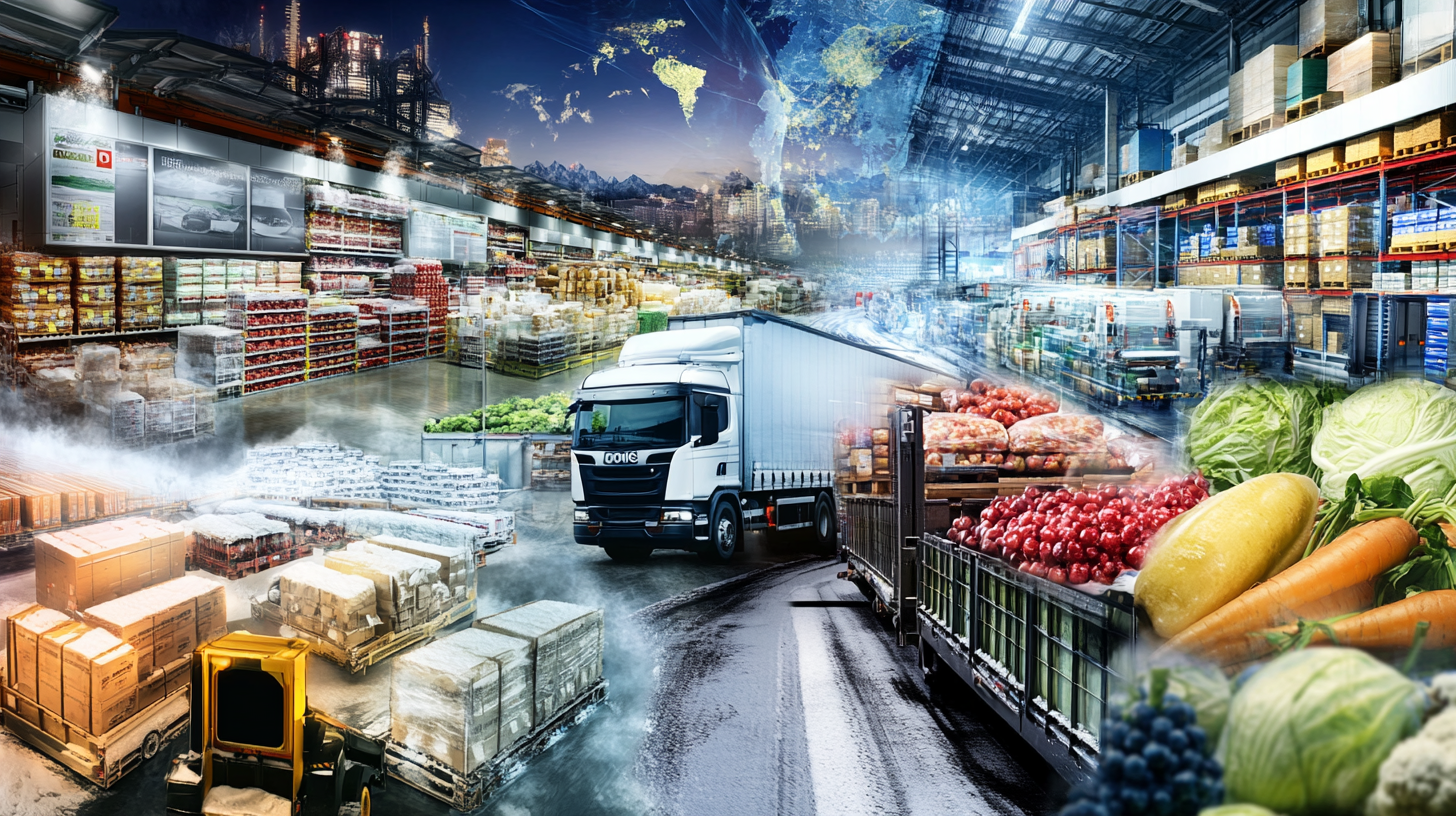
Fresh produce and refrigerated logistics worldwide: Inadequate cold chains contribute significantly to the loss of perishable goods globally – Image: Xpert.Digital
❄️🍎🌱 Fresh and chilled food: A global challenge
🌍❄️ Introduction: The central role of the cold chain
Fresh and chilled foods are among the most perishable goods on the global market. A functioning cold chain is crucial to guaranteeing their quality, safety, and shelf life. A cold chain encompasses all stages from harvesting or production through processing, transport, and storage to the point of sale and ultimately to the end consumer. If this chain is disrupted, for example, due to inadequate refrigeration, fluctuating temperatures, or a lack of infrastructure, it leads to significant losses of perishable goods. This issue is not only an economic one but also has far-reaching consequences for food security, the environment, and social development. Current estimates indicate that around 14% of food worldwide is lost between harvest and retail due to inadequate cold chains. These annual losses amount to approximately 526 million tons, a figure that clearly demonstrates the immense need for action.
🌟 Causes: Why cold chains fail
The reasons for these problems are manifold. Many countries lack basic infrastructure, such as a constant supply of electricity to reliably operate cold storage facilities or refrigerated transport vehicles. The training of personnel who carefully handle sensitive products and monitor compliance with temperature-controlled storage processes is also often inadequate. Logistical bottlenecks, long transport routes, poor road conditions, a lack of refrigerated containers, and a lack of understanding of the importance of unbroken cold chains exacerbate the problem. Developing countries are particularly affected, where promising agricultural harvests cannot reach their full potential because fruits, vegetables, fish, meat, or dairy products spoil on their way to market before they even reach retailers. This results not only in financial losses for producers but also in a reduction of the available food supply for the population.
🌍 Impact: A global problem
The effects are clearly felt globally: When up to 40% of perishable goods are lost in developing countries due to a lack of refrigeration, this has long-term consequences for the food security of millions of people. In Africa, for example, many countries face precisely this problem. Smallholder farmers, already struggling with limited resources and volatile market prices, lose valuable produce before it can even be sold. When perishable goods such as vegetables, dairy products, or meat cannot be refrigerated, their quality deteriorates rapidly, and potential sources of income dwindle. The result is not only economic damage but also an obstacle to the development of the local agricultural sector and thus to the rural value chain. In the long term, economic growth falls short of its potential, and the food situation worsens as less fresh, nutrient-rich food becomes available.
🛠️ Focus regions: Practical examples
- Nigeria: Significant amounts of food are lost annually due to a lack of cold chain logistics. This is due, among other things, to insufficient electricity supply, a lack of storage and refrigeration facilities, and inadequate training.
- India: Between 20 and 50% of perishable food is wasted due to inadequate infrastructure – with enormous economic consequences.
- China: Despite large production volumes, the transport of perishable goods often fails due to a lack of refrigeration facilities.
- Latin America: In countries like Colombia, suitable storage and transport conditions are often lacking after the harvest.
🌱 The meaning: Sustainability and efficiency
The consequences of these global losses are far-reaching. On the one hand, they mean significant economic damage for producers, retailers, and ultimately consumers. Rising food costs, because less produce reaches store shelves, hit poorer segments of the population particularly hard. On the other hand, the losses also have a negative impact on the environment. Every ton of wasted food not only represents wasted resources—water, energy, land—but also increases the emission of climate-damaging greenhouse gases, since spoiled food often ends up in the trash and releases methane during the decomposition process, a gas that is significantly more harmful to the climate than CO₂.
🌟 Solutions: Ways out of the cold chain crisis
To address these challenges, investments in infrastructure, technology, training, and knowledge transfer are essential. Many approaches aim to provide rural regions with the necessary tools to better protect their harvests. Expanding storage and cold storage facilities, implementing modern cold chain logistics, providing mobile refrigerated containers for transport, and training farmers, traders, and logistics personnel are crucial steps.
Technological advances, such as modern sensors that monitor the temperature of goods in real time and new cooling technologies using natural refrigerants, help to minimize losses and improve the environmental footprint. Additionally, smart packaging that indicates the ripeness of food could represent a further step towards sustainability.
More information here:
🌍 Strengthening cold chains worldwide
In the long term, a stable and efficient cold chain is far more than a technical challenge. It is a crucial factor in strengthening food security, making better use of global food production, promoting economic prosperity, especially in rural areas, and reducing the ecological footprint of the agricultural and food sector.
The world's population is growing, and with it, the demands for a stable supply of fresh, nutrient-rich food are increasing. A sustainable food supply cannot be achieved solely through increased agricultural yields. Reducing losses also plays a crucial role. The goal is to make better use of the potential of existing resources.
🔑 Together for a better future
This demonstrates the immense importance of functioning cold chains: they are a key component in reducing global food waste, a crucial element in meeting the increasing demand for safe and high-quality food, and ultimately an indispensable contribution to improving the global food situation.
The problems and solutions presented illustrate that there is no simple, one-size-fits-all solution. The challenges must be considered holistically: in addition to technical infrastructure, stable political frameworks, investments in research and development, and economic incentives are needed to make the establishment of efficient cold chains more attractive.
Only through joint efforts and a global shift in thinking will it be possible to minimize the unnecessary loss of perishable goods. 🌿💡
📣 Similar topics
- 🥶 The importance of the cold chain: A key to global food security
- 🌍 Cold chains in developing countries: Challenges and solutions
- 🚛 From harvest to consumer: Why an unbroken cold chain is crucial
- ❄️ How technology can revolutionize cold chain logistics
- 📉 Food losses worldwide: Why lack of refrigeration costs billions
- ⚠️ Cold chain broken: The economic, social and environmental consequences
- 🇳🇬 Case study Nigeria: Reasons for high food losses and possible measures
- 🍎 Europe's food waste: Even highly developed regions are affected
- 🌱 Sustainable cold chains: A path to less waste and more efficiency
- 🎯 Global cooperation to reduce food supply losses
#️⃣ Hashtags: #ColdChain #FoodLoss #Sustainability #FoodSecurity #Technology

Expert partner in warehouse planning and construction



Xpert.Plus Warehouse Optimization - High-bay warehouses and pallet warehouses: Consulting and planning
We are here for you - Consulting - Planning - Implementation - Project Management
☑️ SME support in strategy, consulting, planning and implementation
☑️ Creation or realignment of the digital strategy and digitization
☑️ Expansion and optimization of international sales processes
☑️ Global & Digital B2B trading platforms
☑️ Pioneer Business Development

Konrad Wolfenstein
I would be happy to serve as your personal advisor.
You can contact me by filling out the contact form below or simply call me on +49 7348 4088 965 .
I'm looking forward to our joint project.
Write to me



Xpert.Digital - Konrad Wolfenstein
Xpert.Digital is a hub for industry focusing on digitalization, mechanical engineering, logistics/intralogistics and photovoltaics.
With our 360° Business Development solution, we support renowned companies from new business to after-sales.
Market intelligence, smarketing, marketing automation, content development, PR, mail campaigns, personalized social media and lead nurturing are part of our digital tools.
You can find more information at: www.xpert.digital - www.xpert.solar - www.xpert.plus
Keep in touch