
Typically German: Cowardice, morality, or ideology? Why we import skilled workers instead of fixing the system – Image: Xpert.Digital
Import instead of repair: Why a country prefers to import skilled workers from abroad rather than repair its own system
The sacred cows of the German labor market: Which reforms could truly solve the skills shortage?
Germany maintains a historically developed web of tax, social security, and pension laws that, in their overall effect, functions like a sophisticated deterrent system against employment. Joint taxation of married couples penalizes the second-earning partner taking up employment. Early retirement without deductions withdraws hundreds of thousands of experienced professionals from the labor market every year. Free co-insurance in statutory health insurance rewards inactivity. And the mini-job system keeps millions of people trapped in a form of employment that contributes neither to retirement savings nor to securing skilled workers. Each of these regulations has historical roots and a political lobby. Together, they form the core of the German labor market paradox: a country that laments a shortage of skilled workers while simultaneously systematically keeping millions of able-bodied individuals out of the labor market.
Related to this:


Sacred cow number one: Joint taxation of married couples
Joint taxation of married couples is the most economically powerful instrument for discouraging women from working in Germany. Introduced in 1958, it is based on a family model that assumes a single earner. Its mechanism is simple, but its effects are devastating: the taxable income of both spouses is halved, the tax calculated on that amount is then doubled. The greater the income disparity between the partners, the greater the tax advantage, reaching a maximum of approximately €15,000 per year for a taxable household income exceeding €500,000.
The problem lies in the marginal tax rate of the second-earning partner. If the wife of a high-earning man takes up employment, her income is effectively taxed at the highest marginal tax rate of their combined income. Every additional euro earned is taxed so heavily that working more hours is hardly worthwhile. For many married women, the effective marginal tax rate on additional income is so high that taking on a part-time or full-time job yields virtually no benefit after taxes, social security contributions, and childcare costs.
The figures from the research institutes are unequivocal. The RWI Leibniz Institute for Economic Research has calculated in a comprehensive simulation that abolishing joint taxation of married couples in favor of individual taxation could free up more than half a million additional full-time workers for the labor market. This would increase the gross domestic product by up to 1.5 percent. The DIW Berlin arrives at a similar result in its own calculations: the labor force participation of married women would increase noticeably if individual taxation were introduced. The Berlin Chamber of Industry and Commerce (IHK Berlin) puts it succinctly: 70 percent of Berlin companies see the shortage of skilled workers as their greatest business risk, and the tax treatment of married couples means that for many women, taking up employment simply isn't financially viable.
From a constitutional perspective, a reform would certainly be possible. While the Federal Constitutional Court declared joint tax assessment with its tax disadvantages for married couples unconstitutional in 1958, it did not necessarily derive a mandatory income splitting system for married couples from this ruling. Several constitutionally compliant reform options exist, ranging from a gradual transition to individual taxation with grandfathering provisions for existing marriages to a real splitting system that simply transfers the basic tax allowance to both partners. A complete abolition would be constitutionally problematic, but a gradual restructuring is legally feasible and recommended by a broad spectrum of economic research.
What the reform would mean in practice: Over 500,000 additional full-time workers roughly correspond to the entire workforce needs of the German IT sector. It's the equivalent of a medium-sized city suddenly becoming productive. And these workers are already in the country, already qualified, and don't need to be integrated, given language training, or recruited.
Sacred cow number two: Early retirement without deductions
The so-called "pension at 63," more accurately the old-age pension for those with particularly long contribution periods, was introduced in 2014 by the Grand Coalition and is considered one of the most expensive labor market policy missteps in recent German history. Anyone who has paid into the pension fund for at least 45 years can retire before the regular retirement age without any deductions. The entry age is being gradually raised from 63 to 65; for those born in 1964 or later, it is 65.
The figures speak for themselves. Since the regulation came into effect, around 735,000 employees have made use of it, and the regulation continues to be very popular; almost a third of all new retirees take this route. Last year alone, early retirement at 63 removed more than 200,000 workers from the labor market, disproportionately in sectors where the shortage of skilled labor is particularly acute: industry, skilled trades, and technical professions.
A study by the Prognos Institute, commissioned by the INSM, has calculated that without the early retirement age of 63, the skilled worker shortage in Germany would be 10 to 20 percent smaller. While this may sound like a moderate effect, in absolute terms it means that around 180,000 additional workers would be available to the labor market each year. Over a ten-year period, this adds up to a figure that could exceed the total annual migration demand.
The fiscal consequences are equally dramatic. By 2035 alone, contributors will have to raise almost €140 billion in additional contributions. As a result, pension insurance contribution rates will rise faster than necessary. At the same time, the pension level will fall because early retirees pay less into the system and draw from it for a longer period. Abolishing the system could relieve contributors of around €8 billion in the first year alone.
The distributional effect is particularly cynical. Early retirement without deductions does not primarily benefit those who have performed the most physically demanding work. According to the German Institute for Economic Research (DIW Berlin), almost 70 percent of West German men born in 1957 who take advantage of the scheme did not work in particularly strenuous professions. It is primarily highly skilled workers and white-collar employees who are opting for early retirement – precisely the group that is most urgently needed. Among STEM (science, technology, engineering, and mathematics) skilled workers, the number of employees over 63 has fallen by 8.5 percent since the introduction of early retirement at 63.
The Swedish model demonstrates that reform is possible. Sweden has a flexible retirement age between 63 and 67, with earlier retirement resulting in reductions and later retirement incurring bonuses. On average, Swedes retire two years later than Germans, and the system is protected against demographic risks by automatic stabilization mechanisms. Converting the German system to a similar model would preserve individual choice while eliminating the economically irrational incentives for early retirement.
🎯🎯🎯 Benefit from Xpert.Digital's extensive, five-fold expertise in one comprehensive service package | BD, R&D, XR, PR & Digital Visibility Optimization

Benefit from Xpert.Digital's extensive, five-fold expertise in a comprehensive service package | R&D, XR, PR & Digital Visibility Optimization - Image: Xpert.Digital
Xpert.Digital possesses in-depth knowledge across various industries. This allows us to develop tailored strategies precisely aligned with the requirements and challenges of your specific market segment. By continuously analyzing market trends and monitoring industry developments, we can act proactively and offer innovative solutions. The combination of experience and expertise generates added value and provides our clients with a decisive competitive advantage.
More information here:
Skilled worker shortage: Germany's 5-million-person solution that nobody uses
Sacred cow number three: The free co-insurance
For decades, spouses without their own income or with only a low income have been able to be covered free of charge under the statutory health insurance scheme. This family insurance currently affects nearly 2.5 million spouses, predominantly women. The regulation creates a strong disincentive to work: those who are covered free of charge lose this benefit upon taking up employment subject to social security contributions. A mid-level job just above the current mini-job threshold of €603 would trigger social security contributions that would negate the net benefit of the co-insurance.
At the end of October 2025, the Confederation of German Employers' Associations (BDA) presented a position paper calling for the abolition of free co-insurance for a spouse. Uninsured spouses would be required to pay a minimum contribution of approximately €220 per month. The BDA anticipates additional revenue of €2.8 billion annually for health insurance funds. Federal Health Minister Nina Warken has taken up the proposal and officially questioned family insurance, a remarkable step for a CDU politician. She described such a reform as a "paradigm shift" that must be implemented in a "socially responsible" manner.
The economic logic is compelling: if co-insured spouses had to pay their own contributions, taking up employment subject to social security contributions would suddenly become highly worthwhile, because the costs of co-insurance would be incurred anyway and could be more than offset by earned income. Combined with a reform of the joint tax assessment for married couples, the effect on female employment would be massive.
Related to this:


Sacred cow number four: The mini-job system
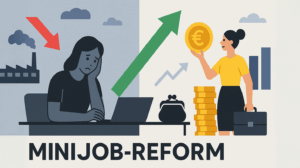
The earnings limit for mini-jobs has been €603 per month since January 2026 and increases automatically with the minimum wage. Around seven million mini-jobs exist in Germany, of which 2.6 million women are employed exclusively in a mini-job, meaning they have no other job subject to social security contributions. Mini-jobbers accrue no or only minimal independent pension entitlements, no unemployment insurance entitlements, and no independent health insurance. The mini-job system is effectively a subsidized dead end that keeps millions of people, especially women, in precarious employment.
For years, the German Trade Union Confederation (DGB) has been calling for the conversion of mini-jobs into jobs subject to social security contributions from the very first hour of work. Coupled with improved opportunities to return from part-time to full-time work, a significant proportion of women in mini-jobs could transition into regular employment. The IAW study, commissioned by the Foundation for Family Businesses, estimates the potential for up to 2.9 million additional full-time equivalent positions if all barriers to part-time and mini-jobs for women were removed.
The reform of mini-jobs is closely linked to the other reform components. Only when joint taxation of married couples no longer penalizes taking on additional work, when co-insurance no longer rewards remaining unemployed, and when sufficient childcare is available, will women in mini-jobs make the transition to regular employment. Viewed in isolation, none of the reforms will achieve its full effect. However, in combination, they would unleash a dynamic that could fundamentally transform the labor market.
Related to this:
Sacred cow number five: The lack of childcare infrastructure
All the aforementioned reforms are ineffective if women want to work and it is financially worthwhile, but no one is available to care for their children. Germany has a legal entitlement to a childcare place, but cannot guarantee it nationwide. The Federal Ministry for Family Affairs quantifies the potential: If currently unemployed mothers with children under six years old were to return to the labor market, at least part-time, according to their desired work schedule, approximately 840,000 more people would be available. In addition, around 71,000 full-time equivalent positions would be created by employed mothers with children under 18 who wish to increase their working hours.
The problem is circular: expanding childcare places requires childcare workers. But the childcare profession itself suffers from a massive shortage of qualified staff, a lack of career opportunities, and insufficient recognition. The solution lies in a substantial upgrade of the profession, better pay, shorter training programs with remuneration, and a societal re-evaluation of care work. All of this costs money, but these investments will pay for themselves many times over in the national economy: through higher tax revenues from mothers' employment, lower social welfare expenditures, and, in the long term, better educational outcomes for children.
What happens if you pull all the levers at once?
The crucial question is not whether the individual reforms are effective, as this has been empirically proven. The question is what happens when they are considered as a whole. The individual effects don't just add up; they reinforce each other.
Specifically, the potential of the individual reform components can be summarized as follows: Reforming the joint taxation of married couples would create over 500,000 additional full-time jobs. Abolishing early retirement without deductions would keep approximately 180,000 to 200,000 experienced professionals in the labor market longer each year. Reforming the non-contributory co-insurance would bring some of the 2.5 million co-insured spouses into employment. Restructuring the mini-job system could transition a significant portion of the 2.6 million women currently employed exclusively in marginal employment into regular jobs. And expanding childcare could mobilize up to 840,000 mothers for the labor market.
In total, and taking into account overlaps—since many women are affected by several of these barriers simultaneously—this results in a realistic overall potential of 1.5 to 2.5 million additional full-time equivalents. Combined with better integration of older unemployed people, the training of low-skilled workers, and the productivity effects of AI, Germany could close the majority of its demographic gap on its own, without having to poach large numbers of skilled workers from countries that themselves urgently need them.
Related to this:

Why it still doesn't happen
The resistance to reform is not based on economic factors, but rather on political and cultural ones. Joint taxation of married couples is seen as a protection of marriage and is considered a fundamental right by conservative voters. Early retirement without deductions is an achievement of the trade unions and the Social Democratic Party (SPD), which no party dependent on employee votes wants to challenge. Free co-insurance is interpreted as a solidarity benefit, although it is in fact a subsidy for non-employment. The mini-job system benefits from a powerful lobby in the hospitality and service sectors that values cheap labor. And the expansion of childcare facilities is hampered by federal jurisdiction, municipal budget constraints, and a shortage of childcare workers.
The result is a country that prefers to recruit caregivers from the Philippines and IT specialists from India rather than reform its own tax and social security systems so that the millions of people already willing to work can actually do so. The irony is that the costs of not reforming, measured in lost economic output, higher social welfare payments, and increased migration pressure, far outweigh the political costs of reform. But in a system that thinks in terms of legislative terms, short-term votes are more valuable than long-term prosperity.
The question, therefore, is not whether these reforms would make economic sense. That is beyond doubt. The question is whether Germany will summon the political courage to tackle its sacred cows before demographics force a decision and the range of choices is significantly smaller than it is today.
Your global marketing and business development partner
☑️ Our business language is English or German
☑️ NEW: Correspondence in your native language!

Konrad Wolfenstein
I and my team are happy to be available to you as your personal advisor.
You can contact me by filling out the contact form here wolfenstein@xpert.digital:or simply call me at +49 7348 4088 965. My email address is
I'm looking forward to our joint project.
☑️ SME support in strategy, consulting, planning and implementation
☑️ Creation or realignment of the digital strategy and digitization
☑️ Expansion and optimization of international sales processes
☑️ Global & Digital B2B trading platforms
☑️ Pioneer Business Development / Marketing / PR / Trade Fairs
Our EU and German expertise in business development, sales and marketing
Our EU and German expertise in business development, sales and marketing - Image: Xpert.Digital
Industry focus areas: B2B, digitalization (from AI to XR), mechanical engineering, logistics, renewable energies and industry
More information here:
A thematic hub offering insights and expertise:
- Knowledge platform covering global and regional economies, innovation and industry-specific trends
- A collection of analyses, insights, and background information from our key areas of focus
- A place for expertise and information on current developments in business and technology
- A hub for companies seeking information on markets, digitalization, and industry innovations