
Innovative marketing after the AI shock: Strategies for success – Creative image on the topic, with AI: Xpert.Digital
From campaign funnel to learning system: The role of AI in marketing
The future of marketing: AI as the key to efficient value creation
Successful Marketing Strategies: How AI is Redefining Competition
The marketing landscape is currently undergoing a profound transformation, significantly shaped by the influence of artificial intelligence (AI). What was perceived just a few years ago as simple text generation has now evolved into a complex organizational operating system that redefines all aspects of marketing. Companies that merely use AI as a content creation tool risk falling behind the competition because they fail to adapt to the changing demands of the markets. The key to success lies not only in the application of advanced technologies but also in the ability to integrate them across the entire value chain.
The new era of marketing demands a paradigm shift: instead of linear processes, dynamic, learning systems are needed that can react quickly to market changes. Companies that can implement AI effectively benefit from increased efficiency and improved customer loyalty. These changes not only challenge traditional structures but also open up new opportunities for innovation and growth. In this analysis, we examine the fundamental changes and the strategies that companies must pursue today to succeed in the digital age.
Marketing after the AI shock: How intelligent systems are redistributing value creation
Those who use AI only as a text generator automate mediocrity – and lose out to organizations that are rebuilding their marketing
The structural break has long since begun
Artificial intelligence is transforming marketing not just through new tools. It's having a profound impact: on responsibilities, cost structures, value creation, business models, media markets, and the relationship between companies and customers. What initially seemed like a faster form of text creation is evolving into a new organizational operating system. AI can capture market signals, model target groups, generate content, test variations, reallocate budgets, optimize campaigns, and analyze results. In doing so, it connects work processes that were previously distributed across market research, strategy, creative, media, sales, IT, and external agencies.
The economic significance therefore lies less in individual, spectacular applications than in the consolidation of the entire marketing chain. A company that merely generates ad creatives or blog posts can, at best, reduce local production costs. A company that connects data, processes, content, media management, and sales signals into a learning system, on the other hand, transforms its responsiveness and marginal costs. Every additional campaign variation, language, or target group becomes more cost-effective. Insights from ongoing activities are incorporated more quickly into the next decision. Periodic campaign planning gives rise to a continuous optimization process.
The widespread adoption of AI should not be confused with economic maturity. In European surveys, around 85 percent of companies were already using AI tools for marketing purposes in 2025. At the same time, less than half had developed specific internal guidelines for AI in marketing. In an international study, only about 20 percent had deeply integrated AI into their marketing processes. Another industry study showed that only 30 percent had fully integrated AI across the entire lifecycle of media campaigns. The gap between usage and integration is the crucial point: Many organizations have access to powerful models, but not yet the data architecture, roles, quality controls, and management logic that will generate sustained economic value.
Marketing innovators don't simply act faster. They restructure work. They decide which tasks can be standardized, where human judgment remains indispensable, and how insights from data are translated into concrete market activity. Their advantage doesn't primarily stem from the best language model, but from the ability to integrate technology into a consistent system of market understanding, brand, sales, and measurement.
From campaign funnel to learning market system
Traditional marketing was largely linear. Market research provided insights, strategists developed positioning, creative teams produced content, media departments bought reach, and analysts evaluated the results after a campaign's completion. Between these stages lay handoffs, approvals, data gaps, and waiting periods. The economic logic was project-based: a briefing led to a campaign, the campaign to a report, and the report, ideally, to an improved next round.
AI is gradually dissolving this linearity. Modern systems can continuously process market information, customer reactions, search behavior, sales data, and campaign results. This generates dynamic segments and hypotheses that are immediately translated into new messages or offers. The impact of these variations can be automatically measured and fed back into further decisions. Planning, production, activation, and analysis are becoming more contiguous. Marketing is thus transforming from a series of completed projects into a learning market system.
This shift shifts the bottleneck. Previously, production capacity, analysis time, and media buying limited the number of possible experiments. Today, models can generate hundreds of variations and analyze vast amounts of data within a short time. The bottleneck increasingly lies in the quality of the source data, the clarity of strategic guidelines, and the ability to formulate meaningful questions. If positioning, target customer definition, or value proposition are vague, AI scales not the quality, but the ambiguity.
Economically, this leads to lower variable costs for many operational services, while the value of effective management increases. Creating an initial draft, adapting a theme, or translating into additional languages becomes less expensive. At the same time, brand management, data modeling, process design, functional validation, and the selection of relevant business cases become more valuable. Value creation shifts from individual execution to the architecture of the system.
What marketing innovators are doing differently today
Leading users don't start by asking which tool to buy. They start by asking where in their value chain time, quality, or revenue is being lost. From this perspective, AI is not an end in itself, but a tool for eliminating specific inefficiencies. Typical areas of inefficiencies include slow market analysis, disconnected customer data, high production costs, insufficient personalization, inefficient media budgets, or inadequate knowledge transfer between marketing and sales.
A second difference lies in the end-to-end perspective. While average users accelerate individual tasks, innovators connect multiple stages. For example, market research identifies a new customer question. The system assigns it to a target group, suggests a professional answer, creates suitable formats, distributes them via relevant channels, and passes on recognizable buying signals to sales. The economic benefit arises not from an isolated step, but from the shortened path between signal and response.
Third, advanced companies no longer treat content as one-off products, but as modular assets. Product knowledge, expert opinions, case studies, performance characteristics, and evidence are stored in a structured manner and enriched with metadata. AI can then assemble target group-, channel-, and language-specific versions from this material without having to start from scratch each time. This reduces costs, improves consistency, and mitigates the risk of fabricated claims.
Fourth, innovators consciously distinguish between automation and delegation. A machine can create a design, suggest priorities, or detect anomalies. However, the responsibility for positioning, legal approval, sensitive statements, and strategic consequences clearly remains with humans. Good organizations define escalation paths, quality criteria, and decision thresholds. They automate what is stable and verifiable and retain human oversight where context, reputation, or high financial risks are involved.
Ultimately, they don't just measure the quantity produced. More texts, ads, or videos don't guarantee reliable business success. What matters are faster learning cycles, lower acquisition costs, higher conversion rates, better customer loyalty, and additional contribution margin. This perspective protects against a common mistake of the first wave of AI: confusing productivity with effectiveness.
The applications that are already economically viable
One of the most robust applications is supporting content production. Generative systems shorten the time required for research, structuring, initial drafts, variant creation, translation, and format adaptation. In controlled trials, humans needed several hours for individual marketing emails, while AI-supported processes generated usable versions in minutes. Consumers rated the results in certain tests similarly to professionally written content. The economic advantage is obvious, but only with clearly defined formats, good specifications, and reliable review.
The benefits are particularly pronounced for recurring, highly varied tasks. Product descriptions, email sequences, social media adaptations, ad variations, internal summaries, and localized versions can all be efficiently supported. The advantage increases with the number of versions required. Where previously only a few variations were created for cost reasons, today it is possible to systematically differentiate by segment, industry, region, language, or stage of the customer journey.
A second promising area is campaign optimization. Predictive models have been used for years for bidding, audience selection, and budget management. Generative systems complement this approach by dynamically generating and adapting creative elements. In video marketing, around half of the surveyed advertisers were already using generative AI by 2025; 86 percent were using it or planning to implement it. By 2026, buyers expected that around 40 percent of video ads would contain AI-generated creative components. This not only reduces production costs but also allows creative variations to be more closely linked to delivery, context, and target audience.
A third area of application is data analytics. AI can condense large amounts of unstructured information: open customer responses, sales notes, service requests, competitor communications, market reports, or meeting minutes. This allows for the identification of recurring objections, emerging issues, changing needs, and potential risks. This is particularly relevant for B2B companies because crucial information is often not contained in clearly structured datasets, but rather in documents, emails, and conversations.
A fourth area is sales support. Systems can prioritize customer accounts, prepare research, summarize conversation content, create personalized contact drafts, and suggest next steps. The greatest benefit doesn't come from fully automated mass outreach. This often only increases the volume of irrelevant messages. More valuable is the combination of machine-based preparation and human relationship building. It gives sales representatives more time for conversations, negotiation, and building trust.
A fifth area is real-time personalization. In a large-scale survey, around 71 percent of consumers expressed a desire for personalized offers and proactive support, while only 34 percent of brands actually provided this. This gap highlights significant potential, but also the difficulty of implementation. Personalization only works when data from marketing, sales, service, and transactions are combined. Without this foundation, AI produces superficially personalized messages that may adjust names and formats, but fail to understand the actual needs.
Where the promised benefits are overestimated
The most visible weakness lies in the mass production of interchangeable content. When many companies use the same models, similar inputs, and comparable data sources, language, visual style, and argumentation become more similar. Costs decrease, but so does differentiation. A company can then publish more without becoming more relevant. The market is flooded with formally correct but substantively thin material.
Even fully automated creative processes remain problematic. In a large study, 48 percent frequently used generative AI for limited tasks such as drafting copy or slogans, but only 9 percent had integrated AI across the entire creative workflow. This is understandable. Creativity in marketing isn't just about generating variations. It encompasses cultural understanding, timing, deliberate rule-breaking, brand intuition, and the ability to adopt a surprising perspective. Models can generate combinations at high speed, but they don't automatically assume the entrepreneurial responsibility for bold positioning.
Another overrated area is fully automated customer communication. Chatbots and agents can efficiently answer standard questions. However, with complex products, complaints, contract issues, or B2B solutions requiring explanation, a seemingly competent but incorrect answer can cause significant damage. The higher the order value and the longer the customer relationship, the more important transparency, traceability, and human escalation become.
Another problematic assumption is that efficiency gains automatically translate into improved company results. While international surveys often show cost and revenue advantages at the level of individual use cases, the measurable effect on overall operating profit remains small for many organizations. In 2025, only 39 percent of the surveyed companies reported any impact of AI on earnings before interest and taxes; for most, the attributed share was less than 5 percent. This is not evidence against AI, but rather against an overly simplistic assumption about its effects. Time saved only has financial value when capacities are actually used differently, external costs are reduced, lead times are shortened, or additional revenue is generated.
The creators behind effective AI are not prompt specialists
Successful applications rarely emerge from a single role. Instead, they are the result of a collaborative effort involving experts who combine market knowledge, data expertise, technology, creative input, legal knowledge, and operational implementation. The key drivers are not necessarily those who formulate the most impressive proposals. More important are individuals who understand processes, evaluate data sources, define quality standards, and can demonstrate economic impact.
Product ownership plays a central role. It defines the problem to be solved, the affected users, and how success will be measured. Data owners are also needed to ensure the origin, accuracy, permissions, and quality of the information. Technology and automation specialists integrate models with existing systems. Brand and subject matter experts define the tone, argumentation, and boundaries. Legal, data protection, and information security experts assess whether the solution is regulatory and organizationally sound.
In smaller companies, several of these tasks can be handled by one person or an external partner. The functions themselves don't disappear as a result. Small and medium-sized enterprises (SMEs) in particular often don't need a large, in-house AI department, but they do need a clear responsibility architecture. External support is beneficial when it not only provides a tool but also contributes knowledge about the industry, processes, content, and market access.
The biggest organizational mistake is placing AI solely within IT or solely within marketing. A purely technical approach underestimates brand, customer context, and communication. A purely marketing-driven implementation underestimates data integration, security, and maintenance. The economic value arises at the interface. Therefore, roles that translate between business departments and technology while simultaneously taking responsibility for results will become increasingly important.
🎯🎯🎯 Data-driven B2B industry hub as a quasi-in-house solution

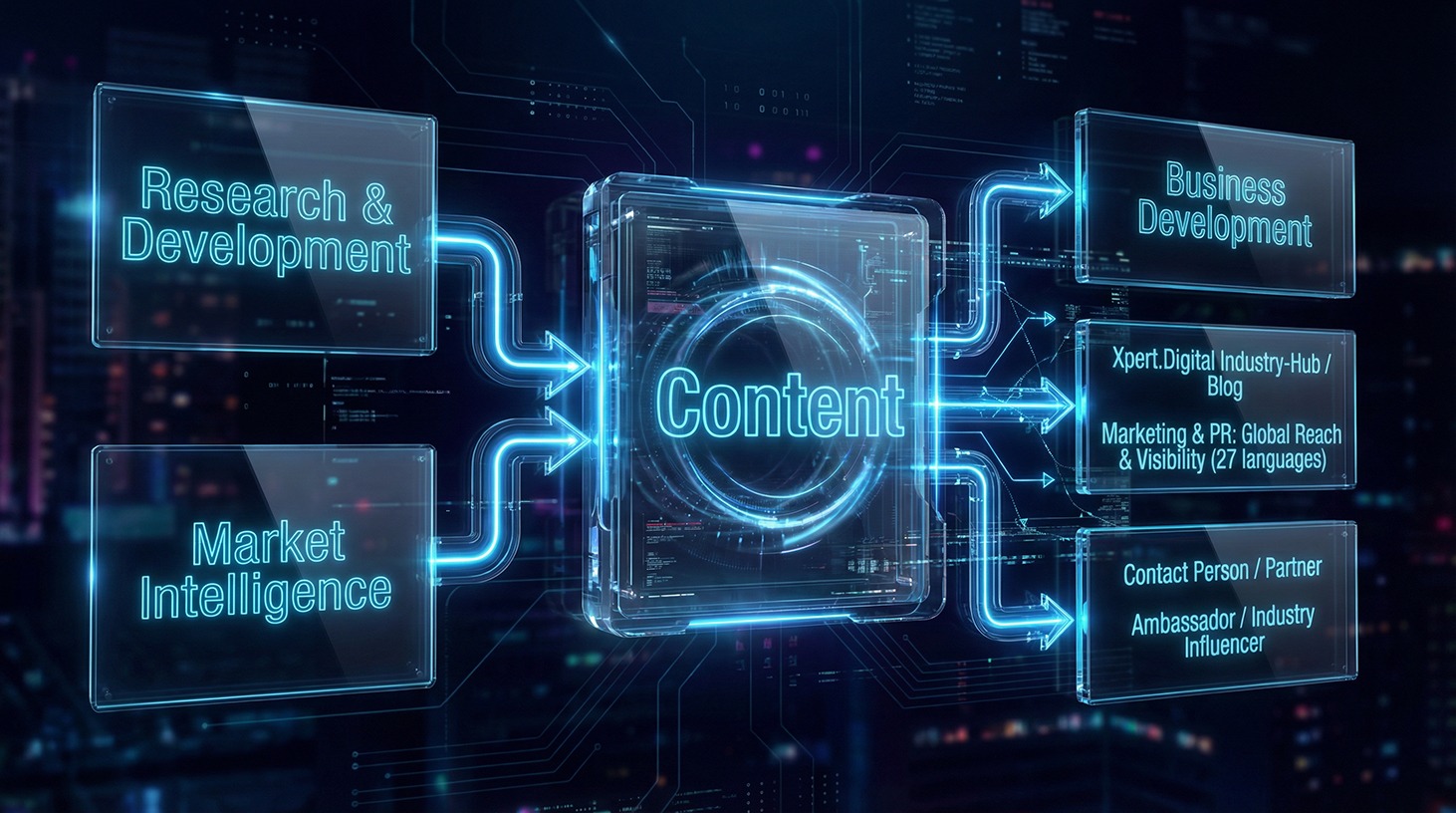
The quasi-in-house solution: How Xpert.Digital closes operational gaps in B2B marketing and sales – Smart Content-Driven Business - Image: Xpert.Digital
Xpert.Digital is a data-driven B2B industry hub led by Konrad Wolfenstein . The company acts as an external, quasi-in-house solution for industrial partners, closing operational gaps in marketing, content, and sales – without requiring additional resources on the client side.
More information here:
Search engines are losing their monopoly on attention
How AI is shifting the marketing value chain
The value creation process begins with gaining insights. Market observation, customer research, and competitive analysis are accelerated and expanded through AI. Models can condense vast amounts of public and internal information, identify patterns, and formulate hypotheses. This reduces the cost of obtaining an initial overview. The value shifts to selecting trustworthy data, interpreting conflicting signals, and deciding which insights are strategically relevant.
In the strategy phase, AI supports scenario planning, segmentation, and forecasting. It can simulate different positioning strategies or structure potential target group reactions. However, the final decision remains a business gamble. Past data doesn't fully capture how markets react to new offerings, crises, or cultural shifts. Strategic quality, therefore, arises from combining the breadth of machine intelligence with human judgment.
In creative production, unit costs drop significantly. Texts, images, voices, videos, and three-dimensional elements can be created and adapted more quickly. This increases the number of possible experiments and makes high-quality formats more accessible to smaller companies. At the same time, the mere production of an asset loses value. The creative concept, originality, consistent brand management, and possession of unique data or experience become more valuable.
In activation, AI is increasingly taking over operational decisions. Target groups, bids, channels, timing, and motivations can be continuously adjusted. For marketing managers, this means that manual campaign management is becoming less important. Instead, the significance of key performance indicators (KPIs) and constraints is increasing. A system that optimizes solely for short-term clicks or conversions can damage brand value, margins, or customer satisfaction in the long run.
In measurement, AI enables faster analysis and more understandable reports. It can explain deviations, formulate hypotheses about causes, and prioritize recommended actions. The danger lies in a false sense of precision. Marketing effectiveness is influenced by seasonality, price changes, distribution, competition, and macroeconomic factors. A linguistically compelling report is no substitute for a thorough causality analysis.
Across the entire value chain, the value of standardized execution is decreasing while the value of integrated control is increasing. Agencies, platforms, and internal teams must respond. Hourly-based compensation models are under pressure when the same output can be delivered in a fraction of the time. Outcome, usage, or platform models are gaining importance. Clients will pay less for the quantity of files produced and demand more speed, quality, business impact, and risk control.
The new economy of budgets, labor, and agencies
The use of AI coincides with a period of tight marketing budgets. In 2025, the average budgets of large companies amounted to 7.7 percent of revenue, significantly below the long-term pre-pandemic level. 59 percent of the marketing managers surveyed considered their resources insufficient to fully implement their strategies. In this environment, AI is primarily being used as a productivity driver. 49 percent reported time savings, 40 percent cost advantages, and 27 percent an increased ability to handle more content or business.
This development has direct consequences for employment and service providers. 39 percent of the marketing managers surveyed planned to reduce labor costs; an equal number intended to cut agency budgets. 22 percent stated that generative AI would reduce their reliance on external agencies for creativity and strategy. However, this does not mean that external partners will become obsolete. Interchangeable output will come under pressure, while specialized expertise, industry access, technology integration, and demonstrable business results will become more valuable.
Internal teams are changing their composition. Less time is needed for initial drafts, manual reporting, variant development, and routine coordination. More time is spent on prioritization, quality assurance, experiment design, data maintenance, and collaboration with sales or product development. The number of operational roles may decrease, while the responsibility and impact of the remaining team increase. A smaller marketing department is therefore not necessarily a weaker marketing department. It can become a strategically stronger core, provided that the saved capacity is not only eliminated but also partially redirected into higher-value capabilities.
The distribution of productivity gains remains a management question. If time savings are achieved solely through staff reductions, the cost ratio may decrease in the short term. In the long term, however, this risks knowledge loss, overload, and strategic impoverishment. If all gains are simply invested in more content, the result is often just additional communication noise. A mixed model is more economically sound: some efficiency gains reduce costs, some increase testing speed, and some strengthen skills that were previously neglected due to capacity constraints.
Search engines are losing their monopoly on attention
AI is not only changing the way marketing is produced, but also its distribution channels. Search engines, social networks, and online marketplaces have long been key intermediaries between supply and demand. Generative response systems are now emerging as an additional layer of decision-making. They aggregate information, compare options, and answer questions without requiring users to visit every underlying website.
This puts the traditional click economy under pressure. Visibility is no longer measured solely by a page's position in search results. It also becomes crucial whether a company appears as a relevant and trustworthy source in machine-generated responses. For marketing, the focus shifts from pure search engine optimization to optimization for generative systems. Structured data, clear terminology, consistent company information, reliable evidence, and original expertise gain in importance.
This development has far-reaching consequences, especially for B2B companies. Buyers can use AI to pre-select complex markets, suppliers, and technologies more quickly. Part of the information search takes place before a supplier even establishes direct contact. Marketing must therefore design content that is both understandable for humans and clearly categorizable for machines. At the same time, the value of personal credibility increases at the end of the journey. The more machines take over the pre-selection, the more important references, expertise, and trust become in the final decision.
Reach doesn't become worthless, but its quality changes. Fewer visits can be associated with higher purchase intent if potential customers are already extensively informed. Therefore, companies need new metrics: mentions in AI responses, citability, the proportion of relevant response contexts, qualified direct inquiries, and the impact of content on actual sales opportunities. The mere number of organic page views loses its significance as an isolated performance indicator.
Trust is becoming a scarce production factor
The cheaper content creation becomes, the scarcer credible attention becomes. While consumers don't always recognize machine-generated content, they are sensitive to deception, arbitrariness, and inappropriate personalization. In a 2025 survey, 58 percent of consumers stated they preferred to buy from companies that didn't use generative AI in their messaging and communication. At the same time, 88 percent of marketing professionals expected a positive impact from the technology. This tension demonstrates that corporate enthusiasm and customer acceptance don't automatically align.
Trust doesn't depend solely on whether AI is used. Purpose, transparency, and outcome are crucial. AI-powered translation, faster service responses, or improved product recommendations can create clear customer value. Conversely, an artificially generated testimonial, a deceptively realistic persona, or automated personalized messaging without any real knowledge of the recipient can destroy trust. Innovators, therefore, treat transparency not as a burdensome obligation, but as an integral part of their brand.
Since August 2, 2026, key transparency rules have been in effect in the European Union for certain AI systems and AI-generated content. Providers of generative systems must support technical detectability. Deepfakes and certain texts on topics of public interest are subject to disclosure requirements, unless a relevant exemption applies. This necessitates that marketing organizations document the creation of content, record approvals, and avoid unintentionally removing technical markers.
Governance, however, should not be reduced to mere legal compliance. Companies need rules regarding training data, confidential information, copyright, discrimination, error correction, and trademark risks. Practical questions also arise: Which models may be used for which data? When is human approval required? How are errors reported? Who is authorized to stop automated campaigns? Without clear answers, the speed of potential damage increases with automation.
Is Xpert.Digital one of the marketing innovators?
Based on functional criteria, there are many arguments in favor of classifying Xpert.Digital as part of the innovative segment of B2B marketing. The model combines market analysis, industry-specific content, digital visibility, marketing automation, business development, and sales support. Particularly relevant is its positioning as an industry hub with a focus on digitalization, mechanical engineering, logistics, intralogistics, and photovoltaics. This ensures that AI is not merely used as a general communication tool, but rather integrated with a specialized context and a dedicated distribution environment.
Another indicator is the development of multilingual, AI-supported research and publication processes. The company's platform combines various AI models to aggregate and analyze international specialist information and translate it into communication strategies. The AIS XPaper and XPaper News systems are designed to make content and insights accessible in numerous languages. This architecture reflects a key characteristic of advanced applications: knowledge acquisition, content development, and distribution are not considered separately, but rather as an integrated process.
The integration of marketing and business development is also strategically sound. Especially in B2B, economic value arises not from reach alone, but from market understanding, qualified contacts, sales capabilities, and long-term positioning. An approach that combines market intelligence, content, public relations, email campaigns, personalized social media, and lead nurturing targets this entire process. This distinguishes it from pure production agencies, whose services primarily consist of individual texts, advertisements, or designs.
For an independent assessment, however, a distinction must be made between a discernible degree of innovation and proven business success. Publicly described capabilities, technical tools, extensive publications, and thematic specialization demonstrate an unusually integrated model. However, these do not replace externally audited key performance indicators (KPIs) regarding customer impact, additional revenue, acquisition costs, retention rates, or long-term profitability. Without standardized, independently verified performance data, it would be an overreach to classify Xpert.Digital as a market leader solely based on its own performance descriptions.
The balanced assessment is therefore: Xpert.Digital is a conceptual and operational marketing innovator because it combines AI, specialist media, industry knowledge, visibility, and business development within a shared value creation logic. Its particular strength lies less in a single model than in the combination of its own information ecosystem, industrial specialization, multilingual scalability, and sales-oriented implementation. The next step toward a solid leading position would be systematic impact documentation with anonymized case studies, clear baseline values, comparison periods, and economic performance indicators.
What true innovation must be measured against
A convincing evaluation system begins with the time to market impact. It should measure how long it takes from a new signal to a verified market reaction. This includes the time from topic identification to publication, the time from customer inquiry to sales response, and the speed at which tests are evaluated. Shorter cycles are economically valuable because companies can learn earlier and correct negative trends more quickly.
The second dimension is quality. Error rates, technical corrections, brand deviations, and legal objections must be recorded, as well as readability and creative evaluation. Faster production is worthless if additional testing negates the time saved or if inaccuracies damage reputation. Quality measurement should therefore consider not only the final product but also the effort involved in its approval.
The third dimension is business impact. Relevant metrics include qualified leads, sales pipeline, conversion rate, customer lifetime value, contribution margin, and avoided costs. For content and marketing communications, the proportion of decision-relevant contacts, sales usage, and presence in AI-based responses can also be measured. Not every activity can be directly attributed to revenue, but a traceable chain of effects is essential.
The fourth dimension is learning capability. An innovative system improves with each use because feedback is structured and fed back into the system. Successful arguments, customer questions, objections, and errors are incorporated into the knowledge base, specifications, and models. Without this cycle, AI remains a replaceable tool. With it, it becomes part of an organization-specific asset that competitors cannot simply copy by purchasing the same software.
The fifth dimension is robustness. Systems must function even with staff changes, model updates, data problems, and new regulatory requirements. Documented processes, clear ownership, and alternative providers reduce dependencies. Especially because the AI market is changing rapidly, the architecture should not be entirely tied to a single model.
The economic advantage arises from orchestration
The decisive competition is not between humans and AI, but between differently organized companies. On the one hand, there are organizations that accelerate individual tasks but maintain their old structures. On the other hand, there are companies that combine data, knowledge, technology, creativity, and sales into a learning system. Both groups can use the same models, but they do not achieve the same value.
The second group succeeds through orchestration. They know what information enters the system, which decisions can be automated, and where human responsibility begins. They build reusable knowledge bases instead of starting from scratch with every campaign. They measure business impact rather than mere output. And they use the time saved not only to reduce costs but also for faster experimentation, better customer understanding, and stronger relationships.
For the marketing market, this means a painful shakeout. Standardized production becomes cheaper and loses margin. Mid-sized, non-specialized providers come under pressure because customers can produce simple services themselves or obtain them via platforms. Three groups will remain: highly specialized experts with deep industry knowledge, scalable production and technology platforms, and integrated partners who are responsible for measurable business results.
Especially in B2B, human expertise remains crucial. Complex investment decisions hinge on risk, trust, internal power dynamics, and long-term relationships. AI can structure information and improve preparation, but it cannot replace genuine reliability. The more operational communication is automated, the more valuable real expertise, personal presence, and the ability to take responsibility become.
Marketing innovators therefore understand a seeming paradox: they are consistently automating in order to create more space for human value creation. Machines take over research, routine tasks, variations, and initial analyses. People concentrate on direction, judgment, originality, and relationship building. The result is not marketing devoid of people, but a smaller, faster, and more strategically effective system.
The provocative truth is: AI doesn't replace marketing. It replaces a significant portion of what has long been mistakenly considered marketing – manual production, fragmented handoffs, untargeted mass communication, and reports without consequences. What remains is more demanding: understanding markets, creating relevance, earning trust, and improving business decisions. This is precisely where it will be decided who in the new value chain merely cuts costs and who builds a lasting competitive advantage.
📈🚀 From visibility to trust 👀🤝 Your scalable path with Xpert.Digital


From visibility to trust: Your scalable path with Xpert.Digital - Image: Xpert.Digital
In industrial B2B, sustainable business relationships rarely emerge overnight. They develop step by step – through visibility, professional relevance, recurring touchpoints, and growing trust. Xpert.Digital's 4-stage model addresses precisely this: It offers a structured path that begins with a manageable entry point and can evolve into deeper collaboration in business development if needed.
Instead of relying on loud marketing promises, this model puts the relationship at the forefront. Companies start with clearly defined, easily calculable measures and then decide, based on their own experience, how far they want to expand the collaboration. A key factor for this undisturbed trust-building process: The platform completely avoids annoying advertising ads, so the editorial focus remains solely on the companies' expertise.
More information here:
Your global marketing and business development partner
☑️ Our business language is English or German
☑️ NEW: Correspondence in your native language!

Konrad Wolfenstein
I and my team are happy to be available to you as your personal advisor.
You can contact me by filling out the contact form here wolfenstein@xpert.digital:or simply call me at +49 7348 4088 965. My email address is
I'm looking forward to our joint project.