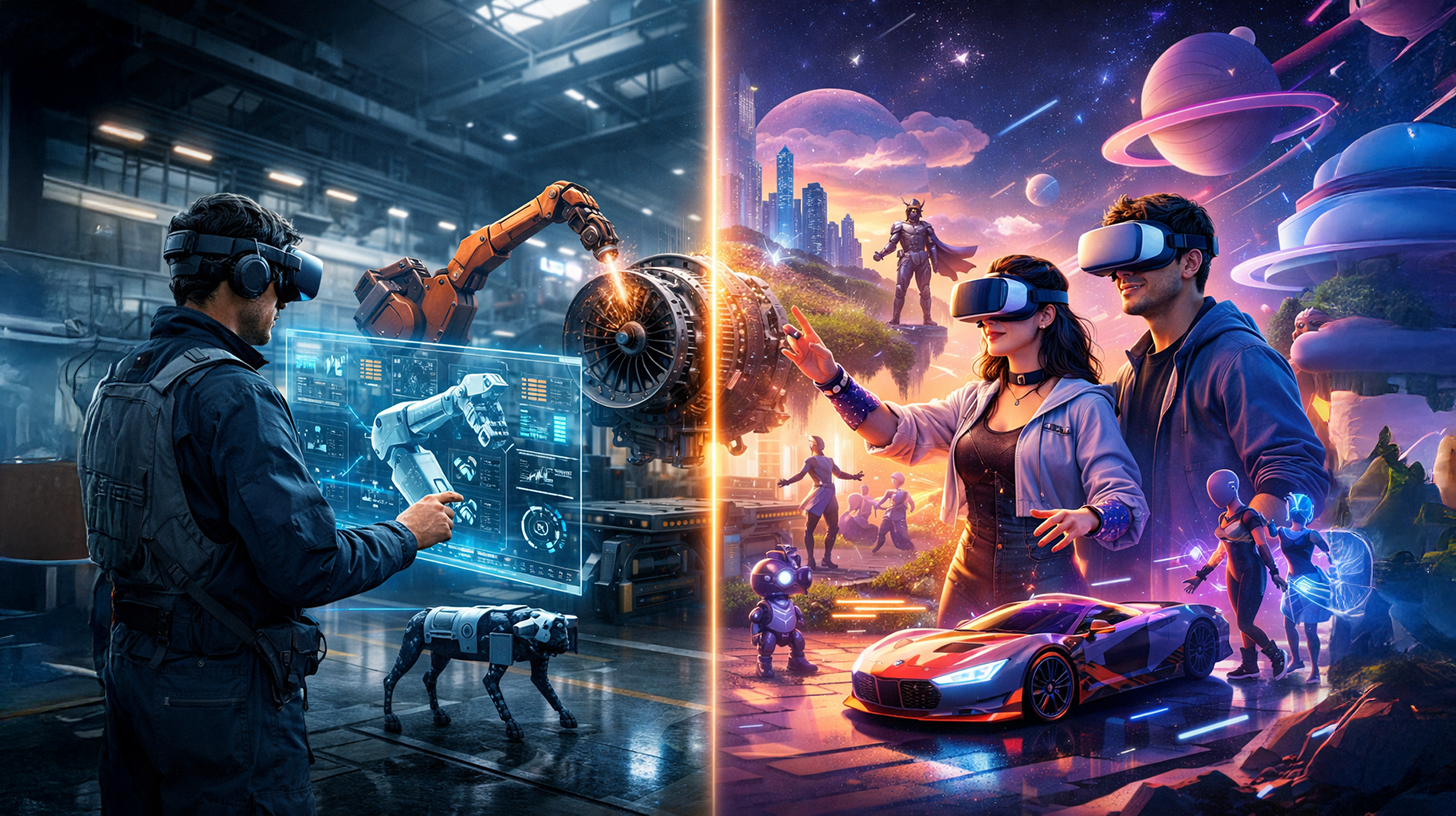
Metaverse Agency | The Industrial vs. Consumer Metaverse: When the hype fades, the real value creation begins – Image: Xpert.Digital
Reports of its death have been greatly exaggerated: The metaverse is here – but not in the way you think
Forget Zuckerberg's flop: This is where the true metaverse revolution is happening
While the world is still fixated on the gigantic losses of Mark Zuckerberg's "Reality Labs" and hastily dismissing the Metaverse as a failed hype experiment, a quiet but massive transformation is taking place behind the scenes. At first glance, the numbers seem devastating: over $71 billion in cumulative losses at Meta and declining user numbers in the consumer sector paint a picture of a burst bubble. But this impression is vastly misleading.
Far removed from VR games and colorful avatars, the technology has found a new, profitable home in the factories of the global economy. For industrial giants like BMW, Siemens, and PepsiCo, the metaverse is no longer a mere gimmick, but a crucial economic factor enabling double-digit percentage efficiency gains. This isn't about a "Second Life" for entertainment, but about digital twins, AI-powered simulations, and a massive acceleration of planning processes.
The following article analyzes this stark discrepancy between the public perception of a failed consumer dream and the booming reality of the "Industrial Metaverse." We examine why key German industries are investing billions right now, how artificial intelligence is acting as a catalyst, and why experts are forecasting GDP growth potential of over €60 billion for the German economy. Learn why, although the hype may be over, the real value creation is only just beginning.
Related to this:

While consumer platforms falter, the industrial metaverse is quietly revolutionizing production – an economic transformation beyond media attention
The contrast could hardly be greater. While Mark Zuckerberg's Reality Labs have accumulated losses of over $71 billion since 2020, with an operating loss of $13.27 billion in the first nine months of 2025 alone, an unspectacular but consequential technological transformation is taking place in the factories of BMW, Siemens, and PepsiCo. The consumer metaverse may have failed in the public eye, but the industrial metaverse is developing far from the headlines into a fundamental productivity driver of the industrial economy.
This discrepancy raises an economically relevant question: Was the metaverse a misguided technological dead end, or was the wrong horse simply saddled? Analysis of current developments suggests the latter. While the vision of a virtual Second Life for consumers failed due to technological, economic, and sociological barriers, the concept is manifesting itself in the manufacturing industry as a logical consequence of digitalization.
The end of the illusion of a universal consumer metaverse
The numbers speak for themselves. Meta had to make layoffs in its Reality Labs in January 2025 after announcing it would cut its 2026 budget by up to 30 percent. While the average price of VR headsets is expected to drop from $400 to $200, this price decline reflects less of increasing mass adoption and more of a desperate attempt to attract users at all. Venture capital investments in Metaverse startups plummeted in the first quarter of 2024. Investors have realized what consumers have long since demonstrated: the grand promise of an all-encompassing virtual parallel world for the general public was overambitious.
The reasons for this failure are structural. First, despite billions in investment, the technological hurdles remained substantial. VR headsets are too bulky, too expensive, and too uncomfortable for extended use for many users. The necessary hardware costs several hundred to thousands of euros, making it inaccessible to the mass market. Second, there was a lack of compelling use cases for the average user. The question of why anyone would spend a significant portion of their time in a virtual environment when social interaction, shopping, and entertainment are also available through conventional digital channels remained largely unanswered. Third, the lack of interoperability proved to be the Achilles' heel. Various tech giants like Meta, Microsoft, and Epic Games are still vying for dominance, resulting in isolated platforms. As long as there isn't a single metaverse, but rather fragmented virtual islands, the vision remains unrealized.
The hype thus followed the cycle described by Gartner exactly. After the technological trigger and the peak of inflated expectations, the consumer metaverse found itself in the trough of disillusionment from 2023 to 2024. Mark Zuckerberg himself called 2025 the year of truth for the metaverse, but the truth was sobering. Meta plans to invest another 62 billion euros, but analysts at Mizuho estimate that budget cuts could increase earnings per share by about 2 dollars in 2026. The market reacted accordingly: After the announcement of the cuts, Meta's stock rose by 4 percent. The economic logic is clear – the capital market rewards the end of a losing bet.
Nevertheless, it would be premature to dismiss the metaverse concept entirely. Despite the consumer challenges, forecasts for the global metaverse market remain optimistic. Statista predicts that the global metaverse market will reach over 2.6 billion users by 2030. Market volume is expected to grow from US$94.4 billion in 2025 to US$464.1 billion by 2030. In Germany, the metaverse market volume is projected to increase from €3.6 billion in 2025 to €18.0 billion by 2030. These figures may seem surprising given the failures in the consumer sector, but they can be explained by a fundamental shift in perspective: the economic potential lies not in private entertainment, but in industrial applications.
The Industrial Metaverse as a productivity revolution
While the Consumer Metaverse sought use cases, the Industrial Metaverse delivers concrete, measurable value creation. The term describes the convergence of virtual 3D environments, digital twins, real-time data, and immersive technologies in an industrial context. It is not a standalone technology, but rather the interplay of various technologies: digital twins, the Internet of Things, artificial intelligence, virtual and augmented reality, cloud computing, and 3D simulations.
The application areas extend across the entire product lifecycle. First, the Industrial Metaverse enables entirely new engineering approaches. The ability to access a central database with various tools such as CAx, simulation, and planning software allows product designs to be tested for functionality and manufacturability as virtual prototypes in short cycles. Simultaneously, automation solutions and plant concepts can be planned. This allows previously sequential engineering processes to be parallelized, enabling a significantly earlier start to production. This offers considerable economic potential.
A second area of application involves empowering and supporting people. Immersive environments can be used for virtual training. Simulation environments with connectivity to real-world production enable remote control and maintenance of real assets via the virtual representation. Monitoring applications and assistance systems go far beyond simple dashboards or graphical work instructions. Boeing was able to reduce training time per person by 75 percent, Airbus achieved 25 percent faster maintenance performance compared to traditional methods, and Delta Airlines increased technician proficiency checks from 3 to 150 per day—an increase of 5,000 percent. In the healthcare sector, VR training led to 40 percent fewer surgical errors, and in manufacturing, to 43 percent fewer workplace accidents.
A third area concerns the optimization and simulation of production processes. Parallel to development, production can already be simulated in various scenarios, enabling analyses of production efficiency, resilience, and sustainability. 75 percent of industrial companies that have implemented large-scale VR and AR technologies report a 10 percent improvement in operational efficiency. The economic value added by AR IoT in the manufacturing sector is estimated at $40 to $50 billion by 2025, expanding to $90 to $110 billion by 2030.
The core functionalities of the Industrial Metaverse can be clustered into four technical areas. First, photorealistic rendering, a technology transfer from the gaming industry, enables immersive environments and realistic synthetic data. Second, physical simulation tools for testing processes and physical relationships. Third, digital twins for the virtual representation of real-world assets with bidirectional data flow. Fourth, collaborative platforms for cross-location and cross-domain collaboration in virtual environments.
Concrete implementations and measurable results
The theoretical potential is manifesting itself in concrete corporate projects with impressive results. BMW is using the NVIDIA Omniverse platform to virtually launch production at its future plant in Debrecen more than two years before series production begins. Digital twins enable real-time simulations that virtually optimize layouts, robotics, and logistics systems. The Omniverse platform is not only being used for Debrecen but is being rolled out across BMW's entire global production network. Digital factory planning enables time efficiency and cost savings through virtual simulations, increases sustainability, and offers flexibility and scalability in production.
Siemens is collaborating with NVIDIA to connect Siemens Xcelerator with NVIDIA Omniverse. The partnership unites Siemens' industrial ecosystem with NVIDIA's AI-powered, physically accurate virtual engine. In January 2026, Siemens introduced Digital Twin Composer, a software solution that builds Industrial Metaverse environments at scale. It delivers real-time, contextual insights for every product, process, and factory. Companies can interact with these virtual representations and refine the design before physical implementation.
PepsiCo, in cooperation with Siemens, is digitizing selected production and warehouse facilities in the US by transforming them into highly accurate digital 3D twins. These simulate plant operations and the entire supply chain. Within just a few weeks, the teams optimized and validated new configurations to increase capacity and throughput. Up to 90 percent of potential problems can be identified before any physical changes are made. This approach has already resulted in a 20 percent increase in throughput during the initial deployment, shorter development cycles, nearly 100 percent validation of design data, and a 10 to 15 percent reduction in capital expenditures.
Siemens Energy is recreating power plants in the Metaverse to predict when they will require maintenance. Sensor manufacturer Sick has developed virtual twins for several sensor models and published them on NVIDIA's Omniverse platform. This platform allows the sensors to be tested in physical 3D simulation using a Robotic Simulation Kit. Schunk, the specialist for gripping and clamping technology, has defined a five-step process for bringing digital twins to life. Timo Gessmann, CTO of Schunk, explains: "A complete robot cell was developed in the Metaverse that behaves exactly as it was built in the physical world.".
Deutsche Bahn is revolutionizing rail transport by building a large digital twin of railway networks and trains to maximize rail capacity and reduce the carbon footprint of operations. GE used digital twin technology to determine the configuration of each wind turbine before construction. Their goal was to increase efficiency by 20 percent by analyzing the data from each turbine.
Related to this:

The economic dimension of industrial transformation
The macroeconomic implications of this development are considerable. A report by the US internet company Meta on the economic potential of the metaverse predicts that the application of metaverse technologies could increase Germany's gross domestic product (GDP) by up to €66 billion per year until 2035. Services, production, and manufacturing would particularly benefit. A study for the European think tank ECIPE concludes that the metaverse could transform the German economy, especially through productivity gains in sectors such as manufacturing, mechanical engineering, financial services, and retail. It could increase German GDP by €71 billion by 2035.
The costs of delayed adoption are substantial. For the German automotive industry, a delayed implementation would result in a 10 percent loss in exports, amounting to more than €12 billion per year. These costs are exacerbated by global competition. US companies have a long track record of successfully integrating internet products into industry, while China and its technology giants are developing strategic initiatives to capitalize on the metaverse.
China has recognized the importance of the metaverse for maintaining global competitiveness. The Chinese Ministry of Industry and Information Technology has developed a plan for XR development. China is already mobilizing its industrial policy and diplomatic influence to challenge Germany's current leadership position in the industrial metaverse. In parallel, China has made significant contributions to the ITU's Metaverse Working Group, the most important forum for setting standards for an immersive internet. China's major mobile network operators have established the Metaverse Industry Committee to foster innovation and synergies among virtual world builders. Chinese technology companies such as Alibaba, Baidu, NetEase, and ByteDance have announced their own virtual world initiatives.
In this context, it is essential that Germany and Europe do not fall behind. Industry 4.0 innovations in the metaverse will be central to German productivity growth. Survey data indicates that users of smart factories enjoy increased labor productivity of up to 12 percent. An average metaverse-capable worker earns 12 percent more than a worker without this technology. The productivity premium for German industrial workers is likely even higher.
Artificial intelligence as a catalyst for industrial metaverse development
The integration of artificial intelligence is proving to be a crucial accelerator for the industrial metaverse. AI is not merely a tool for improvement, but a fundamental building block of design and functionality. Its ability to learn, adapt, and generate is essential to realizing the vision of a living, dynamic, and personalized virtual universe.
Despite losses in the consumer sector, Meta is banking on the power of AI to realize its vision of an immersive digital future. The 5X Initiative calls for 80 percent of Metaverse employees to integrate AI tools into their daily work by the end of 2025, not as a nice extra, but as a productivity booster. This transformation comes at a critical juncture. After the initial Metaverse hype subsided, Meta is now focusing on the power of AI.
In industrial applications, AI enables the development of intelligent non-player characters (NPCs) and avatars. Interacting with lifeless or repetitive virtual characters significantly diminishes immersion. AI-powered NPCs and avatars, on the other hand, can simulate human-like behavior, respond to user interactions in real time, and even learn from them. Personalization is another key feature. Adaptive AI systems continuously analyze user behavior, preferences, and interactions to adjust the virtual experience in real time.
NVIDIA's Omniverse platform offers tools that combine AI and metaverse technology for industrial applications. Companies like BMW and Siemens use generative AI to generate synthetic training data for machine learning models. Entire processes can be simulated on virtual plants to generate datasets before the physical line is built. This allows for a wealth of production insights to be available before the start of production, and AI algorithms to be pre-trained even before entering a real-world learning environment.
A high-performance application implemented at the WZL machine tool laboratory in Aachen in cooperation with BCG and AWS demonstrates the potential: Defects on components are randomly generated without producing a large amount of actual scrap. This significantly accelerates the development of AI-based quality assurance systems. Cognitive robot operations, machine vision applications for quality assurance, the optimization of operating points in production plants, and the intelligent navigation of automated guided vehicles are just a few of the numerous examples of applications that can be implemented more efficiently using the concept of the Industrial Metaverse.
🗒️ Xpert.Digital: A pioneer in the field of Extended and Augmented Reality

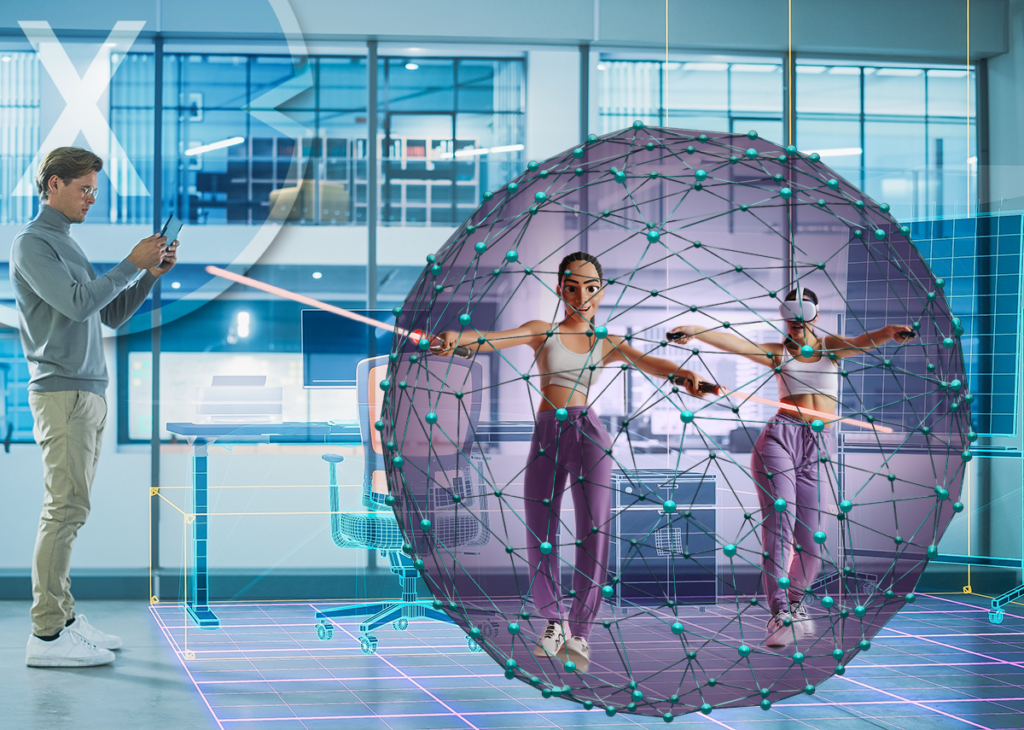
Finding the right Metaverse agency, planning office, or consulting firm - Image: Xpert.Digital
🗒️ Finding the right Metaverse agency, planning office, or consulting firm – Search and search: Top Ten Tips for Consulting & Planning
More information here:
After the big hype: Why the metaverse is now secretly conquering industry
Structural challenges and implementation barriers
Despite impressive success stories and forecasts, substantial challenges remain. The lack of interoperability represents a key hurdle. There is no single metaverse. Technology giants like Meta and Microsoft are still vying for dominance in establishing a global standard. Interoperability and a cohesive metaverse world are lacking. As long as such standards are absent, many companies are hesitant to invest.
The metaverse landscape is diverse, with platforms built using different technologies and protocols. This diversity drives innovation but also creates barriers to interoperability. A consistent user experience across all platforms remains a challenge. Global collaboration is essential for a fully interoperable metaverse, and the involvement of major platforms could be crucial in this endeavor.
The IEC, through its dedicated Standardization Evaluation Group, is investigating standardization needs in the area of metaverse and related technologies. The primary goal is to establish a shared understanding and a uniform definition of metaverse and to develop a roadmap for further standardization activities. Working on common norms and standards helps to identify weaknesses and potential for misuse early on.
Technological hurdles persist. On the one hand, the computing power in many metaverse worlds is still insufficient to handle millions of users worldwide and the increasing graphical detail. On the other hand, user experiences still vary significantly depending on the hardware used. Modern VR devices do not offer a seamless user experience. They are either too heavy and tethered but powerful enough, or lightweight and wireless but laggy and weak. The devices fail to meet the diverse and varied needs of the target audience.
Implementation costs remain prohibitive for small and medium-sized enterprises (SMEs). So far, only very large companies are integrating the Omniverse platform into their existing processes. While the currently high costs for software and hardware integration could decrease, thereby opening up further use cases for SMEs, this process takes time. Marco Thull, Head of Marketing at igus, emphasizes the need to reach SMEs with limited budgets and expertise so they don't miss out on future technologies.
Another structural problem concerns the lack of regulation. A user's identity in the metaverse is linked to their cryptocurrency wallet. The absence of rules and regulations means that a user has no recourse to a regulatory authority. The responsibility for user protection lies with the platform. The lack of legal guidelines also means that the platform and its owners have a moral obligation to protect their users. Data sovereignty requires clear control rights for users. Sensitive user data must be stored on demonstrably secure platforms.
Related to this:
Sustainability and energy consumption as critical factors
The sustainability dimension of the Metaverse is ambivalent. On the one hand, the Industrial Metaverse offers opportunities to increase sustainability through the optimization of production processes, the reduction of prototyping waste, virtual testing instead of physical trials, and the minimization of travel costs through virtual collaboration. On the other hand, the underlying infrastructure causes significant environmental impacts.
The energy demands of AI facilities are jeopardizing progress in the global energy transition. A recent study by the Öko-Institut, commissioned by Greenpeace, shows that the electricity consumption of data centers offering AI-supported services will be eleven times higher in 2030 than in 2023. At the same time, greenhouse gas emissions will rise from 29 million tons of CO2 equivalent in 2023 to 166 million tons. By 2030, AI-specific data centers will account for almost half of all data center emissions worldwide.
Blockchain technologies used for NFTs and decentralized metaverse platforms pose a particular environmental problem. Bitcoin's annual electricity consumption is equivalent to the total annual energy consumption of Ireland. This energy is primarily derived from fossil fuels. However, solutions are on the horizon. The Proof of Stake method, intended to replace the currently established and energy-intensive Proof of Work, shows a significant improvement in terms of computing power and, consequently, energy consumption and CO2 emissions. ETH 2.0 is predicted to achieve an energy efficiency of 99 percent.
According to calculations by the Öko-Institut (Institute for Applied Ecology), water consumption for cooling data centers will quadruple between 2023 and 2030, from 175 billion liters of water worldwide to 664 billion liters. AI data centers, however, consume twice as much water as conventional ones. By 2030, the expansion of data centers and AI capacities could generate up to five million tons of additional electronic waste.
These figures underscore that artificial intelligence and the metaverse can only be valuable tools for climate protection if they themselves are operated in a climate-friendly manner. To limit environmental impacts, Greenpeace calls for mandatory transparency regarding the energy, water, and raw material consumption of AI systems. Efficiency standards should apply to data centers and AI applications and be identifiable through appropriate labels. Data centers should be integrated into renewable energy and heating networks without expanding nuclear power generation to meet AI's electricity needs.
The business model of metaverse agencies
Alongside technological development, a new service segment is emerging: metaverse agencies that support companies in entering virtual worlds. These agencies offer a comprehensive service portfolio that differs significantly from consumer marketing.
In the B2B context, the offering initially comprises strategy development and consulting. To succeed in the metaverse, companies need a solid strategy tailored to their individual requirements and goals. Experienced teams analyze the current market position and identify potential growth opportunities within the metaverse. Subsequently, a comprehensive action plan is developed that concretizes goals and visions and makes them achievable.
A second area concerns technical implementation. Metaverse agencies develop virtual showrooms, digital twins, training environments, and collaborative workspaces. Presenting brands and products in the virtual world is a crucial aspect of metaverse marketing. Creative teams help create an engaging and unique presence in virtual environments that reflects brand identity and attracts potential customers.
A key component of metaverse marketing is the creation of interactive and immersive experiences. Agencies develop unique in-game events and activations tailored to the needs of the target audience. These events can include exclusive product launches, virtual concerts, or interactive games that offer users an unforgettable experience.
Performance marketing and analytics are another key focus. Success in metaverse marketing means continuously measuring campaign performance and making optimizations based on that data. Performance marketing experts help monitor the effectiveness of marketing activities across the metaverse and make data-driven decisions. Advanced analytics tools and methods provide detailed insights into campaign performance, identify key performance indicators (KPIs), and uncover areas for improvement.
The technological foundation is primarily comprised of two game engines: Unity and Unreal Engine. Unity is more frequently used for metaverse platforms because it is more cross-platform and lightweight. The development cycle and cost overrun are simply lower with Unity. Unreal is better suited for maximum performance and generally looks better, but it also requires powerful hardware to run smoothly. Metaverses are similar to MMORPGs, so it makes more sense to make the game accessible to less powerful hardware, which Unity does better. Unity also supports web support, a feature that was removed from Unreal Engine. Currently, only pixel streaming works, which is very expensive to host in a large-scale multiplayer context.
The long-term perspective: Productivity plateau
The question of where the Industrial Metaverse stands in the Gartner Hype Cycle is crucial for strategic investment decisions. While the Consumer Metaverse remains mired in the trough of disillusionment, the Industrial Metaverse has already entered the path of enlightenment. Practical applications have been identified, and the technology is beginning to deliver real value. Reputable applications are gaining traction, companies and developers are learning from failures, and standards, best practices, and the first stable business models are emerging.
Gartner predicts that the metaverse will enter a consolidation phase over the next five to ten years. During this time, practical applications will become established and the market will stabilize. The forecasts indicate that the path to the full plateau of productivity is still long. According to Gartner, the metaverse has a 10-plus year outlook to develop and become mainstream. These forecasts are reasonable given the available data and demonstrate that the path to the metaverse is still very long and complex. Despite all the hype, the trillions in projections, and the claims that we already have metaverses, the true metaverse will take many years to arrive because it requires numerous technological disruptions as well as its social acceptance.
As Jake Zim points out: If we truly believe in these technologies, we must commit to staying in the field for the next 10 years. Although we've come a long way, we're still in the early stages and it will take many years before we finally see our dreams become reality.
For the short to medium term, from 2025 to 2027, the metaverse will likely establish itself in niche areas. The industrial metaverse and gaming will remain the main drivers, while consumer applications will grow more slowly. The integration of AI technologies will open up new opportunities and improve the quality of experiences. Mark Zuckerberg calls 2025 the year of truth for the metaverse. Meta plans to invest a further €62 billion, which shows that despite losses, the company is sticking to its vision, albeit with stronger AI integration and reduced expectations in the consumer sector.
In the long term, from 2028 to 2035, the metaverse could become a major digital infrastructure, similar to today's internet. The successful integration of AI, improved hardware, and new use cases could lead to wider adoption. Blockchain-based digital economies could enable new business models. McKinsey estimates that the metaverse has the potential to create a market of up to $5 trillion by 2030, provided that regulatory harmonization occurs and a uniform tax system for digital transactions is implemented.
Strategic implications for companies
The economic analysis leads to clear strategic recommendations for various business categories. For fully digital companies like social media platforms and gaming firms, it is essential to be part of the metaverse. This also includes online retailers, who need to develop immersive shopping experiences.
For companies that manufacture tangible products, such as automotive and textile companies, the metaverse offers a unique opportunity to diversify and profitably expand their portfolio. Avatars wearing branded clothing in exchange for digital money transfers are already a reality. Presenting products in virtual showrooms, enabling virtual test drives or fittings, and integrating AR functions into marketing campaigns are becoming standard tools.
For companies that rely heavily on human interaction, expanding their business models into the metaverse will take the longest. Nevertheless, these companies should also monitor developments and experiment with pilot projects. The question is not whether, but when the technology will become relevant to their respective business models.
Manufacturing companies should assess the suitability of their redesign projects for implementation in a virtual environment. Projects can be made more efficient step by step, and virtual twins can become the standard. Investing in digital twins pays for itself over the entire lifecycle of equipment through improved planning, reduced downtime, optimized maintenance, and increased production capacity.
A wait-and-see strategy is no strategy at all. German companies should examine potential applications and closely monitor further technological developments, as Bitkom CEO Dr. Bernhard Rohleder emphasizes. There is a clear need for a visionary strategy that looks at least 10 years into the future, but starts now, says Rob Davis, Head of Innovation at Ogilvy.
The industrial metaverse requires collaboration. This virtual world is not being built by a single company or a few partners. Openness and interoperability are fundamental prerequisites for building the industrial metaverse, as Timo Gessmann, CTO of Schunk, explains. Companies should therefore participate in the development of standards early on and establish partnerships along the value chain.
The silent revolution beyond the hype
The hype surrounding the consumer metaverse was overblown, that much is undeniable. The vision of a Second Life for the masses, where people spend most of their time in virtual worlds, seems more naive than ever today. Meta paid a heavy price for maintaining this illusion, incurring losses of over $71 billion. But while media headlines proclaim the failure of the metaverse, a fundamental transformation is taking place in the factories, design offices, and planning departments.
The industrial metaverse is no longer a futuristic vision, but a present reality with measurable economic impact. BMW launches virtual production two years before physical construction, PepsiCo increases throughput by 20 percent through digital twins, and Siemens offers a platform with its Digital Twin Composer that identifies up to 90 percent of potential problems before physical changes are made. These concrete successes are based on a fundamental insight: the metaverse is not an entertainment platform for consumers, but a production tool for industry.
The economic dimensions are considerable. An increase in German GDP of 66 to 71 billion euros by 2035, productivity gains of 12 percent for metaversely skilled workers, a reduction in investment spending of 10 to 15 percent, and a doubling of production capacity compared to conventional plants – these figures do not describe a hypothetical future, but rather developments that have already occurred or are imminent.
The integration of artificial intelligence further accelerates this transformation. AI is not just an add-on, but the backbone of the industrial metaverse. It enables the generation of synthetic training data, the optimization of complex simulations, predictive maintenance, and the intelligent control of autonomous systems. The convergence of AI, digital twins, IoT, cloud computing, and immersive technologies creates a completely new quality of industrial production.
The challenges remain substantial. A lack of interoperability, high implementation costs, inadequate standards, data protection and security concerns, as well as significant energy consumption, necessitate coordinated efforts from industry, policymakers, and research institutions. The need for global cooperation in standards development is evident, as is the urgency of ensuring that small and medium-sized enterprises (SMEs) are not left behind.
Global competition is intensifying the pressure to act. China is already mobilizing its industrial policy and diplomatic influence to challenge Germany's leadership position in the industrial metaverse. US companies have a long track record of successfully integrating internet products into industry. Germany and Europe must combine their strengths in precision engineering and industrial excellence with digital innovation to remain competitive.
The economic reality of the Industrial Metaverse refutes the pessimistic diagnosis of the failed Metaverse project. The consumer hype may be over, but the industrial revolution has only just begun. While Meta is scaling back its Reality Labs and cutting its budget, BMW, Siemens, PepsiCo, Mercedes-Benz, and numerous other industrial companies are investing heavily in digital twins and virtual production environments. They are doing so not out of ideological conviction or technological enthusiasm, but based on sound business calculations. The return on investment calculations are positive, the competitive advantages evident, and the risks of non-adoption too high.
The Industrial Metaverse is progressing through the Gartner Hype Cycle faster than expected. It has largely overcome the trough of disillusionment and is on the path to enlightenment. The plateau of productivity is in sight. The hype is over. The real value creation is beginning now.
Your global marketing and business development partner
☑️ Our business language is English or German
☑️ NEW: Correspondence in your native language!

Konrad Wolfenstein
I and my team are happy to be available to you as your personal advisor.
You can contact me by filling out the contact form here wolfenstein@xpert.digital:or simply call me at +49 7348 4088 965. My email address is
I'm looking forward to our joint project.
☑️ SME support in strategy, consulting, planning and implementation
☑️ Creation or realignment of the digital strategy and digitization
☑️ Expansion and optimization of international sales processes
☑️ Global & Digital B2B trading platforms
☑️ Pioneer Business Development / Marketing / PR / Trade Fairs
🎯🎯🎯 Benefit from Xpert.Digital's extensive, five-fold expertise in one comprehensive service package | BD, R&D, XR, PR & Digital Visibility Optimization

Benefit from Xpert.Digital's extensive, five-fold expertise in a comprehensive service package | R&D, XR, PR & Digital Visibility Optimization - Image: Xpert.Digital
Xpert.Digital possesses in-depth knowledge across various industries. This allows us to develop tailored strategies precisely aligned with the requirements and challenges of your specific market segment. By continuously analyzing market trends and monitoring industry developments, we can act proactively and offer innovative solutions. The combination of experience and expertise generates added value and provides our clients with a decisive competitive advantage.
More information here: