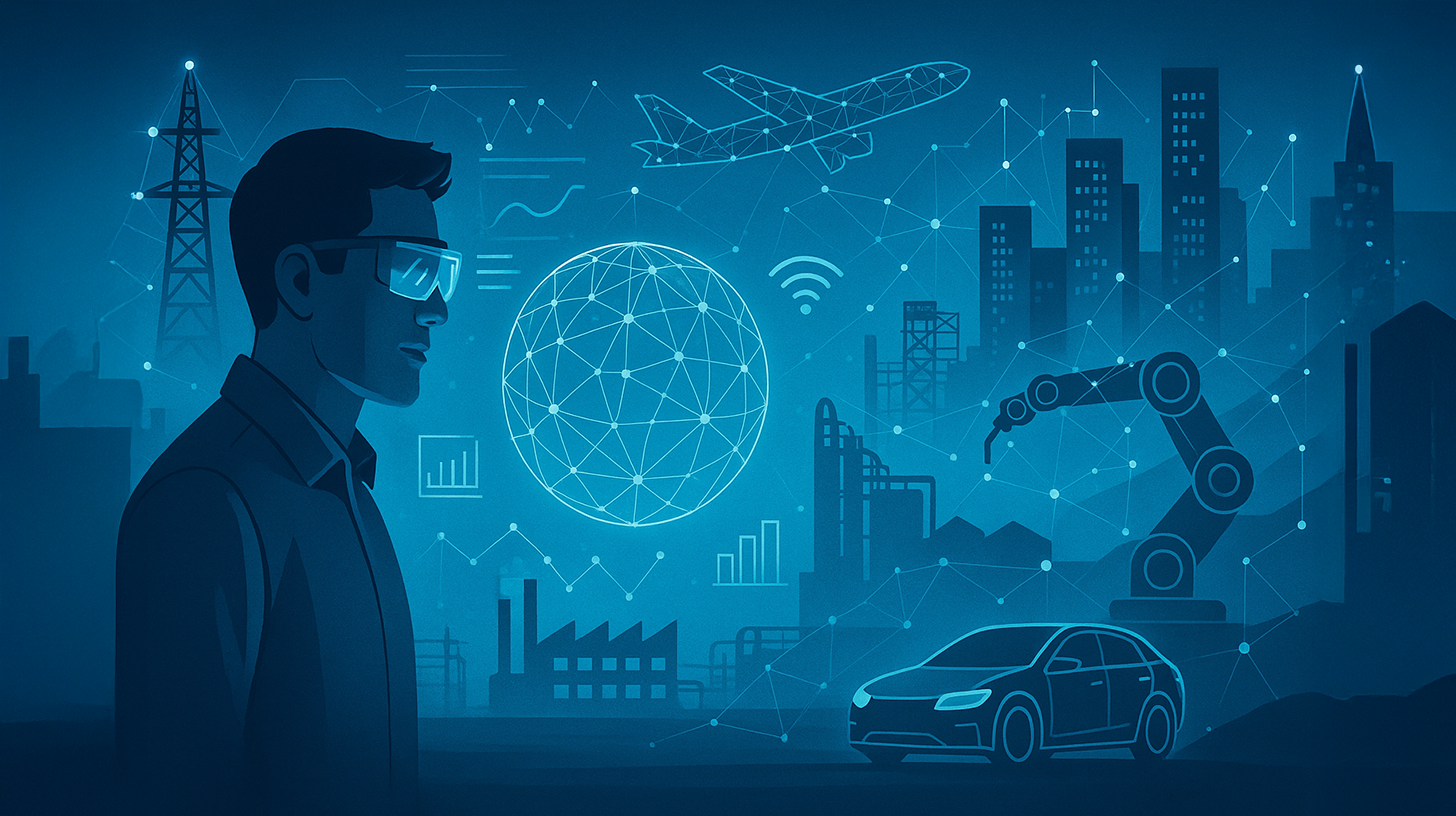
The Industrial Metaverse: A global inventory of the next digital revolution – Image: Xpert.Digital
Digital Twins & AI: How Siemens and Renault are already saving millions in virtual factories
### Productivity +20%, CO2 -50%: The Industrial Metaverse already delivers these incredible figures ### More than just a buzzword: 7 features that make the Industrial Metaverse the next big thing ### The factory in the computer: How the Industrial Metaverse works, NVIDIA and Microsoft's biggest bet ### After Industry 4.0 comes this: Why the Industrial Metaverse creates the most sought-after jobs of the future ###
One to one: How the real world gets a perfect digital copy – and what that means for all of us
Industrial digitalization is on the cusp of its next transformative phase. Following the fourth industrial revolution, known as Industry 4.0, which focused on networking machines and collecting data, a new stage is now emerging: the Industrial Metaverse (IMV). This concept goes far beyond previous approaches, postulating the complete fusion of the physical and virtual worlds into a single, persistent, and interactive ecosystem. It is not a single, isolated technology, but rather the profound convergence of a multitude of established and emerging technologies that, in combination, create an emergent capability that is more than the sum of its parts.
In contrast to the often speculative and entertainment-driven visions of the Consumer Metaverse, which creates virtual worlds for social interaction, gaming, and commerce, the Industrial Metaverse is firmly rooted in reality. Its primary goal is to solve concrete, real-world problems and create tangible economic and societal benefits. It is a tool being developed to better understand, control, and optimize complex industrial systems—from individual machines to entire factories and global supply chains. The driving force behind its development is not fiction, but the business necessity to increase efficiency, accelerate innovation, and operate more sustainably.
This report provides a comprehensive global overview of the current state of development of the Industrial Metaverse. It begins with a sound definition and delimitation to establish a clear understanding of the concept. The technological building blocks that enable this new paradigm are then analyzed. A detailed examination of the global market, investment trends, and the strategies of leading technology companies illuminates the economic dynamics. Concrete use cases and case studies from key industries highlight the potential already realized and the measurable successes. The report quantifies the diverse benefits, from productivity gains to contributions to sustainability, while also addressing the significant challenges that must be overcome on the path to widespread implementation. Finally, the report offers a glimpse into the future, in which generative artificial intelligence, in particular, will act as a catalyst for the next stage of development of the Industrial Metaverse.
Fundamentals of the Industrial Metaverse: Definition and Delimitation
To fully grasp the transformative potential of the Industrial Metaverse, a precise definition and a clear distinction from related concepts are essential. The IMV is more than just a technological buzzword; it represents a fundamental shift in how industry interacts with the digital world.
A comprehensive definition
At its core, the Industrial Metaverse describes an immersive, virtual space used for industrial applications to revolutionize research and development, production, logistics, and supply chain management. It is a virtual world that acts as a mirror image of real machines, factories, buildings, cities, and transportation systems—an "always on" universe permanently connected to physical reality.
A structured definition can be developed based on the seven characteristics formulated by the Fraunhofer Group for the metaverse in general, which apply particularly to the IMV:
- Combination of virtual and augmented reality worlds: The IMV does not consist of isolated systems, but is a network of virtual worlds that are interconnected with each other and with physical reality.
- Social media: It is a space where people, represented by avatars, can interact, communicate and cooperate to work together on real-world problems.
- Persistent and long-lasting: The IMV exists continuously and regardless of whether an individual user is active.
- Integrative system: It bundles and utilizes a variety of technologies, including augmented reality (XR), artificial intelligence (AI), the Internet of Things (IoT) and blockchain, with open standards and interoperability being crucial.
- Capturing the real environment: A core function is the continuous capture of conditions and data from the real world to keep the virtual models up-to-date and accurate.
- Multimodal participation: Users can participate in IMV in different ways and with varying intensity, whether via a desktop computer, a tablet or fully immersively with VR glasses.
- Close integration with the real world: This is the defining characteristic. Information, actions, and interactions are exchanged bidirectionally between the virtual and real environments and influence each other.
In addition, the IMV can be understood as a "networked, holistic digital twin of a complex system." This perspective emphasizes its function as a tool that allows decision-makers not only to understand the past but also to predict the future through simulations, thus enabling more informed strategic decisions. The fundamental paradigm shift lies in the move from pure data analysis, as was characteristic of Industry 4.0, to data-driven, real-time interaction. Value no longer arises solely from the retrospective evaluation of data, but from the ability to interact directly with the system in a physically accurate simulation and to experience the immediate consequences of decisions.
The crucial differences
Clearly distinguishing the Industrial Metaverse from other forms of the Metaverse is crucial for understanding its unique value creation.
The consumer and e-commerce metaverse primarily targets end consumers. The focus here is on social interaction, entertainment, gaming, and the creation of virtual shopping experiences. Value creation is based on the sale of digital goods, such as avatar clothing or virtual properties, and the provision of immersive experiences. These worlds are often purely virtual and self-contained.
The enterprise metaverse focuses on internal collaboration within companies. A prominent example is Accenture's "Nth Floor" platform, used for onboarding new employees and for virtual meetings. The aim here is to improve office work, communication, and corporate culture in a virtual environment.
The Industrial Metaverse (IMV) differs fundamentally from both of these in its purpose and data foundation. It is not primarily focused on people, but rather on physical assets and products (asset/product-centric). The data that feeds the IMV comes directly from real machines, processes, and systems. The overarching goal is the optimization of the physical world—increasing efficiency, productivity, quality, and sustainability in real-world production and the value chain. Its defining characteristic is the constant, bidirectional connection to physical reality. A change simulated and validated in the digital twin is implemented in the real factory; data from the real factory flows back in real time, updating the twin. It is not a means of escapism, but a powerful tool for mastering physical reality.
The development of Industry 4.0
The Industrial Metaverse is not a sudden revolution, but the logical and consistent further development of the principles of Industry 4.0. Industry 4.0 laid the foundation through the introduction of cyber-physical systems, i.e., the networking of machines and systems via the Internet of Things, and created the basis for data spaces such as Catena-X or Manufacturing-X to enable cross-company data exchange.
The IMV builds on this foundation and expands it in two crucial dimensions. First, it integrates people into the data space in a new, intuitive way. While Industry 4.0 often viewed people as operators or observers of dashboards, the IMV, through immersive interfaces such as VR and AR, enables direct, spatial interaction with the data and the digital representations of the machines. Second, the IMV broadens the focus from optimizing individual components to optimizing the entire system. While the digital twin in Industry 4.0 often represented a single machine or a production line, the IMV aims for the "whole-system digital twin." This encompasses the entire value chain, including upstream and downstream processes, suppliers, customers, and even external environmental influences. This broadening of the perspective elevates digital simulation from a purely operational to a strategic decision-making level, making it possible to model and manage the complex interactions of an entire industrial ecosystem.
Technological Convergence: Building Blocks of the Industrial Metaverse
The Industrial Metaverse (IMV) does not emerge from a single groundbreaking invention, but from the synergistic convergence of a range of powerful technologies. Many of these technologies have existed for years, but it is their deep and seamless integration that creates the emergent capability that distinguishes the IMV: the ability to mirror, simulate, and control complex real-world systems in a virtual environment in real time.
The Digital Twin as the core element
The heart and fundamental basis of the Industrial Metaverse is the Digital Twin. It is far more than just a static 3D model. A modern Digital Twin is a dynamic, physics-based simulation model that behaves exactly like its real-world counterpart and reacts to data and changing conditions in real time. Development is progressing from simple digital representations to highly complex, photorealistic, and physically accurate simulations. Partnerships between industry leaders like Siemens and NVIDIA are driving this development, with the goal of creating interactive twins that not only look like their real-world counterparts but also behave identically in every respect. These high-precision twins serve as a persistent virtual environment for simulations, live interactions, and as an interface between the real and digital worlds.
Artificial Intelligence and Machine Learning
If the digital twin is the heart, then artificial intelligence (AI) is the engine driving the industrial metaverse. AI and machine learning (ML) are essential for processing the vast amounts of data generated by IoT sensors in the real world and transforming them into valuable insights. AI algorithms analyze these data streams, recognize patterns, identify anomalies, and thus enable applications such as predictive maintenance, which forecasts a machine's maintenance needs before a costly breakdown occurs. AI-based simulations support engineers in the design and optimization of new products by running through thousands of design variations in a very short time. Generative AI plays a particularly transformative role. It enables entirely new forms of interaction with digital twins, for example, via natural language, as demonstrated by the Siemens Industrial CoPilot in collaboration with Microsoft. Furthermore, generative AI can accelerate the design process itself by generating optimized designs based on predefined parameters such as weight, stability, and material consumption.
Immersive Technologies (XR)
Extended Reality (XR) – the umbrella term for Virtual Reality (VR), Augmented Reality (AR), and Mixed Reality (MR) – forms the crucial interface between humans and the Industrial Metaverse. These technologies make the complex data and simulations of the IMV (Industrial Metaverse) tangible and intuitively operable for humans.
Virtual Reality (VR)
VR creates fully immersive, computer-generated environments. In an industrial context, VR is used for realistic training scenarios where employees can practice complex or dangerous tasks in a safe virtual environment without blocking real machinery or exposing themselves to risk.
Augmented Reality (AR)
AR overlays the real world with digital information. For example, a technician wearing AR glasses can have maintenance instructions, circuit diagrams, or real-time sensor data projected directly onto the machine they are working on, within their field of vision. This enables hands-free work and significantly reduces error rates.
The foundation of connectivity
A robust foundation of connectivity technologies is required to ensure that the bidirectional connection between the real and virtual worlds functions smoothly.
The Internet of Things (IoT) forms the sensory layer of the IMV. Countless sensors on machines, products, and in the logistics chain continuously collect physical data such as temperature, pressure, vibration, and position. Actuators, in turn, translate digital commands into physical actions. These IoT devices provide the constant stream of data that keeps the digital twin "alive" and up-to-date.
High-performance networks like the 5G mobile standard and, in the future, 6G, are the lifeblood of IMV. They ensure fast, reliable, and, above all, low-latency data transmission between IoT devices, edge and cloud servers, and users' XR devices. Only extremely low latency makes immersive, real-time interactions possible in the first place.
Cloud and edge computing provide the immense computing power required for complex simulations, AI models, and the rendering of virtual worlds. While the cloud can store and process vast amounts of data for global analysis, edge computing enables data processing directly on-site at the machine, which is crucial for time-critical applications with minimal latency.
Security and trust through software-defined automation
The true value of the industrial metaverse unfolds only when insights and optimizations gained in the virtual world can be quickly and reliably transferred back to the real world. This is where software-defined automation comes into play, acting as a crucial bridge between digital simulation and physical execution. A key element here is virtual programmable logic controllers (PLCs). Traditionally, PLCs are the "brains" of factories – physical boxes that control individual machines or processes. Virtualization allows them to be managed centrally and updated via software updates. A process optimization validated in the digital twin can thus be rolled out to the entire real factory with just a few clicks.
In this interconnected system, cybersecurity and trust are of fundamental importance. Protecting critical industrial data and processes from unauthorized access is a basic requirement. Technologies such as blockchain and distributed ledger technologies (DLT) can play a key role here by enabling tamper-proof, transparent, and traceable transactions, for example, for documenting supply chains or safeguarding intellectual property.
🗒️ Xpert.Digital: A pioneer in the field of Extended and Augmented Reality

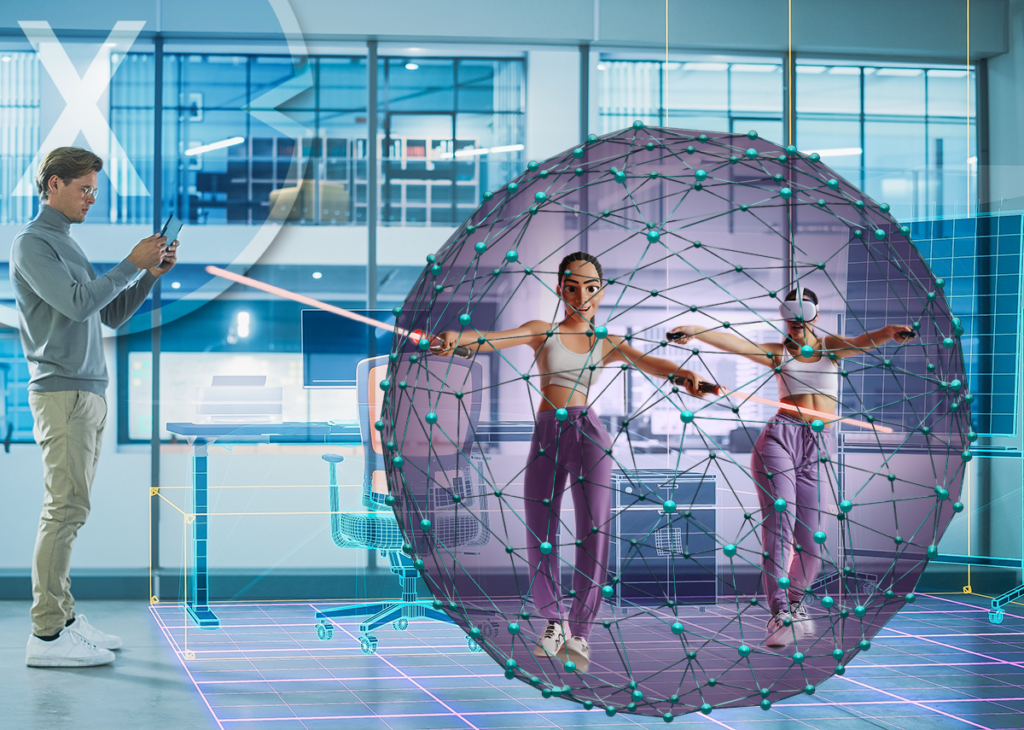
Finding the right Metaverse agency, planning office, or consulting firm - Image: Xpert.Digital
🗒️ Finding the right Metaverse agency, planning office, or consulting firm – Search and search: Top Ten Tips for Consulting & Planning
More information here:
81% of companies are ready: The rise of the industrial metaverse
Global Market Overview and Economic Dynamics
The industrial metaverse has evolved from a visionary concept into a dynamic and rapidly growing global market. Increasing investments and high adoption rates in key industries signal a profound shift toward immersive, data-driven production and business models. This economic momentum is fueled by clear strategic drivers and a rapidly evolving technology landscape.
Market size and growth forecasts
The assessment of the global Industrial Metaverse market reveals remarkable dynamics and exceptional growth potential. Various analysts arrive at differing, but consistently optimistic, estimates. The market size for 2024 is projected to be between USD 23.79 billion and USD 54.53 billion.
Future projections are even more impressive, underscoring the anticipated transformative power of IMV. Forecasts for the period up to the early 2030s vary, but all point to exponential growth. Some analyses predict a market of $100 billion by 2030, while others project $183.7 billion by 2032 or even $228.6 billion by 2029. The projected compound annual growth rates (CAGR) consistently range from around 30% to over 50%. These figures clearly demonstrate that IMV is not considered a niche technology, but rather one of the key growth markets of the coming decade.
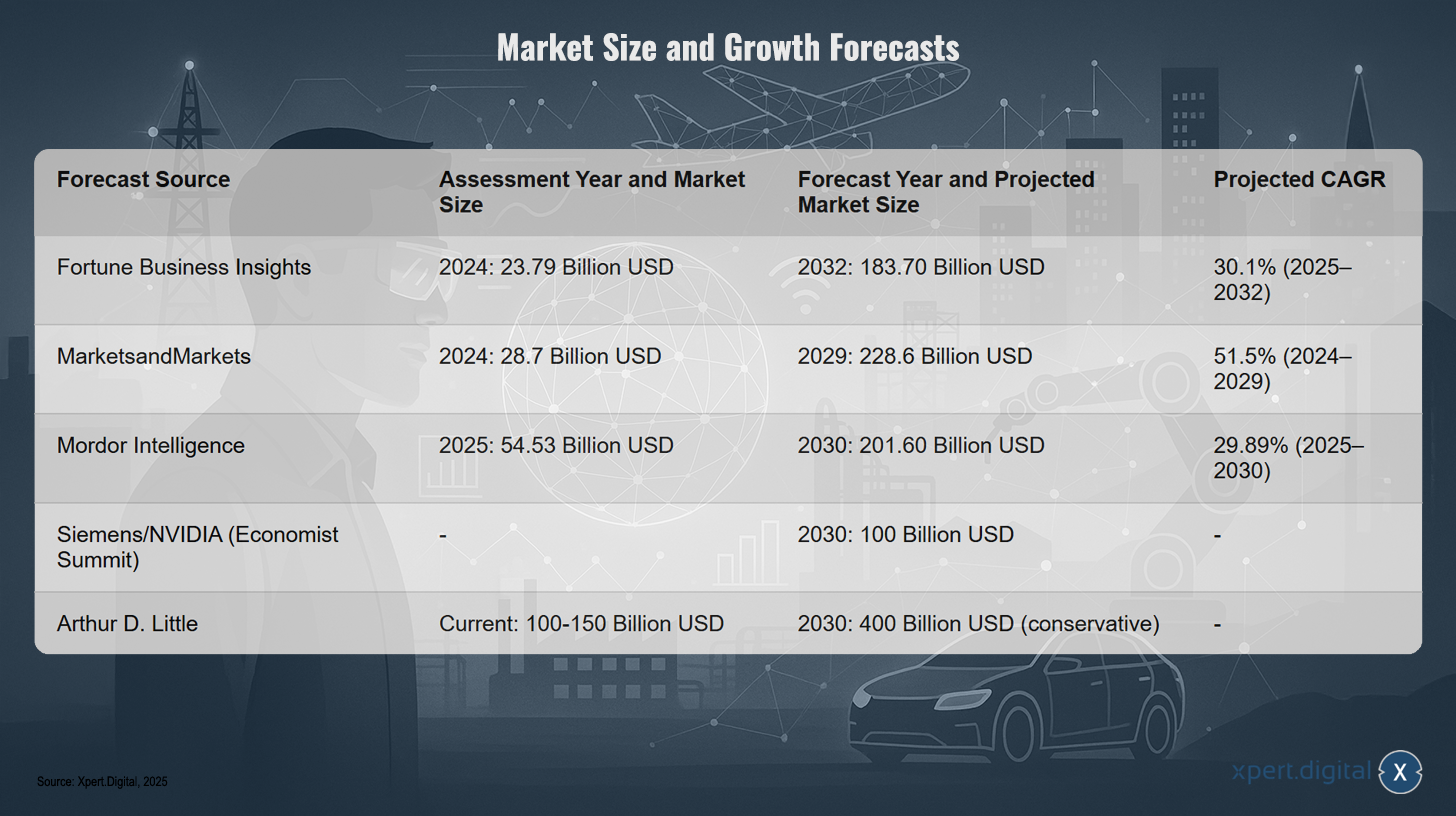
Market size and growth forecasts – Image: Xpert.Digital
Regional developments and adoption rates
The adoption of IMV technologies is a global phenomenon, but with significant regional differences in the speed and depth of implementation. A comprehensive global survey conducted by S&P Global and Siemens in 2024 shows that 81% of the companies surveyed worldwide are already actively engaged with the Industrial Metaverse, whether through implementation, testing, or planning.
North America, particularly the USA, plays a leading role. Here, over 38% of companies are already actively using IMV technologies, while another 40% are in the testing phase. This pioneering role is not only due to a high level of technological affinity, but primarily to the strong presence of leading platform providers who develop and deliver the fundamental "operating systems" of IMV. As a result, North America dominated the global market in 2024 with a share of 33.21%.
Asia, particularly China, is closely following North America with a similarly high level of commitment to the adoption and testing of IMV solutions. The Asia-Pacific region is expected to experience the highest growth rate, driven by government incentive programs in countries such as South Korea, China, and India.
Europe, led by Germany, is also positioning itself as a key player. In Germany, around two-thirds of industrial companies are already using or testing IMV solutions. Germany's strength lies in its deep industrial base and its pioneering role in Industry 4.0, which provides a solid foundation for implementing IMV use cases. Other regions, such as Canada, Australia, the United Kingdom, and India, are also making steady progress.
Investment trends
The strategic importance of the Industrial Metaverse is reflected in rising investments. A survey by S&P and Siemens confirms a significant increase in spending: 62% of companies worldwide increased their investments in IMV technologies in 2024.
A notable trend is the driving role of small and medium-sized enterprises (SMEs). At 68%, SMEs are increasing their investments at an above-average rate. This suggests that the underlying technologies, particularly through cloud and "as-a-service" models, are becoming increasingly accessible and affordable, and are no longer reserved for large corporations.
At the same time, large corporations are making massive financial commitments. The percentage of companies investing more than USD 10 million annually in IMV has doubled year-on-year to 30%. These robust investments demonstrate that IMV has moved beyond the experimental phase and is now seen as a core strategic element for future competitiveness.
Strategic drivers for adoption
The motivation for these substantial investments is multifaceted, but can be traced back to three key strategic drivers:
- Growth potential (55%): The most important driver is the expectation of developing new revenue streams, innovative business models and increasing market reach.
- Innovation promotion (47%): Almost half of the companies are investing to accelerate their innovation processes. Technologies such as digital twins and AI make it possible to drastically shorten product development cycles and test solutions faster than the competition.
- Improving customer support (43%): Companies use IMV to optimize service processes and improve customer interaction, for example through remote support or virtual product demonstrations.
Furthermore, sustainability is increasingly establishing itself as a crucial factor. The ability to virtually simulate production processes and entire supply chains enables companies to optimize resource consumption, reduce waste, and specifically lower their carbon footprint, which brings both ecological and economic benefits.
Strategies of Technology Leaders: The Architects of the Industrial Metaverse
The development of the industrial metaverse is being driven primarily by a handful of global technology companies. These companies are creating the fundamental platforms, tools, and ecosystems that enable industrial enterprises to implement their own IMV solutions. Their strategies are not monolithic but complementary, focusing on different layers of the overall technological landscape. Instead of a "platform war," a "platform convergence" is emerging, characterized by strategic partnerships and the pursuit of interoperability.
Siemens: The ecosystem approach with Siemens Xcelerator
Siemens positions itself as a central integrator, combining its deep domain expertise from the real world of automation and industry with the digital world. Siemens' strategy is based on Siemens Xcelerator, an open digital business platform. This platform does not function as a closed system, but rather as a curated marketplace that combines Siemens' comprehensive portfolio with the solutions of certified partners. The strategic focus is clearly on openness, the creation of strong ecosystems, and enabling interoperability.
A key component of this strategy is the pioneering partnership with NVIDIA. By linking Siemens Xcelerator with the NVIDIA Omniverse platform, the goal is to create photorealistic, physics-based, and real-time interacting digital twins that combine the best of both worlds: Siemens' precise engineering data and NVIDIA's powerful visualization and simulation engine. Siemens has defined four strategic imperatives to pave the way for IMV: interoperability, standardization, data integration, and the building of ecosystems.
NVIDIA: The Omniverse platform as a simulation engine
NVIDIA, originally known for its graphics processing units (GPUs), has established itself as a provider of the fundamental computing and simulation infrastructure for IMV (Integrated Visual Virtualization). At the heart of this strategy is the NVIDIA Omniverse platform, a development and collaboration environment for creating 3D applications. Omniverse is based on the open standard Universal Scene Description (USD), developed by Pixar, which facilitates interoperability between different 3D tools and applications.
The platform enables the creation of physically accurate, real-time rendered digital twins of the highest visual quality. NVIDIA's core competence lies in the combination of high-performance computing, advanced AI expertise, and photorealistic visualization capabilities. Omniverse is described as the "operating system for building and operating physically realistic digital twins" and is increasingly delivered via cloud services (Omniverse Cloud) to facilitate access. NVIDIA takes an open approach, integrating its platform with the software of numerous industry partners, including Siemens, Dassault Systèmes, and Autodesk.
Microsoft: The integration of cloud, edge, and immersive experiences
Microsoft's strategy for the Industrial Metaverse builds on the foundation of its established Azure cloud ecosystem. The approach aims to meet customers where they are in their digital transformation and enable them to embark on a phased journey. A key pillar is the creation of a common data foundation through the seamless integration of information technology (IT) and operational technology (OT) data. This is achieved through a range of Azure services such as Azure IoT, Azure Synapse Analytics, and Azure Digital Twins.
Azure Arc extends management and control from the cloud to the edge, directly to the machine. The human interface to the IMV is created through immersive experiences. Here, Microsoft relies on its HoloLens 2, one of the leading mixed reality headsets, as well as Microsoft Mesh, a platform that enables collaborative, immersive meetings directly within Microsoft Teams. The strategy is clearly focused on integration into existing business processes and leveraging the scalability of the global cloud infrastructure.
Dassault Systèmes: The 3DEXPERIENCE platform and the “Virtual Twin Experience”
Dassault Systèmes (DS) leverages its decades-long leadership in Product Lifecycle Management (PLM) and 3D Design (CAD) software. The 3DEXPERIENCE platform is the centerpiece of its strategy and is positioned as a holistic business and innovation platform, serving as the "single source of truth" for all product-related data and processes.
DS is deliberately differentiating its offering by transitioning from the "Digital Twin" to the more powerful "Virtual Twin Experience." This approach not only emphasizes the digital representation but also incorporates science-based modeling and simulation, enabling a closed feedback loop between the virtual and real worlds. DS's long-term vision is the "3D UNIV+RSES," conceived as a "virtual-plus-real" representation of entire ecosystems. These are intended not only for simulation but also as highly complex training environments for AI systems, while protecting customers' intellectual property.
From competition to synergy: New strategies of technology companies
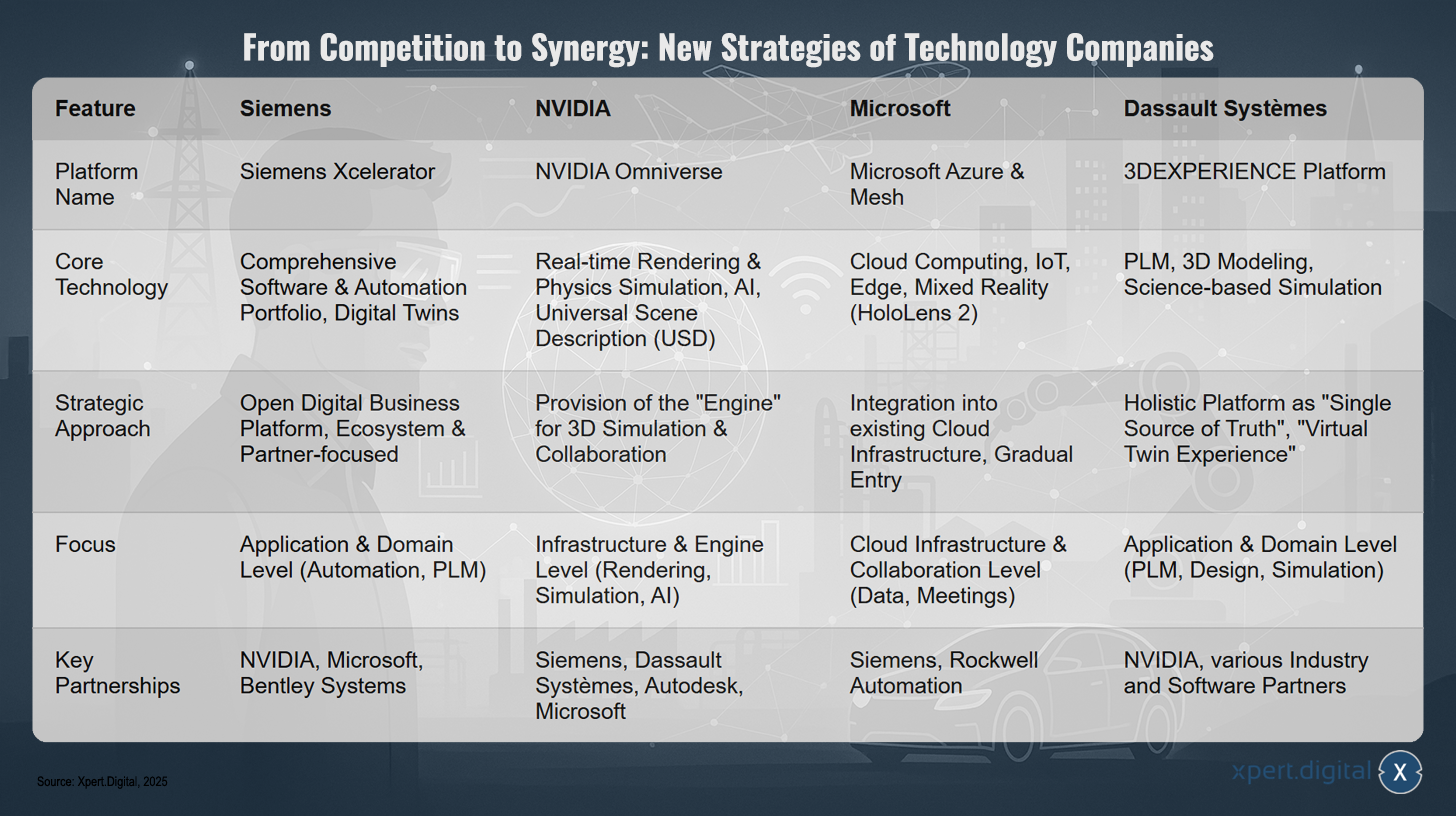
From competition to synergy: New strategies of technology companies – Image: Xpert.Digital
This comparative analysis shows that the technology leaders are pursuing complementary strategies that focus on different but equally necessary layers of the IMV ecosystem. This specialization fosters intensive collaboration and drives the development of an interoperable, high-performing overall ecosystem, rather than remaining in isolated, competing silos.
Dassault Systèmes is a leading company in digital transformation and product development with its innovative 3DEXPERIENCE platform. Compared to other technology companies such as Siemens, NVIDIA, and Microsoft, Dassault Systèmes pursues a holistic approach based on a "Virtual Twin Experience.".
The platform focuses on Product Lifecycle Management (PLM), 3D modeling, and science-based simulation. Unlike Siemens' open digital business platform or NVIDIA's rendering and simulation engine, Dassault Systèmes positions itself as a "single source of truth" for businesses.
Strategic partnerships with NVIDIA and other industry and software partners enable the company to continuously expand its technology solutions. The focus is on application and domain levels such as design, product development, and simulation, making Dassault Systèmes a key player in the digital transformation landscape.
Use cases and transformation in key industries
The true significance of the Industrial Metaverse is revealed not in theory, but in practical application. Numerous key industries are already using IMV technologies to solve real-world problems, transform processes, and create measurable value. Analysis of specific case studies demonstrates how shifting from physical to virtual iteration loops leads to fundamental improvements in cost, speed, and quality.
Manufacturing industry: The intelligent factory of the future
In the manufacturing industry, IMV unfolds perhaps its most comprehensive potential. It enables the virtual planning, simulation, and commissioning of entire factories long before the first physical foundation stone is laid. This allows material flows to be optimized, bottlenecks identified, and errors avoided, leading to significant savings in time and costs. During operation, production processes are continuously monitored and optimized by digital twins fed with real-time data. Applications such as remote maintenance by experts who connect virtually to a machine, or immersive training for employees in VR environments, are becoming the new standard.
Case study: Siemens' “Digital Native Factory” in Nanjing
A prime example of implementing this vision is Siemens' "Digital Native Factory" in Nanjing, China. This factory was planned digitally from the ground up and realized as a holistic "Digital Enterprise." At the heart of the project was a comprehensive digital twin that encompassed not only the production facilities but also the building structure and all logistical processes. The entire factory layout was simulated and optimized in this virtual environment. Employees were able to walk through their future workstations using VR headsets and provide valuable feedback for the final design. The results of this digital approach are impressive: production capacity was increased by 200% and productivity by 20%. At the same time, the footprint was reduced by 40% while maintaining the same output, eliminating the need to invest in a completely new second production line. Furthermore, the optimization in the digital realm led to significant savings in energy and water consumption, considerably improving the site's sustainability.
Automotive industry: From virtual planning to agile production
The automotive industry, characterized by high complexity and rapid innovation cycles, is another pioneer in the adoption of IMV. Use cases span the entire value chain, from collaborative vehicle development and virtual prototyping to crash test simulation, detailed production line planning, and the optimization of global supply chains. Companies like BMW are already using NVIDIA's Omniverse platform for the virtual planning of their factories.
Case study: The Renault Group
The Renault Group has implemented what it claims is the first comprehensive industrial metaverse in the automotive industry to accelerate its digital transformation. In this system, 100% of production lines are networked, and all supply chain data is hosted and processed in real time within the metaverse. Digital twins of the factories and the entire supply chain enable continuous monitoring and control. A central control tower consolidates all relevant information, allowing for real-time responses to disruptions. The projected economic impact by 2025 is substantial: Renault anticipates savings of €320 million through process optimization, a further €260 million through reduced inventory, a 60% reduction in vehicle delivery time, and a 50% reduction in the manufacturing carbon footprint.
Aerospace and Defense: Managing Complexity and Security
In the aerospace industry, where products consist of millions of individual parts and the highest safety standards apply, IMV offers crucial advantages. It enables the collaborative development of highly complex systems, the simulation of the interaction of all components, the training of pilots and astronauts in realistic VR environments, and the support of maintenance personnel through AR instructions.
Case study: Airbus
Airbus is using mixed reality technologies, particularly the Microsoft HoloLens 2, in a variety of applications. In manufacturing, digital work instructions and 3D diagrams are projected directly onto the actual components. This has reduced manufacturing time for certain processes by a third while simultaneously improving quality. During the complex retrofitting of A330 aircraft at the Getafe site, 70% of work orders are already carried out using mixed reality. In the design process, engineers can virtually validate their designs in an immersive environment, reducing the time required for this step by 80%. These examples demonstrate how IMV helps manage the immense complexity of the industry while simultaneously increasing efficiency and safety.
Energy industry and utility companies: Simulation for sustainability and resilience
For the energy sector, IMV (Integrated Virtualization) is a key instrument for managing the energy transition and ensuring a resilient energy supply. It enables the creation of digital twins of complex infrastructures such as electricity grids, power plants, or entire urban supply systems. Operators can monitor energy consumption in real time within these virtual environments, uncover inefficiencies, and simulate various scenarios—for example, the impact of extreme weather events or the integration of a large number of renewable energy sources into the grid. This allows for better planning, increased grid stability, and targeted optimization toward a more sustainable and resilient energy supply.
Healthcare: Precision, Personalization and Innovation
The IMV also opens up new horizons in healthcare, particularly at the intersection of medical technology, diagnostics, and therapy. It enables the development, prototyping, and evaluation of AI-based medical technology in a virtual environment before expensive physical devices are built. Surgeons can plan and train in detail for highly complex procedures using patient-specific digital twins created from CT or MRI scans.
Case study: Use of 3D printing and digital twins in surgery
A concrete use case that illustrates the principles of the Industrial Metaverse (IMV) in healthcare is the combination of digital patient models with 3D printing. A precise digital twin of the relevant anatomy is created from a patient's image data. This 3D model then serves as a template for 3D printing patient-specific implants, surgical guides, or detailed anatomical models for surgical planning. For example, SJD Barcelona Children's Hospital used a highly detailed 3D-printed model of a tumor and surrounding structures to develop a minimally invasive surgical strategy that would not have been possible without the model and resulted in a significantly better outcome for the young patient. This process—from digital patient data to the virtual twin to the physical, 3D-printed object that makes a crucial difference in the real world—embodies the core idea of the Industrial Metaverse.
🎯🎯🎯 Benefit from Xpert.Digital's extensive, five-fold expertise in one comprehensive service package | BD, R&D, XR, PR & Digital Visibility Optimization
Benefit from Xpert.Digital's extensive, five-fold expertise in a comprehensive service package | R&D, XR, PR & Digital Visibility Optimization - Image: Xpert.Digital
Xpert.Digital possesses in-depth knowledge across various industries. This allows us to develop tailored strategies precisely aligned with the requirements and challenges of your specific market segment. By continuously analyzing market trends and monitoring industry developments, we can act proactively and offer innovative solutions. The combination of experience and expertise generates added value and provides our clients with a decisive competitive advantage.
More information here:
AI and Simulation: How Companies Can Double Their Efficiency
Quantifiable benefits and added value
The implementation of the Industrial Metaverse is not an end in itself, but is driven by the promise of significant and measurable economic benefits. These benefits are not isolated, but form a system of mutually reinforcing effects that permeate the entire value chain and lead to a fundamental increase in competitiveness.
Increased productivity and efficiency
The potential for significant efficiency improvements and productivity gains is one of the main drivers for the adoption of IMV (Integrated Virtual Simulation). Through the virtual simulation and optimization of production processes, improved resource utilization, and the minimization of unplanned downtime through predictive maintenance, companies can significantly increase their Overall Equipment Effectiveness (OEE). Productivity gains are often in the double-digit percentage range. Siemens' "Digital Native Factory" in Nanjing, for example, achieved a 20% productivity increase. These gains result from a combination of optimized processes, more qualified employees through better training, and data-driven, real-time decision-making.
Sustainable cost reduction and resource optimization
The industrial metaverse offers significant opportunities for sustainable cost reduction across various business areas. A key lever is the drastic reduction in the need for expensive physical prototypes in product development, as these are replaced by virtual prototypes. Similarly, travel costs are significantly reduced through remote collaboration, virtual commissioning, and remote maintenance. Early error detection during the simulation phase prevents costly scrap and rework in actual production. The Renault Group case study illustrates the scale of this potential, with planned savings of €320 million from process optimization alone. These cost reductions are often directly linked to improved resource optimization, enhancing both profitability and environmental responsibility.
Accelerating innovation and market launch
The ability to quickly and cost-effectively test new ideas, products, and production concepts in a virtual environment is a crucial competitive advantage. IMV enables the parallelization of product and production development, significantly shortening traditionally sequential and lengthy processes. Companies can react more quickly to market changes and bring innovations to market faster. The case of Siemens Numerical Control, where time to market was reduced by an impressive 200%, demonstrates the transformative potential in this area.
Improving global cooperation
In a globalized economy, the Industrial Metaverse transcends physical distances and time zones. Globally distributed teams of engineers, designers, production planners, and even suppliers can work on the same digital twins in a shared, persistent virtual space, as if they were in the same room. This not only improves the efficiency of collaboration but also fosters knowledge transfer, breaks down departmental silos, and leads to more holistic and better decisions.
Sustainability as a key advantage
Beyond its direct economic benefits, IMV is evolving into a crucial tool for achieving sustainability (ESG) goals. Through detailed simulation of energy and material flows, companies can precisely analyze and optimize their resource consumption, waste, and emissions. Virtual product development reduces material consumption for prototypes, and the reduced travel associated with remote collaboration directly contributes to lowering the carbon footprint. The Renault Group has set itself the ambitious goal of reducing the carbon footprint of its vehicle manufacturing by 50% using IMV. IMV thus makes it possible to reconcile economic and ecological considerations and achieve more sustainable industrial value creation.
Challenges on the path to implementation
Despite its enormous potential and already visible successes, the path to widespread implementation of the Industrial Metaverse is fraught with significant challenges. These hurdles are not only technological in nature, but also encompass organizational, financial, legal, and human aspects. The success of the IMV will depend largely on how well companies and society manage to resolve these complex, socio-technical issues.
Technical hurdles
The biggest technical challenge, cited by 47% of companies, is the lack of interoperability and standardization. Integrated Market Virtualization (IMV) arises from the convergence of technologies, platforms, and data formats from various vendors. Without common, open standards, seamless integration of these components is virtually impossible. Proprietary, isolated solutions prevent the creation of a networked ecosystem and significantly limit the potential of IMV. Initiatives such as the Metaverse Standards Forum and the Alliance for Open Universal Scene Description (OpenUSD) are working on developing such standards, but this process is complex and lengthy.
Closely related to this is the challenge of data integration and quality. Merging data from heterogeneous sources, particularly from operational technology (OT) and information technology (IT), is a complex task. The accuracy and value of a digital twin depend directly on the quality, completeness, and timeliness of the underlying data. Ensuring a robust and reliable data foundation is therefore a fundamental requirement.
Organizational and financial aspects
Implementing the Industrial Metaverse requires significant initial investments in hardware (e.g., XR devices, high-performance servers), software licenses, and personnel training. These high costs can pose a significant hurdle, especially for small and medium-sized enterprises (SMEs).
Furthermore, the technical complexity of implementation should not be underestimated. It is not enough to simply purchase individual technologies; they must be integrated into existing processes and IT landscapes and aligned with overarching business objectives. This requires a clear strategy, a deep technical understanding, and often a fundamental transformation of organizational structures and workflows.
Data security, data protection and legal framework
The industrial metaverse processes vast amounts of highly sensitive corporate data, including design plans, production data, and trade secrets. Ensuring data security and cybersecurity is therefore of vital importance to protect against industrial espionage, sabotage, and other cyberattacks.
At the same time, companies operate in a complex legal environment. Currently, there is no specific "metaverse law." Instead, existing laws from civil law, data protection law (e.g., GDPR), copyright law, and labor law must be applied to the new virtual realities, leading to considerable legal uncertainty. Particularly for globally operating teams in a shared virtual space, the complex question of applicable national law arises, for example, regarding working hours or co-determination.
The human factor: skills shortage and skills development
One of the biggest obstacles to the rapid adoption of IMV is the shortage of qualified professionals. 44% of companies see the skills shortage as a major challenge. There is a lack of experts with in-depth knowledge of key technologies such as AI, digital twins, IoT, and XR. This poses a serious threat to future competitiveness, particularly in industrialized nations like Germany, where the population's digital skills are below average compared to other EU countries.
There is an urgent need to fundamentally modernize education and training systems and adapt them to new requirements. Skills in data analysis, computer science, and the application of VR/AR technologies must be taught widely. Companies must invest in retraining and further education for their existing workforce and create new, attractive job profiles to attract and retain talent for the industry of the future. Without the people who can design, operate, and further develop these complex socio-technical systems, the full potential of the industrial metaverse will remain untapped.
The Future of the Industrial Metaverse
The industrial metaverse is only at the beginning of its development, but the direction is clear: it will fundamentally change the way products are designed, manufactured, and operated. Future technological breakthroughs, particularly in the field of artificial intelligence, will further accelerate this transformation, leading to an even more interconnected, autonomous, and sustainable industrial ecosystem. It is therefore crucial for companies to set their strategic course now.
The role of generative AI as a catalyst
Generative artificial intelligence (GenAI) is emerging as one of the most transformative forces in the industrial metaverse. Its impact extends far beyond mere data analysis and particularly concerns the interaction with and creation of virtual worlds.
GenAI will revolutionize the IMV user experience by enabling interaction through natural language. Instead of having to operate complex software, engineers or managers can formulate their requests in simple language, such as: "Simulate the impact of a machine X failure on weekly output." GenAI acts as an intelligent translator between human intent and complex technical simulation, thus democratizing access to the powerful tools of the IMV.
Furthermore, GenAI will drastically accelerate the creation process of virtual content. It can create realistic 3D models from text descriptions or 2D sketches, generate complex virtual environments, or suggest optimized design alternatives for components. The combination of the physics-based precision of IMV and the data-driven creativity of GenAI promises an exponential acceleration of innovation cycles.
Long-term vision: A networked, autonomous and sustainable industrial ecosystem
The long-term vision of the Industrial Metaverse extends far beyond the optimization of individual factories. It aims for a global network of interoperable digital twins that map entire value chains and ecosystems. In such a networked system, the production capacities of different companies could be used dynamically and flexibly to respond to fluctuations in demand or to make supply chains more resilient.
In this vision of the future, autonomous systems and AI agents will take over routine tasks in planning, control, and maintenance, while human workers can focus on complex problem-solving, creativity, and strategic decision-making. This could lead to a kind of "digital marketplace for industrial capacity," where production orders are assigned by AI to the most suitable and available resource in the network. The IMV would then no longer be just an optimization tool, but the operating system for a "manufacturing-as-a-service" economy that achieves maximum efficiency, resilience, and sustainability.
Recommendations for companies: Strategic imperatives
To succeed in this rapidly evolving landscape and capitalize on the opportunities of the industrial metaverse, companies must adopt a proactive and strategic approach. Based on analyses of technology leaders and the challenges of implementation, four key strategic imperatives can be derived that can serve as a guide for businesses:
- Promote interoperability: Companies should consistently rely on open standards and interfaces when making technology decisions and avoid proprietary, isolated solutions. The ability to seamlessly exchange data and models with partners, suppliers, and customers will be a crucial competitive advantage.
- Driving standardization forward: Instead of just waiting, companies should actively participate in shaping standards, for example by collaborating in cross-industry bodies such as the Metaverse Standards Forum. This is the only way to ensure that future standards meet their own requirements.
- Understanding data integration as a foundation: A robust, company-wide data strategy is the basic prerequisite for every IMV project. This includes overcoming the silos between IT and OT and creating a unified, high-quality data foundation.
- Think in ecosystems: No single company can manage the complexity of IMV alone. Building strategic partnerships with technology providers, research institutions, customers, and even competitors is essential to pool knowledge, share risks, and jointly develop innovative solutions.
Companies that heed these imperatives and understand the industrial metaverse not as a short-term technology trend, but as a long-term strategic transformation, will be able to shape the next wave of industrial digitalization and sustainably secure their position in global competition.
Digital twins and AI: The turning point of industrial innovation
The Industrial Metaverse marks a crucial turning point in the digital transformation of industry. It is no longer a distant vision of the future, but a pragmatic evolution already underway, building upon and significantly expanding the foundations of Industry 4.0. Analysis of the global state of development paints a clear picture: the IMV is evolving into a central paradigm for 21st-century industrial value creation, driven by robust investments and a high, steadily increasing adoption rate in all major industrialized nations.
The core idea of the Industrial Metaverse – the complete merging of the physical and virtual worlds through a holistic, data-driven digital twin – enables fundamental change. The focus shifts from pure data collection and analysis to the immersive, interactive simulation and real-time control of complex, integrated systems. This leads to quantifiable and mutually reinforcing benefits: significant increases in productivity and efficiency, sustainable cost reductions, a dramatic acceleration of innovation cycles, and improved global collaboration. Furthermore, the IMV proves to be a crucial tool for achieving sustainability goals by enabling the optimization of resource and energy consumption.
The technological realization is being driven by global platform leaders such as Siemens, NVIDIA, Microsoft, and Dassault Systèmes, whose complementary strategies aim to create an open, interoperable, and collaborative ecosystem. Instead of a competition for closed systems, a future of networked specialization is emerging.
Nevertheless, the path to the full realization of the Industrial Metaverse is fraught with considerable challenges. Technical hurdles such as a lack of interoperability and standardization, the complexity of data integration, cybersecurity issues, and unresolved legal frameworks must be overcome. Perhaps the greatest challenge, however, lies in the human factor: the acute shortage of skilled workers in the relevant digital disciplines poses a serious threat to competitiveness and necessitates massive efforts in education and training.
Looking to the future, generative artificial intelligence will act as a crucial catalyst, democratizing interaction with the industrial manufacturing system (IMV) and exponentially expanding its capabilities. The long-term vision of a globally networked, autonomous, and sustainable industrial ecosystem is ambitious, but the technological and strategic groundwork for it is being laid today.
For companies, the industrial metaverse is no longer an option, but a strategic necessity. Those who act proactively now, invest in open technologies and ecosystems, and build the necessary skills will not only transform their own business models, but also significantly shape the future of global industry.
We are here for you - Consulting - Planning - Implementation - Project Management
☑️ SME support in strategy, consulting, planning and implementation
☑️ Creation or realignment of the digital strategy and digitization
☑️ Expansion and optimization of international sales processes
☑️ Global & Digital B2B trading platforms
☑️ Pioneer Business Development

Konrad Wolfenstein
I would be happy to serve as your personal advisor.
You can contact me by filling out the contact form below or simply call me on +49 7348 4088 965 .
I'm looking forward to our joint project.
Write to me


Xpert.Digital - Konrad Wolfenstein
Xpert.Digital is a hub for industry focusing on digitalization, mechanical engineering, logistics/intralogistics and photovoltaics.
With our 360° Business Development solution, we support renowned companies from new business to after-sales.
Market intelligence, smarketing, marketing automation, content development, PR, mail campaigns, personalized social media and lead nurturing are part of our digital tools.
You can find more information at: www.xpert.digital - www.xpert.solar - www.xpert.plus
Keep in touch