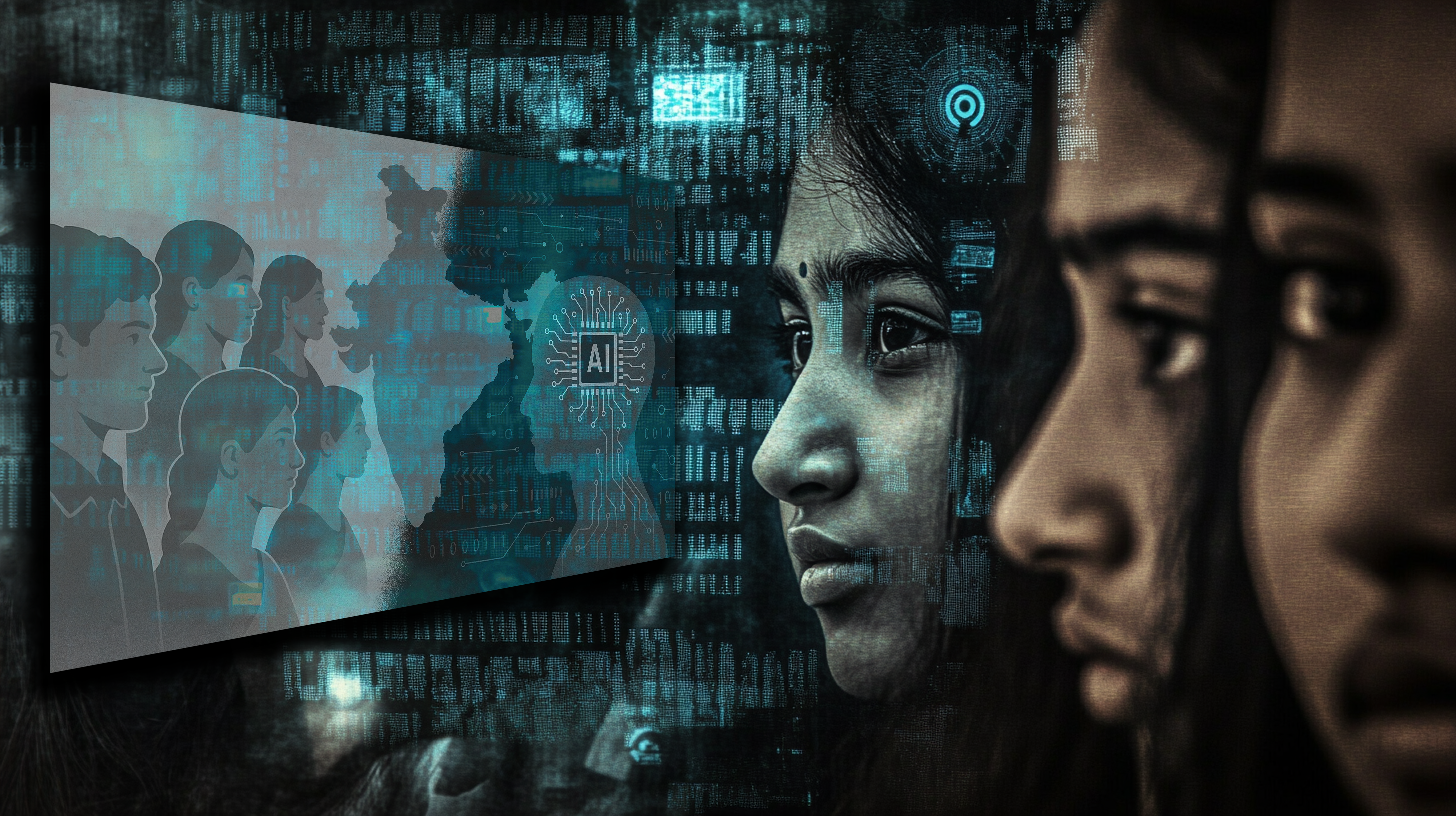
Artificial intelligence shocks India: Is India's economic miracle in danger? AI threatens millions of jobs – Image: Xpert.Digital
Bernstein report warns: AI threatens India's economic growth
AI shock for India: Is India's economic miracle in danger? AI threatens millions of jobs
The rise of artificial intelligence threatens to turn India's demographic advantage into an economic disadvantage. A new report by the US investment bank Bernstein challenges the long-held narrative of India's economic miracle. Around 500 million young Indians aged five to 24 will enter the labor market in the next two decades. But while this "demographic dividend" has so far been seen as a guarantee of economic growth, AI could negate this supposed advantage by taking over numerous jobs more efficiently and cost-effectively than human workers.
Related to this:


The concept of the demographic dividend and its significance for India
The demographic dividend refers to the economic growth potential that arises when the proportion of the working-age population increases relative to the non-working-age population (children and the elderly). For India, this means specifically that demographic change is leading to a decline in the birth rate and a shift in the age structure of society, favoring a growing working-age population. Unlike China, whose labor force is already beginning to shrink, India's labor pool will continue to grow until around 2030.
In theory, this development should bring several economic advantages: The large supply of young workers keeps wage increases moderate, while increased tax revenues expand the potential for investment. At the same time, the balance of dependency shifts – employees have relatively fewer elderly people and children to support, which increases savings rates and expands investment and consumption opportunities.
This demographic dividend was long considered India's greatest economic asset. Forecasts were optimistic: according to current estimates, India could overtake the US by 2039 and become the world's second-largest economy after China.
AI is hitting a nerve in the Indian economy
The Bernstein report now fundamentally challenges these optimistic forecasts. Particularly alarming is the fact that AI is impacting precisely those sectors that have been considered India's economic strength – the service sector, including IT outsourcing, business process management, and knowledge work. Over ten million people work in these areas, many of whom belong to the top 25 percent of earners in the country.
The fundamental problem: AI solutions can already perform many of these tasks with greater precision and speed – and at a fraction of the cost of hiring Indian entry-level professionals. Unlike industrial automation, the shift to AI requires minimal investment, accelerating the transformation. The Bernstein analysis warns emphatically: "The rise of AI threatens to wipe out all the benefits of India's demographic dividend.".
Even at the lower end of the labor market, simple jobs like elevator operators, parking attendants, or tollbooth staff could be replaced by AI systems. Is industry a possible solution? Currently, only twelve percent of India's population works in manufacturing – according to the Bernstein report, India is still in its infancy in this sector.
The Indian Innovation Paradox in the Age of AI
Particularly worrying is what observers might call the "innovation paradox": While India boasts one of the highest rates of AI expertise among its workforce globally and is home to thousands of AI startups, this is barely reflected in relevant patents. India registers only 0.2 percent of all AI patents worldwide, while China accounts for 61 percent and the US for 21 percent.
Bernstein analysts attribute this lag to a flawed strategy: While China has consistently developed its own alternatives to Western technology – from microblogging and electric cars to AI models – India has simply adopted Western platforms. "India didn't adopt the 'ban foreign, develop its own' approach in the internet age – and now it's too late," is their harsh assessment.
This trend is underscored by the recent successes of Chinese AI companies like DeepSeek, whose R1 AI model outperformed many Western competitors in terms of performance – and at a fraction of the cost. The company is already working on a successor model, R2, which is expected to launch this spring.
India's labor market problems in a global context
The challenges posed by AI are not limited to India. Global studies show that even developed economies are facing massive upheavals. In Germany, according to a McKinsey study, up to three million jobs (seven percent of total employment) could be affected by AI-driven changes by 2030.
A key difference: While social safety nets and retraining programs can cushion the transition in industrialized countries, comparable mechanisms are lacking for a large portion of the population in India. Furthermore, there is a stark mismatch between education and the reality of the job market: 70 percent of university graduates and 42 percent of those with a second degree are working below their skill level. AI is likely to exacerbate this problem.
Another worrying difference: Western countries offer significantly higher salaries for advertised positions requiring AI skills – in the US, on average 25 percent more. In India, however, comparable financial incentives for AI specialists are lacking, which could accelerate the brain drain.
Related to this:

Structural problems of the Indian economy
The challenge posed by AI is hitting an Indian economy already grappling with structural problems. Past economic growth has not translated into a proportional increase in employment. Since 2007, the number of employed people in India has even declined slightly, particularly among women in rural areas.
The structure of the Indian economy is changing too slowly: While the service sector is driving economic growth, it employs only 22 percent of the working-age population. The labor-intensive industrial sector has not grown strongly enough to meet the increasing demand for jobs. The proportion of people with regular incomes remains low at 16 percent.
The Indian government faces the challenge of creating the right framework to promote job growth. This includes expanding infrastructure, improving education and healthcare systems, increasing agricultural productivity, combating corruption, and reforming the labor market.
The future outlook: From showcase model to cautionary tale?
India risks transforming from a model of success to a cautionary tale. The demographic advantage, long celebrated as an engine of growth, could turn into a social and economic burden. The central question is: Can the country keep pace with the AI revolution – or will it fall behind in the future?
To overcome these challenges, India would need to invest massively in its own AI research and development, reform its education system, and develop an AI strategy that takes into account the country's unique demographic situation. Specifically, this means promoting AI innovations that complement human labor and do not primarily aim to save labor.
At the same time, Indian policymakers must find new ways to harness the demographic dividend in the age of AI. This could include promoting sectors less susceptible to AI automation, such as personal services, creative industries, or sustainable agriculture.
A wake-up call for India's economic policy
The warning from Bernstein's analysis is an urgent wake-up call for India's economic policy. The demographic dividend – once seen as its greatest economic advantage – could be transformed into a demographic burden by advances in AI.
The challenge is immense: 500 million young people will need productive employment opportunities in the next two decades in a job market increasingly shaped by AI. The previous equation of "more young people = more jobs = more growth" no longer holds true. India must fundamentally rethink its economic strategy and find its own position in the global AI landscape – otherwise, the demographic dividend risks being wasted before it can have its full effect.
Related to this:
Your global marketing and business development partner
☑️ Our business language is English or German
☑️ NEW: Correspondence in your native language!

Konrad Wolfenstein
I and my team are happy to be available to you as your personal advisor.
You can contact me by filling out the contact form here wolfenstein@xpert.digital:or simply call me at +49 7348 4088 965. My email address is
I'm looking forward to our joint project.