
Marketing: In-house or external via an agency? A comprehensive and neutral analysis – Image: Xpert.Digital
The human factor is key to success: Why team quality matters in marketing decisions
Why does this question even arise?
This question regularly occupies marketing managers and CEOs: Should marketing be built in-house or outsourced to an external agency? The discussion is justified, as both approaches have their advantages and disadvantages. But as with many decisions, there's no one-size-fits-all solution. The answer depends on many factors, but above all on one: the people who implement the marketing.
What makes choosing one model over another sensible? First, the company's goals must be clarified. Are the goals continuous marketing measures or project-based campaigns? What budgets are available? How important is direct control over marketing activities?
The discussion is often conducted on a superficial level. What's overlooked is that both in-house teams and agencies are only as good as the people who work there. A motivated, passionate employee can achieve extraordinary results in both a company and an agency. An employee who simply goes through the motions will not bring the desired success in either environment.
What are the advantages of in-house marketing?
The advantages of the internal solution
An in-house marketing team offers several undeniable advantages. First, there's a deep connection to the company. In-house employees often know the corporate culture, products, and target audiences better than external service providers. They are connected to the brand on a daily basis and, over time, develop an intuitive understanding of effective communication strategies.
Communication channels are significantly shorter. When quick decisions are needed, internal teams can react immediately. There's no need to create briefings, coordinate external meetings, or go through lengthy approval processes. This agility can be a decisive advantage, especially in dynamic markets.
Complete control is another important point. The company itself determines how resources are deployed, what priorities are set, and in which direction the marketing develops. This control also extends to costs. Instead of project-based agency fees, predictable fixed costs arise from salaries and infrastructure.
The challenges of internal teams
However, an in-house team also presents challenges. Building a competent marketing team is time-consuming and expensive. Qualified marketing specialists are highly sought after in the job market. Many consciously choose the creative environment and variety offered by agencies.
The costs are often higher than initially calculated. In addition to salaries, there are social security contributions, office equipment, software licenses, and training costs. A complete marketing team with all the necessary specializations can quickly become expensive.
Another problem is limited expertise. An internal team cannot be equally strong in all marketing disciplines. Specialized knowledge in areas such as SEO, performance marketing, or creative concept development is often limited. This can lead to suboptimal results or the need for additional external support.
What are the advantages of using external agencies?
The strengths of external service providers
Agencies bring specialization to the table. They have experts in various marketing disciplines – from strategy and creative to performance marketing. This expertise has been built up over years and is continuously developed. Agencies invest in the latest tools and technologies, which an individual company often cannot afford or is unwilling to invest in.
Industry experience is another advantage. Agencies work with diverse clients from different sectors. They are familiar with best practices, have solved various challenges, and can leverage this knowledge effectively. This external perspective can lead to innovative solutions that internal teams might not have developed.
Flexibility in resource planning is particularly attractive for smaller companies. Instead of maintaining a full internal team, resources can be scaled as needed. Lower costs are incurred during quieter periods, while resources can be quickly increased for larger projects.
The disadvantages of the agency solution
External agencies also have weaknesses. The distance from the company can be problematic. Agency employees often don't know the internal processes, the corporate culture, or the specific challenges as well as internal employees. This can lead to misunderstandings or less targeted measures.
Longer communication channels are unavoidable. Briefings must be created, appointments coordinated, and feedback loops completed. This takes time and can be a hindrance in fast-paced situations.
Relying on external service providers carries risks. If an agency changes its working methods, loses key personnel, or the collaboration ends, the company may be left without a functioning marketing structure. The accumulated knowledge and experience are lost.
The decisive factor: The human being
Passion versus following the rules
The decision between in-house and agency marketing is often made at the wrong level. It's not primarily about structures or cost models, but about the people who implement the marketing. A passionate employee will achieve excellent results in both an internal team and an agency. An employee who only does the bare minimum will deliver disappointing results in both environments.
Passion in marketing is more than just a nice word. It manifests itself in the willingness to go above and beyond, develop creative solutions, and continuously improve. Passionate employees identify with their tasks and the company. They are intrinsically motivated and work not just for the salary, but for the success of the cause.
The opposite extreme is the "jobber"—an employee who drops everything promptly at 5 p.m. and only does the bare minimum. Current studies show that 78 percent of German employees are merely going through the motions. This quiet quitting is a problem for both companies and agencies.
How do you create passionate employees?
Passion doesn't arise spontaneously. It must be nurtured and sustained. Both companies and agencies have a responsibility here. Leadership plays a crucial role. Employees need appreciation, clear goals, and opportunities for professional development.
Intrinsic motivation is more sustainable than extrinsic incentives. While bonuses and premiums can provide short-term motivation, long-term enthusiasm arises from meaningful tasks, autonomy, and opportunities for personal development. Employees want to understand why their work is important and how it contributes to overall success.
The work environment is also crucial. A supportive, appreciative environment fosters motivation. Conversely, micromanagement, a lack of career prospects, or poor leadership can demotivate even passionate employees and lead to a work-to-rule approach.
The third component: Artificial intelligence
AI as a Game Changer in Marketing
In recent years, a third component has entered the marketing discussion: artificial intelligence. AI is fundamentally changing the way marketing is done. It can automate processes, analyze data, create content, and optimize campaigns. Both in-house teams and agencies need to engage with this technology.
AI offers enormous potential. It can analyze vast amounts of data in seconds, recognize patterns, and make predictions. Personalized advertising, automated content creation, and dynamic pricing are just a few examples of AI applications in marketing. The increase in efficiency can be substantial.
At the same time, AI also poses risks. Data privacy, algorithmic bias, and the danger of generic content are challenges that must be addressed. AI can provide creative impetus, but it cannot completely replace human creativity and emotional intelligence.
The impulse generator makes the difference
This illustrates once again that humans remain the decisive factor. AI is only as good as the person driving it. A passionate marketing expert will use AI tools creatively and strategically. They will ask the right questions, critically evaluate the results, and incorporate human elements where necessary.
An employee who lacks passion for AI may only use it superficially. They will use standardized prompts, accept results without reflection, and fail to unlock the technology's full potential. AI will then become just another tool, a by-the-book tool, rather than a lever for exceptional results.
The initial impetus is crucial. AI needs clear objectives, well-thought-out strategies, and creative approaches. It can support marketing experts in brainstorming, creating variations, and accelerating processes. But the strategic direction, the creative vision, and the emotional connection with the customer must still come from humans.
Our recommendation: 🌍 Limitless reach 🔗 Connected 🌐 Multilingual 💪 Sales power: 💡 Authentic with strategy 🚀 Innovation meets 🧠 Intuition


From local to global: SMEs conquer the world market with a clever strategy - Image: Xpert.Digital
In an era where a company's digital presence determines its success, the challenge lies in creating an authentic, personalized, and far-reaching presence. Xpert.Digital offers an innovative solution that positions itself as the intersection of an industry hub, a blog, and a brand ambassador. It combines the advantages of communication and sales channels in a single platform and enables publication in 18 different languages. Cooperation with partner portals and the ability to publish articles on Google News and a press distribution list with approximately 8,000 journalists and readers maximize the reach and visibility of the content. This represents a crucial factor in external sales and marketing (SMarketing).
More information here:
The crucial question: Where can I find the best people for my marketing?
Which solution is the right one?
It depends on the circumstances
The question of in-house versus agency marketing can't be answered with a blanket statement. Both models can be successful – if the right people are involved and the framework is right. For continuous marketing activities and long-term brand management, there are many arguments in favor of an internal team. For specialized projects or when internal expertise is lacking, an agency may be the better choice.
Many successful companies rely on a hybrid model. A small in-house team handles strategic leadership and ongoing tasks. An agency is brought in for special projects, creative campaigns, or technical implementations. This way, they combine the advantages of both approaches.
Company size also plays a role. Larger companies are more likely to be able to afford a full in-house marketing team. Smaller companies often rely on external support or gradually build up internal expertise.
The importance of leadership
Regardless of the chosen model, leadership is crucial. Both internal teams and external agencies need clear goals, regular feedback, and appreciation for their work. Leaders must understand that marketing is a creative process that requires time and space.
Sustainable employee management means maintaining motivation in the long term. This isn't achieved through constant motivational events or superficial benefits, but through a work environment that fosters intrinsic motivation. Employees want to find meaning in their work, have opportunities for professional development, and be valued as individuals.
Micromanagement is the enemy of motivation. Both internal teams and agencies need trust and freedom to work creatively. Excessive control leads to working to rule and prevents exceptional results.
The future of marketing
Technology and humanity
The future of marketing will be shaped by the combination of technological possibilities and human creativity. AI will take over many routine tasks and open up new possibilities for data analysis and personalization. At the same time, human skills such as empathy, creativity, and strategic thinking will be more important than ever.
Both in-house teams and agencies need to adapt to these changes. They must learn to use AI tools effectively without losing the human element. The key is to use technology to enhance human capabilities, not as a replacement.
The most successful marketing organizations of the future will be those that are both technologically adept and people-oriented. They will strategically use AI to achieve better results, but always with a focus on authentic, emotional connections with their target audiences.
Continuous learning as a success factor
The marketing landscape is changing rapidly. New platforms, technologies, and consumer habits are constantly emerging. Both internal teams and agencies must be prepared to learn and adapt continuously. This requires a culture of continuous learning and a willingness to experiment.
Continuing education is becoming a critical success factor. Marketing experts not only need to expand their professional expertise but also develop technical skills in using AI tools. At the same time, soft skills such as communication, collaboration, and critical thinking are becoming increasingly important.
Companies and agencies that invest in the professional development of their employees will be more successful in the long run. They create an environment in which passion and expertise can flourish – regardless of whether marketing is organized internally or externally.
Humans decide
The debate about in-house marketing versus external agencies is often focused on the wrong aspects. Cost comparisons and organizational structures are important, but not decisive. Success depends primarily on the people who implement the marketing – their skills, their motivation, and their passion for the work.
A passionate employee will achieve outstanding results in both an internal team and an agency. They will use AI tools creatively, learn continuously, and go above and beyond the minimum requirements. An unengaged employee will only deliver mediocre performance in both environments—no matter how good the structure or available tools are.
The art lies in finding the right people, leading them effectively, and creating an environment where passion and creativity can flourish. Both companies and agencies have a responsibility here. They must understand that sustainable motivation doesn't arise from incentives or pressure, but from meaningful tasks, appreciation, and opportunities for development.
AI will continue to transform marketing and open up new possibilities. But here, too, the principle applies: the technology is only as good as the person operating it. A strategically minded, creative innovator will guide AI to extraordinary results. An unmotivated user will achieve only mediocre results, even with the best tools.
The decision between in-house and agency marketing should therefore not be based primarily on cost savings or organizational models, but on the question: Where can I find the best people for my marketing? And how can I ensure that they remain motivated and can work successfully in the long term?
In a world where technology is becoming increasingly important, people remain the decisive factor for success. Companies and agencies that understand this and act accordingly will achieve more successful marketing results in the long run – regardless of their chosen organizational structure.
XPaper AIS - R&D for Business Development, Marketing, PR and Content Hub
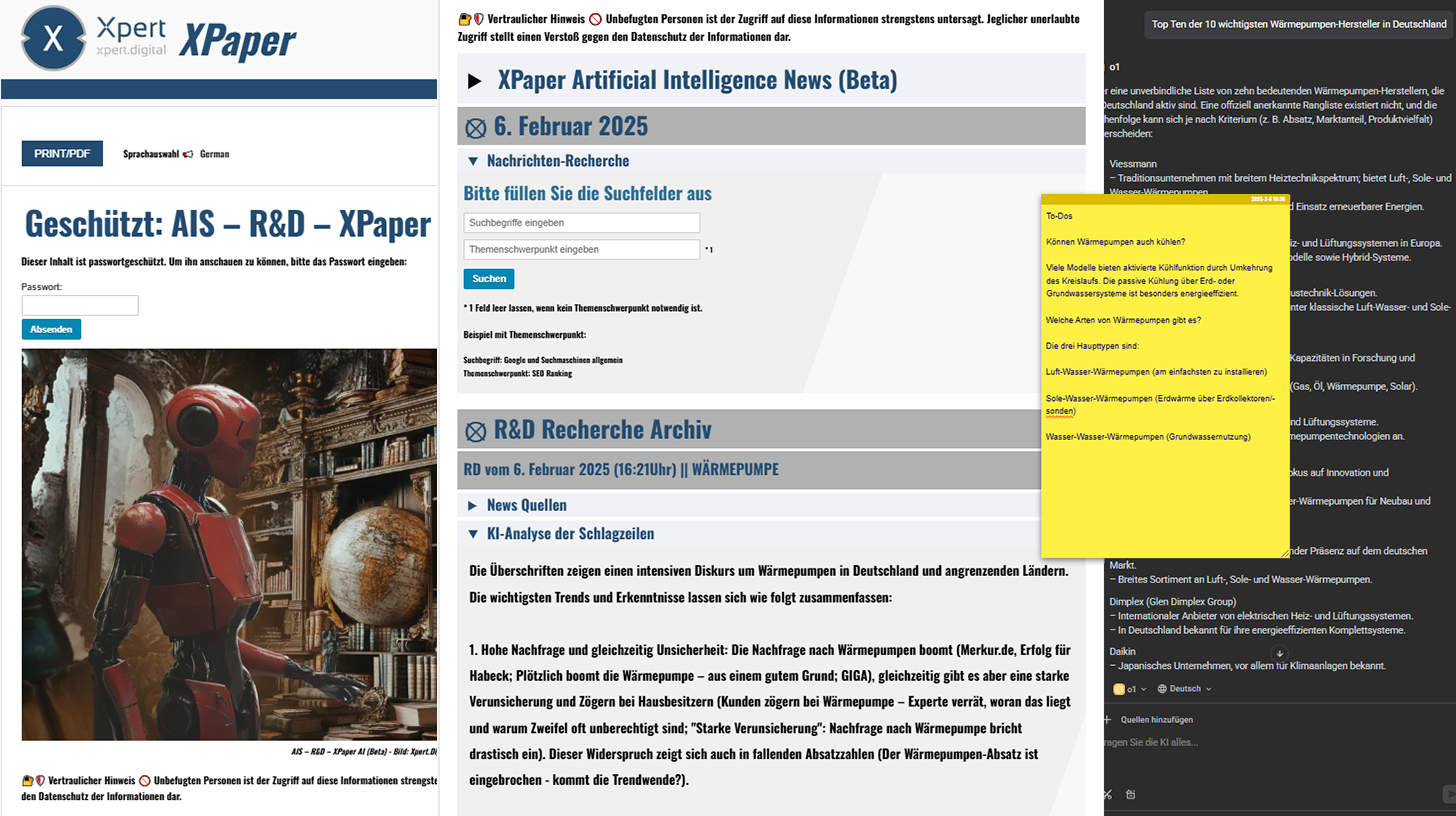
XPaper AIS application possibilities for business development, marketing, PR and our industry hub (content) - Image: Xpert.Digital
This article was handwritten. I used my self-developed R&D research tool, 'XPaper,' which I primarily use for global business development in a total of 23 languages. Stylistic and grammatical refinements were made to make the text clearer and more fluid. Topic selection, drafting, and the collection of sources and materials are all handled by an editorial team.
XPaper News is based on AIS (Artificial Intelligence Search) and differs fundamentally from SEO technology. However, both approaches share the goal of making relevant information accessible to users – AIS on the search technology side and SEO on the content side.
Every night, XPaper sifts through the latest news from around the world with continuous, round-the-clock updates. Instead of investing thousands of euros monthly in cumbersome and generic tools, I've created my own tool to stay up-to-date in my work in Business Development (BD). The XPaper system is similar to tools used in the financial sector, which collect and analyze tens of millions of data points every hour. At the same time, XPaper isn't just for business development; it's also used in marketing and PR – whether as a source of inspiration for the content factory or for article research. The tool allows you to evaluate and analyze all sources worldwide. No matter what language the data source speaks, it's no problem for the AI. Various AI models are available for this purpose. The AI analysis quickly and clearly generates summaries that show what's currently happening and where the latest trends lie – and XPaper offers this in 18 languages. XPaper allows for the analysis of independent subject areas – from general to specific niche topics, in which data can be compared and analyzed with past periods, among other things.
Your global marketing and business development partner
☑️ Our business language is English or German
☑️ NEW: Correspondence in your native language!

Konrad Wolfenstein
I and my team are happy to be available to you as your personal advisor.
You can contact me by filling out the contact form here wolfenstein@xpert.digital:or simply call me at +49 7348 4088 965. My email address is
I'm looking forward to our joint project.