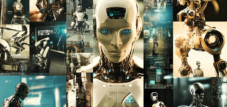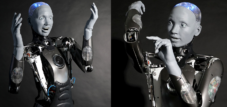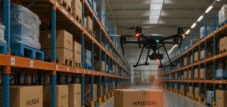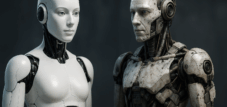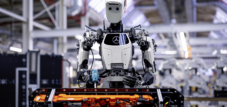
No longer science fiction: Human-machine hybrids – What humanoid robots can do better than any other machine – Image: Xpert.Digital
The rise of robot colleagues: Why BMW and Mercedes are now relying on human-like machines
More than just AI: The one major problem still hindering the triumph of humanoid robots
Long the stuff of science fiction, they are now entering the factory floors of the real world: A new era of automation is dawning, driven by humanoid robots that no longer operate as specialized machines in isolated environments, but as versatile assistants right at our side. This paradigm shift is made possible by the convergence of two megatrends: groundbreaking advances in artificial intelligence, which enable robots to learn by observation, and highly developed sensors and actuators that give them human-like movements.
While automotive giants like BMW and Mercedes-Benz, as well as global logistics companies, are already launching initial pilot projects to automate monotonous and physically demanding tasks, the path to mass adoption is still fraught with considerable hurdles. Limited battery life, unresolved safety issues, and still-high acquisition costs are hindering widespread deployment. Nevertheless, the forecasts are enormous, and a global race between the USA and China for technological supremacy is already in full swing. Are we at the beginning of a revolution that will sustainably shape our working world and society, or is it merely hype with unresolved teething problems? This overview sheds light on the current state of the technology, the biggest challenges, and the far-reaching visions behind the new era of robotics.
Related to this:

The new robot era: Why humanoid machines could shape the future of automation
Are we facing a paradigm shift in robotics? While traditional industrial robots served for decades as specialized workhorses in secluded production areas, a new generation of humanoid robots is making its way into the human workplace. The question is no longer whether these machines will arrive, but how quickly they will become widespread and what role they will play in our future.
What makes humanoid robots so special?
What distinguishes a humanoid robot from a conventional industrial robot? The answer lies in its fundamental design philosophy. A humanoid robot has a human-like body structure with two arms, two legs, and a movable torso. This configuration opens up entirely new possibilities, as it allows the machines to operate in environments originally designed for humans.
The decisive advantage lies in their universal adaptability. While traditional robots are specifically designed for certain tasks and often require extensive modifications to the work environment, humanoid robots can theoretically be used anywhere humans work. They use the same doors, stairs, and work surfaces, and operate the same tools and machines.
What technological advances will enable the breakthrough?
How could decades of research suddenly result in a market-ready technology? The answer lies in the convergence of several technological developments. On the one hand, advances in electromechanical actuators and significant improvements in sensor technology have created the hardware foundation. Modern humanoid robots are equipped with sophisticated camera systems, lidar sensors, microphones, and force-torque sensors. Tactile sensors enable them to detect whether they are coming into contact with objects or people.
On the other hand, artificial intelligence has become the most important enabler for humanoid robots. Breakthroughs in this area have been achieved faster than even experts had anticipated. Generative AI models are revolutionizing the ways in which robots can interact and could be the key to providing robots with world models that enable them to navigate their environment.
How are Large Behavior Models revolutionizing robot control?
What happens when robots are no longer programmed but trained? Boston Dynamics demonstrates a completely new approach with its Atlas robot: Large Behavior Models (LBMs). These enable the robot to learn complex tasks through observation, instead of being programmed in detail for every movement.
The technology works similarly to language models: Atlas can learn both simple pick-and-place tasks and more complex manipulations such as tying a rope, turning over a bar stool, or spreading out a tablecloth. It is particularly noteworthy that these tasks would be extremely difficult to implement using traditional robot programming techniques, as they involve deformable geometries and complex manipulation sequences.
Where are humanoid robots already working today?
Which companies are already using humanoid robots in practice? The list of commercial applications is still manageable, but quite impressive. Agility Robotics has taken on a pioneering role with its Digit robot. In mid-2024, the company signed a multi-year contract with the logistics provider GXO. The Digit robots are used in a textile company, where they pick up boxes from transport racks and place them on conveyor belts.
BMW has been testing humanoid robots from the Californian company Figure at its Spartanburg, USA plant for about a year. The Figure 02 robots pick up sheet metal parts from a transport rack and place them into a fixture. Mercedes-Benz is also testing humanoid robots from the Texas-based company Apptronik at its Digital Factory Campus in Berlin and in its production plants. The Apollo robots still have relatively simple tasks: transporting components or modules to the production line or performing initial quality checks.
Why are car manufacturers leading the way?
What makes the automotive industry an ideal testing ground for humanoid robots? The industry faces several challenges that humanoid robots can address. First, there is an acute shortage of skilled workers, especially in physically demanding areas. Second, modern production methods require greater flexibility that traditional, stationary robots cannot offer.
Humanoid robots offer a crucial advantage here: they can be integrated into existing production lines without requiring extensive modifications. This is particularly valuable in so-called brownfield situations, where existing facilities are to be automated. Their human-like form allows the robots to use the same tools and workstations as human workers.
What challenges limit its use?
Why aren't humanoid robots in widespread use yet? The biggest hurdles lie in several critical areas. Battery life poses a fundamental challenge. Current humanoid robots have a battery life of only 2 to 4 hours. For practical use, an improvement to at least 4 to 5 hours with fast charging within one hour is necessary.
The problem lies in the energy intensity of upright movement. Standing and walking upright in a stable manner is energy-intensive and requires enormous computing power, which in turn consumes a correspondingly large amount of energy. Walking on two legs is less efficient than rolling. A humanoid robot weighing approximately 80 kg and with a body volume of 80 liters has only limited space for batteries when limbs, motors, electronics, and structural components are taken into account.
How complex is the mechanical design?
What makes the design of humanoid joints so challenging? A human has 140 true joints; including so-called pseudo-joints like intervertebral discs, the number rises to 212. A humanoid robot, on the other hand, has to manage with only about 48 to 68 joints. This reduction leads to compromises in mobility and explains why even advanced robots still appear "stiff in the hips.".
The demands placed on joint technology are extreme. Humanoid robots require highly compact designs that integrate motors, gearboxes, drives, encoders, and sensors into a single module. Simultaneously, they must offer low weight, low energy consumption, minimal heat generation, and high responsiveness. Depending on their position in the body, the requirements vary considerably: leg joints must bear heavy loads and generate high torques, while arm and wrist joints need to be optimized for precision and compactness.
What security risks exist?
Why is safety the biggest hurdle to the mass deployment of humanoid robots? Unlike traditional industrial robots, which operate in shielded areas, humanoid robots are intended to work directly alongside humans. This creates entirely new safety challenges.
A critical problem is balance control. When a robot is walking on two legs, a reliable control system must ensure its balance. If the control system fails, the robot can fall over and injure people nearby. Humanoid robots are often large, heavy, and powerful. Without adequate safety precautions, they could inadvertently injure people through collisions, crushing, or falls.
To make matters worse, there are still no established safety standards for dynamically stable industrial mobile robots. Although the International Organization for Standardization (ISO) has appointed a committee to develop safety rules, these standards are still under development.
When will humanoid robots become economically viable?
At what cost will humanoid robots become an economically attractive alternative? Prices are falling dramatically faster than expected. Currently, most humanoid robots cost between $200,000 and $250,000. Mercedes-Benz production chief Jörg Burzer is quoted as saying: "Costs will be crucial... when they reach a double-digit thousand-dollar figure – which is entirely possible – it will become very interesting.".
Optimistic forecasts predict significantly lower costs. The German consultancy Nexery expects an average selling price of $55,000 in 2030. Morgan Stanley projects that by 2050 the average selling price of a humanoid robot will fall to $50,000, which is roughly equivalent to the cost of a year's human labor in high-income countries.
The cost analysis becomes particularly interesting when considering total operating time. If a robot works two 8-hour shifts per day, a robot costing US$16,000 effectively costs less than US$2.75 per hour in depreciation terms over a 3-year period.
How big could the market become?
What economic dimensions could humanoid robotics reach? Forecasts vary considerably, but all point to enormous growth potential. Morgan Stanley estimates that the market for humanoid robots could reach a volume of $5 trillion by 2050, including the associated supply chains as well as repair, maintenance, and support services. By 2050, more than 1 billion humanoid robots could be in use.
The most ambitious forecast comes from Tesla CEO Elon Musk, who predicts that there will be ten billion humanoid robots in the world by 2040 – more than the 9.2 billion people who, according to UN projections, will be living on Earth in 2040. At the beginning of 2024, Goldman Sachs projected a market volume of 28 billion US dollars for 2035 – six times higher than a previous estimate.
A new dimension of digital transformation with 'Managed AI' (Artificial Intelligence) - Platform & B2B solution | Xpert Consulting


A new dimension of digital transformation with 'Managed AI' (Artificial Intelligence) – Platform & B2B solution | Xpert Consulting - Image: Xpert.Digital
Here you will learn how your company can implement customized AI solutions quickly, securely and without high entry barriers.
A managed AI platform is your all-inclusive, worry-free solution for artificial intelligence. Instead of dealing with complex technology, expensive infrastructure, and lengthy development processes, you receive a ready-made solution tailored to your needs from a specialized partner – often within just a few days.
The key advantages at a glance:
⚡ Rapid implementation: From idea to ready-to-use application in days, not months. We deliver practical solutions that create immediate added value.
🔒 Maximum data security: Your sensitive data stays with you. We guarantee secure and compliant processing without sharing data with third parties.
💸 No financial risk: You only pay for results. High upfront investments in hardware, software, or personnel are completely eliminated.
🎯 Focus on your core business: Concentrate on what you do best. We take care of the entire technical implementation, operation, and maintenance of your AI solution.
📈 Future-proof & scalable: Your AI grows with you. We ensure continuous optimization and scalability, and flexibly adapt the models to new requirements.
More information here:
Germany in the robotics race: Catching up or falling behind?
Which countries are leading the development?
Where are the centers of humanoid robotics innovation? Market observers see the USA and China clearly in the lead. The International Federation of Robotics lists 46 companies worldwide that have developed humanoid robots with legs: eight in North America, 21 in China, and six in Japan and Korea.
In China, the government set clear development goals in this area years ago and provides massive support to the industry. In the US, enormous sums of venture capital are flowing into robotics startups. Additionally, there is great interest in the US in using robotics for military and security purposes, resulting in substantial funding from DARPA and the US Department of Defense.
Related to this:


What role does Germany play in humanoid robotics?
Can Germany still catch up in humanoid robotics? The only German player to have gained significant recognition in this field is Neura Robotics from Metzingen near Stuttgart. Founded in 2019, the company focuses primarily not on humanoid robots, but on "cognitive robots." Of the five robots in its product line, only one is humanoid.
The German Research Center for Artificial Intelligence (DFKI) is working intensively on the future of humanoid robotics. The Systems AI for Robot Learning (SAIROL) research department develops learning-based control algorithms for humanoid robots. The DFKI Robotics Innovation Center in Bremen is researching innovative methods for safe and self-learning robot control.
What are the most important areas of application?
In which areas will humanoid robots first be deployed? The first commercial applications are concentrated in logistics and manufacturing, where tasks are repetitive and structured. Over 90 percent of the humanoid robots projected by 2050 are expected to be used for industrial and commercial purposes, with less than 10 percent in households.
In manufacturing, humanoid robots can perform a wide variety of tasks: machine control, loading of production lines, transport of workpieces between workstations, assembly work, loading and unloading of machines, welding, screwing, polishing and grinding, gluing and dosing, inspection and quality control, and painting.
How does the way of working change from deterministic to autonomous?
What does the paradigm shift from deterministic to autonomous robotics mean? While the movements of classical robots are programmed down to the smallest detail, humanoid robots are intended to recognize and analyze their environment and, at least within certain limits, make autonomous decisions regarding their actions.
This transformation is not limited to humanoid robots, but can also be applied to stationary robots or those on wheels. AI is initially independent of the physical form and can be used in various "embodiments." Nevertheless, humanoid robots offer unique advantages due to their versatility and adaptability to human environments.
What alternative concepts are there?
Are two legs always the best solution? Many developers and users are asking themselves whether a robot with two legs is truly the optimal solution, or perhaps one with four legs would be more suitable. Four-legged robots are already in productive use: Boston Dynamics' robot dog "Spot" has been roaming the Audi and BMW plants for some time now, scanning the facilities and creating digital twins of the factories.
Apptronik designed its Apollo robot with a modular construction. Depending on the application, the customer can receive the torso on a wheeled chassis or mounted on a fixed base. This flexibility demonstrates that not all applications require a fully humanoid robot.
Which industries will be transformed first?
Where will the transformation brought about by humanoid robots be felt most quickly? The logistics industry is at the forefront. GXO Logistics, one of the world's largest contract logistics providers, sees humanoid robots as a potential solution to ongoing labor shortages and the demand for adaptable automation. The robots take over repetitive, physically demanding tasks, allowing human workers to focus on safer, more creative activities.
In automotive production, BMW, Mercedes-Benz, and other manufacturers are demonstrating how humanoid robots can be integrated into existing iFactory initiatives. This digital production strategy aims to increase efficiency, sustainability, and flexibility in manufacturing.
What are the long-term societal impacts?
How will the world of work change with the advent of humanoid robots? While automation could potentially eliminate 85 million jobs by 2025, it will simultaneously create 97 million new roles, many of them related to robot management and maintenance. In manufacturing, 2.1 million jobs could become vacant by 2030, with robot maintenance and programming among the most in-demand skills.
Humanoid robots are transforming jobs rather than simply eliminating them. They typically take over dangerous, repetitive, and physically demanding tasks, shifting human workers into higher-value positions such as robot programming, maintenance, process optimization, and quality control.
What ethical questions arise?
What social and ethical considerations need to be taken into account? A key question is what societies ultimately want to "allow" technology to do and what framework they set for it. The integration of humanoid robots requires careful consideration of job security and employee acceptance.
The use of humanoid robots in private households and in the care of the elderly is particularly sensitive. Safety considerations will ensure that humanoid robots only enter these areas in the final stages of development. One expert is quoted as saying: "Until they can prove that a humanoid robot will never fall on a baby, it won't work in the home.".
How is production capacity developing?
When will humanoid robots be available in larger quantities? Some manufacturers are already finalizing plans for mass production. Figure has announced plans to establish a robot manufacturing facility where humanoid robots will produce other humanoid robots. At the start of mass production, the capacity will be 12,000 robots per year.
Apptronik has partnered with the Florida-based contract manufacturer Jabil, which will now produce the Apollo robots worldwide. Tesla has ambitious production targets: internal plans call for approximately 10,000 Optimus units to be produced by 2024, followed by production version 2 in 2025 with a capacity of 10,000 units per month.
What determines success or failure?
What factors will determine the widespread adoption of humanoid robots? Success depends on overcoming several critical challenges. Technically, advances are needed in robustness, resilience, power supply, motor skills, and artificial intelligence. Economically, costs must continue to decrease and production volumes must increase to achieve economies of scale.
Regulatory aspects such as security standards and legal frameworks will be crucial. Societal acceptance of the new technology must be fostered. Much of the development takes place within tech companies, requiring enormous investments that far exceed public funding. This leads to a lack of transparency and makes realistic assessments of actual progress difficult.
How do humanoid robots differ from traditional industrial robots?
What makes humanoid robots structurally different from conventional automation solutions? Traditional industrial robots are optimized for specific tasks and operate with significantly fewer joints, making them easier to control, faster, and more reliable. They will therefore continue to form the backbone of automation for production tasks requiring high speed and precision.
Humanoid robots, on the other hand, are generalists. Their strength lies not in speed or precision at individual tasks, but in their versatility and adaptability. They can theoretically perform any task a human can, albeit perhaps more slowly or less precisely. This flexibility makes them particularly valuable in dynamic environments where requirements change frequently.
What technological breakthroughs are still pending?
What innovations could bring about the final breakthrough? Solid-state batteries promise higher energy density, improved safety, and a longer lifespan compared to traditional lithium-ion batteries. This technology could solve the energy density problem and enable longer operating times for humanoid robots.
In actuator technology, new joint concepts such as the Archimedes Drive are being developed, promising high torques in a compact design and with quiet operation. Advances in materials science could enable lighter and stronger components.
How realistic are the optimistic forecasts?
Are the trillion-dollar forecasts realistic or exaggerated? Experts are divided. On the one hand, the technical challenges beyond tech demos remain considerable. On the other hand, developments are accelerating exponentially, driven by enormous private investment and competition between tech giants.
Widespread industrial application is not expected for another five to ten years. Higher production volumes are necessary to reduce costs. The introduction of humanoid robots is likely to proceed relatively slowly until the mid-2030s, accelerating in the late 2030s and 2040s.
What does this mean for the future of work?
How will human-robot interaction develop? The future lies not in replacing human workers with robots, but in intelligent cooperation. Humanoid robots will complement human capabilities, not replace them. They will take over physically demanding, repetitive, or dangerous tasks, allowing humans to focus on creative, strategic, and interpersonal activities.
This development requires massive investments in retraining and further education. Companies implementing humanoid robots report an average increase of 35 percent in employee training expenditures. New job profiles are emerging: robot trainers and supervisors, maintenance specialists, process designers, and creative problem solvers.
Humanoid robotics is at a turning point. While the technological foundations have been laid and initial commercial applications demonstrate what is possible, significant challenges remain. Success will depend on whether the industry can strike a balance between technological innovation, economic viability, regulatory certainty, and societal acceptance. The next five to ten years will be crucial in determining whether humanoid robots truly take over human spaces or remain a niche technology for the time being.
We are here for you - Consulting - Planning - Implementation - Project Management
☑️ SME support in strategy, consulting, planning and implementation
☑️ Creation or realignment of the AI strategy
☑️ Pioneer Business Development

Konrad Wolfenstein
I would be happy to serve as your personal advisor.
You can contact me by filling out the contact form below or simply call me on +49 7348 4088 965 .
I'm looking forward to our joint project.
Write to me



Xpert.Digital - Konrad Wolfenstein
Xpert.Digital is a hub for industry focusing on digitalization, mechanical engineering, logistics/intralogistics and photovoltaics.
With our 360° Business Development solution, we support renowned companies from new business to after-sales.
Market intelligence, smarketing, marketing automation, content development, PR, mail campaigns, personalized social media and lead nurturing are part of our digital tools.
You can find more information at: www.xpert.digital - www.xpert.solar - www.xpert.plus
Keep in touch