
How is AI modernizing the financial sector? Managed AI as an accelerator of digital transformation – Answers to 25 questions – Image: Xpert.Digital
Build vs. Buy in the financial sector: Why developing AI in-house is often the wrong strategy
The new currency of the financial world is intelligence – How Managed AI is redefining the sector
The financial industry is facing perhaps its biggest transformation since the introduction of online banking. But this time it's not just about digitizing analog processes, but about making them fundamentally smarter. Pressure is mounting on banks, insurers, and finance departments from all sides: customers expect real-time responses, regulators demand complete transparency, and the market is calling for drastic cost efficiency.
Within this complex environment, artificial intelligence (AI) has evolved from an experimental innovation project into an indispensable strategic infrastructure. However, the central question for decision-makers is no longer "whether" AI should be used, but "how".
A crucial paradigm shift is taking place: away from risky, expensive in-house development (Build) and towards managed AI (Buy). Instead of investing years in building internal data science teams and proprietary models, modern financial institutions are increasingly turning to highly specialized, externally managed AI solutions. These "managed services" not only offer immediate scalability and access to global data pools, but also solve one of the industry's biggest problems: meeting complex compliance requirements while maintaining technological agility.
From automatically processing thousands of invoices to autonomous AI agents that predict liquidity bottlenecks – managed AI transforms rigid cost centers into dynamic centers of excellence. But how does this transformation work in detail? What risks need to be considered? And why is the ROI of managed solutions often many times higher than that of internal projects?
The following deep dive provides answers to the 25 most important questions about modernizing the financial sector. It highlights the strategic advantages, the technical implementation, and the visionary future of an industry where humans and machines work hand in hand.
Related to this:
Questions and answers on modernizing finance through managed AI
The financial sector is undergoing a technological transformation that surpasses all previous modernization phases in both speed and impact. Artificial intelligence (AI) has evolved from an analytical tool to a strategic infrastructure. While traditional financial processes relied on manual data entry, repetitive checks, and human judgment, the focus is increasingly shifting towards predictive automation.
The revolution, however, lies not only in AI itself, but in how it is implemented and operated. Managed AI – that is, externally provided and continuously maintained AI solutions – transforms an abstract technology into an immediately usable tool. Companies no longer need to build their own data centers or data science teams, but can instead access ready-made, scalable models that deliver secure, compliant, and measurable added value.
Related to this:


Why is the financial sector a hotspot for artificial intelligence?
The financial sector generates and processes an enormous amount of structured and unstructured data: transactions, balance sheet figures, contracts, emails, regulatory documents. This data is highly sensitive, strictly regulated, and business-critical. It is precisely at this interface that AI demonstrates its strengths: it recognizes patterns, draws connections, and can automate routine tasks without requiring human attention at every step.
Managed AI, in particular, accelerates this development because providers have been able to train their models on global datasets, thus offering pre-trained solutions that deliver immediate results. The larger the dataset, the more precise the models – an advantage that individual banks or insurance companies could hardly replicate internally.
What is the difference between in-house development (Build) and managed service (Buy)?
This is the central strategic decision for many financial institutions: Do they develop their own AI systems or do they buy ready-made, managed solutions?
In-house development (building) involves setting up an internal data science team to design, train, test, and operate models. This provides long-term control but is expensive, time-consuming, and risky. Studies show that up to 60% of internal AI projects fail, mostly due to poor data quality, insufficient scalability, or regulatory hurdles.
Managed AI (Buy), on the other hand, shifts this risk to the provider. It offers ready-to-use AI models that run as a service – including maintenance, updates, and compliance certifications. Companies don't pay high upfront costs, but rather usage-based fees.
The pragmatic approach: Only those elements that generate a genuine competitive advantage should be developed (built) internally – for example, in algorithmic trading. Standard processes such as document capture or contract analysis are ideal for managed AI models because they benefit from the experience and economies of scale of specialized providers.
What specific economic advantages does managed AI offer – especially in terms of ROI?
Return on investment (ROI) is a crucial factor in the financial sector. Managed AI can significantly accelerate ROI because it drastically reduces the time-to-value – the time until the first measurable benefit.
An internal project for automated document recognition can take 12 to 18 months before delivering initial stable results. In contrast, a managed AI solution often requires only a few weeks for integration. The models are already trained, tested, and optimized based on customer feedback.
Measurable results include, for example:
- Reduction of costs per invoice by up to 80%.
- Reduction of the month-end closing process from several days to just a few hours.
- Reducing human error in audits, which reduces compliance penalties.
- Faster release of liquidity through automated payment reconciliations.
These effects are cumulative: the more processes are networked, the greater the economies of scale. A bank that runs its accounts payable, dunning, and contract analysis on the same managed AI platform achieves an exponential boost in productivity.
What role do CIOs and CTOs play in the managed AI context?
For CIOs and CTOs, managed AI is strategically and operationally relevant. Its value lies not only in its technical performance, but also in its security and maintenance model.
Financial data is among a company's most sensitive assets. Any integration of new technologies must meet stringent security and data protection standards. Managed AI providers typically hold certifications such as SOC 2, ISO 27001, or GDPR compliance – requirements that can take months or even years to establish internally.
At the same time, managed AI models solve the classic problem of "model drift." AI models lose accuracy over time because data distributions change. With managed services, the provider automatically takes care of retraining and infrastructure updates. This gives CTOs continuity and stability, while freeing up internal IT resources for innovation projects.
Overall, this creates a governance model that combines control and security: IT monitors usage and interfaces, while the provider guarantees the model quality.
How exactly does AI modernize the financial data process?
The modernization of finance begins with two core functions: data extraction and data abstraction.
Extraction means that systems automatically gather information from unstructured sources. These are typically invoices, receipts, contracts, or emails containing booking information. Without AI, clerks had to manually enter this data – an error-prone and costly process.
Managed AI automatically reads every incoming document. The AI recognizes numbers, dates, and contextual information regardless of format, layout, or language.
Abstraction goes a step further: The AI understands the content. It recognizes whether an amount represents a travel expense reimbursement or a supplier invoice, classifies booking codes, and automatically assigns cost centers. This semantic intelligence makes the data immediately usable for ERP systems like SAP or Oracle, without any manual post-processing.
For example, a managed AI solution scans 10,000 supplier invoices per day, automatically recognizes which expenses occur regularly, prioritizes payments by due date, and can even derive predictive cash flow forecasts.
Which specific processes in finance can be automated?
The range of automatable processes is constantly growing along with the capabilities of AI. Key use cases include:
- Accounts payable and accounts receivable: Automatic processing, reconciliation and approval of invoices.
- Expense and travel cost management: Identifying, validating, and posting expenses from email receipts or scans.
- Financial planning and forecasting: Using historical data to predict revenues, costs and risks.
- Compliance and audit: Automatic review of booking policies and detection of potential fraud indicators.
- Contract analysis: Quickly extract and evaluate legally relevant clauses.
Managed AI simplifies these processes because it works with pre-trained domain models. Banks, insurance companies, and fund managers no longer need to develop their own AI but can instead obtain specialized models "as-a-service" that are precisely optimized for their specific work environment.
What are AI agents, and how are they changing financial processes?
AI agents represent the next evolutionary step after static automation. While classical systems react to fixed, predefined rules, AI agents act autonomously, interpret situations, and perform actions that would normally require human interaction.
For example, an agent can identify a discrepancy between an order and an invoice, independently formulate a query to the supplier, analyze their response, and adjust the booking in the system.
This paradigm shift creates "digital employees" in financial administration. Instead of employees checking every transaction, they monitor AI agents at a strategic level. This leads to faster workflows, higher accuracy, and better compliance.
This is particularly important in the following areas:
- Dunning (Dunning): AI recognizes overdue invoices and independently initiates reminder letters.
- Cash flow management: Agents dynamically prioritize payments based on liquidity.
- Supplier communication: Automated resolution of discrepancies without human intervention.
How do capital markets benefit from managed AI?
In the capital markets, speed is just as important as precision. Managed AI enables the real-time analysis of enormous amounts of data – from financial news and social media sentiment to company reports.
A prominent example is sentiment analysis. Pre-trained NLP (Natural Language Processing) models can evaluate news streams from hundreds of thousands of sources in seconds: Is market sentiment towards a company positive or negative? Which topics were trending before a price movement?
An asset manager who accesses managed AI signals doesn't need to operate their own data pipeline, finance API maintenance, or conduct model training. Instead, aggregated, validated data streams flow into their trading strategy. This reduces technical barriers to entry and enables smaller funds to implement strategies with big data elements.
Similarly, managed AI can support regulatory requirements in high-frequency trading by automatically checking transaction data for market abuse patterns.
🤖🚀 Managed AI Platform: Faster, safer & smarter to AI solutions with UNFRAME.AI
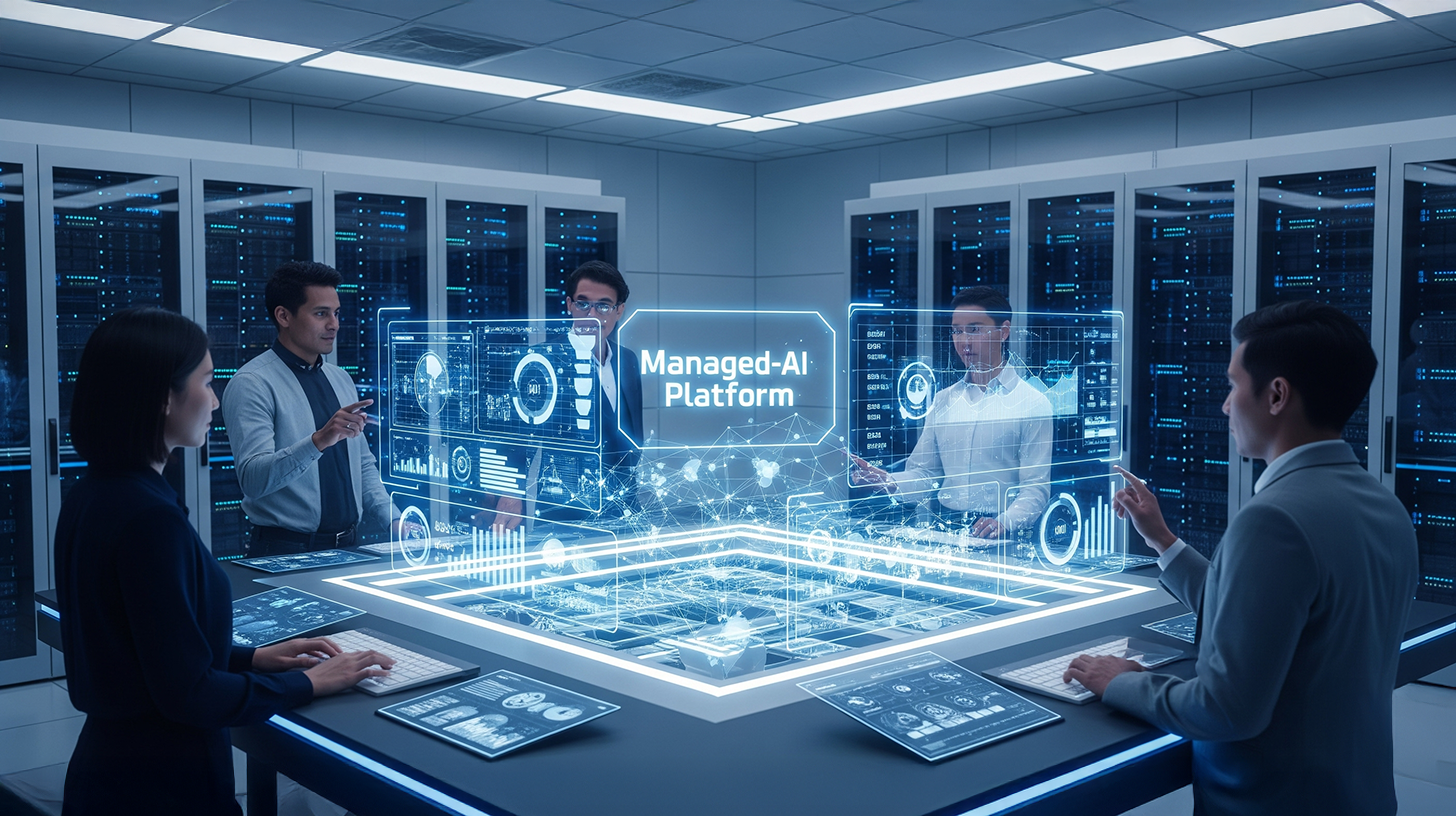
Managed AI Platform - Image: Xpert.Digital
Here you will learn how your company can implement customized AI solutions quickly, securely and without high entry barriers.
A managed AI platform is your all-inclusive, worry-free solution for artificial intelligence. Instead of dealing with complex technology, expensive infrastructure, and lengthy development processes, you receive a ready-made solution tailored to your needs from a specialized partner – often within just a few days.
The key advantages at a glance:
⚡ Rapid implementation: From idea to ready-to-use application in days, not months. We deliver practical solutions that create immediate added value.
🔒 Maximum data security: Your sensitive data stays with you. We guarantee secure and compliant processing without sharing data with third parties.
💸 No financial risk: You only pay for results. High upfront investments in hardware, software, or personnel are completely eliminated.
🎯 Focus on your core business: Concentrate on what you do best. We take care of the entire technical implementation, operation, and maintenance of your AI solution.
📈 Future-proof & scalable: Your AI grows with you. We ensure continuous optimization and scalability, and flexibly adapt the models to new requirements.
More information here:
Managed AI: The secret lever for your competitive advantage
What role does AI play in the legal and regulatory environment?
Law and compliance are both critical and complex in the financial sector. AI systems support these areas by reviewing documents, extracting clauses, and highlighting risks.
Managed AI platforms offer specialized modules for analyzing legal texts, such as ISDA framework agreements, loan agreements, or general terms and conditions. These systems compare thousands of contract clauses for discrepancies or potential pitfalls. What would take a team of lawyers days happens in seconds.
A practical advantage lies in the documentation: Every AI decision can be logged in an audit-proof manner. This facilitates audits and enables regulatory evidence to be provided to authorities.
Because managed services adhere to strict GDPR and AML (Anti-Money Laundering) regulations, compliance security is not weakened, but rather strengthened. For banks, this translates into lower legal risks and reduced auditing efforts.
How does managed AI improve customer support in financial institutions?
Customer expectations have changed radically. Nobody wants to wait days for a response from their bank's customer service anymore. At the same time, dealing with financial matters requires a precise understanding of sensitive data.
Managed AI chatbots and voice assistants are trained on industry-specific taxonomies – that is, the semantic understanding of transaction details. This allows the bot to answer questions like "Why was my direct debit declined?" or "When will my transfer be credited?" in a context-appropriate manner.
These systems analyze transaction data, identify patterns, and offer customer-centric solutions. They relieve the burden on human service employees while simultaneously delivering consistent, documented answers.
Since Managed AI already includes pre-trained language models for banks and insurance companies, the tedious training of internal chatbot systems is eliminated. Integration and benefits are almost immediate.
What challenges exist when implementing managed AI?
Despite all the advantages, companies must consider some hurdles:
- Data sovereignty: Companies must clarify how sensitive data is transferred to the managed AI provider and protected there.
- Integration: Existing IT systems, especially older ERP or accounting platforms, require APIs and adjustments.
- Change Management: Employees must learn to interact with AI systems and critically question their results.
- Trust: Managed AI requires trust that external providers will deliver stable, long-term results and meet compliance requirements.
Many providers address these concerns with strict encryption procedures, clearly defined service-level agreements (SLAs), and transparent audit logs.
How does managed AI differ from traditional outsourcing in the financial sector?
A common misconception is that managed AI is simply a new form of outsourcing. In fact, the approach goes significantly further. While traditional outsourcing transfers personnel or tasks, managed AI transfers the intelligence – that is, the ability to automate and make decisions.
The company retains control over data, processes, and results. It doesn't delegate tasks, but rather functionality. The AI works in real time with internal systems, but is trained and maintained externally.
This creates a flexible organizational form: human and artificial workforces cooperate in real time. Companies retain their compliance responsibilities but significantly reduce operating costs and development risks.
What will the finance department of the future look like?
The finance department of the future is no longer a manual accounting office, but a data-driven center of excellence. Routine tasks are almost completely automated, and employees act as AI supervisors, validating results, managing strategies, and interpreting models.
Key features of this transformation are:
- Real-time reporting instead of monthly closing.
- Predictive forecasting instead of static budget planning.
- Continuous risk analysis by AI agents.
- Close integration of finance, IT and compliance.
Internally, roles will change: AI-powered analysts will replace data entry clerks. Strategic consulting services will gain importance as AI takes over routine tasks.
What role do ethics and transparency play in managed AI models?
The introduction of AI in finance inevitably raises ethical questions – especially regarding credit decisions, risk assessments, or customer segmentation.
Managed AI providers must therefore offer comprehensive transparency mechanisms: explainable AI models, traceable decision rules, and regular fairness audits. Some providers use bias dashboards to automatically detect potential discrimination.
This creates a new quality criterion for financial institutions: AI ethics as a competitive factor. Companies that use algorithms responsibly not only improve their compliance but also their reputation.
How can managed AI initiatives be strategically prioritized?
Not every function immediately justifies the use of AI. The key lies in a step-by-step approach based on three phases:
1. Identify automation opportunities: High-volume processes with clear rules (e.g., document processing).
2. Pilot and integrate: Test run with managed services to verify performance and data flows.
3. Scale and network: Successful AI modules are integrated across ERP, CRM, and compliance systems.
Many organizations begin with document-centric processes because they quickly deliver measurable results. The next step involves analytical tasks such as forecasting and risk assessment.
What trends are emerging for the coming years?
Several trends can be foreseen for the period up to 2030:
- Ubiquitous AI agents: Instead of isolated modules, ecosystems of autonomous financial agents are emerging that interact via common interfaces.
- Embedded Finance and AI: Integration of financial services directly into business processes – with AI-supported decision logic in the background.
- Real-time auditing: Continuous monitoring of transactions instead of occasional checks.
- Hyper-personalized banking: AI creates individual financial strategies for each customer based on live data.
- Cooperative AI: Humans and AI work collaboratively; specialists monitor, question, and control algorithmic decisions.
Managed services become the basic infrastructure for this – comparable to cloud computing a decade ago.
How does this development change the competitive dynamics in the industry?
AI is leveling technological barriers to entry. Smaller institutions can achieve the same level of automation as large banks through managed AI, without billions in investment. This increases competitive pressure and forces large players to innovate more rapidly.
At the same time, providers are increasingly differentiating themselves through the intelligent use of their proprietary data. Those who utilize managed AI save resources and can focus their creativity on new products – a crucial advantage in stagnant markets.
Future competition will therefore not be based on size, but on speed of reaction and data strategy competence.
Are there any examples of successful managed AI applications in practice?
Yes, several case studies already demonstrate the benefits today:
- A major German bank achieved a 70% reduction in its costs per transaction through managed AI-based receipt recognition.
- A European asset manager reduced its monthly closing processes from five days to less than eight hours.
- An insurer automated claims settlements through document understanding and reduced processing times by 60%.
- A FinTech company used managed AI for customer KYC (Know Your Customer) verification and reduced manual verification efforts by 85%.
These examples show that progress is not theoretical, but immediately noticeable in practical business operations.
What future role will humans play in AI-powered finance?
Humans remain central, but their roles are changing. As AI automates routine work, the human role shifts towards interpretation, control, and ethical responsibility.
Future finance professionals need less accounting knowledge and more data literacy. They must understand how models are trained, when bias can occur, and how to critically evaluate results.
This creates a new culture in the financial organization – less operational, more analytical and strategic.
How can managed AI be integrated into existing enterprise architectures?
Technical integration is usually achieved via APIs or middleware solutions that regulate data flows between systems. Leading managed AI providers offer pre-built connectors to ERP systems (e.g., SAP, Oracle, Workday) and CRM platforms.
A typical sequence of events:
- Analysis of the data inventory and definition of process goals.
- Connecting managed AI systems to internal software via secure API interfaces.
- Test operation with selected data sets.
- Full integration and monitoring via dashboards.
This architecture makes it possible to gradually integrate managed AI without rewriting core systems.
How do managed AI models contribute to sustainability in finance?
Sustainability also includes operational efficiency. AI reduces paper consumption, decreases manual workloads, and optimizes resource utilization.
Furthermore, AI supports impact analyses: It evaluates ESG indicators, compares companies according to sustainability criteria and detects greenwashing through text analysis of public reports.
Managed providers can provide this data in a bundled format, enabling financial institutions to make more efficient sustainable portfolio decisions.
Which regulatory developments promote or hinder the use of managed AI?
The European AI Regulation (AI Act) plays a central role. It creates a binding framework that distinguishes between risk-free, limited, and high-risk applications.
In the financial sector, systems that decide on creditworthiness, risk assessments, or compliance controls are considered high-risk AI. Managed AI providers must therefore guarantee transparency, traceability, and data security.
In the long run, however, this regulation will act as a quality filter rather than a hindrance. Providers who meet the requirements will enjoy greater market acceptance, and companies will gain legal certainty in their use of the system.
What is the significance of "explainable AI" in the financial industry?
Transparency is mandatory, not optional. Financial decisions must be comprehensible at all times – for internal auditors, customers, and regulatory authorities.
Explainable AI (XAI) allows insight into the decision logic of models: Why was a transaction blocked? What factors led to the credit rating?
Managed AI providers are integrating XAI dashboards that graphically interpret models. This allows financial experts to maintain control and trust, even when processes are automated.
How do managed AI models differ in their technical architecture?
Basically, there are two architectures:
- Centralized cloud-based managed AI (Model-as-a-Service).
- Local or hybrid deployment (on-premises managed).
Cloud models offer maximum scalability and rapid updates. On-premises models excel in data protection and integration control. Many providers opt for hybrid approaches, where sensitive data remains internal while model training and maintenance take place in the cloud.
This flexibility allows financial institutions to comply with regulatory requirements without sacrificing innovation.
How will the relationship between humans, machines, and regulation develop in the long term?
The interplay of these three actors will determine the future of finance. Machines provide speed and precision, humans provide responsibility and interpretation, and regulation ensures fairness and transparency.
Managed AI is the connecting element that makes innovation accessible, secure, and scalable. It not only transforms processes but also creates a new balance between technology, governance, and strategic thinking.
Final thought
The modernization of finance through AI is no longer a project – it's a watershed moment. Managed AI accelerates this transformation because it democratizes access to advanced technology.
Those who adopt managed solutions early on gain advantages in terms of time, cost efficiency, and freedom to innovate. This makes it clear: the future of finance is not only digital, but intelligent – and it starts now.
Consulting - Planning - Implementation

Konrad Wolfenstein
I would be happy to serve as your personal advisor.
You can contact me at wolfenstein∂xpert.digital or
Just call me on +49 7348 4088 965 .