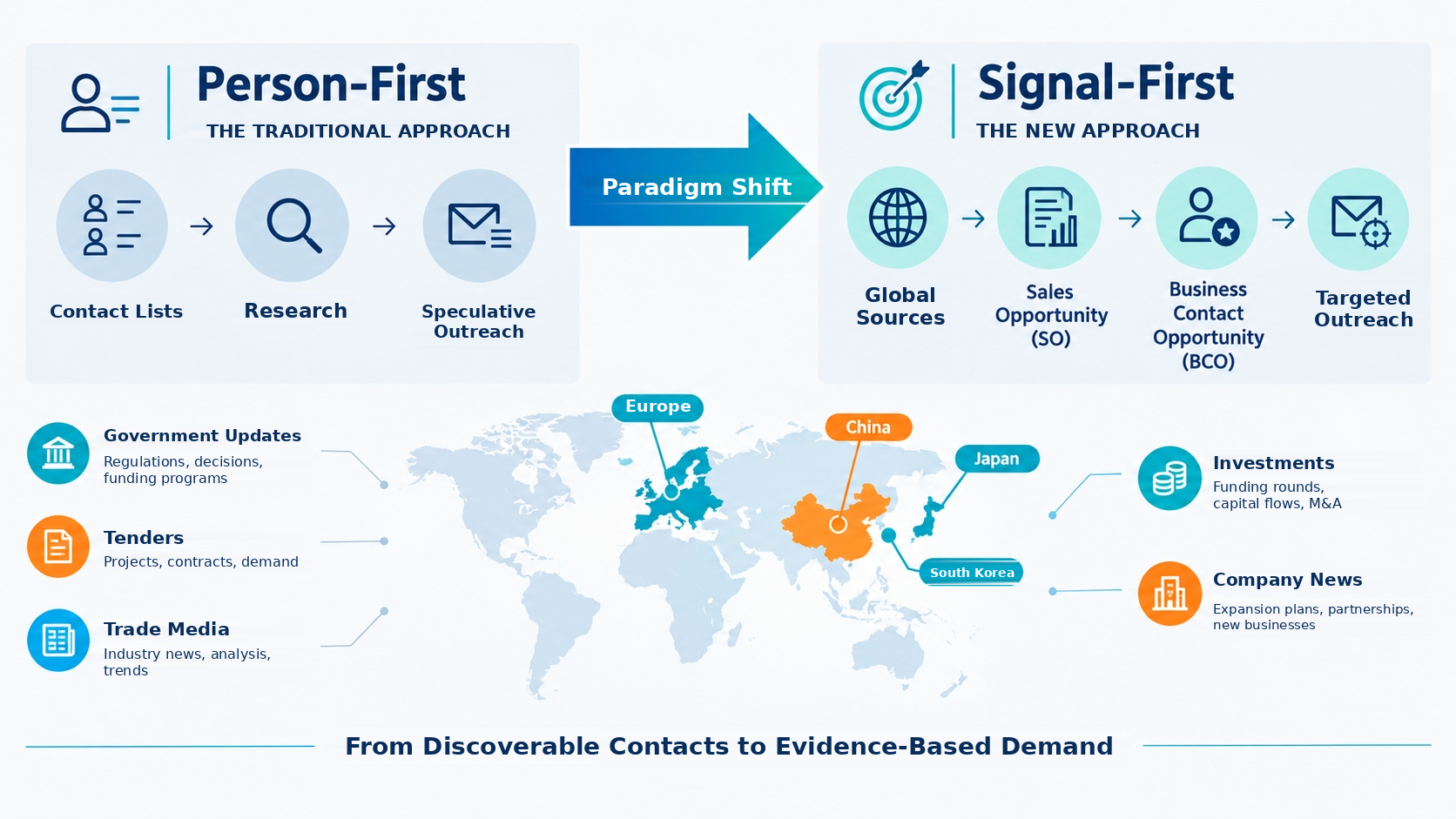
LinkedIn & Co. are no longer enough: When contacts are no longer sufficient – How demand intelligence is reshaping B2B sales – Creative image on the topic, with AI: Xpert.Digital
B2B sales in transition: Why the right occasion is becoming more important than the right contact – How new demand data is changing B2B sales
Those who understand companies earlier, win: The new logic in B2B sales
XMedia vs. LinkedIn? Why business events are gaining importance in B2B sales
In B2B sales, it was long believed that whoever found the right contacts had a decisive advantage. But in many markets, names, job titles, and company profiles are now readily available. The bigger challenge lies in recognizing which company is currently developing a specific need – and why now is the right time to approach them.
This is precisely where demand intelligence comes in. Instead of simply collecting as many potential contacts as possible, it analyzes company announcements, investments, location decisions, and other economic changes. From such indicators, well-founded business opportunities arise, along with clues as to which individuals or teams might be involved in a potential purchasing decision.
This approach changes the role of sales data: A contact profile alone reveals little about whether a company is currently investing. A specific event, on the other hand, can indicate a new need for action. The example of XMedia and LinkedIn Sales Navigator demonstrates how these two perspectives can be combined – and why competition in B2B sales could increasingly depend on who recognizes relevant changes first and translates them into an appropriate approach.
Related to this:

Those who only find decision-makers will be too late – the competition is decided at the first reliable signal of need
B2B sales is undergoing a fundamental economic transformation. For many years, access to the most comprehensive contact data possible was considered a decisive competitive advantage. Those who could filter companies by industry, size, and location, identify the relevant executives, and contact them directly possessed a powerful sales infrastructure. Platforms like LinkedIn Sales Navigator have professionalized and globally scaled this model. They connect professional identities, company affiliations, career paths, relationships, and digital activities in a single, usable data space.
But the economic bottleneck is shifting. In mature B2B markets, a fundamental lack of contact information is becoming less and less common. The more difficult question is which company actually becomes relevant and for what reason, what need underlies an observable change, and when an approach is likely to be successful. A list of fifty logistics managers, production managers, or IT decision-makers describes an addressable market, but not yet a concrete demand. It reveals little about whether a company is expanding a plant, automating its intralogistics, planning a new energy supply, regionalizing supply chains, or replacing a central software platform.
This is precisely where the concept of event- and demand-oriented sales intelligence comes in. In this understanding, XMedia would not simply be another database, nor a mere news aggregator. The economic objective is to translate heterogeneous external information into two actionable units: a Sales Opportunity (SO), representing a substantiated demand signal, and a Business Contact Opportunity (BCO), which identifies the likely relevant stakeholders, functions, and access points. The shift from discoverable contacts to verifiable business opportunities thus not only changes the user interface of a sales tool; it shifts the value creation process across the entire sales economy.
Related to this:

The bottleneck shifts from the address to the occasion
Traditional sales databases primarily solve an identification problem. They answer which companies fall into a target segment, who works there, what a person's role is, and through which relationships or communication channels access seems possible. This information remains valuable. Without a reliable identity layer, account-based selling, relationship management, and personalized communication remain difficult. The economic benefit of such systems lies in reducing search costs and consolidating a fragmented labor market into a structured professional network.
The marginal benefit of additional contact profiles decreases, however, when multiple providers can reach similar target groups with comparable filters. A thousand more names only marginally improve sales performance if it remains unclear which of these individuals are currently engaged in a relevant investment decision. The problem is no longer just reach, but prioritization under uncertainty. The larger the addressable contact pool, the greater the effort can become if signals are lacking that allow for the differentiation of time-critical and economically promising cases from merely theoretical target customers.
In the industrial B2B sector, this distinction is particularly significant. Large investments often arise from concrete changes: new production capacities, relocations, decarbonization targets, automation programs, safety requirements, management changes, funding decisions, supply chain bottlenecks, or technological disruptions. Such events form the context in which budgets are created, priorities are redefined, and suppliers are evaluated. A mere profile, on the other hand, describes a person and their role, not necessarily the current pressure on their company.
Demand intelligence therefore shifts the central sales question. Instead of first asking which person fits a target profile, the focus is on examining which economic event indicates a potential need. Only then does the search begin for the people and roles that assess, influence, or are responsible for this need. From an economic perspective, the search process is reversed: The goal is not to qualify contacts retrospectively through research, but rather to identify a qualified event that leads to the most likely relevant contacts.
Two models produce different truths
LinkedIn Sales Navigator is much more than just a digital address book. The platform combines advanced search filters with account and lead information, relationship paths, activity alerts, AI-generated summaries, and various forms of buyer intent. Account IQ condenses company information and strategic topics, while Lead IQ summarizes professional backgrounds, interests, and activities. Account Pages and Account Hub consolidate account information, relationship signals, and indicators of potential interest. CRM integrations, TeamLink, and direct contact via InMail are also included.
An objective analysis should not underestimate this capability. LinkedIn possesses an exceptionally large database of professional identities and relationships. The network recognizes job changes, new roles, published content, interactions, profile activity, and interest in specific categories. Such data can indicate the optimal time for outreach and improve personalization. Sales Navigator thus reduces information costs, which would be significantly higher without this platform.
The crucial limitation lies less in the absence of signals than in their origin and meaning. LinkedIn's strength rests primarily on first-party data from its own ecosystem, as well as on connected company and CRM data. A profile visit, interaction with content, following a company page, or an identified category interest can indicate attention or purchase intent. However, it remains a behavioral signal. It describes what individuals are doing within a digital system, and not necessarily what real-world project is currently underway outside that system.
XMedia follows a different evidence model. Its starting point would be documented changes in companies, markets, and institutional environments. These include investment announcements, permits, capacity expansions, location decisions, collaborations, funding programs, new subsidiaries, technological partnerships, personnel decisions, or changes in supply chains. These events are not automatically synonymous with a guaranteed contract. However, they possess a different informational value: they point to real resource allocation, organizational change, or strategic pressure to act.
Both models thus produce different kinds of truth. Platform-related intent data measures digital attention and relationship proximity. Event-related demand data measures observable changes from which an economic need can be derived. The first model is particularly strong in identifying who might be reachable, interested, or relationship-oriented. The second model focuses on why a company is becoming sales-relevant right now. In a high-performing sales architecture, these two perspectives are not necessarily opposites. They can complement each other, provided their respective boundaries remain transparent.
SO and BCO become the smallest economic unit
The real innovation of the XMedia model lies not in the collection of news items. News aggregation is largely standardized from a technical standpoint and easily interchangeable from an economic perspective. Automatic translation alone also hardly provides a lasting competitive advantage anymore, because powerful language models have significantly reduced translation costs. Value is only created when unstructured information is transformed into a qualified, comprehensible, and actionable business process.
In this model, a sales opportunity does not describe a project already won or a guaranteed purchase intention. It is a structured hypothesis about a potential need. This hypothesis requires at least a triggering event, a temporal reference, an affected company or location, a thematic category, an assessment of the economic potential, and verifiable evidence. Depending on the industry, further factors may be added, such as investment size, project phase, regulatory pressure, technological dependencies, or the likelihood of external suppliers being involved.
The Business Contact Opportunity (BCO) adds the organizational dimension to this object. In complex B2B purchases, a single person rarely makes the decision. Technical departments, purchasing, finance, IT, production, sustainability officers, site management, and executive management can all assume different roles. A robust BCO, therefore, must do more than simply provide a name. It should reflect the expected function of a person in the decision-making process, distinguishing between technical user, economic decision-maker, project manager, potential advocate, and organizational access point, and clearly indicating the degree of certainty of assignment.
From an economic perspective, only the combination of SO (Socially Active) and BCO (Business Customer Opportunity) forms a usable unit. SO without a contact reference remains market information. BCO without a demand signal remains a target person. Together, they create a qualified sales opportunity that can be transferred to a CRM (Customer Relationship Management) system, assigned to a responsible party, and linked to a concrete next step. This consolidation reduces communication losses between market research, business development, marketing, and sales.
The value of such a package increases with its depth of context. A general indication that a manufacturer is expanding has limited use. It becomes more valuable when it includes location, time horizon, type of capacity expansion, technology involved, potential follow-up investments, and relevant functional areas. The value is even greater when similar past events reveal which products are typically needed, which decision-making roles are involved, and at what stage contact is appropriate. Then the system evolves from a notification platform into a learning opportunity infrastructure.
The productivity gap is a cost problem
The economic pressure to automate sales research is considerable. Surveys from 2024 showed that sales representatives spent around 70 percent of their time on activities unrelated to actual selling. More recent studies from 2026 indicate that the proportion of non-sales-related tasks remains at approximately 60 percent. These figures are not entirely comparable, as survey methods and samples can vary. Nevertheless, the magnitude clearly demonstrates that a significant portion of valuable sales work time is spent on administration, data maintenance, research, coordination, proposal creation, and system migrations.
For 2026, more than 4,000 sales professionals from 22 countries were surveyed. 87 percent of sales organizations were already using some form of artificial intelligence, for example, for lead generation, forecasting, lead scoring, or email creation. 54 percent of respondents had already had experience with AI agents, and almost nine out of ten planned to use them by 2027. According to the surveyed salespeople, fully implemented agents could reduce the time spent researching prospects by 34 percent and creating emails by 36 percent. These figures represent expectations and not guaranteed productivity gains, but they illustrate where companies see the greatest potential for improvement.
The economic significance stems from the opportunity costs. Every hour a highly qualified sales representative spends compiling sources, verifying company names, translating local news, or searching for responsible parties is an hour unavailable for customer meetings, solution development, or negotiations. This becomes particularly costly when multiple employees are researching the same companies simultaneously or when findings remain in personal notes and isolated spreadsheets.
Automated SO and BCO generation can reduce these costs, provided it doesn't simply produce new amounts of data. A system that outputs thousands of unprioritized signals daily merely shifts the burden. Productivity only arises through consolidation, deduplication, relevance assessment, and workflow integration. The economic goal, therefore, is not the maximum amount of information, but rather the best possible ratio between the number of opportunities examined and the human time invested.
Several key performance indicators (KPIs) are crucial for evaluating such a system. These include the accuracy of identified opportunities, the proportion of truly relevant Business Consumption Indicators (BCOs), the time from the initial event to its deployment in sales, the sales representative acceptance rate, the number of qualified conversations, the impact on the pipeline, and ultimately, the closing rate. Equally important is the false positive rate. If many events lack genuine sales relevance, user trust quickly diminishes. Therefore, an economically viable system must not only uncover more opportunities but also control the costs of incorrect prioritization.
Early information becomes tradable capital
Markets don't function with perfectly evenly distributed information. Companies observe different sources, possess varying levels of understanding, and interpret signals at different speeds. Those who recognize a relevant change earlier can build relationships sooner, influence technical requirements, mobilize partners, and position their solution within the emerging decision-making framework. Information thus possesses option value: it opens up possibilities for action before the competition recognizes the same opportunity.
This advantage, however, is temporary. Once an investment becomes widely known, the signal's exclusivity diminishes. Simultaneously, competition for customer attention intensifies. The economic value of an opportunity therefore depends not only on its accuracy but also on its freshness. A late but fully confirmed tip may be less valuable than an early, well-founded tip with transparently disclosed uncertainty. The system consequently requires a balance between speed and verification.
This trade-off can be described as the information economics of sales. A threshold that is too low generates many false alarms. A threshold that is too high provides reliable signals, but with a delay. Therefore, different thresholds must apply to different industries and products. For standardized solutions with short sales cycles, a larger number of weaker indicators can be beneficial. For capital-intensive industrial projects with long decision-making processes, a smaller number of highly qualified opportunities is more valuable.
The competitive advantage doesn't arise simply from discovering a news item. Many market participants can read the same message. The crucial added value lies in the faster economic interpretation. When a new production line is announced, it's essential to deduce which equipment, software, logistics systems, energy infrastructure, security solutions, or services are likely to be needed. This translation from the event into potential demand categories requires industry knowledge, ontologies, and empirical data. Only this transforms publicly available information into proprietary decision support.
🎯🎯🎯 Data-driven B2B industry hub as a quasi-in-house solution


The quasi-in-house solution: How Xpert.Digital closes operational gaps in B2B marketing and sales – Smart Content-Driven Business - Image: Xpert.Digital
Xpert.Digital is a data-driven B2B industry hub led by Konrad Wolfenstein . The company acts as an external, quasi-in-house solution for industrial partners, closing operational gaps in marketing, content, and sales – without requiring additional resources on the client side.
More information here:
LinkedIn as a complementary system in B2B sales
Asia's digital markets follow their own information logics
The potential is particularly great in regions where economic information is only partially accessible via Western platforms. China is the clearest example. In 2021, LinkedIn discontinued its localized social networking version and replaced it with a more job-focused offering that lacked a traditional social feed. The successor application, InCareer, was shut down on August 9, 2023. While certain company offerings in the areas of talent, marketing, and learning continued, individual users in mainland China did not gain access to a comparable information base to the former network.
This does not mean that Chinese business information is inherently hidden. Rather, it originates within a different digital ecosystem. Government and ministry portals, regional authorities, business registries, Baidu, WeChat, industry platforms, local trade publications, associations, and B2B marketplaces contain extensive business information. The challenge lies in its distribution, its language, changing technical access methods, and differing document structures. Furthermore, there are variations in the naming conventions of companies, subsidiaries, and locations.
Japan exhibits a different, but equally relevant, structure. At the end of 2025, LinkedIn had approximately 5.40 million registered members there. This corresponded to about 4.4 percent of the population. Since this figure represents registered accounts and not monthly active users, it should not be equated with actual regular usage. For an industrialized nation with highly developed technology, mechanical engineering, electronics, and automotive sectors, the platform thus represents a useful, but by no means complete, snapshot of the professional information space.
Japanese ministries, industry associations, company websites, and local trade publications remain important sources. The EU-Japan Centre therefore specifically analyzes Japanese-language documents, political publications, surveys, and official statements for European companies. This example demonstrates that the language and source barrier is not merely theoretical. Even institutional actors are creating translation and interpretation services because a large portion of the relevant information does not automatically appear in English-language business channels.
South Korea also possesses structures, including local portals, news ecosystems, business platforms, and its own digital business culture, that cannot be fully represented by LinkedIn. For Western companies in semiconductors, battery technology, photovoltaics, robotics, electronics, and plant engineering, this can lead to a systematic gap in understanding. Those who only monitor English-language secondary reports and Western networks often receive information after an additional intermediary step and lose context from the original document.
A global XMedia system could leverage this fragmentation economically. The advantage wouldn't lie in the blanket claim that Asian signals are generally detected months earlier. Such a timeframe is unreliable without systematic measurement. However, it's plausible that directly monitoring local primary and specialist sources reduces intermediary steps and makes information available sooner in certain cases. The actual advantage would need to be measured for individual source groups, languages, and industries.
Translation alone does not create a moat
Modern language models have drastically reduced the cost of machine translation. This makes multilingualism a necessary basic function, but not automatically a lasting unique selling proposition. Competitors can also use translation models. A solid advantage only arises from the entire processing chain: discovering sources, extracting content, recognizing language and document type, clearly assigning companies and individuals, classifying events, checking for inconsistencies, determining the temporal context, and translating the result into a sales action.
Entity resolution is particularly challenging. Companies can appear in various scripts and transliterations, use brand and legal names, or belong to complex corporate structures. A product or service might be assigned to a subsidiary, while the investment decision is made at the corporate level. Without accurate mapping, duplicates or incorrect connections arise. The technical quality of the translation is of little use if the system addresses the wrong company or branch.
Cultural and institutional context is also crucial. A local government notification, a change in management, or a letter of intent does not have the same economic significance in every market. Terms can denote different project phases depending on the legal system, industry, and administrative practice. A system must therefore distinguish between linguistic translation and economic interpretation. The former conveys words, the latter assesses the substance of the action.
The sustainable competitive advantage therefore lies in four interconnected assets. First, the system requires a broad, legally accessible, and continuously maintained data landscape. Second, it needs industry-specific knowledge models that translate events into demand categories. Third, it must learn from user feedback which signals actually lead to conversations, offers, and deals. Fourth, it must be integrated into the systems that sales teams use daily. The more these elements interact, the more difficult it becomes to replace the service with a generic chatbot or a simple search engine.
Data quality determines trust and profit margins
The central operational challenge is not text generation, but error control. Generative systems can formulate plausible relationships even when the underlying attribution is uncertain. In sales, this leads to concrete costs. A misidentified investment ties up working time, an outdated function damages credibility, and an unsubstantiated claim can strain customer relationships.
Therefore, every opportunity should have a transparent evidence structure. This includes the timing of the original information, the type of source, the number of independent confirmations, the certainty of the company attribution, the recency of the contact role, and the separation between observed fact and inferred need hypothesis. Users must be able to recognize which components are reliable and which are based on a model-driven inference.
Economically, this transparency is part of the product. It reduces the user's review costs and increases the willingness to integrate the system into critical processes. At the same time, it enables risk-based automation. Highly confirmed opportunities can be automatically distributed to the responsible teams. Weaker leads can initially remain on a watchlist or undergo human review.
Another quality factor is updating. Business Case Orders (BCOs) age quickly because people change roles, companies reorganize, and projects are transferred to other responsibilities. Contact assignment must therefore be understood as an ongoing process. The same applies to opportunities: a project that has been announced can be postponed, scaled down, or canceled. A system that only generates new signals but doesn't update existing cases will produce an increasing number of outdated sales assumptions over time.
Data quality directly impacts a provider's margin. High automation reduces the cost per opportunity but can increase the error rate. Intensive manual review improves quality but increases the product's cost and limits scalability. A viable model will therefore require tiered review: automated processing for broad coverage, targeted human review for valuable or uncertain cases, and continuous learning from user decisions.
LinkedIn remains a powerful complement
The assumption that XMedia will completely replace LinkedIn in the short term would be economically unconvincing. LinkedIn has strong network effects. The more professionals maintain their profiles, the more valuable the platform becomes for other users and companies. Relationships, shared contacts, career histories, published content, and professional identities cannot be easily reconstructed from public company announcements.
Furthermore, LinkedIn is continuously developing its Sales Navigator. Buyer Intent, Account IQ, Lead IQ, Account Pages, Account Hub, TeamLink, CRM integrations, and AI-powered lead preparation reduce even some of the research work. The company explicitly positions Sales Navigator as an AI-powered sales tool, not a static directory. Therefore, every competitor must expect LinkedIn to integrate further external data sources, expand event signals, or enter into partnerships with specialized data providers.
XMedia should therefore not base its positioning on a denigration of LinkedIn. A clear division of labor is more credible. XMedia identifies and substantiates a potential business opportunity. LinkedIn supports identity verification, relationship tracking, and initial contact. CRM systems manage the opportunity process, while communication and automation tools support outreach. In such an architecture, XMedia acts as the upstream intelligence and early warning layer.
This complementary position can be commercially attractive because it lowers the barrier to entry. Companies don't need to replace existing sales tools, but rather fill a clearly identifiable gap. At the same time, a strategic option emerges. If BCO mapping, contact data quality, and workflow integration become sufficiently robust, XMedia can gradually replace functions for which customers currently use Sales Navigator or other data providers. The transition from a complementary product to a partial substitute would thus not be a marketing claim, but rather the result of increasing product quality.
From complementary product to partial substitute
The substitution effect depends on the purpose a company pursues with Sales Navigator. If the platform is primarily used for direct contact, networking, and personal background information, its substitutability remains low. However, if it mainly serves to search for target companies and manually qualify contacts, a high-quality SO and BCO platform can take over a larger portion of the functions.
The crucial factor is the portion of the sales process that XMedia actually automates. A mere notification platform falls far short of the core concept of Sales Navigator. A system that recognizes events, assigns companies, models buying groups, verifies contacts, creates CRM records, calculates priorities, and recommends next steps comes significantly closer to an alternative sales infrastructure.
Market dynamics favor such integrated systems. B2B buyers today use an average of about ten interaction channels along their buying journey. In 2024, around 71 percent of the B2B companies surveyed offered e-commerce, and for these companies, approximately 34 percent of revenue came from online channels. At the same time, 57 percent of sales professionals indicated in 2026 that sales cycles are becoming longer. Sales teams therefore need to coordinate more channels, larger buying groups, and longer decision-making processes. Individual contact records are increasingly insufficient for this.
Current analyses increasingly describe B2B purchasing decisions as the result of larger, interconnected buying groups. Internal departments, procurement, management, external consultants, partners, existing customers, and AI agents can all influence the decision-making process. A BCO should therefore not be understood as a single contact, but rather as a dynamic map of a buying network. This represents a significant evolution of the original concept. The economically relevant question is not only whom to approach, but also which constellation of stakeholders assesses a need and how consensus is generated within that group.
The business model determines the scalability
XMedia has several revenue models available. A traditional per-user subscription is simple, but it can underestimate the value of an enterprise-wide intelligence platform. Pricing based on the number of monitored markets, industries, companies, or opportunities may better reflect the delivered benefits. For large clients, enterprise-wide licenses, API access, and usage-based models are also conceivable.
Willingness to pay depends less on the quantity of data than on its economic impact. An industrial sales company with high order values can pay significantly more for a few, highly precise opportunities than a supplier of standardized products with small contract values. Therefore, the offering should be segmented by industry. Mechanical engineering, automation, energy infrastructure, data centers, logistics systems, semiconductors, and industrial software have long sales cycles and high individual order values. Here, an opportunity identified early can yield substantial financial benefits.
On the cost side, expenses arise for data access, crawling, licenses, translation, model operation, quality assurance, compliance, sales, and customer integration. The gross margin improves when the same source and processing infrastructure can be used for multiple customers. At the same time, standardization must not go so far as to eliminate industry-specific relevance. Scalability is therefore achieved more through reusable technical components and ontologies than through identical expenditures for all users.
A key asset is feedback from real-world sales processes. When customers report which opportunities were accepted, rejected, pursued, or won, the system can improve its prioritization. This creates a data network effect: increased usage generates more results data, better results data improves the models, and better models increase customer value. However, this effect is only achievable if companies are willing to share sensitive pipeline and results information or at least provide anonymized feedback.
Regulation and data access limit expansion
A global intelligence platform operates in a complex legal environment. Publicly available information is not automatically free from usage restrictions. Copyright, database rights, platform terms of service, data protection, competition law, and national regulations can limit its collection and further processing. Especially with personal data, the principles of purpose limitation, transparency, data minimization, and a sound legal basis apply.
Web scraping involving personal data generally falls under the scope of the General Data Protection Regulation (GDPR). A provider must therefore define which data is needed for which purpose, exclude sensitive categories, establish retention periods, and respect the rights of data subjects. Additional requirements apply to international data flows. Therefore, technically feasible source monitoring is not automatically legally or commercially viable.
Dependencies on platforms and websites also pose a risk. Technical interfaces can be closed, layouts changed, access restricted, or licensing terms tightened. A business model based on a few, difficult-to-replace sources has a structural concentration risk. Source diversity is therefore not just a product feature, but a form of risk diversification.
Furthermore, there is the reputational risk. Aggressive automated marketing based on personal information can be perceived as surveillance by target customers. XMedia should therefore operate not only legally, but also transparently and proportionately. The focus should be on business events, company context, and professionally relevant roles, not on private behavioral profiles.
Success depends on implementation
XMedia's strategic potential is considerable, but not automatically realized. The technical capability to collect, summarize, and translate texts is insufficient. Crucially, it must demonstrably convert information into business action. This requires a system with a clear taxonomy of events, robust industry models, precise entity resolution, transparent evidence, up-to-date contact mapping, and deep integration into existing sales processes.
A universal approach is not recommended for market launch. It makes more sense to concentrate on a few industries and regions where high contract values, hard-to-access data sources, and identifiable information asymmetries converge. In such segments, the benefits can be measured more quickly. Suitable examples include industrial automation, intralogistics, energy infrastructure, data centers, photovoltaics, battery technology, and semiconductor equipment. The source and event architecture can then be expanded gradually.
Equally important is a robust comparative test. XMedia should measure, for selected markets, how many relevant events are identified, how early they appear compared to established information channels, how many lead to qualified conversations, and what the rate of misattributions is. Only with such data can the claimed information advantage be transformed from a plausible narrative into verifiable business value.
For sales managers, the key metric isn't the number of leads generated. What matters is an expanded pipeline, shorter research times, higher call conversion rates, better prioritization, and earlier access to buying groups. For senior management, the focus is on revenue impact, margin, strategic market coverage, and the ability to expand into new regions without a proportional increase in personnel costs. The product must bridge both levels.
More than just contact details: How XMedia approaches B2B sales from the perspective of the event
LinkedIn remains strong – but XMedia starts earlier
XMedia's primary attack on LinkedIn Sales Navigator isn't where LinkedIn is most powerful. The professional identity and relationship network remains a difficult-to-copy asset. The attack targets a different area: the underlying question of which company is relevant right now and for what specific reason. If this question can be reliably answered, simply searching for people loses some of its strategic significance.
Related to this:

The economic paradigm shift, therefore, does not consist of replacing one contact directory with a larger one. It consists of shifting from reach to evidence, from profiles to events, and from isolated leads to situational buying networks. The combination of sales opportunity and business contact opportunity can become the new smallest unit of value creation in data-driven B2B sales.
In the short term, XMedia is primarily a complementary system. It provides market and demand context, while LinkedIn supports identity, relationships, and communication. In the medium term, it could become a partial substitute if contact attribution, buying group modeling, and CRM integration become sufficiently powerful. In the long term, the decisive factor is not the number of observed sources, but the ability to derive reliable and measurably successful sales decisions from them.
The strongest position, therefore, is not that LinkedIn is outdated or merely a digital address book. Such a statement would be factually incorrect and strategically unnecessary. A more precise observation is that LinkedIn primarily reveals who is visible, reachable, and potentially interested within the professional network. XMedia can further demonstrate why a company is becoming relevant right now, what needs might arise from a particular event, and which constellation of stakeholders should be addressed.
This shifts the balance of power in B2B sales. The winner is not necessarily the company with the most contacts, but rather the one that understands real changes earliest and translates them into a credible, well-timed approach. Contacts remain essential. However, without a compelling reason, they increasingly become interchangeable infrastructure. The real competitive advantage arises where information becomes needs intelligence and needs intelligence translates into action.
📈🚀 From visibility to trust 👀🤝 Your scalable path with Xpert.Digital

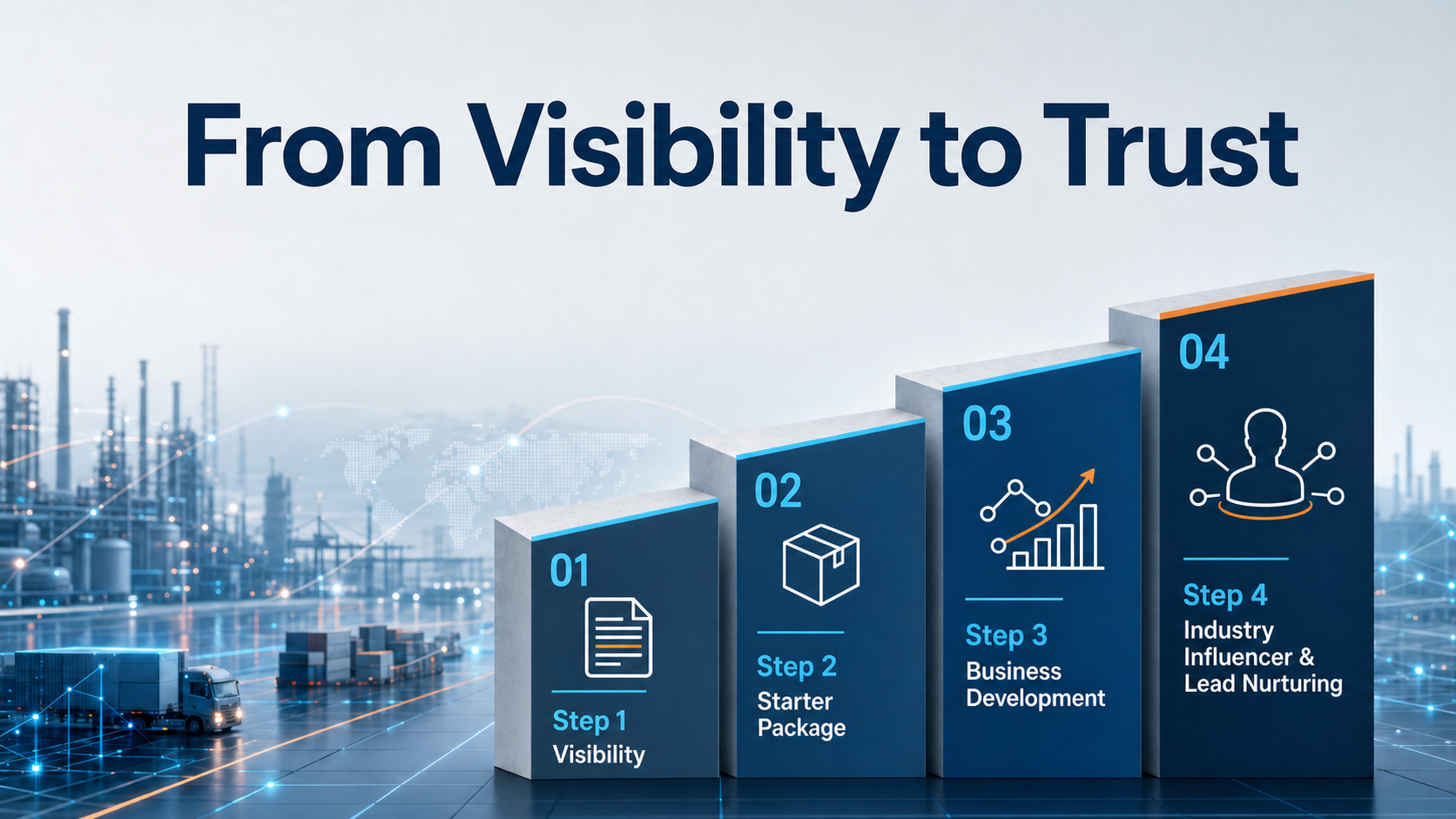
From visibility to trust: Your scalable path with Xpert.Digital - Image: Xpert.Digital
In industrial B2B, sustainable business relationships rarely emerge overnight. They develop step by step – through visibility, professional relevance, recurring touchpoints, and growing trust. Xpert.Digital's 4-stage model addresses precisely this: It offers a structured path that begins with a manageable entry point and can evolve into deeper collaboration in business development if needed.
Instead of relying on loud marketing promises, this model puts the relationship at the forefront. Companies start with clearly defined, easily calculable measures and then decide, based on their own experience, how far they want to expand the collaboration. A key factor for this undisturbed trust-building process: The platform completely avoids annoying advertising ads, so the editorial focus remains solely on the companies' expertise.
More information here:
Your global marketing and business development partner
☑️ Our business language is English or German
☑️ NEW: Correspondence in your native language!

Konrad Wolfenstein
I and my team are happy to be available to you as your personal advisor.
You can contact me by filling out the contact form here wolfenstein@xpert.digital:or simply call me at +49 7348 4088 965. My email address is
I'm looking forward to our joint project.