
How companies are found in ChatGPT: OpenAI's planned business hub under scrutiny – From AI click to customer – Creative image on the topic, using AI: Xpert.Digital
Business Agents in ChatGPT: ChatGPT may soon measure how often companies appear in responses
How companies are found in ChatGPT: OpenAI's planned business hub under scrutiny – From AI click to customer
Business Agents in ChatGPT: ChatGPT may soon measure how often companies appear in responses
More than a dashboard: OpenAI could make companies directly visible in ChatGPT
ChatGPT as a customer interface: What OpenAI's Business Hub could change for companies
ChatGPT could become more than just a place where companies occasionally see their products and services mentioned. OpenAI is apparently working on a business hub that will combine company profiles, data on visibility in AI responses, and a dedicated business agent. This would allow companies to track how often they appear in ChatGPT responses, how many users click through to their website from there, and how potential customers receive answers directly on the platform.
The potential transformation extends beyond a new analytics dashboard. If companies maintain their information in ChatGPT, measure their visibility, and have customer questions answered there, the platform could become a crucial interface between information search and purchasing decisions. This promises new opportunities – but also raises questions about measurability, access, and dependency.
The Business Hub is not yet generally available; its final functionality has also not been confirmed. The information currently available describes a development stage, not a binding product commitment. Therefore, caution is advised when drawing far-reaching conclusions: a mention is not automatically an endorsement, a click is not a sale, and a company profile is no guarantee of better visibility. The crucial factor will be whether OpenAI's planned tools deliver reliable data – and whether companies can actually derive better decisions from it.
ChatGPT as a new gateway to the customer: What OpenAI's planned business hub could change for companies
Whoever facilitates the demand no longer needs to handle the purchase themselves
OpenAI is apparently working on a business unit that aims to combine three previously separate tasks: measuring a company's visibility in ChatGPT, managing business information, and answering customer questions through a dedicated business agent. The economic core of this development isn't simply an additional chart for marketing departments. Crucially, it's the potential creation of an infrastructure through which companies can manage their presence within an AI-driven decision-making process.
The planned analytics tool is intended to show daily how often a company is mentioned in ChatGPT replies and how often users click through to its website from those replies. This information could make a previously difficult-to-measure touchpoint between companies and potential customers more visible. However, neither a generally available product launch nor the final scope of features has been confirmed. The features identified so far represent a development stage, not a binding performance commitment.
This distinction is crucial for economic analysis. An observed banner is not yet a finished business model. Access discernible in the program code is not yet a widely available function. Nevertheless, a strategic direction can be derived from the combination of company profiles, analytical data, and business agents: ChatGPT could not only convey information about companies but also increasingly organize the interface where a general question becomes a concrete business interest.
This creates a dual perspective for companies. On the one hand, they could receive more direct information about their visibility within ChatGPT for the first time. On the other hand, they would become more dependent on a platform for measurement, presentation, and customer interaction whose selection mechanisms are only partially transparent.
Three functions that together mean more than a dashboard
The recognizable business hub combines three functional areas. Companies should be able to track their mentions and the resulting website clicks, store current company and product information, and provide a business agent that answers customer questions based on predefined content.
Each of these functions solves a specific, understandable problem. An analytics section provides insight into one's own online presence. Up-to-date company data can reduce outdated information. A specialized agent can answer frequently asked questions and support potential customers in their decision-making process.
However, their greater economic significance arises from their interplay. An analytical tool can thus potentially become an operational business interface. Companies would not only observe whether they appear in responses, but also provide information with which they can improve their presentation within the platform. Subsequently, they could handle part of their customer communication directly there.
This creates a potential cycle: A company maintains its data, monitors its visibility, changes content, and then checks the development of key performance indicators. If customer questions are also answered via a business agent, this cycle expands to include a communicative layer.
However, this does not guarantee control over ChatGPT responses. Information provided by a company must be distinguished from the decision of whether, when, and in what context the system mentions a brand. Likewise, there is no evidence that using the Business Hub would result in better organic ranking. Data maintenance, verification, and preferential visibility are distinct issues and should not be equated analytically.
Two key figures provide access, but do not yet explain a market
The planned analysis area will initially focus on two metrics: the frequency with which a company appears in responses and the number of clicks on links to the company website. Both will be displayed in charts on a daily basis.
This limitation is both a strength and a weakness. Two easily understandable key performance indicators (KPIs) facilitate getting started. A company could determine whether its measured online presence is growing over several weeks, whether certain days stand out, or whether more users are visiting its website.
At the same time, as things stand, essential explanatory levels are missing. The tool is not intended to display the underlying prompts, user data, competitive comparisons, or rankings. It would therefore initially only document that something is happening, without reliably explaining why.
An increase in mentions could, for example, be due to greater demand for a product category. Other possibilities include increased brand awareness, changes in the system's response patterns, or a seasonal effect. A successful revision of the company's own content would be just one of several possible causes.
A decrease in clicks wouldn't necessarily be conclusive. It could indicate lower interest. However, it could also mean that users have already found sufficient answers to their questions within ChatGPT and have no further need for information. Without additional information, these explanations remain competing hypotheses.
The economic benefit of the dashboard therefore depends less on the visual quality of its charts than on the question of what reliable decisions can be derived from the figures.
Without clear counting rules, an impression is not a reliable unit
The still unclear definition of an "impression" is particularly important. In everyday language, it can be understood as a company appearing in a response. However, this description is insufficient for a reliable business analysis.
Does each mention within the same answer count individually? Is a repeated mention within a conversation counted again? Must the company name actually be visible to the user? Are text mentions, linked names, and opened company profiles tracked separately? What role do newly generated answers play?
As long as such questions remain unanswered, the metric's interpretation is limited. A company might see a sharp increase even though only the technical method of data collection or presentation has changed.
The content of a mention also plays a role. A brand might appear as a recommendation, be mentioned as an alternative, or be discussed in connection with a problem. Mere frequency doesn't differentiate these cases. Even a critical response can generate visibility without making a positive economic contribution.
For business decisions, a multidimensional approach would therefore be useful: How frequently does the brand appear, in what context, with what function within the response, and with what subsequent user behavior? The tool currently available seems to cover primarily the first question and part of the last.
The key limitation is therefore: A precisely measured quantity is not automatically a meaningful quantity. Precision in data collection does not replace clarity about the meaning.
A numerical example shows how quickly visibility is misjudged
The economic limitations of mentions and clicks can be illustrated with a purely hypothetical example. Let's assume a company is mentioned 100,000 times within a month and receives 2,000 website clicks as a result. This equates to a click-through rate of 2 percent.
If the company achieves 150,000 recorded appearances and 2,400 clicks in the following month, mentions increase by 50 percent and clicks by 20 percent. However, the click-through rate drops to 1.6 percent.
This trend allows for several interpretations. The company might be mentioned more frequently in the early stages of the information-gathering process, when users are not yet ready to visit a website. It might be appearing in broader, less purchase-oriented contexts. Or the additional mentions might be of lesser economic significance than the previous ones.
Let's assume that 100 purchases result from the first 2,000 visits, but only 96 from the subsequent 2,400 visits. The number of visits would have increased, yet the number of purchases would have decreased slightly. Whether the overall economic impact is actually worse also depends on factors such as the average order value, profit margin, returns, and customer loyalty.
This example does not describe observed ChatGPT performance metrics. It illustrates the necessary analytical chain: mentions may lead to clicks, clicks may lead to qualified leads, and these may lead to economic revenue.
Focusing solely on the first stage risks mistaking attention for business success. Conversely, considering only the final stage can lead to overlooking crucial preparatory contacts. A sound evaluation must integrate both aspects.
Why comparing your own web analytics is essential
A particularly useful approach is to compare the clicks reported in the Business Hub with the sessions recorded in your own web analytics that originate from ChatGPT. However, a complete match should not be assumed.
A click and a session are distinct events. A user can click multiple times without creating several separate sessions. Conversely, a technical or temporal correlation can lead to a visit being attributed differently in web analytics than expected.
Furthermore, there are potential measurement gaps. A landing page might be closed before the analysis tool loads. Consent settings can limit data collection. Redirects, different devices, and technical limitations can influence the attribution. Which of these factors are actually relevant would need to be examined within the respective company system.
The comparison therefore primarily serves a diagnostic function. It can help identify systematic deviations. If the platform consistently reports significantly more clicks than the analysis records in terms of corresponding visits, this should not immediately lead to the conclusion that the platform data is faulty. First, definitions, time periods, and technical requirements would need to be compared.
From a business perspective, a consistent measurement chain is crucial. Only when it is clear how a platform click becomes a recorded visit and then a qualified contact, can the channel's importance be reliably assessed.
The real bottleneck lies between attention and contribution margin
For company management, the question ultimately is not whether a new dashboard provides interesting figures. The crucial question is whether it enables better decisions to be made.
This includes the allocation of marketing budgets, the prioritization of content, the improvement of product information, and the organization of customer support. Each of these decisions requires different data.
For a communications department, more frequent and accurate brand mentions can be relevant. For sales, on the other hand, generating relevant inquiries is more important. For an online retailer, contribution margin, returns, and repeat purchases are key. For an industrial supplier, a single qualified project contact can be more economically valuable than thousands of irrelevant visits.
A uniform evaluation based on click volume would obscure these differences. Particularly in B2B business, lengthy decision-making processes and multiple stakeholders can mean that an early AI response only becomes commercially relevant much later.
It would therefore make sense to link platform data with the respective company goals. However, not every interaction should be forcibly attributed to a single trigger. An AI response can support a decision-making process without being its sole cause.
The more challenging business question is therefore not how many customers made a purchase after using ChatGPT, but what additional contribution the presence there actually made.
External prompt analyses supplement the figures, but do not replace root cause analysis
External prompt tracking is a possible complement to the planned dashboard. This involves repeatedly asking selected questions to an AI system to observe which companies, products, or information sources appear in the answers.
Such studies could help to contextualize the development of proprietary platform metrics. If a company improves its technical product information and subsequently scores correctly more often on relevant test questions, this would indicate a potential impact.
That wouldn't be proof. External test questions only partially reflect real user conversations. The selection of questions, their wording, the conversational context, and the frequency of repetition all influence the result. Furthermore, the tested questions may not correspond to those from which the actual platform metrics are derived.
Another pitfall lies in the selection of the observation area. Focusing solely on questions where one's own brand is already strong can generate a convenient but not very meaningful measurement of success. Conversely, considering only a few particularly important search patterns may lead to overlooking a wide range of other usage scenarios.
External analyses are therefore most valuable as structured diagnostic tools. They can develop hypotheses, compare response quality, and document changes. The internal platform data could then show whether the actual measured user behavior has also changed simultaneously.
Both perspectives complement each other. Neither alone provides a complete picture of the market.
🎯🎯🎯 Data-driven B2B industry hub as a quasi-in-house solution


The quasi-in-house solution: How Xpert.Digital closes operational gaps in B2B marketing and sales – Smart Content-Driven Business - Image: Xpert.Digital
Xpert.Digital is a data-driven B2B industry hub led by Konrad Wolfenstein . The company acts as an external, quasi-in-house solution for industrial partners, closing operational gaps in marketing, content, and sales – without requiring additional resources on the client side.
More information here:
GEO needs verifiable results, not just more cosmetic key performance indicators
GEO needs verifiable results, not just more cosmetic key performance indicators
The planned tool is also likely to increase the importance of the discussion about Generative Engine Optimization. This refers to improving the conditions for companies and their offerings to be accurately and relevantly considered in generated responses.
This work becomes economically worthwhile where it solves specific information problems: unclear product descriptions, contradictory company information, poorly explained performance features, or missing answers to typical customer questions.
However, optimization that primarily aims to increase the number of brand mentions without improving their relevance would be problematic. More mentions can remain a weak metric if they neither facilitate user orientation nor contribute to relevant business contacts.
A future dashboard could therefore foster two opposing developments. It could improve performance monitoring because companies would receive platform-internal metrics for the first time. However, it could also promote a market for superficial promises of success if rising curves are used uncritically as evidence of effective measures.
A reliable assessment would need to document changes, select appropriate comparison periods, and consider other influencing factors. Even then, uncertainty remains. Especially with small case numbers, a single day or a few additional contacts can drastically alter the picture.
The sober perspective is therefore: A new measuring instrument increases observability. It does not eliminate the requirements for sound analysis.
Verification protects identities and can simultaneously restrict access
According to current information, access to the Business Hub will be contingent upon verified authorization to represent the company. Connecting a Shopify store is mentioned as one possible method. However, this does not imply that only Shopify merchants will be permitted or that an online store is mandatory.
The need for protection is understandable. If companies can process data and operate an agent on their behalf, it is essential to prevent unauthorized individuals from assuming these functions. Verification is therefore an integral part of the trust architecture.
The competitive issue, however, concerns the design. A process that integrates particularly easily into standardized trading systems could be more complex for other companies. This would affect, for example, consultancies, local service providers, craft businesses, or specialized B2B providers without a traditional online shop.
The crucial question is whether alternative forms of verification will be provided. Controlled company domains or other verifiable proof of authorization would be conceivable, for example. Whether such methods will be offered remains to be seen.
The economic significance lies in the relative access costs. Even minor technical hurdles can have different effects, depending on whether large providers have specialized teams or smaller companies have to handle the setup themselves.
A disadvantage for smaller providers is therefore a plausible risk, but not yet a proven result. It depends on the actual procedures, their effort, and their availability.
Entity recognition is becoming a technical prerequisite for economic visibility
The insights into the beta code described above suggest another mechanism: A company profile could appear in a sidebar when users click on a highlighted company name. This would require ChatGPT to recognize the brand as an independent entity, assign it to a supported company type, and have the feature enabled.
This logic is economically significant because it creates an additional layer between a mere mention of a company and a structured corporate presence. A company can be mentioned verbally without automatically creating a searchable profile.
The four identifiable company types do not yet allow for a reliable statement about which industries are fully covered. Their precise boundaries also remain unclear. The existence of such categories initially only indicates that the function is apparently not applied indiscriminately to every identified organization.
For companies, a consistent digital identity is therefore becoming increasingly important. Unique names, verifiable company information, and a clear allocation of brands, products, and companies could help avoid confusion. However, this does not guarantee any specific technical benefit.
Especially with similarly named companies, corporate groups, or brands using generic terms, there is an obvious problem of misclassification. If the wrong entity is identified, even a formally correct mention count can be economically misleading.
Therefore, a subsequent analysis should not only ask about the frequency of data collection, but also whether the correct company is actually meant.
Company profiles could shorten the path to the website or make it unnecessary
According to the instructions, the intended profile can contain a logo, images, website, delivery terms, return policy, and a verification status. Furthermore, the business agent could be launched from there.
These elements don't just concern the visual presentation. They are closely related to questions that are relevant to a purchase decision: Is this the right supplier? What are the terms and conditions? How credible is the presentation? Where can I get a concrete answer?
The more of these questions are answered directly within ChatGPT, the less necessary an initial visit to the company website becomes. This wouldn't necessarily be a disadvantage. A user could arrive at the website better informed and take more targeted action there.
Conversely, the company might lose some of the opportunity to shape the information process on its own digital platforms. The platform would then not only attract attention but also handle a larger part of the initial selection process.
This creates a problem of evaluating traditional traffic goals. Fewer website visits could be related to lower demand. However, they could also reflect more efficient pre-qualification. Conversely, more visits wouldn't necessarily indicate an improvement in quality if they simply result from incomplete information.
The economically sensible target metric is therefore not maximum traffic on one's own website, but a reliable and profitable path from information need to suitable business contact.
The business agent moves customer service closer to the purchase decision
A business agent could further change this approach. If potential customers ask questions directly within the platform, some of the information and consultation work that currently takes place before visiting the company website can be completed.
The potential benefit lies in faster processing of recurring questions. Delivery areas, product features, return policies, or basic application possibilities could be explained in a structured manner, provided the stored information is up-to-date and unambiguous.
In the B2B sector, however, it is particularly important to distinguish carefully between general information and binding advice. An agent can explain what services a supplier describes. This does not automatically mean that they can reliably assess complex technical capabilities, individual pricing, or legally relevant commitments.
Therefore, cost analysis should not stop at saved call minutes. Additional costs include data maintenance, quality control, responsibilities, and handling unclear cases. An agent with outdated information can generate more queries instead of reducing them.
From an economic perspective, his deployment would be convincing if he efficiently resolves standard questions and forwards complex issues to the appropriate contacts. The best agent wouldn't necessarily be the one who answers every question, but rather the one who reliably considers the limitations of his information base.
This makes the organization behind the agent at least as important as the visible surface of the conversation.
Shared agent access makes the separation of advertising and organic presence more important
The code notes describe four ways to access the same agent chat. One of these is supposed to be an ad above the input field. If this structure is actually implemented, organic and paid leads could converge in the same subsequent business interaction.
This doesn't automatically mean that paid presence influences organic responses. Nor does it prove that company data and advertising are becoming technically inseparable. However, it does point to a relevant need for measurement.
If one user accesses the Business Agent via an ad and another via a company profile, both may see the same conversation interface. However, for economic evaluation purposes, their access methods must remain distinguishable.
Otherwise, it would be difficult to determine what proportion of contacts resulted from paid reach, organic mentions, or other entry points. Subsequent performance measurement could also lead to double-counting or underestimating the costs of individual contact channels.
For users, the question of transparency arises in parallel. They should be able to recognize when they are receiving a general AI response and when they are interacting with a company-specific agent. Clear labeling protects not only users but also companies from false expectations.
The closer information retrieval, corporate presentation and advertising become, the more important clear boundaries between these functions become.
The platform could gain in importance without having to handle every sale itself
From OpenAI's perspective, the potential strategic value lies not solely in additional advertising revenue. A business hub could also deepen relationships with companies and strengthen the platform as a place for business guidance.
When companies maintain their data there, measure their visibility there, and supplement their customer communication there, several interconnected user relationships emerge. Switching to another platform would then no longer affect just a single marketing channel, but several organizational processes.
It's important to distinguish between potential revenue streams and existing offerings. Whether Analytics, Profiles, or Business Agents will be subject to fees in the future remains unclear. Specific pricing and contract models are also unknown.
Different economic models are conceivable, such as free basic functions and additional services for larger companies. A close integration with other company offerings is also conceivable. These possibilities are scenarios, not confirmed plans.
The basic platform logic can still be described: Whoever aggregates demand and shapes access to relevant suppliers can exert economic influence without owning the entire purchasing process.
Therefore, for companies, not only a potential usage price would be relevant. Equally important would be dependencies on data access, measurement definitions, reach, and customer contact.
Smaller providers could benefit if professional fit were given greater weight
The potential impact on competition is unclear. On the one hand, well-known brands and technologically advanced companies could have an advantage. On the other hand, dialogue-based responses could offer an opportunity to specialized providers if users formulate very specific requirements.
A small manufacturer doesn't need to be a leader in an entire product category to be particularly well-suited for a narrowly defined application. Specialized advice can be more relevant to a specific problem than that of a competitor with a broader product range.
For such providers to benefit, their capabilities must be correctly identified and clearly described. Imprecise performance specifications, contradictory data, or a poorly identifiable company identity could hinder this assessment.
At the same time, it would be premature to conclude that this automatically gives smaller specialist companies an advantage. Whether the system actually gives more weight to professional qualifications than to brand recognition or other indicators cannot be determined from the information available so far.
The balanced perspective is therefore this: The business hub could reduce information barriers, but it could also create new conditions for participation. Whether it opens up competition or reinforces existing advantages depends on access, recognition, presentation, and measurability.
Especially for smaller companies, a simple, verifiable access that is not exclusively tailored to trading systems would be of great importance.
Companies need to define data maintenance and responsibilities before investing large optimization budgets
A sensible sequence for entrepreneurial preparation can be derived from the identifiable functions. The starting point is not the pursuit of as many AI mentions as possible, but rather the quality of one's own information base.
Company name, website, service description, product features, and terms and conditions should be consistent. Responsibilities for changes must be clearly defined. Especially with multiple companies or brands, it's crucial to know which entity is responsible for which statements.
A second focus is on their own measurement capabilities. Companies should know which visits and inquiries they can already reliably track and where their limitations lie. An additional platform dashboard does not replace a functioning internal analysis.
Thirdly, a potential business agent needs clear boundaries regarding content. What questions are they allowed to answer based on the information they've provided? When must they forward inquiries to a colleague? How are outdated details corrected? Who reviews problematic answers?
Fourth, experiments should be designed so that their results remain interpretable. If product data, website, advertising, and communication strategy are all changed simultaneously, it becomes difficult to attribute any subsequent improvement to a single measure.
This preparation is beneficial even if the product launch is delayed or the final feature set differs. It improves the company's information quality regardless of the specific platform.
The crucial question is whether the display of numbers translates into verifiable control
The planned business hub could bridge a significant gap between AI-mediated visibility and business performance measurement. Direct data on mentions and clicks would provide an additional point of observation in a currently opaque information process.
However, its limitations are equally clear. Without clear definitions, transparent access rules, and a link to actual business results, its usefulness remains limited. A lack of prompts and competitive data makes it difficult to explain changes. Undefined impressions already complicate the interpretation of the initial figures.
The combination with company profiles and business agents makes the development more economically attractive than an isolated analytics tool. It could expand ChatGPT's role from information dissemination towards an integrated contact and decision-making interface.
The strongest justifiable perspective is therefore neither a blanket overestimation of its importance nor a premature devaluation. The tool could be useful because it makes a relevant touchpoint more measurable. However, it would not provide a complete market picture and would not automatically prove the success of GEO measures.
For companies, its value will depend on whether better information leads to better decisions: to more accurate representations, more relevant inquiries, more efficient customer service, and a demonstrable economic contribution. The number of mentions would be a start, but not the end result.
📈🚀 From visibility to trust 👀🤝 Your scalable path with Xpert.Digital

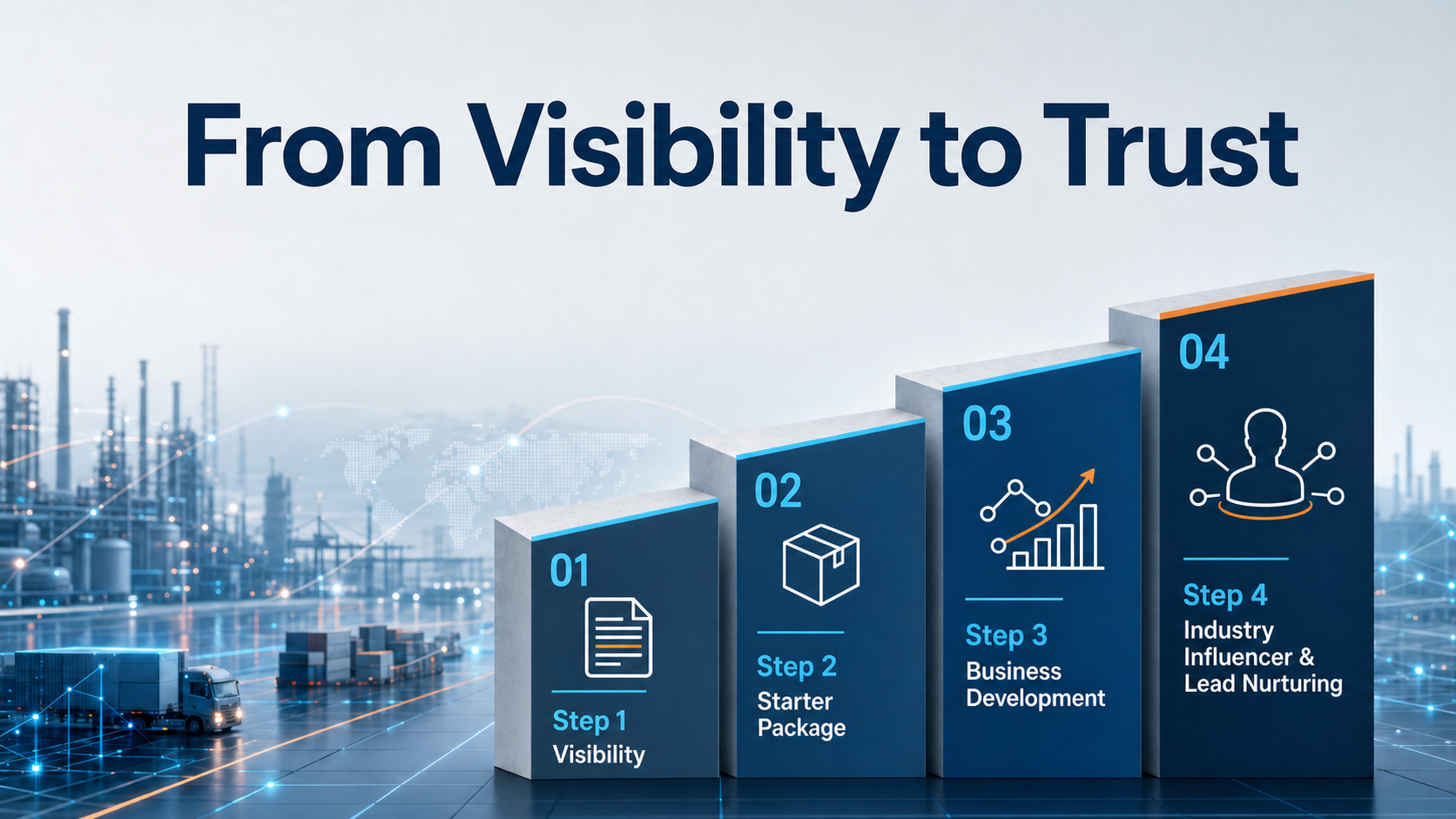
From visibility to trust: Your scalable path with Xpert.Digital - Image: Xpert.Digital
In industrial B2B, sustainable business relationships rarely emerge overnight. They develop step by step – through visibility, professional relevance, recurring touchpoints, and growing trust. Xpert.Digital's 4-stage model addresses precisely this: It offers a structured path that begins with a manageable entry point and can evolve into deeper collaboration in business development if needed.
Instead of relying on loud marketing promises, this model puts the relationship at the forefront. Companies start with clearly defined, easily calculable measures and then decide, based on their own experience, how far they want to expand the collaboration. A key factor for this undisturbed trust-building process: The platform completely avoids annoying advertising ads, so the editorial focus remains solely on the companies' expertise.
More information here:
Your global marketing and business development partner
☑️ Our business language is English or German
☑️ NEW: Correspondence in your native language!

Konrad Wolfenstein
I and my team are happy to be available to you as your personal advisor.
You can contact me by filling out the contact form here wolfenstein@xpert.digital:or simply call me at +49 7348 4088 965. My email address is
I'm looking forward to our joint project.