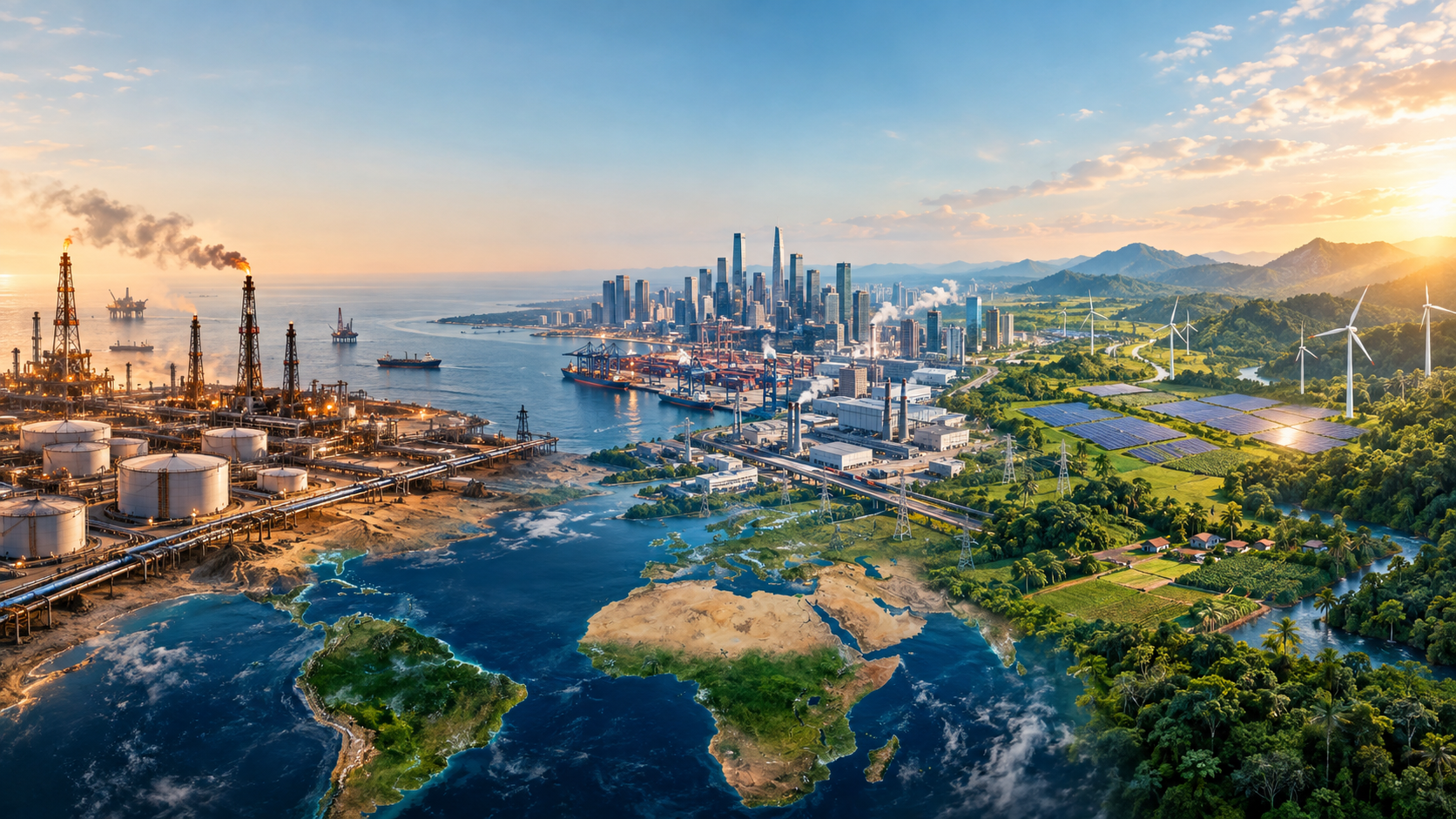
Why powerful states hesitate on climate protection: The four wealth channels – How climate policy is changing the global economy – Creative image on the topic, with AI: Xpert.Digital
Climate protection and national interests: Who wins and who loses?
Securing prosperity through climate policy: A call for active measures
Germany's role in global climate change: opportunities and challenges
Climate protection is often portrayed as a purely technical project focused on reducing emissions and expanding renewable energies. However, this view is too simplistic, as decarbonization also represents a comprehensive struggle over resources, with far-reaching economic and political consequences. A global analysis of 169 countries reveals that their interests regarding climate policy diverge significantly. Some countries heavily reliant on fossil fuels face considerable risks, while others, particularly in the Global South, could benefit from ambitious climate action. This complex situation raises not only questions of justice and national prosperity but also poses major challenges for policymakers. The key to successful climate policy lies in understanding these diverse interests and translating them into collective action. Only in this way can global warming be effectively addressed without creating an unequal distribution of costs and benefits.
Climate protection as a global struggle for distribution
The world could win – but its most powerful states have shockingly little incentive to do the right thing quickly
Climate protection is often described as a technical project: reducing emissions, expanding renewable energies, renovating buildings, electrifying transport, and transforming industrial processes. This description is not wrong, but it remains economically incomplete. Decarbonization is simultaneously a large-scale reassessment of assets, production sites, natural resources, infrastructure, and political power. It determines which deposits lose value, which regions generate new energy yields, which economies avoid climate damage, and which states could be paid for carbon dioxide sequestration in the future. Thus, climate policy is not only environmental policy, but also distributional, industrial, trade, financial, and security policy.
A global study of 169 countries makes this distributional dimension particularly visible. It ranks the countries according to the economic consequences of climate policies with varying levels of ambition and considers four key asset components: the value of fossil fuel extraction, the anticipated damages of climate change, the potential of solar and wind energy, and the capacity to sequester carbon dioxide in forests and managed natural areas. This results in five groups of countries with significantly different interests. Nineteen countries can expect considerable disadvantages, 81 countries stand to gain significantly, while 69 economies will experience comparatively moderate changes. This seemingly unspectacular middle group is crucial because it accounts for the vast majority of global economic output and a large share of global emissions.
The key economic insight is therefore this: The world as a whole has a strong interest in limiting global warming, but this shared interest fragments at the national level into vastly different cost-benefit analyses. Some countries see their most important source of revenue threatened. Others would benefit most from avoided damage but lack both sufficient capital and geopolitical clout. Still others could easily accelerate the transition but do not experience such a strong immediate benefit relative to the size of their economies. This divergence between global benefits and national incentives explains a significant portion of political inertia.
Four wealth channels are changing the global economy
The first channel concerns fossil resources. If climate policy is successful, global demand for coal, oil, and natural gas will decline. This will not only cause individual companies to lose market share, but will also lead to a reassessment of exploration rights, pipelines, refineries, export terminals, power plants, specialized ports, and government revenue claims. An oil field is only economically worth as much as the expected future net revenues from its production. If anticipated sales fall or the long-term achievable price decreases, this asset shrinks even now. Climate policy therefore has an impact long before the actual end of production, through expectations, financing costs, and investment decisions.
The second channel consists of avoided climate damage. Reduced warming protects harvests, labor productivity, health, buildings, transportation infrastructure, and water supplies. This benefit often appears less visible in national accounts than a new power plant or factory. An undamaged bridge doesn't make headlines, but it has real economic value. The same applies to avoided droughts, reduced heat-related mortality, or lower insurance losses. Climate protection doesn't create new physical assets here, but rather prevents the loss of existing capital and future production.
The third channel is the potential of renewable energies. Regions with high solar irradiance, good wind conditions, available land, and suitable grid connections can generate energy at low marginal costs. This creates opportunities for electricity supply, industrial development, green hydrogen, synthetic fuels, and new export relationships. Crucially, however, natural potential alone does not guarantee economic returns. Only grids, storage facilities, reliable institutions, a skilled workforce, solvent consumers, and affordable capital can transform solar and wind power into productive assets.
The fourth channel concerns carbon sequestration. Forests, soils, peatlands, mangroves, and other ecosystems can absorb and store carbon. If such services are credibly measured, permanently secured, and internationally compensated, previously undervalued natural resources will gain additional economic value. This reassessment can make forest conservation more attractive than short-term deforestation. However, it also carries risks: unreliable measurement methods, double counting, limited storage time, land conflicts, and the danger of local populations losing control over their livelihoods. Therefore, economically sound compensation for carbon sequestration requires clear ownership rights, robust monitoring, and fair participation of local communities.
These four channels operate simultaneously and can reinforce or balance each other. An oil-exporting country may lose fossil fuel revenues but simultaneously possess excellent conditions for solar energy. A forested country may benefit from carbon markets but be particularly vulnerable to droughts and fires. An industrialized nation may face high conversion costs but gain from avoided damage, technological innovations, and reduced energy imports. Therefore, the classification into country groups describes dominant interests, not immutable fates.
Why nineteen states could actually lose
The potential losers include primarily oil-producing countries heavily reliant on fossil fuels, including numerous OPEC members as well as countries like Canada and Venezuela. This group accounts for nearly eleven percent of global carbon dioxide emissions, but only about six percent of global economic output. Nevertheless, their political influence is greater than this economic share would suggest, because oil and gas are strategic commodities. They affect transportation costs, inflation, industrial production, military capabilities, and the foreign policy stability of import-dependent states.
For these economies, decarbonization doesn't simply mean the decline of any single sector. In many cases, fossil fuel exports finance government budgets, foreign exchange earnings, public employment, subsidies, infrastructure, and social stability. If this revenue base collapses, it creates not only a sector-specific problem but also a fiscal and societal adjustment risk. The government loses financial flexibility while simultaneously having to invest in new industries, education, and social security. The later the diversification begins, the more abrupt the necessary transformation can be.
Countries with high extraction costs, weak institutions, limited industrial base, and high public dependence on resource rents are particularly vulnerable. Producers with low costs can initially gain market share when global demand falls because more expensive suppliers are forced out. This effect can delay the phase-out and trigger a race for the remaining markets. In the short term, this can even lead to increased extraction, despite the declining long-term value of fossil fuel reserves. This creates a paradox for climate policy: the more credible the anticipated future drop in demand appears, the greater the incentive for individual suppliers to quickly monetize their remaining reserves.
Stranded assets in this context encompass more than just written-off oil rigs. They can include bank loans, government bonds, pension funds, regional real estate markets, and the employment of specialized workers. Even infrastructure designed for decades of use can become unprofitable prematurely. Ignoring these risks threatens financial market turmoil and political backlash. Conversely, if the state assumes these risks too generously, a perverse incentive is created: private owners retain the profits of the fossil fuel past, while the general public bears the losses of the transition.
Nevertheless, it would be too simplistic to view these countries' interests as inherently hostile to the climate. Many possess large areas, high levels of solar radiation, existing energy infrastructure, and technical expertise. They could continue parts of their export role in a lower-carbon world, for example, through electricity, hydrogen, ammonia, metals, chemical products, or services related to energy systems. However, the transition will not happen automatically. A country that has previously sold crude oil does not automatically possess the competitive prerequisites for producing complex plants or green industrial products.
The most credible strategy for fossil fuel exporting countries therefore consists of a combination of fiscal prudential planning, economic diversification, and a controlled decline in new extraction investments. Revenues from the remaining export years should be channeled more strongly into human capital, productive infrastructure, and internationally competitive industries. At the same time, debt should be avoided for projects whose profitability depends on persistently high fossil fuel demand. Predictable global climate policy helps in this regard because it provides countries with a clearer planning horizon and limits chaotic price cycles.
The big winners remain politically weak
On the other side are 81 countries with particularly pronounced advantages from ambitious climate protection. These countries are home to approximately 35 percent of the world's population, yet together they generate only about 13 percent of global economic output. This discrepancy lies at the heart of a fundamental power problem. Many people and economies have much to gain, but possess only limited influence over capital markets, trade rules, technology standards, and international negotiations.
Within this group, 51 countries stand to benefit most from the reduction of climate-related damage. These are predominantly countries in the Global South, including numerous African economies. Their vulnerability stems from several factors: high temperatures, dependence on rain-based agriculture, weak infrastructure, limited insurance coverage, and low fiscal reserves. An extreme event in these countries doesn't just affect individual assets. It can set back development progress, increase public debt, disrupt education, and exacerbate political instability.
The benefits of climate protection are particularly high in such countries relative to their economic output. However, this does not mean they can easily invest in the short term. Countries with high long-term profits often face high financing costs. Private investors demand risk premiums to account for currency fluctuations, political uncertainty, weak electricity consumers, regulatory changes, and limited capital markets. As a result, a solar park in a sunny location can be more expensive to finance than a comparable project in a wealthy country with lower solar irradiance. The physical potential and the economically achievable return diverge.
Thirteen other countries possess particularly favorable conditions for solar and wind energy. This could lead to a new development strategy. Affordable electricity improves the supply to households and businesses, reduces import dependency, and can attract energy-intensive production. However, simply installing as many solar panels as possible is not enough for successful exports. Resilient grids, storage facilities, port infrastructure, long-term power purchase agreements, and an industrial policy that enables local value creation without permanently subsidizing inefficient structures are essential.
Seventeen countries stand to particularly benefit from their carbon sequestration capacity. Forests and other natural areas could become internationally compensated assets. Such a development would be economically significant because it integrates the conservation of nature into the calculations of public and private actors. However, payments for carbon storage must not become a cheap license for continued emissions in wealthy countries. They must be additional, permanent, and verifiable. Furthermore, a substantial portion of the proceeds must reach the communities that actually protect forests and landscapes.
The term "winner" can therefore be misleading. It describes a potential, not a guaranteed outcome. Without favorable financing, institutional capacity, technology transfer, and access to markets, a country can remain poor despite significant natural advantages. In the worst-case scenario, it exports green hydrogen or raw materials while its own population suffers from electricity shortages and the majority of its added value flows abroad. Climate policy would then be more ecologically progressive, but would perpetuate old patterns of dependency.
A fair transformation must offer these countries more than project loans. What's needed are subsidies for public goods, guarantees against political and currency risks, participation from multilateral development banks, debt relief in particularly difficult cases, and reliable revenues from international markets. Equally important are training, local suppliers, regional power grids, and transparent contracts. Only then will theoretical potential translate into lasting gains in productivity and prosperity.
The powerful center determines the pace
The most politically important group comprises 69 economies, including the United States, China, the member states of the European Union, and thus also Germany. These countries account for approximately 81 percent of global economic output and 59 percent of the world's population. Neither the risks of climate change nor the financial gains from climate protection are as drastic relative to their economic output in the four dimensions examined as they are for the clearest winners and losers. In absolute terms, however, the avoided damage and new investment opportunities can be enormous.
This group of countries can be described as moderately affected, but by no means insignificant. On the contrary: it controls the majority of financial markets, patents, industrial supply chains, demand, and military power. It sets standards for vehicles, steel, chemicals, batteries, financial reporting, and traded goods. If it introduces ambitious regulations, investment decisions will change far beyond its borders. If it hesitates, international climate goals will lose credibility.
The relatively low level of interest shown by this group is economically understandable. Wealthy and diversified economies can partially absorb damage, adapt infrastructure, and insure against risks. At the same time, decarbonization incurs visible costs: existing facilities are retrofitted, power grids are expanded, buildings are modernized, and consumption patterns change. The benefits of avoided damage often lie in the future and are widely distributed across society. The costs, on the other hand, are concentrated in specific industries, regions, and households. Politically, concentrated losses are often more effective than distributed gains.
There is also a problem of timing. Governments think in terms of election cycles, companies in investment cycles, and households in monthly budgets. Climate protection unfolds a significant portion of its benefits over decades. Those who replace an expensive system today bear the costs immediately; those who thereby prevent future damage can hardly discern their individual contribution to the benefit. This asymmetry encourages procrastination. It also explains why abstract long-term goals are more easily adopted than concrete short-term measures.
At the same time, a purely relative view underestimates the innovation potential of large economies. They possess research institutions, capital, industrial experience, and large domestic markets. Investments in batteries, grids, heat pumps, low-emission steel, or synthetic fuels can trigger learning curves and reduce costs worldwide. Those who shape standards and economies of scale early on can reap technological rents and export advantages. Conversely, those who act too late risk dependence on foreign supply chains.
The group of moderate countries is therefore not neutral. It is both the referee and the most important player. Its decisions determine whether capital remains tied to fossil fuels or flows into new systems. The fact that these countries are not the biggest relative winners does not lessen their responsibility. Rather, it shows why moral appeals alone are not enough. Climate policy must be designed in such a way that its economic benefits become visible within these countries, are widely distributed, and are politically sustainable.
🎯🎯🎯 Data-driven B2B industry hub as a quasi-in-house solution


The quasi-in-house solution: How Xpert.Digital closes operational gaps in B2B marketing and sales – Smart Content-Driven Business - Image: Xpert.Digital
Xpert.Digital is a data-driven B2B industry hub led by Konrad Wolfenstein . The company acts as an external, quasi-in-house solution for industrial partners, closing operational gaps in marketing, content, and sales – without requiring additional resources on the client side.
More information here:
The role of fossil fuels in global climate policy
Germany's advantage does not lie in waiting
Germany is among the economies with moderate impacts. This should not lead to the conclusion that a slow transition would be economically sound. As a highly industrialized, export-oriented, and energy-import-dependent country, Germany faces particular risks and opportunities. It is less affected by the loss of its own fossil fuel revenues than major oil and gas exporters. At the same time, a significant portion of its value creation depends on energy-intensive industries, automotive manufacturing, mechanical engineering, and complex supply chains.
The central economic policy challenge is to reconcile decarbonization with location quality. High or volatile energy prices can discourage investment, especially if grids, power plants, storage facilities, and permits are not available in time. However, permanent subsidies for every existing production structure would also be problematic. They might perpetuate business models that are not competitive in the long term and shift risks onto taxpayers. A more sensible approach is a reliable transformation architecture that creates infrastructure, limits investment risks, and simultaneously provides clear incentives for efficiency and innovation.
Germany can benefit from avoided climate damage, even if this benefit appears smaller relative to the overall economy than in poorer and more exposed countries. Floods, heat waves, low water levels, and damage to forests, agriculture, or infrastructure generate real costs. In addition, international climate impacts affect the German economy through supply chains, migration, food prices, and geopolitical instability. The notion that a wealthy country can adapt to unchecked climate change in isolation underestimates these interconnections.
In terms of industrial policy, Germany must distinguish between strategic resilience and costly autarky. Not every component of a green value chain needs to be manufactured domestically. However, critical dependencies on grid equipment, power electronics, battery materials, or certain raw materials should be diversified. European procurement, recycling, long-term partnerships, and open trade relations are usually more efficient than trying to replicate all production stages nationally.
For social acceptance, the distribution of costs is crucial. Rising CO₂ prices can be effective, but they burden households differently. People in rural areas, commuters, tenants in poorly insulated buildings, and low-income households have less capacity to adapt. If revenues are returned transparently or used for targeted relief and public infrastructure, climate policy can become more socially balanced. If the use of these funds remains unclear, it creates the impression of an additional fiscal burden without any discernible benefit.
Germany's long-term advantage therefore lies neither in going it alone nationally nor in waiting for others to act. It lies in a European strategy that combines a large market, common standards, cross-border networks, research, and trade policy influence. This allows Europe to strengthen its moderate internal incentives with leverage in the external economy. However, this requires that rules remain predictable and that the expansion of physical infrastructure keeps pace with regulatory objectives.
Climate policy is primarily capital policy
The analysis of national assets makes it clear that the transformation will be decided through investment. Emissions targets alone do not build a power grid or finance a factory. Capital flows where expected returns are commensurate with the risk. Climate policy changes this relationship through carbon pricing, standards, subsidy programs, guarantees, public procurement, and the provision of infrastructure.
In wealthy countries, financing costs are generally lower. Legal certainty, stable currencies, and low capital markets reduce risk premiums. In many emerging and developing countries, the opposite is true. Even technically viable projects fail due to high interest rates, currency risks, or the creditworthiness of state-owned electricity purchasers. This results in a global misallocation of resources: capital sometimes finances projects in less profitable locations because institutional risks are lower there.
This problem cannot be solved simply by attracting more private investors. Private investors can bear risks, but they demand compensation in return. Development banks, guarantees, and mixed financing can assume or pool certain risks. Instruments that standardize projects, facilitate local currency financing, and ensure reliable revenues are particularly effective. Public funds should not arbitrarily subsidize private returns, but rather be used to specifically reduce those risks that individual companies cannot effectively control.
Carbon pricing is ultimately a tool for managing capital. It makes emissions-intensive production more expensive and improves the relative profitability of cleaner alternatives. However, its effectiveness depends heavily on credibility and predictability. A fluctuating or politically uncertain price signal does not automatically lead to long-term investments. Companies must be able to expect that climate-friendly facilities will remain economically viable over their entire lifespan.
Revenues from CO₂ pricing offer a second lever. They can be refunded to households, used for infrastructure, employed to reduce other taxes, or channeled into transformation programs. Each option has different effects on efficiency, distribution, and public acceptance. Lump-sum refunds are transparent and can benefit low-emission households. Investments in networks and public transport increase long-term adaptation options. Tax cuts can mitigate economic distortions, but do not necessarily distribute the benefits in a socially balanced way.
This makes the question of winners and losers within states just as important as between them. A country may gain economically while certain regions, workers, or households lose out. Conversely, an economy may bear transition costs even though individual sectors reap enormous profits. National averages mask these conflicts. Effective climate policy therefore requires regional structural policies, further education, mobility support, and social safety nets that enable adaptation, rather than indefinitely preserving outdated practices.
New jobs are not an automatic replacement
The expansion of renewable energies creates jobs in production, planning, installation, operation, maintenance, grids, and services. Many millions of people worldwide already work in this sector, with solar energy accounting for the largest share. Such figures demonstrate the economic dynamism of the transformation, but say little about whether lost jobs are actually replaced.
A job is not arbitrarily interchangeable. A refinery worker has different qualifications, may earn more, and lives in a different region than someone installing solar panels. New jobs may emerge later, be geographically distant, or be subject to different pay scales. Even if the total number of jobs increases, individual communities may experience permanent losses. These disparities shape political perceptions more than national net figures.
Furthermore, technological advances and economies of scale can reduce employment per installed unit. Successful expansion therefore does not necessarily lead to proportionally increasing employment. This is generally positive for prosperity, as higher productivity reduces costs. However, for the political narrative of a green jobs miracle, it means that promises should be formulated carefully.
A credible structural policy must begin early. Continuing education only after a factory closure is too late. Regions need investment in transportation, digital networks, universities, commercial space, and quality of life before their old revenue base completely collapses. Companies should bear a portion of the adjustment costs if they have profited from fossil fuel assets for years. The state, in turn, must provide public goods and mitigate social hardship without guaranteeing every past industry structure.
The quality of new jobs is just as important as their quantity. Secure working conditions, collective bargaining agreements, career advancement opportunities, and access for women and disadvantaged groups all influence social legitimacy. A transformation that statistically creates jobs but simultaneously replaces well-paid industrial work with precarious service sector jobs becomes politically unstable. Climate policy and labor market policy must therefore not be treated separately.
Package solutions can combine national interests
When states gain and lose differently, uniform commitments alone are hardly sufficient. International cooperation becomes more likely when several policy areas are linked. A country might agree to stricter climate targets if, in return, it receives better market access, technology transfer, research cooperation, investment guarantees, or financial support. Such package deals translate an abstract common interest into concrete national benefits.
Trade policy has a significant impact. Climate-friendly products need markets, while emissions-intensive production should not simply migrate to countries with weaker regulations. Border adjustment schemes can limit distortions of competition, but from the perspective of poorer exporting countries, they quickly appear protectionist. Their legitimacy increases if revenues are partially used for the decarbonization of affected trading partners and if technical support facilitates access to climate-friendly production methods.
Research and technology partnerships are a second key element. They should extend beyond the sale of finished equipment. Joint development, training, local maintenance, and the establishment of suppliers increase added value in partner countries. At the same time, intellectual property rights and investment incentives must be considered. The solution usually lies not in the blanket expropriation of technology, but in tiered licensing, publicly funded research, and cooperative production models.
Direct financial transfers can be justified if they compensate for clearly defined global services or offset particularly high adjustment burdens. These include protecting large carbon sinks, prematurely withdrawing from economically viable fossil fuel projects, or investing in cross-border infrastructure. However, transfers must be tied to verifiable results, transparent procedures, and social protection standards. Otherwise, there is a risk of corruption, windfall gains, and a loss of political support in donor countries.
For fossil fuel exporting countries, transitional agreements could combine a credible demand path with support for diversification. A disorderly collapse in demand creates fiscal crises and increases the incentive to resume production as quickly as possible. A predictable decline facilitates investment planning and reduces the risk of new, ultimately unprofitable projects. Such agreements are difficult because they require strategic information and long-term trust. Nevertheless, they make more economic sense than a policy that publicly announces a phase-out while simultaneously building new import infrastructure without a clear usage path.
Package deals are not a moral discount on climate protection. They are a tool for combining different interests in such a way that cooperation becomes rational for more participants. Successful international policy does not require every country to act for the same reason. Rather, it must ensure that different motives lead to a compatible outcome.
The limits of the winner-loser map
As insightful as the classification of the 169 countries is, it should not be misinterpreted as an exact ranking of future prosperity. Long-term scenarios extending to the end of the century are based on assumptions about technology, population growth, prices, politics, and climate impacts. Small changes can shift the magnitude of individual benefits. The clusters reflect structural interests, not precise balance sheets for each national budget.
The four wealth dimensions examined capture key mechanisms, but not the entire economy. Technological leadership, trade dependencies, critical raw materials, adaptive capacity, institutional quality, military risks, and social conflicts can all alter the outcomes. A country with moderate direct impacts can be severely affected through supply chains. A potential winner can squander their opportunity through poor governance. A fossil fuel exporter can successfully diversify and grow out of a losing position.
Even national averages are problematic. Canada, as a resource-rich nation, can absorb losses in fossil fuel wealth, while individual provinces and industries are affected very differently. Germany may experience moderate overall impacts, although certain industrial centers face high transformation costs. In forested countries, national revenues from carbon sequestration may increase while local communities lose land. The political economy therefore plays out on multiple levels.
Furthermore, assessing climate damage is fraught with uncertainty. Many models capture marketable losses better than the loss of biodiversity, health, cultural heritage, or political stability. Catastrophic risks and tipping points can only be translated into average growth effects to a limited extent. As a result, the benefits of ambitious climate policies can be systematically underestimated.
Conversely, the costs of transformation should not be downplayed. Capital must be written off, infrastructure replaced, personnel trained, and security of supply ensured. Some technologies will be more expensive or available more slowly than hoped. An objective analysis must acknowledge both: Unchecked climate change causes significant and increasing damage, but the transition is neither free nor conflict-free.
The value of the map of countries therefore lies not in a definitive answer, but in a better way of asking the questions. The crucial question is not simply whether climate protection makes sense globally. It is essential to ask who bears which costs and when, who gains which assets, who can block decisions, and what mechanisms for compensation enable cooperation. Only this perspective explains why scientifically sound goals are so difficult to implement politically.
Securing prosperity requires more than emissions targets
Effective climate policy must accelerate the transformation of the capital stock without jeopardizing social and political stability. This requires clear long-term goals, but also credible short-term measures. Electricity grids, permits, skilled workers, storage facilities, railways, charging infrastructure, and industrial demonstration plants are not add-ons to climate policy, but rather its material foundation.
Equally important is adapting to unavoidable changes. Even ambitious climate protection measures cannot prevent all damage. Flood protection, heat-resilient cities, water management, resilient agriculture, and adapted healthcare systems remain necessary. Prevention and adaptation are not mutually exclusive. The weaker the emissions reductions, the more expensive and limited the adaptation becomes.
The international financial architecture must be more strongly evaluated based on its ability to facilitate productive investments in countries with high climate benefits. Low financing costs are a global public good when they accelerate low-emission infrastructure. Development banks should be able to assume more risk without compromising their financial soundness. Guarantees, equity capital, and local currency instruments can be more effective in this regard than additional market-based loans, which further burden already indebted states.
Protecting natural carbon sinks requires reliable rules. Payments must be long-term, measurable, and socially legitimate. Forest protection must not be pitted against food security or land rights. At the same time, it is essential to prevent short-term certificates from justifying long-term emissions. Natural sinks complement the rapid reduction of fossil fuel emissions, but they do not replace them.
In large economies moderately affected by climate change, climate policy must be seen as a modernization project. This does not mean justifying every measure with short-term growth. It means organizing the actual economic benefits: reduced import dependency, more robust infrastructure, technological expertise, cleaner air, and a capital stock that remains productive even under stricter global regulations. Where costs arise, they must be transparently identified and fairly distributed.
The provocative conclusion is that it is not only the obvious losers who are hindering climate protection. The decisive factor is the powerful states, for whom neither the damages nor the benefits appear immediately dramatic in relation to their size. They could act, but often lack sufficient short-term incentives. This is precisely why climate policy must shift its focus from appealing to their interests to simply appealing to their sense of responsibility.
The real conflict revolves around power
Global decarbonization will create new assets and devalue old ones. Countries with fossil fuel revenues face real losses. States with high damage risks, abundant renewable resources, or large carbon sinks have significant gains. However, the distribution of political power does not reflect these advantages. The biggest winners are often too poor to finance their own opportunities, while the powerful middle class does not benefit enough from the transformation to automatically choose maximum speed.
Climate protection thus becomes a test of international capacity for action. A purely national cost-benefit analysis lacks ambition because some of the benefits accrue outside national borders and beyond the next election cycle. A purely moral narrative, on the other hand, fails due to concentrated losses and unequal adaptation possibilities. Only a policy that translates global benefits into national, regional, and social incentives is sustainable.
This includes package agreements, reliable trade, favorable financing, technology partnerships, and targeted transfers. Equally necessary are clear rules against windfall gains, social exclusion, and green protectionism. Climate cooperation must not become a permanent subsidy for fossil fuel elites, nor a new form of economic dependency. It must create productive alternatives and reward verifiable achievements.
Long-term prosperity is not achieved by simply protecting every existing asset. Economic change always involves a revaluation of capital. The crucial question is whether this process is forward-looking, orderly, and socially sustainable, or whether delays make it more chaotic and costly. A credible climate policy devalues fossil fuel assets but simultaneously builds networks, technologies, natural capital, and resilient infrastructure.
The global economy is therefore not faced with a choice between climate protection and prosperity. It faces a choice between managed modernization with unequally distributed but manageable transition costs, and unchecked warming, the damage from which becomes increasingly difficult to control. The overall economic benefit argues for decisive action. However, political success depends on whether the losers receive a credible transition, the potential winners gain access to capital, and the powerful middle class develops a direct interest in a faster pace of change.
The 19 potential losers explain why resistance exists. The 81 clear winners demonstrate the magnitude of the untapped opportunities. The 69 moderately affected economies explain why the decision nevertheless remains open. These are the countries where money, emissions, and decision-making power are concentrated. Their ability to reconcile short-term national calculations with long-term global prosperity will determine whether decarbonization leads to the orderly creation of new wealth or to decades of distributional conflict.
📈🚀 From visibility to trust 👀🤝 Your scalable path with Xpert.Digital


From visibility to trust: Your scalable path with Xpert.Digital - Image: Xpert.Digital
In industrial B2B, sustainable business relationships rarely emerge overnight. They develop step by step – through visibility, professional relevance, recurring touchpoints, and growing trust. Xpert.Digital's 4-stage model addresses precisely this: It offers a structured path that begins with a manageable entry point and can evolve into deeper collaboration in business development if needed.
Instead of relying on loud marketing promises, this model puts the relationship at the forefront. Companies start with clearly defined, easily calculable measures and then decide, based on their own experience, how far they want to expand the collaboration. A key factor for this undisturbed trust-building process: The platform completely avoids annoying advertising ads, so the editorial focus remains solely on the companies' expertise.
More information here:
Your global marketing and business development partner
☑️ Our business language is English or German
☑️ NEW: Correspondence in your native language!

Konrad Wolfenstein
I and my team are happy to be available to you as your personal advisor.
You can contact me by filling out the contact form here wolfenstein@xpert.digital:or simply call me at +49 7348 4088 965. My email address is
I'm looking forward to our joint project.