FLUX Black Forest instead of Sand Hill Road: How Black Forest Labs is breaking up the German AI complex – Image: Xpert.Digital
Why a 50-person team from Freiburg is exposing the megalomania of Silicon Valley
From the “left-behind continent” to the AI avant-garde: The shifted framework of the debate
For years, an almost ritualistic complaint dominated in Germany and Europe: In artificial intelligence, especially with fundamental generative models, the USA and China were insurmountable, while Europe was too regulated, too fragmented, and too lacking in capital. Germany's role in this narrative was clearly defined – strong research, strong industry, but structurally incapable of producing world market leaders in the digital sector.
With Black Forest Labs (BFL) from Freiburg, this narrative suddenly becomes less clear. Founded in the spring of 2024, the company has raised around $450 million in less than two years, is valued at approximately $3.25 billion, and employs only about 50 people. Its Flux image models are among the most popular in the world, competing with Google's current image systems and integrated into products from Adobe, Meta, Microsoft, Canva, telecommunications companies, and others.
Black Forest Labs (BFL) is an AI company based in Freiburg, specializing in generative image models.
BFL develops the Flux models (e.g. FLUX.1, FLUX.1-pro, FLUX.1-schnell, FLUX.1.1-pro, FLUX.2) and offers them via its own APIs and platform partners.
Flux (or FLUX.1/FLUX.2) is a text-to-image model family developed by Black Forest Labs.
There are different variants with different focuses (e.g., "dev" open, "pro" commercial, "fast" for high speed, FLUX.2 for 4-MP output and multi-reference control).
Suddenly, a German AI lab is on the radar of investors like Andreessen Horowitz, Salesforce, and other heavyweights in the US venture capital scene, and is being openly described by business media as a "rival of Google." The story from Freiburg is therefore economically interesting because it touches on two levels simultaneously:
Firstly, it shifts the perception of what is actually possible in Germany in the field of AI. Secondly, it forces us to re-examine what "keeping up with Silicon Valley" actually means – and on which playing field Germany can realistically compete.
To put this into perspective, it's not enough to simply tell a founder's story. It requires examining capital flows, infrastructure, regulation, corporate culture, and strategic path decisions – precisely those variables that differentiate between an isolated success story and a structural trend reversal.
Related to this:

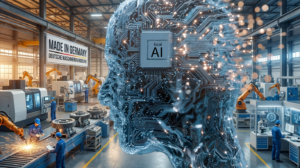
Black Forest Labs as a symptom: What the Freiburg case study reveals about Europe's AI potential
Black Forest Labs is an extreme case in several respects. The company has raised more than $450 million in capital in less than two years, including $300 million in a single Series B round led by Salesforce Ventures and the fund AMP. This raised its valuation to $3.25 billion – a figure virtually unprecedented for a German deep-tech startup in such a short time.
What is economically remarkable, however, is not only the valuation, but above all the combination of revenue growth, capital efficiency, and personnel efficiency. According to reports, annual recurring revenue is in the mid-double-digit millions, and this was achieved within just over a year of its founding; in addition, there is an order backlog in the high three-digit millions. With around 50 employees, this results in an exceptionally high value creation per employee, more reminiscent of the early stages of US hypergrowth companies than of traditional German technology companies.
Furthermore, there is the strategic positioning: BFL primarily offers models and infrastructure for other providers, rather than building a single, end-customer-centric platform. The Flux models serve as technological building blocks for image generation, editing, and, in the future, video production; they are integrated, for example, into design tools, creative software, social media platforms, and AI assistants of major US corporations. Thus, BFL operates more like a specialized infrastructure player in a global value chain, rather than an isolated consumer service.
The founding team's background reinforces this picture. The founders, led by Robin Rombach and several co-founders, were instrumental in the development of Stable Diffusion, one of the key models that has fueled the global hype surrounding generative image AI since 2022. Instead of following the Silicon Valley founding myth, BFL emerged from a network of German and European research locations such as Heidelberg and Tübingen, as well as industry experience at Nvidia.
This case study thus demonstrates three things:
- Firstly: Europe – and specifically Germany – certainly possesses world-class research expertise that can be translated into its own, internationally competitive basic models.
- Secondly, if access to capital, customers and computing power is secured, even a small, highly specialized team can generate added value on a scale that can be measured globally.
- Thirdly, the dividing line between "Europe" and the USA is much more permeable in practice than political debates suggest. BFL is simultaneously a flagship German start-up and deeply integrated into US capital and customer flows.
This very ambivalence is the starting point for a sober economic analysis of the question: Is Germany really keeping up with Silicon Valley – or is this an exceptional case being used as a projection screen for a politically convenient narrative?
Capital power and economies of scale: Why the comparison with Silicon Valley is dangerously simplistic.
To put Germany and Europe's position into perspective, it's worth looking at the raw numbers. Between 2013 and 2023, US AI companies raised almost $500 billion in private capital, while European firms – including those in the EU and the UK – raised just over $75 billion. The US thus attracted roughly six times more private AI funding.
In 2023, only around US$8 billion of venture capital in the EU was specifically allocated to AI, compared to around US$68 billion in the US and about US$15 billion in China. In 2024, private AI investment in the US continued to rise, exceeding US$100 billion; in generative AI alone, US investment volume surpassed the combined totals of China, the EU, and the UK by more than US$25 billion.
While Europe is catching up – for example, through strong funding rounds for Mistral in France, Aleph Alpha and DeepL in Germany, and Helsing in the security sector – it still lags significantly behind in absolute numbers. Even with strong growth rates in European AI funding, the starting point remains considerably lower, and the gap is widening rather than narrowing.
Against this backdrop, referring to individual European stars quickly appears overly optimistic. While BFL is valued at a good three billion US dollars, companies like Anthropic or OpenAI have long been operating on a completely different scale. Anthropic, for example, achieved valuations in the mid-three-figure billion range after recent funding rounds, supported by deals in which Microsoft and Nvidia are investing up to 15 billion US dollars together, with Anthropic in return acquiring cloud and GPU capacity worth around 30 billion US dollars.
In parallel, further double-digit billions of dollars are flowing into infrastructure projects such as OpenAI's planned "Stargate" data center project, for which sums in the order of 100 billion US dollars are rumored. Hyperscalers such as Microsoft, Google, Amazon, and Meta plan to increase their investments in data centers to over 300 billion US dollars by 2025; this year alone, almost 500 billion US dollars will flow into data centers worldwide.
In comparison, even the ambitious EU initiative "InvestAI," which aims to mobilize up to €200 billion in public and private funds for AI infrastructure and ecosystems, seems significantly smaller and, above all, more time-consuming. Furthermore, it remains unclear how much of this will actually be invested and how quickly these funds will take effect.
The structural starting point is therefore clear:
- The US has a significantly larger and more risk-tolerant private capital supply, hyperscalers with gigantic cash flows, dense networks of VC funds, pension funds and sovereign wealth funds, and a huge bet on AI infrastructure, which is reflected in energy, real estate and chip markets.
- Germany and Europe are moving upwards, but on a different scale. Individual companies like BFL, Mistral, or Aleph Alpha are economically significant, but they operate in a global market where trillions are already being invested in AI infrastructure and applications.
The crucial question, therefore, is not whether Germany can produce individual stars – that is clearly possible – but whether it can build a critical mass of companies, capital, and infrastructure that can structurally compete with Silicon Valley. And here, the answers are considerably more sobering.
Infrastructure as a bottleneck: Computing power, energy, and the price of catching up.
The economic viability of fundamental AI models depends heavily on economies of scale in computing infrastructure. Nvidia alone sells millions of H100 accelerators; each of these chips consumes up to 700 watts, more power than the average per capita electricity consumption in a US household. If the planned sales figures are added together, the total power consumption of H100 installations will be comparable to the electricity demand of major US metropolitan areas.
At the same time, huge AI clusters are emerging in the US: Microsoft, Amazon, Meta, xAI, and others are planning data centers with two gigawatts or more of connected load, transforming entire regions. OpenAI's Stargate cluster in Texas and Meta's and Amazon's projects in the Midwest are designed to operate hundreds of thousands of GPUs in tightly coupled computing networks—a scale that is increasingly becoming a requirement for training the next generation of Foundation Models.
This arms race poses a double challenge for Europe. Firstly, access to high-end GPUs is already scarce and heavily dependent on Nvidia's supply and pricing strategies. Secondly, questions of energy supply and grid infrastructure are looming: forecasts predict that by 2030, data centers could consume more electricity than Germany and France combined today; a significant portion of this increased demand will be attributable to AI loads.
The EU is attempting to counteract this trend: Within the framework of InvestAI, several "AI Gigafactories" are to be established – large, specialized data centers intended to serve as European counterparts to the US hyperscaler clusters. In Germany, there are consortium plans, for example from Deutsche Telekom and the Schwarz Group, to jointly launch an AI data center project and apply for EU funding. At the same time, the German government is investing in high-performance computers, AI service centers, and the expansion of the Gaussian supercomputing infrastructure.
However, the scale remains limited. Expanding a GPU cluster with approximately one gigawatt of power based on current Nvidia generations is estimated to require investments in the tens of billions; for next generations like GB300 or beyond, the estimated cost for a single gigawatt is between 40 and 50 billion euros. Germany's national strategies alone, which allocate a total of five billion euros for AI by 2025, illustrate the vast gap to the necessary infrastructure dimensions.
Economically, this means that even if Europe and Germany massively increase their resources, they will likely not be able to compete on equal terms with the US hyperscalers in the global infrastructure race. Instead, they must consider in which niches and architectures – such as more efficient models, specialized edge AI, or particularly regulation-sensitive sectors – they can remain competitive with less, but more targeted, computing power.
Black Forest Labs embodies precisely this logic: Instead of building its own global cloud empire, the company optimizes its models to run highly efficiently, integrate seamlessly into existing platforms, and thus indirectly benefit from the infrastructure investments of others. This is economically rational – and at the same time an indication that "keeping up" here is not defined by raw infrastructure capacity, but by model quality, efficiency, and intelligent integration into existing ecosystems.
Regulatory regimes compared: a hindrance, an advantage, or simply a different path?
Another key distinguishing feature between Europe and the USA is their respective regulatory environments. While the USA primarily relies on market-driven dynamics and tends to intervene ex post – for example, via competition authorities or sector regulation – the EU has created a comprehensive, ex ante regulatory regime with the AI Act, which also explicitly addresses general-purpose models.
The AI Act introduces the concept of "General Purpose AI Models" (GPAI) and stipulates transparency and documentation obligations for these models, particularly those with potentially systemic risks. Providers of powerful base models must provide technical documentation, describe training data at least in aggregated form, systematically analyze risks, implement safeguards, and, under certain circumstances, register their models in European registries.
European companies like Aleph Alpha and Mistral have repeatedly warned that overly strict or vaguely defined regulations will hinder their ability to catch up with US competitors – especially at a time when they already have to manage with less capital, computing power, and data. The debate surrounding the design of regulations for Foundation Models has therefore centered on how narrow or broad the definition should be and how much discretion the EU Commission should have in classifying models as "systemic."
On the other hand, the EU emphasizes the opportunities of a regulated path: Those who incorporate trust, transparency, and legal compliance into their models from the outset could enjoy long-term advantages in sensitive sectors such as healthcare, finance, public administration, or critical infrastructure. In these sectors, not only performance and price matter, but also traceability, liability issues, data protection, and ethical standards.
For Germany, a highly regulated, export-oriented industrial economy, this logic is not unfamiliar. In many sectors – from mechanical engineering and automotive to medical technology – German companies have learned to operate in highly regulated environments and differentiate their products precisely through compliance with standards and quality. The open question is whether this model can be credibly transferred to the AI sphere without falling behind in fundamental technologies.
Black Forest Labs offers an indirect argument in this regard: The company relies heavily on open and licensed model releases, addresses developer ecosystems, and operates in sectors where copyright, trademark, and liability issues are particularly sensitive—such as the creative and media industries. The fact that BFL is still in high demand demonstrates that regulation and economic success are not mutually exclusive—provided that regulatory requirements are clear, proportionate, and predictable for all market participants.
While the US lacks comparably comprehensive AI regulations, requirements are also increasing there due to court rulings, industry standards, consumer protection laws, and sectoral regulators. The difference lies less in the "whether" of regulation, but rather in the "how" and "when" of regulation. The US relies more on reactive corrective action, while Europe focuses on proactive management – with all the associated opportunities and risks.
Our EU and German expertise in business development, sales and marketing


Our EU and German expertise in business development, sales and marketing - Image: Xpert.Digital
Industry focus areas: B2B, digitalization (from AI to XR), mechanical engineering, logistics, renewable energies and industry
More information here:
A thematic hub offering insights and expertise:
- Knowledge platform covering global and regional economies, innovation and industry-specific trends
- A collection of analyses, insights, and background information from our key areas of focus
- A place for expertise and information on current developments in business and technology
- A hub for companies seeking information on markets, digitalization, and industry innovations
Why Germany doesn't need a second Silicon Valley – but its own digital SMEs
Culture, business models and the German special path: Between the Valley myth and digital SMEs
An often underestimated aspect in the debate about "keeping up with Silicon Valley" is the cultural and institutional embedding of entrepreneurship. The Silicon Valley model is based on extremely risk-tolerant venture capital, rapid scaling cycles, aggressive expansion strategies, and a willingness to "disrupt" entire industries, even at the expense of long-term stability.
German SMEs traditionally stand for something different: long-term thinking, family or founder control, a focus on niche markets, high technical expertise, but often moderate growth ambitions and limited risk appetite. Studies explicitly describe SMEs as the "antithesis" to Silicon Valley entrepreneurship – not in the sense of backwardness, but as an independent, resilient formula for success.
In the current debate, there are frequent attempts to downplay this model in favor of an imported Silicon Valley ideal. However, a growing number of voices argue that Germany doesn't need more US-style startups, but rather a kind of "digital Mittelstand" (SME sector): highly focused, digitally driven companies that operate profitably, soundly, and with a long-term perspective, without following the hypergrowth dogma.
This is precisely where Black Forest Labs becomes interesting. On the one hand, the company is very similar to a classic Silicon Valley gazelle: rapid value growth, strong US VC investment, global ambition, and leveraging international financial and talent flows. On the other hand, its operational reality is more reminiscent of a highly focused laboratory: a clearly defined product line (flux models), a small, very close-knit founding group with long-standing collaborations, and an organization that prioritizes short communication channels, clear responsibilities, and rapid iteration.
In economic terms, BFL shows that elements of both worlds can be combined:
The Silicon Valley model provides access to large amounts of venture capital, including US-dominated venture capital, the courage to position oneself globally, and the willingness to accept high valuations early on.
The company's mid-sized business DNA provides technical depth, long-term team relationships, high quality standards, and a certain restraint in the face of public hype – including the conscious decision to keep the company headquarters in Freiburg rather than San Francisco.
The point is: if Germany tries to copy Silicon Valley one-to-one, it will almost inevitably lose. Neither the capital base, nor the regulatory environment, nor cultural preferences are identical. However, if it succeeds in developing a high-performance digital ecosystem from the existing industrial and SME model, one that selectively utilizes Silicon Valley mechanisms, the result can be competitive on its own – albeit differently than the myth of the "German OpenAI" suggests.
The role of the USA: partner, investor, competitor – and unavoidable point of reference.
Any analysis of Germany's AI position without explicitly considering the USA would be incomplete. The United States is not only the largest investor, but also the most important technological, political, and cultural frame of reference – and at the same time, the main competitor.
The US has been investing enormous sums in AI research and applications for years; private AI investments in the hundreds of billions per year are now a reality. US companies dominate the list of "significant AI models": In a recent ranking, 40 of the most important models are from US organizations, 15 from China, and only three from all of Europe.
At the same time, US capital is heavily infiltrating Europe. American investors are increasingly participating in European AI funding rounds, particularly in Switzerland, France, the UK, and Germany, because these countries offer a combination of high-quality research, stable regulatory frameworks, and access to the EU single market. ETH Zurich spin-offs in Switzerland, French companies like Mistral, and German firms such as Aleph Alpha, DeepL, and BFL are among those benefiting from this interest.
For Germany, this means that the US is both an enabler and a threat. Without US capital, US cloud infrastructure, and US market access, BFL's rise in this form would hardly have been conceivable. Conversely, this strong integration means that value creation, control, and data flows are largely integrated into US systems – with all the associated risks to technological sovereignty and strategic dependencies.
Economically, this is a classic dilemma for middle powers in global innovation systems:
- If you isolate yourself too much, you risk losing touch with others.
- If you open yourself up completely, you risk becoming dependent in the long run.
BFL illustrates what a pragmatic middle ground can look like: Utilizing US capital and customers, while retaining core technical expertise and intellectual property in-house, and deliberately expanding European locations and structures. Whether this balance can be sustained in the long term, however, depends less on individual companies than on the political and economic framework shaped by Germany and the EU.
Germany's structural strengths: industry, data, skilled workers – and the underestimated momentum
Despite all its shortcomings in capital and infrastructure, Germany has several structural advantages that are often underestimated in the context of the AI economy.
Firstly, the country has a globally unique density of industrial application areas for AI: automotive, mechanical engineering, chemicals, logistics, healthcare, energy – everywhere data streams, optimization problems and automation potentials arise that are ideally suited for AI-supported applications.
Secondly, Germany adopted a national AI strategy early on and has repeatedly increased funding for it; by 2025, a total of around five billion euros is to be made available, the majority of which will go towards research, computing infrastructure, and the establishment of AI professorships and clusters of excellence. In addition, the Federal Ministry of Education and Research is investing in AI service centers, which are intended to provide science and industry with access to high-performance computers and AI resources.
Thirdly, the level of education in technical and scientific subjects is high, and universities such as Munich, Tübingen, Aachen, and Berlin are developing into attractive hubs for AI talent. Regions like Heidelberg/Heilbronn, where Aleph Alpha is located, are explicitly positioning themselves as new European AI hubs.
Fourth, Germany, with its SMEs, has an enormous number of potential AI users who, while often still at the beginning of their journey, are in many cases financially sound and planning for the long term. The real leverage, therefore, lies less in the number of newly founded AI startups, but in the speed and depth with which existing companies adapt AI technologies and integrate them into scalable business models.
The problem: Implementation lags significantly behind the potential. In Germany, only a minority of companies systematically use AI applications; often, not only are solutions lacking, but also cultural and organizational prerequisites – such as data strategies, clear responsibilities, or appropriate qualifications at the management level.
While Black Forest Labs signals that cutting-edge research and entrepreneurial ambition are possible in Germany, whether a broader economic dynamic develops from individual cases depends on whether it is possible to build bridges between research, start-ups and industrial users – in other words, to close precisely the transfer gap that German associations have been criticizing for years.
This is where a “digital SME” strategy could come into play: not only promoting flagship projects like BFL, but also enabling thousands of small and medium-sized enterprises to develop AI-based products and services – possibly based on models such as those provided by BFL, Aleph Alpha or international providers.
Scenarios for the next ten years: Niche leadership or a dedicated AI platform?
An experienced observer of the US reveals that even there, real power in AI is concentrated in the hands of a handful of corporations and a few model labs. The area of basic models and hyperscale infrastructures is strongly trending towards oligopolization – not least because entry costs are growing into the hundreds of billions.
Roughly three strategic paths are emerging for Germany and Europe:
- First, there is the attempt to build a separate, largely sovereign AI bloc: with several European gigafactories, independent GPU or alternative chip production, European hyperscalers, and a number of sovereign foundation models operating independently of US platforms. This scenario would be costly, politically ambitious, and only realistic if EU member states were to mobilize and coordinate substantial sums of money on a sustained basis.
- Secondly, a focused niche strategy: Europe accepts that it will not be number one in generic mega-models and global hyperscaler infrastructure, but aims for leading positions in specific sectors (industrial AI, robotics, health, mobility, security) as well as in regulated, “trust-based” AI applications. Infrastructure is built more as a targeted enabler than as a comprehensive counterweight.
- Thirdly, a hybrid path: Europe builds minimal sovereignty capacities (at least one or two large training centers, several independent general-purpose models), but deliberately remains strongly networked in global capital and technology flows, while concentrating on sectors where it has structural strengths.
Black Forest Labs clearly fits the logic of paths two and three: no proprietary global cloud centers, but independent, competitive models; strong integration into US ecosystems, but core technological expertise in Europe; focus on concrete, high-revenue application areas instead of abstract “AGI” visions.
For Germany, it would be economically risky to interpret the BFL story as proof that it is now "on par with Silicon Valley." A more realistic view is that BFL demonstrates what is possible when research excellence, entrepreneurship, access to international capital, and focused business models converge—and that such constellations are still the exception.
The real challenge is to turn the exception into a trend:
- More labs, like BFL or Aleph Alpha, that develop independent model stacks based on their research.
- More industrial AI players translating generative and analytical models into production-related applications.
- And more digital SMEs that scale their niches globally via digital, AI-driven products without abandoning their cultural strengths.
Germany can keep up – if it stops asking the wrong questions.
The initial claim that "Germany can compete with Silicon Valley" is misleading in this form. In terms of absolute capital volume, hyperscaler infrastructure, and the density of global Big Tech companies, the gap is significant and, so far, is widening rather than narrowing. In this respect, Germany will not "catch up" in the medium term, but will only be able to manage its own position more intelligently.
However, it is true that Germany can indeed compete with Silicon Valley if the benchmark is defined more precisely. A 50-person lab in Freiburg, which competes with Google for the crown in image AI and is used by Fortune 500 companies worldwide, refutes the old reflex that Germany is structurally incapable of digital excellence.
Germany can keep up if:
- It has proactively combined its strengths – industry, SMEs, research, regulatory expertise – with AI and has not tried to imitate Silicon Valley, but has developed its own compatible, yet independent model.
- It accepts that sovereignty does not necessarily mean absolute autarky, but rather strategic control over critical nodes: its own models, its own specialized infrastructure, its own talent bases.
- It closes the transfer gap between research and industry and systematically creates the conditions that turn outliers like Black Forest Labs into an entire generation of deep-tech companies.
The provocative truth is this: Germany loses if it continues to chase after the question of when "our OpenAI" will be created. It wins if it understands that the real playing field is not in San Francisco, but in the factory halls, laboratories, hospitals, logistics centers, and administrative offices between the Black Forest and the Baltic Sea.
In this context, Black Forest Labs is less proof that Germany is "already there" and more a signal that it's worth seriously embarking on that journey. The economics of AI rewards not only raw size but also efficiency, focus, and intelligent integration into complex value creation systems. This is precisely where the opportunity lies for a German and European model that doesn't try to be Silicon Valley—but confidently engages with it on equal footing where it matters most.
A new dimension of digital transformation with 'Managed AI' (Artificial Intelligence) - Platform & B2B solution | Xpert Consulting

A new dimension of digital transformation with 'Managed AI' (Artificial Intelligence) – Platform & B2B solution | Xpert Consulting - Image: Xpert.Digital
Here you will learn how your company can implement customized AI solutions quickly, securely and without high entry barriers.
A managed AI platform is your all-inclusive, worry-free solution for artificial intelligence. Instead of dealing with complex technology, expensive infrastructure, and lengthy development processes, you receive a ready-made solution tailored to your needs from a specialized partner – often within just a few days.
The key advantages at a glance:
⚡ Rapid implementation: From idea to ready-to-use application in days, not months. We deliver practical solutions that create immediate added value.
🔒 Maximum data security: Your sensitive data stays with you. We guarantee secure and compliant processing without sharing data with third parties.
💸 No financial risk: You only pay for results. High upfront investments in hardware, software, or personnel are completely eliminated.
🎯 Focus on your core business: Concentrate on what you do best. We take care of the entire technical implementation, operation, and maintenance of your AI solution.
📈 Future-proof & scalable: Your AI grows with you. We ensure continuous optimization and scalability, and flexibly adapt the models to new requirements.
More information here:
Your global marketing and business development partner
☑️ Our business language is English or German
☑️ NEW: Correspondence in your native language!

Konrad Wolfenstein
I and my team are happy to be available to you as your personal advisor.
You can contact me by filling out the contact form here wolfenstein@xpert.digital:or simply call me at +49 7348 4088 965. My email address is
I'm looking forward to our joint project.
☑️ SME support in strategy, consulting, planning and implementation
☑️ Creation or realignment of the digital strategy and digitization
☑️ Expansion and optimization of international sales processes
☑️ Global & Digital B2B trading platforms
☑️ Pioneer Business Development / Marketing / PR / Trade Fairs
🎯🎯🎯 Benefit from Xpert.Digital's extensive, five-fold expertise in one comprehensive service package | BD, R&D, XR, PR & Digital Visibility Optimization

Benefit from Xpert.Digital's extensive, five-fold expertise in a comprehensive service package | R&D, XR, PR & Digital Visibility Optimization - Image: Xpert.Digital
Xpert.Digital possesses in-depth knowledge across various industries. This allows us to develop tailored strategies precisely aligned with the requirements and challenges of your specific market segment. By continuously analyzing market trends and monitoring industry developments, we can act proactively and offer innovative solutions. The combination of experience and expertise generates added value and provides our clients with a decisive competitive advantage.
More information here: