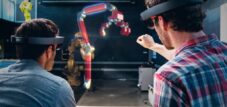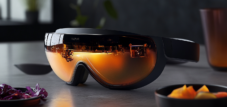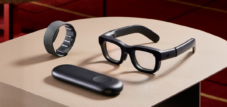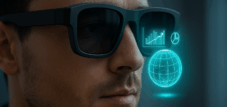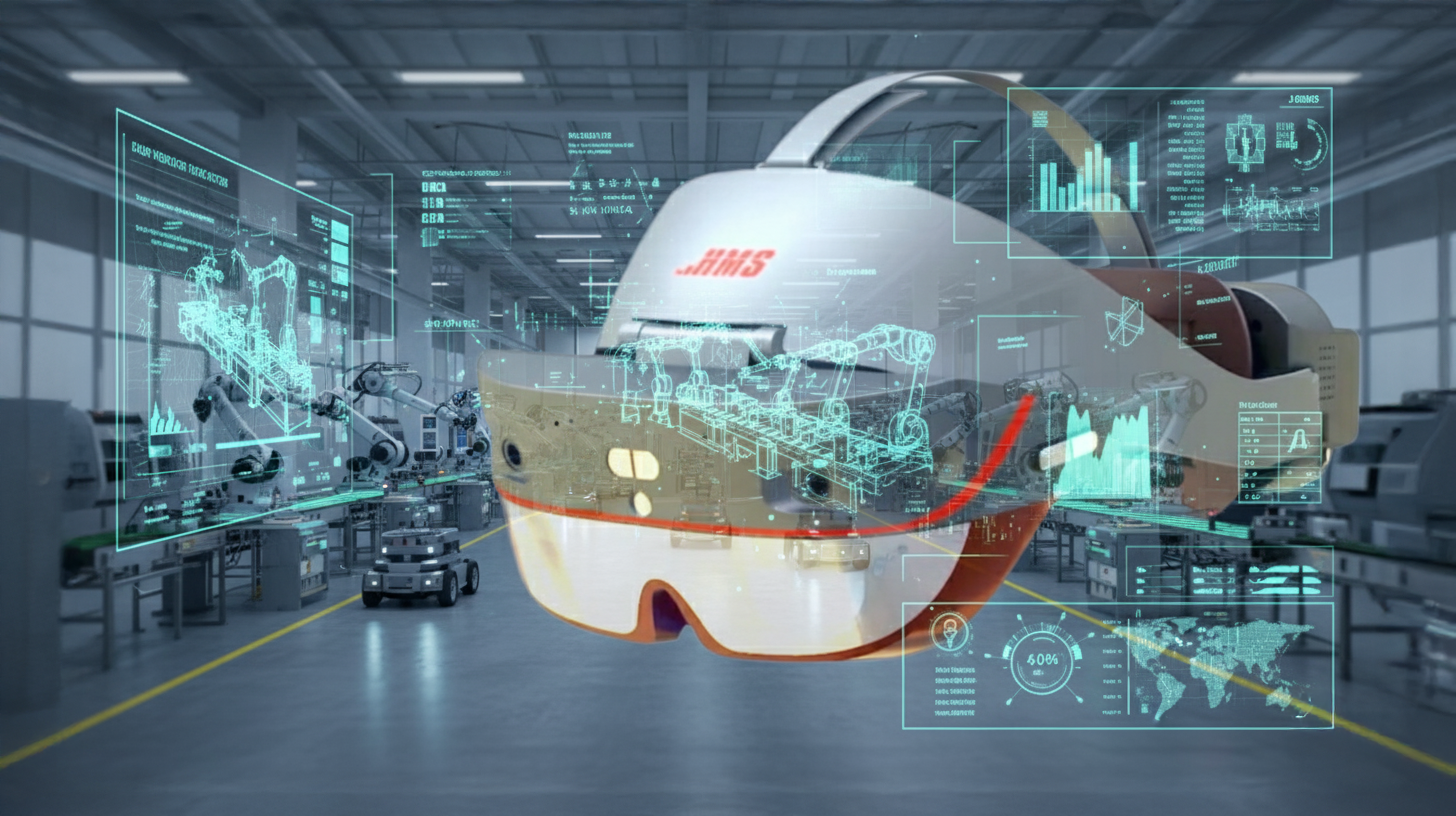
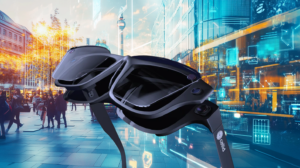
HMS Singray G2 Industrial Enterprise AR/VR Glasses – HoloLens successor from Japan? No more charging breaks thanks to an ingenious battery trick – Image: HMS / Creative image: Xpert.Digital
Cheaper than HoloLens – Singray G2 in detail: What the new AR hope for industry can really do
What is the HMS Singray G2 and who is behind it?
Who or what is HMS? HMS is a Japanese company specializing in computer vision and AI technologies for edge computing. The company focuses on bringing the efficiency and convenience of the digital online world to the physical offline world through computer vision and AI technology. Founded in 2019, the company employs between 51 and 200 people.
What makes the Singray G2 special? The HMS Singray G2 is a new augmented reality headset specifically designed for industrial and business use. The device was unveiled at the Augmented Enterprise Summit in Dallas in September 2025 and is aimed exclusively at B2B customers in sectors such as manufacturing, construction, logistics, 3D design, and healthcare.
Why is the Singray G2 seen as a potential successor to the HoloLens 2? Microsoft has discontinued production of the HoloLens 2 and will only provide security updates until the end of 2027. This has left a gap in the enterprise AR market that the Singray G2 aims to fill. Its positioning as the "spiritual successor" to the HoloLens 2 is based on its similar architecture with offloaded tracking and a see-through approach.
Related to this:


How does the Birdbath optic of the Singray G2 work?
What are birdbath optics and how do they work? Birdbath optics use a system of semi-transparent mirrors and lenses to project digital content directly into the field of view. The name "birdbath" comes from the shape of the optical arrangement, which resembles a birdbath. In the Singray G2, a concave mirror magnifies a 1080p Sony Micro-OLED display to a diagonal field of view of 48.5 degrees.
How do birdbath optics differ from waveguides? Birdbath optics are significantly cheaper to manufacture than waveguide technology, such as that used in the HoloLens 2, Magic Leap, or the planned Snap devices. However, the main disadvantage is that the real-world environment must be darkened more significantly so that the digital elements appear clearly visible and less translucent.
Why did HMS choose birdbath optics? Birdbath optics are primarily used in entertainment devices such as display glasses from Xreal or Viture. These are usually powered by external devices, but the Singray G2 has its own processing power. The main argument for birdbath optics is their cost-effectiveness combined with sufficient image quality for industrial applications.
What technical features does the Singray G2 offer?
Which processor is used? The Singray G2 uses Qualcomm's Snapdragon 8 Gen 2 from 2022, which is also the basis for the XR2 Gen 2 used in current XR headsets like the Quest 3 or Pico 4 Ultra. Additionally, Intel's Movidius Myriad X vision processor from 2017 is used.
Why are these seemingly outdated chips being used? The combination of the Snapdragon 8 Gen 2 and the Movidius Myriad X was deliberately chosen to maximize energy efficiency. Decent battery life is essential for standalone headsets in industrial applications. The Movidius Myriad X is specifically optimized for computer vision tasks and can process up to four trillion operations per second with a minimal power consumption of just 1.5 watts.
What sensors and cameras are included? The sensor suite comprises a 13-megapixel RGB camera, a depth sensor, a stereo fisheye system for visual localization, and a 9-axis motion sensor. The device supports both 6-DoF and 3-DoF tracking at a frequency of 1,000 Hz.
What about the display quality? The Singray G2 offers a resolution of 1920×1200 pixels at a 90Hz refresh rate. The diagonal field of view is 48.5 degrees, with a horizontal field of view of 45 degrees and a vertical field of view of 28 degrees.
Related to this:
What special features does the battery system offer?
What makes the Singray G2's battery so special? The device features a 4,800 mAh battery that is hot-swappable. This is made possible by an integrated buffer battery that allows for a three-minute battery swap without shutting down the device.
Why is hot-swapping important for industrial applications? Industrial environments often require long operating times, where downtime can be costly. Hot-swapping allows workers to continue working even when the battery needs to be changed. Similar features are also offered by other enterprise AR glasses, such as the Vuzix M4000 or the Digilens Argo.
What is the battery life? The Singray G2 offers a capacity of 18.2 Wh, which should provide sufficient runtime for industrial use. For comparison, the RealWear Navigator 500 offers up to 8 hours of runtime with a 2,600 mAh battery.
What software runs on the Singray G2?
Which operating system does the headset use? HMS uses a customized version of Android as its operating system. This allows for broad compatibility with existing Android applications and development tools.
Which standards are supported? The Singray G2 supports OpenXR and Unity AR Foundation. OpenXR is a license-free, open standard that enables cross-platform development of AR and VR applications. Unity AR Foundation is a framework that allows developers to create AR applications once and then deploy them on various platforms.
What software is pre-installed? Software from frontline.io is pre-installed, which, according to the provider, offers a complete system for industrial AR applications. frontline.io is a Software-as-a-Service platform that enables companies to manage their knowledge base across various operating systems, devices, and locations. The platform offers features such as digital twins, interactive workflows, remote support, and immersive learning environments.
Will there be an app marketplace? Yes, in addition to the pre-installed software, HMS is planning an app marketplace. This will allow developers and businesses to find and install specialized applications tailored to their specific needs.
For which industries is the Singray G2 intended?
In which sectors is the glasses intended for use? The Singray G2 is aimed at business customers in the manufacturing, construction, logistics, 3D design, and healthcare industries. These sectors particularly benefit from AR technology because they often involve complex machinery and processes that require careful handling, intensive maintenance, and specialized training.
How does the application work in practice? The glasses are designed for hands-free operation: Digital instructions and assembly plans are displayed directly in the field of vision to avoid interrupting workflows. Colleagues can provide real-time support remotely via live video transmission. This is particularly valuable for remote assistance during maintenance or repair work.
What are the advantages of AR in industry? AR glasses in industry can lead to increased efficiency, as employees receive real-time information about machines, work instructions, or fault diagnoses. Additionally, costs can be reduced because travel expenses are eliminated and experts can provide remote support. Safety is enhanced because information is displayed directly in the field of vision, eliminating the need to look at a separate display.
How is the Singray G2 technically protected?
What protection class does the housing offer? The housing is IP65 certified and therefore protected against dust and water jets. This protection class is sufficient for use in industrial environments where the devices are frequently exposed to harsh conditions.
How robust is the construction? The glasses were specifically designed for industrial use and are robust enough for demanding work environments. The IP65 certification ensures that the device remains functional even in dusty conditions and with occasional contact with water.
What operating temperatures are supported? While specific temperature ranges for the Singray G2 are not mentioned, comparable enterprise AR glasses like the Vuzix M4000 offer operating temperatures from -20°C to 45°C. This is typical for industrial AR devices that need to function in various environmental conditions.
🗒️ Xpert.Digital: A pioneer in the field of Extended and Augmented Reality

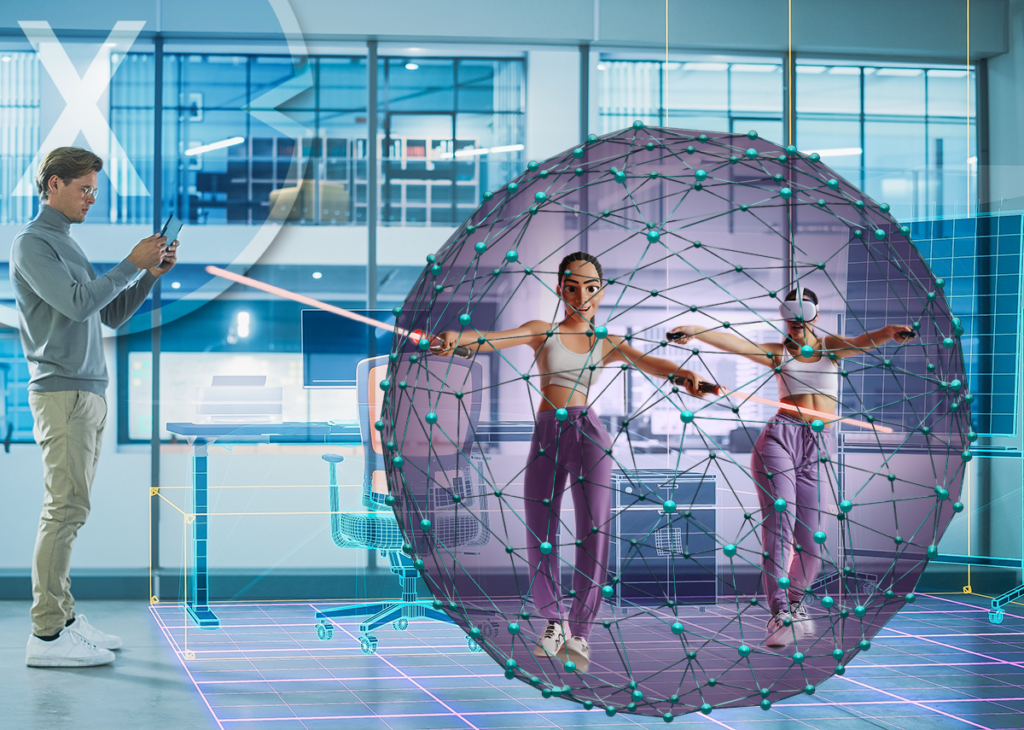
Finding the right Metaverse agency, planning office, or consulting firm - Image: Xpert.Digital
🗒️ Finding the right Metaverse agency, planning office, or consulting firm – Search and search: Top Ten Tips for Consulting & Planning
More information here:
3 reasons why companies should choose the Singray G2
What is the market position of the Singray G2?
How does the Singray G2 compare to the competition? With Microsoft discontinuing the HoloLens 2, a gap has opened up in the enterprise AR market. Competitors like the Magic Leap 2, Meta Quest Pro, Vuzix M4000, and Digilens Argo are positioning themselves as alternatives. The Magic Leap 2, for example, offers a wider 44° horizontal field of view and a resolution of 1440×1760 pixels per eye, all while weighing only 260 grams.
What are the technical advantages of the Singray G2? The combination of offloaded tracking via the Movidius Myriad X and the optical see-through approach should theoretically give the Singray G2 superior performance compared to the Quest 3. Compared to the HoloLens 2, it is even said to be 3-4 times more powerful.
What role does energy efficiency play? By offloading tracking to the separate Movidius chip and using the less power-hungry Birdbath optics, the G2 could achieve similar performance to devices with more modern chips, but with better energy efficiency. This is a crucial factor for use in industrial environments where long operating times are required.
Related to this:
When will the Singray G2 be available?
When can pre-orders be placed? HMS plans to allow pre-orders sometime in 2025. However, specific dates for the start of pre-orders have not yet been announced.
When will the official market launch take place? The glasses are scheduled to officially go on sale in 2026. This gives HMS sufficient time to finalize the software and ensure that the pre-installed frontline.io platform is optimally configured for the hardware.
Is the price already known? HMS has not yet announced a price for the Singray G2. Given its positioning as an enterprise device and its technical specifications, it can be assumed that it will be in a similar price range to other business AR glasses, which typically cost between €1,000 and €5,000.
What developer support is available?
Which development standards are supported? The Singray G2 supports OpenXR, the industry-wide standard for AR and VR development. Developed by the Khronos Group, OpenXR allows developers to write applications once and run them on different platforms. Additionally, it supports Unity AR Foundation, a framework that simplifies cross-platform AR development.
What is OpenXR and why is it important? OpenXR is a royalty-free, open standard that provides unified access to various VR and AR platforms. It reduces fragmentation in the XR market and allows developers to run their applications across multiple hardware ecosystems without significant rework. Major players such as Meta, Microsoft, Sony, and Unity support OpenXR.
How does Unity AR Foundation work? Unity AR Foundation is a cross-platform framework that allows you to develop AR applications once and then deploy them on iOS, Android, and other platforms. It supports features such as planar detection, feature point detection, light sensing, hit testing, image tracking, and 3D object tracking.
What does the frontline.io integration mean?
What does the pre-installed frontline.io software offer? frontline.io comes pre-installed on the Singray G2 as a complete system for industrial AR applications. The software offers various modules such as digital twins, interactive workflows, parts management, visual remote support, and immersive learning environments.
How do digital twins work in practice? The digital twins from frontline.io allow you to explore interactive 3D models that replicate machines or objects. Features include rotation, part extraction, operation, X-ray view, and hotspots. This technology enables companies to control their machines without requiring physical interaction.
What role does remote support play? AR-based remote support enables effective collaboration through chat, subtitle translations, and the exchange of interactive workflows. Remote colleagues can see in real time what the wearer of the glasses sees and provide appropriate support. This is particularly valuable in times when travel restrictions or staff shortages make direct on-site expert support difficult.
How has the AR enterprise market developed?
What trends will shape the industrial AR market in 2025? The AR market is developing at an impressive pace. Five key trends are emerging: device interoperability frees companies from being tied to specific hardware vendors, AI integration improves reality analysis, automated AR work instructions are generated directly from CAD models, enhanced collaboration revolutionizes cross-team cooperation, and integration with third-party technologies leads to seamless connections.
How big is the AR market? The global augmented reality market is projected to grow from US$140.34 billion in 2025 to US$1,716.37 billion by 2032. The European market for smart AR glasses is expected to grow at a compound annual growth rate (CAGR) of 32.5% between 2025 and 2033, reaching a value of US$28.5 billion by 2033.
What factors drive this growth? Growth is fueled by technological advancements, increasing consumer acceptance, and diverse industrial applications. Progress in display technologies, sensor integration, processor performance, and component miniaturization enables more powerful, comfortable, and aesthetically pleasing AR glasses. Furthermore, the integration of AI and machine learning enhances the glasses' ability to understand real-world environments.
What other challenges remain?
What are the technical limitations of birdbath optics? The main disadvantage of birdbath optics is that the real environment needs to be significantly darkened for digital elements to be clearly visible. This can be problematic in bright environments or during outdoor use. Waveguide technology offers better visibility in these situations, but is considerably more expensive to manufacture.
What about the acceptance of AR glasses? Despite technological advancements, challenges remain regarding user acceptance. Many users find current AR glasses too bulky for long shifts, and battery life is often limited. Operation can also be challenging in noisy industrial environments under time pressure.
What role does the software ecosystem play? The success of AR glasses depends heavily on available applications. With support from OpenXR and the Unity AR Foundation, as well as the pre-installed frontline.io software, HMS is attempting to create a robust software ecosystem. The planned app marketplace is intended to offer additional flexibility.
What does the future of enterprise AR look like?
What developments can be expected for 2025 and beyond? The enterprise AR market will continue to consolidate, with fewer but stronger players. Meta plans to launch an Android XR platform with Project Moohan by the end of 2025, while Apple is expected to announce its own smart glasses in 2026. Google is working with Warby Parker on its own AI glasses for the end of 2025.
What role will AI play? AI integration is becoming increasingly important for AR glasses. Smart glasses will increasingly function as personal assistants, providing context-sensitive information and support with complex tasks. The combination of computer vision and AI enables more precise object recognition and better interaction with the environment.
How will the hardware evolve? Future AR glasses will be lighter, more energy-efficient, and more powerful. New technologies, such as movable micromirrors, could overcome the limitations of current display technologies. The integration of advanced sensors and better processors will open up new application possibilities.
The HMS Singray G2 is positioning itself as a key player in this rapidly evolving market. With its combination of proven technology, industrial-grade design, and comprehensive software support, it could indeed fill the gap left by Microsoft in the enterprise AR segment. However, its success will depend on how well HMS balances cost, performance, and ease of use, and how quickly the AR ecosystem develops around the headset.
Related to this:
Your global marketing and business development partner
☑️ Our business language is English or German
☑️ NEW: Correspondence in your native language!

Konrad Wolfenstein
I and my team are happy to be available to you as your personal advisor.
You can contact me by filling out the contact form here wolfenstein@xpert.digital:or simply call me at +49 7348 4088 965. My email address is
I'm looking forward to our joint project.
☑️ SME support in strategy, consulting, planning and implementation
☑️ Creation or realignment of the digital strategy and digitization
☑️ Expansion and optimization of international sales processes
☑️ Global & Digital B2B trading platforms
☑️ Pioneer Business Development / Marketing / PR / Trade Fairs
Our global industry and economic expertise in business development, sales and marketing

Our global industry and economic expertise in business development, sales and marketing - Image: Xpert.Digital
Industry focus areas: B2B, digitalization (from AI to XR), mechanical engineering, logistics, renewable energies and industry
More information here:
A thematic hub offering insights and expertise:
- Knowledge platform covering global and regional economies, innovation and industry-specific trends
- A collection of analyses, insights, and background information from our key areas of focus
- A place for expertise and information on current developments in business and technology
- A hub for companies seeking information on markets, digitalization, and industry innovations