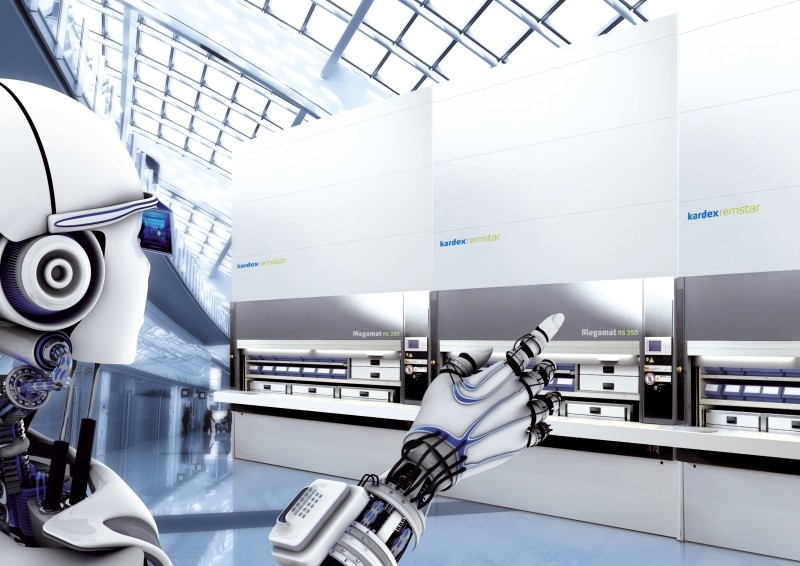
The Japanese electronics company has announced the market-ready development of software that will replace human decision-making in warehouses with artificial intelligence (AI). This new software for optimizing warehouse workflows relies entirely on computing technology, rather than middle management. The AI is a learning technology designed to track the behavior of warehouse employees. It analyzes their approaches to problem-solving and, if it demonstrates an efficiency-enhancing effect, shares these insights with the rest of the workforce. Hitachi anticipates that the new technology will lead to productivity gains of eight percent compared to conventional warehouse management systems.
AI works as follows:
Process Analysis and Recommendations:
Although they often operate within a rather rigid framework of instructions, warehouse employees are constantly and proactively seeking even the smallest ways to improve their workflows. This is partly to speed things up, partly to simplify them. AI gathers information about this and evaluates the efficiency of each approach. Promising solutions are automatically adopted and then disseminated to all employees as new rules.
Responding to Short-Term Changes – From Big to Small Data:
Conventional software systems analyze the incoming, broad stream of big data. This allows for predictions about standard trends. However, it becomes more difficult when it comes to providing appropriate responses to short-term events (e.g., severe weather affecting truck arrivals and departures, or the sudden surge in demand for rain gear resulting from bad weather). AI's approach goes deeper here, using its innovative filtering function to analyze employee behavior and provide answers to these situationally arising events.
Rapid decision-making without human intervention:
The intelligent software architecture allows AI to efficiently filter and analyze relevant information from the broad data stream and take action without prior feedback from a human supervisor; in other words, to issue instructions to employees. Since AI does not need to coordinate with a human counterpart, the system can react much faster and implement the necessary measures more quickly.
According to Hitachi, warehouse logistics is just the first area of application for AI. In the future, the intelligent "robot" could also be used in business areas such as finance, transportation, or production.
Keep in touch