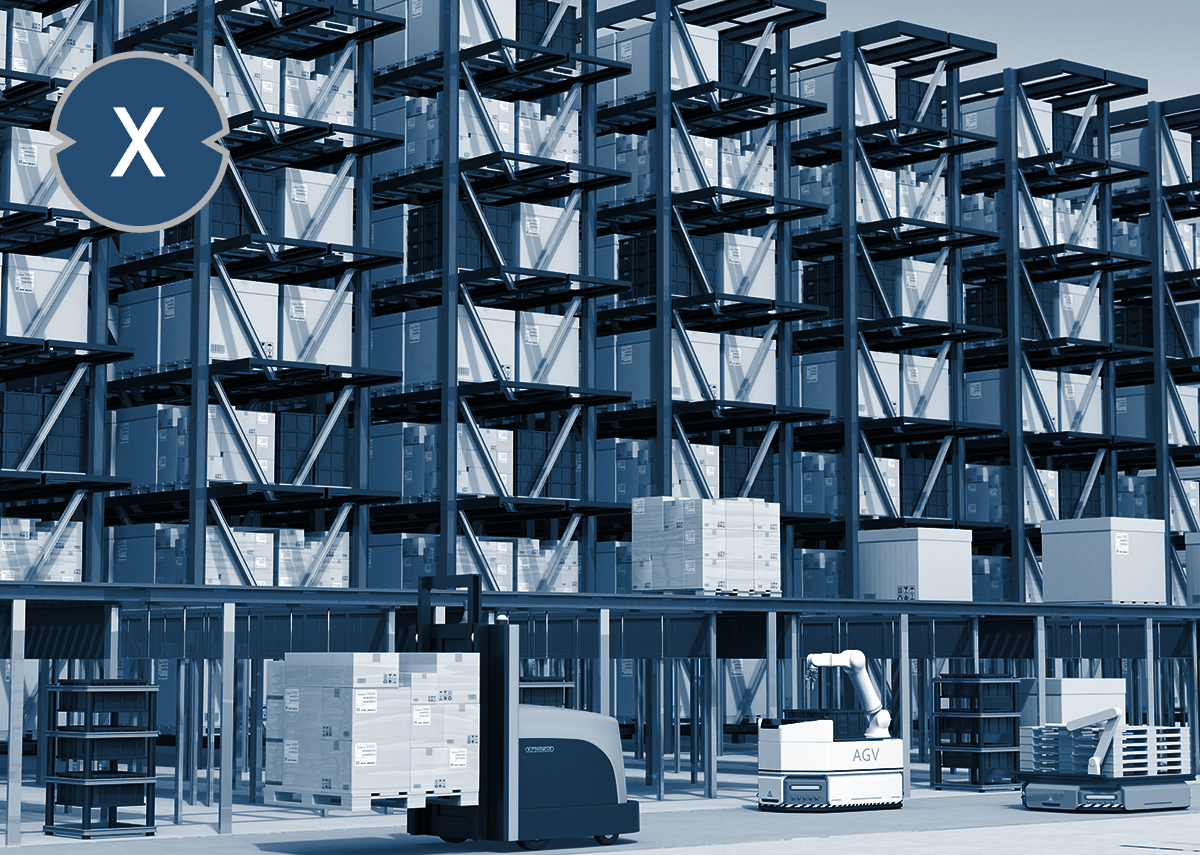
A high-bay warehouse (HBW) – Image: Xpert.Digital / Chesky|Shutterstock.com
A high-bay warehouse (HBW) is a warehouse with racks reaching a height of 12 meters or more; currently, the maximum height is approximately 50 meters. The capacity of a high-bay warehouse ranges from a few thousand pallet spaces to several hundred thousand.

It represents a storage system that utilizes a large amount of space and requires significant investment during its construction. These systems are usually fully electronically managed with a warehouse management system. Goods are transported within the warehouse by stacker cranes. High-bay warehouses can accommodate both flat and long goods.
📦 Pallet and high-bay warehouse solutions for logistics managers and warehouse managers
Do you need expert support in implementing your requirements? Do you have questions about Smart Factory, Smart Logistics, or digitalization?
🏬 Warehouse optimization and automation for industry, production and trade
Automating warehouses and supply chains is a key element of warehouse optimization. We can help you with that.
🛒 E-commerce warehousing solutions for returns, fast shipping (same-day delivery), and error-free order picking
E-commerce has specific requirements, and competition is constantly intensifying. It's no coincidence that e-commerce is considered a driving force behind market changes. Our strength lies in our digital expertise, which enables us to deliver innovative solutions and implementations.
High-bay warehouses are mostly constructed from steel. However, purely wooden racking systems are less common. There are currently six wooden high-bay warehouses in Europe. The tallest of these, at 30 meters, is located in Kleinheubach. The range of racking system designs is extensive. Between a fully automated, silo-style high-bay warehouse and a manually operated racking system installed in a hall, there are numerous hybrid forms. The term "silo-style" specifically refers only to a structure where the racking serves as the load-bearing substructure for the roof and facade.
Storage area in a high-bay warehouse
Here, goods are stored in high-bay racking. Between each pair of racks is an aisle in which storage and retrieval machines (SRMs) move, which, for example, can only travel lengthwise along the aisle using rails or induction, in order to store and retrieve goods from the racks.
The storage and retrieval machines are automatically controlled when order picking takes place in the pre-zone (goods to person). However, they can also be operated manually when order picking takes place directly on the shelf (person to goods). In a warehouse with automated operation, this area is secured against human access for safety reasons, using fences and light barriers.
Each aisle has a storage and retrieval area. In an automated high-bay warehouse, conveyor technology moves the load units to the loading and unloading points for the forklifts. In manually operated high-bay warehouses, the frontmost positions in the racking at the end are designed as transfer points for the forklifts.
The pre-zone in a high-bay warehouse
A high-bay warehouse includes an inbound or storage area where goods are delivered and from which the storage and retrieval machines retrieve the goods for storage. Similarly, an outbound area is required where the storage and retrieval machines place the goods after retrieval.
Components of this conveying technology can include chain conveyors, powered roller conveyors, gravity roller conveyors, lifting tables, rotary tables, transfer units, automated guided vehicles (AGVs), transfer cars, and vertical conveyors. A special feature of these storage and retrieval machines is a truck shuttle system for each storage level, as seen in fully automated compact warehouses.
In automated picking warehouses, picking stations are located in the pre-zone. The pallet comes from the high-bay warehouse to the picking station, the goods are removed, logged out, and the pallet returns to the high-bay warehouse.
In the pre-zone, goods are also identified for the warehouse management system or material flow computer; this point is referred to as the I-point (identification point). Here, the goods are marked with automatically readable identifiers, such as a barcode or smart label, and are managed by the warehouse management system from this point until they are checked out.
The management and control of a high-bay warehouse
A high-bay warehouse is managed and controlled by an IT system. The landscape of these systems is highly heterogeneous. An ERP system is almost always integrated. This often includes a warehouse management system (WMS), which in turn communicates with a material flow computer. The material flow computer controls the conveyor technology in the receiving area, the stacker cranes, and possibly technology in other departments. In less complex systems, the material flow computer is usually integrated into the warehouse management system.
The IT system coordinates the storage and retrieval of goods according to specific guidelines. Optimizing the software to individual requirements is crucial for the warehouse's performance.
Storage often follows the principle of dynamic storage – formerly known as chaotic storage. In simple terms, this means the system automatically selects any available space and stores the goods. If necessary, this chaotic principle can be supplemented with rules. For example, it can be required that a material contained in several containers be distributed across multiple rows of shelves in such a way that different storage and retrieval machines can access it. This ensures that the material remains available even if one of the machines fails.
The ABC strategy for increasing throughput is also widespread. Here, the most frequently needed items are stored in area A (close to the storage/retrieval point) of the warehouse. In area A, travel distances are relatively short, and therefore storage/retrieval times are also reduced. Similarly, area B, at a medium distance, is used for less frequently needed items, and area C, at the rear of the warehouse, for rarely needed items.
It is also possible to distribute the stored goods as evenly as possible by weight in order to load the shelf structure evenly.
Automated storage and collection systems
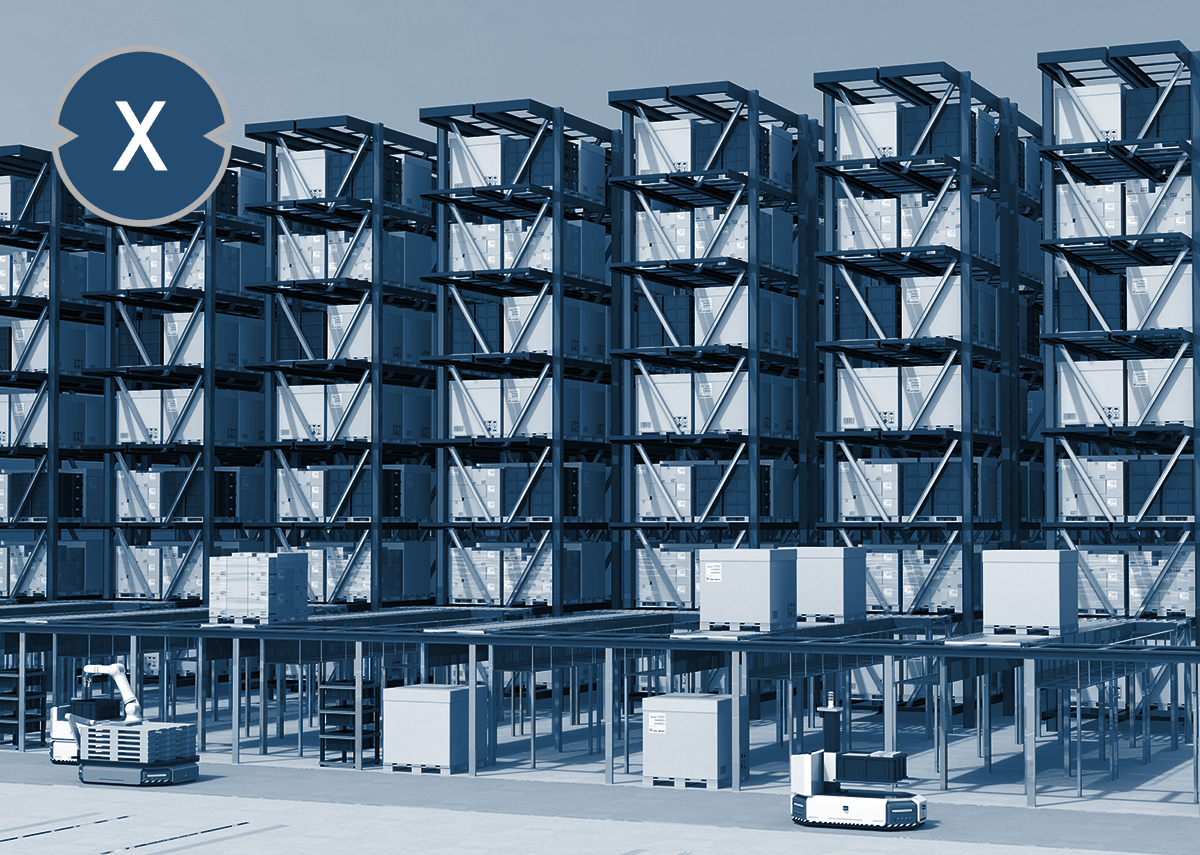
Automated pallet high-bay warehouse – Image: Xpert.Digital / Chesky|Shutterstock.com
Related to this:
Automated storage and retrieval system – AS/RS (Automatic Storage and Retrieval System)
More information here:
Automated Small Parts Warehouse (AS/RS)
More information here:
Related to this:
Why Xpert.Plus? – Consulting and planning for automated pallet high-bay warehouses (HBW) – Building a high-bay warehouse
Xpert.Plus is a project of Xpert.Digital. We have many years of experience in supporting and consulting on warehouse solutions and in logistics optimization, which we combine under Xpert.Plus in a large network.

Konrad Wolfenstein
I would be happy to serve as your personal advisor.
You can contact me by filling out the contact form below or simply call me on +49 7348 4088 965 (Munich) .
I'm looking forward to our joint project.
Write to me


Xpert.Digital – Konrad Wolfenstein
Xpert.Digital is a hub for industry focusing on digitalization, mechanical engineering, logistics/intralogistics and photovoltaics.
With our 360° Business Development solution, we support renowned companies from new business to after-sales.
Market intelligence, smarketing, marketing automation, content development, PR, mail campaigns, personalized social media and lead nurturing are part of our digital tools.
You can find more information at: www.xpert.digital – www.xpert.solar – www.xpert.plus
Keep in touch