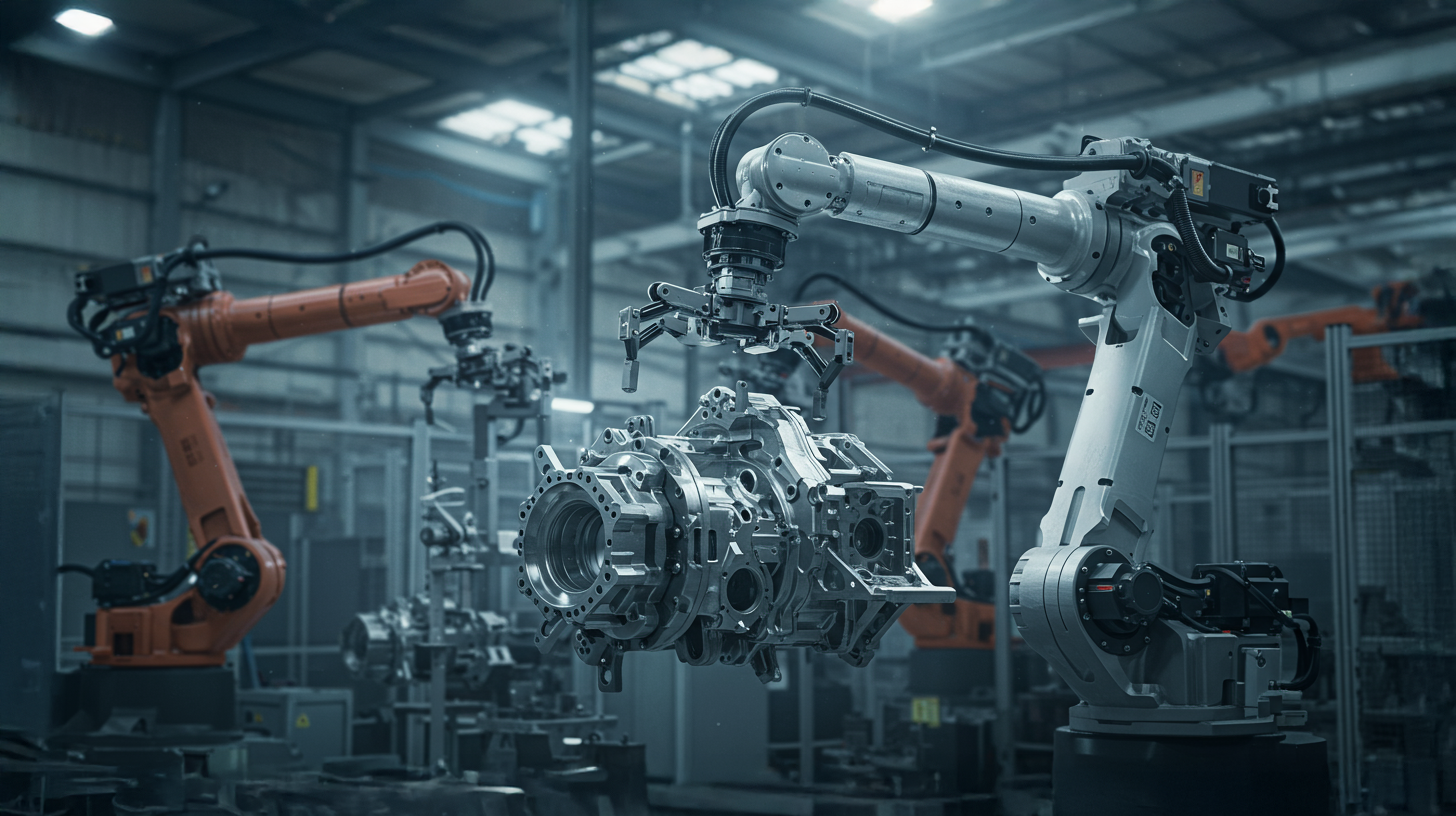
The silent revolution of heavy-duty robots in mechanical engineering: Why AI is now the deciding factor for the most powerful robots – Creative image Xpert.Digital
More powerful than ever before – and now also clever: This is what the new super robots can really do
### Forget the factory floor: These robot giants are now conquering construction sites and wind farms ### No more cages needed: How multi-ton robots are becoming safe teammates for humans ### The answer to the skilled worker shortage? These robots are taking over the world's toughest jobs ### Clash of the titans: Not strength, but software decides who builds the best robot ###
The Evolution of Strength: Latest Developments in High-Performance Heavy-Duty Robots
The heavy-duty robot sector is undergoing a profound transformation that extends far beyond simply increasing payload and reach. The latest developments demonstrate a paradigm shift towards a holistic approach that prioritizes intelligence, adaptability, user-friendliness, and the development of new applications. Software, artificial intelligence (AI), and advanced mechatronics have become the primary value drivers, enabling these powerful machines to tackle complex tasks in dynamic environments, often in direct collaboration with human workers. Key trends include the increasing blurring of boundaries between traditional industrial robots and collaborative systems (cobots), expansion into sectors such as construction and renewable energy, and the growing importance of total cost of ownership (TCO) and sustainability. These developments are defining the next generation of heavy-duty robots, which are not only stronger but, more importantly, smarter, more flexible, and more accessible.
The new generation of heavy-duty robots: Redefining power and precision
The market for heavy-duty robots is evolving from a pure competition for maximum payload to a diversified landscape where application-specific performance and efficiency take center stage. Leading manufacturers differentiate their products through a combination of power, speed, compactness, and intelligent design.
Definition of the modern heavy-duty class: More than just raw power
Heavy-duty robots are designed to handle loads typically starting at 250 kg and/or requiring a reach of over 4 meters. They form the backbone of industries such as automotive manufacturing, mechanical engineering, foundries, and increasingly, construction, where they move massive components like engine blocks, steel beams, and entire vehicle bodies. The range of payload capacities is enormous, extending from several hundred kilograms to the current peak of 2,300 kg.
The evaluation of modern heavy-duty robots has evolved, however. While maximum payload remains a key criterion, holistic efficiency metrics are increasingly coming into focus. These include the payload-to-weight ratio, the required footprint, energy consumption, and the ability to handle loads with high moments of inertia precisely and dynamically. These criteria reflect a deeper understanding of total cost of ownership and the requirements of modern, flexible production environments.
Competitive landscape and flagship models (2024-2026)
The market is dominated by established players such as KUKA, Fanuc, ABB, and Yaskawa, while new competitors like Estun from China are gaining increasing importance. The strategies of these companies show a remarkable divergence that goes beyond simply maximizing payload capacity.
Fanuc remains the undisputed market leader in the ultra-heavy-duty segment with its M-2000iA series. The M-2000iA/2300 model, with a payload capacity of 2.3 tons, is the world's most powerful 6-axis articulated robot and is ideally suited for tasks requiring absolute maximum strength, such as lifting complete vehicle chassis.
KUKA pursues a strategy of optimized performance. While the KR FORTEC ultra series offers lifting capacities of up to 800 kg, it is characterized by an exceptionally good payload-to-weight ratio and a compact design. This is achieved through innovative design features such as a double-arm system, which increases rigidity without excessively increasing weight. For palletizing applications, the KR 1000 titan series offers models with lifting capacities of up to 1,300 kg.
ABB is positioning its flagship IRB 8700 as the fastest robot in its class. With a payload capacity of up to 800 kg (or 1,000 kg with a tilted wrist), it is said to achieve cycle times 25% faster than comparable models. ABB also emphasizes its reliability through a simplified mechanical design with only one motor and gearbox per axis, which reduces maintenance and lowers total cost of ownership.
Yaskawa offers a broad portfolio that includes the Motoman MH600 with a 600 kg payload capacity. Its parallel joint design ensures high stability and rigidity, which is particularly advantageous when handling workpieces with a high moment of inertia. The GP series is designed for high-speed applications.
Emerging competitors like Estun and Kawasaki are also entering the market. Estun, China's largest manufacturer of industrial robots, plans to launch models like the ER 13300 with a 1,000 kg payload in Europe. Kawasaki is expanding its portfolio with the MXP710L (710 kg) and the M-series, which can handle up to 1,500 kg.
These different approaches demonstrate that the heavy-duty robot market has evolved from a one-dimensional race for the highest payload to a more differentiated competitive landscape. Manufacturers now compete based on specialized performance characteristics tailored to specific customer requirements – be it maximum force, efficiency in confined spaces, or maximum speed. This allows users to choose a solution optimized for their individual production conditions, rather than simply opting for the most powerful model available.
Robot Giants: A Comparison of the Most Powerful Industrial Robots
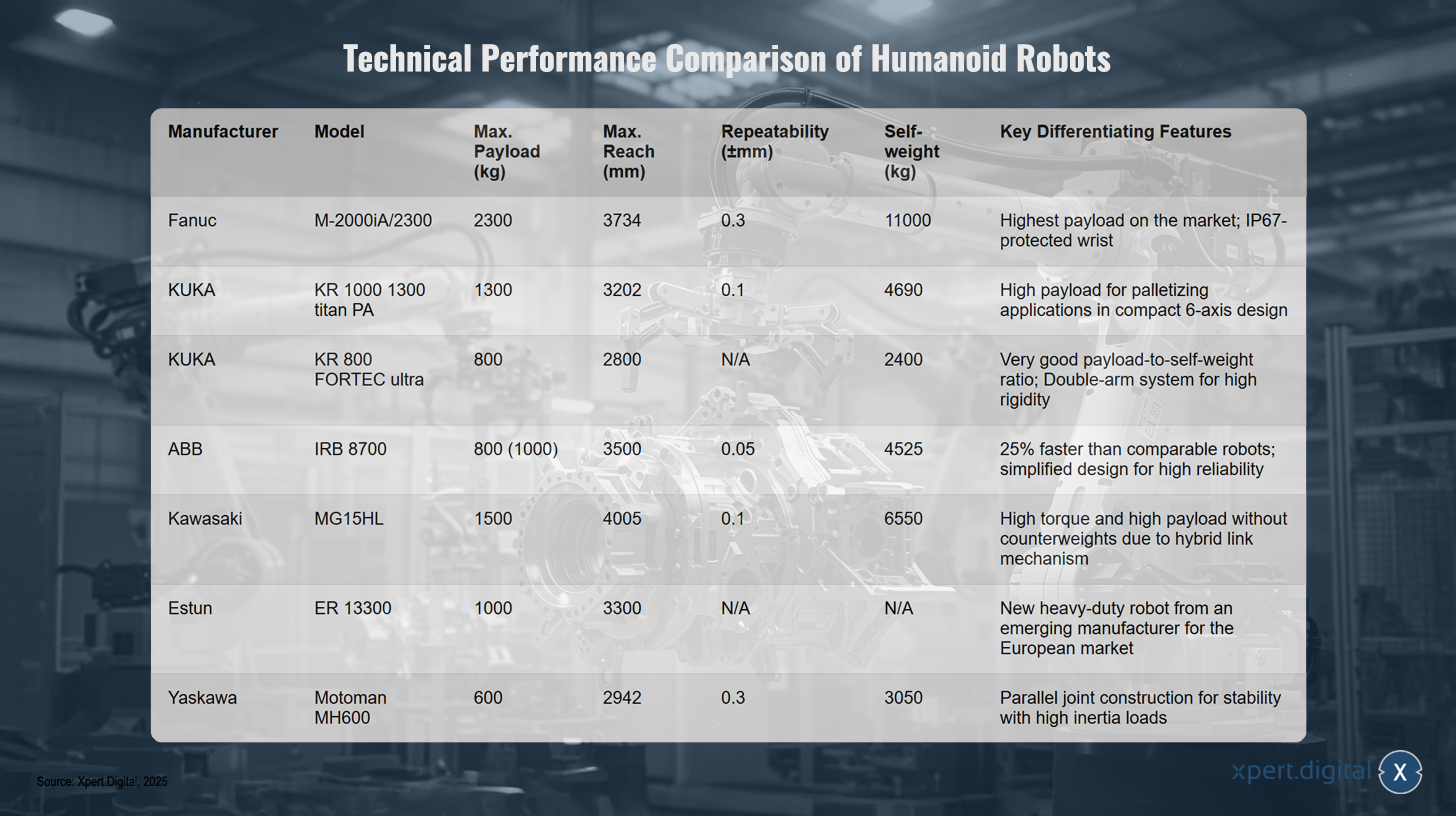
Robot Giants: A Comparison of the Most Powerful Industrial Robots – Image: Xpert.Digital
In the world of industrial robots, there are some impressive giants that stand out due to their enormous payload capacities and technical specifications. Manufacturers such as Fanuc, KUKA, ABB, Kawasaki, Estun, and Yaskawa compete for the top position in this market segment.
The Fanuc M-2000iA/2300 stands out with its exceptional payload capacity of 2300 kg and also features an IP67-protected wrist. KUKA presents the KR 1000 1300 titan PA, a robot with a 1300 kg payload capacity, ideal for palletizing applications and boasting a compact 6-axis design. The ABB IRB 8700 scores points with 25% higher speed compared to similar models and a simplified design for maximum reliability.
Kawasaki's MG15HL utilizes a hybrid link mechanism that enables high torque and payloads without additional counterweights. The Yaskawa Motoman MH600 impresses with its parallel linkage design, which guarantees stability under loads with high moments of inertia.
An interesting newcomer is the Estun ER 13300, a heavy-duty robot aiming to conquer the European market. These robots impressively demonstrate the technological advancements in industrial automation and the continuous innovation of leading manufacturers.
The intelligence engine: AI and software as key differentiating features
The most significant advances in heavy-duty robots are no longer purely mechanical in nature. Rather, it is the fusion of robotics with artificial intelligence and advanced software that fundamentally expands the capabilities of these machines and revolutionizes their operation.
From automation to autonomy: The influence of artificial intelligence and machine learning
AI and machine learning (ML) are transforming industrial robots from rigid, pre-programmed tools into adaptive, intelligent systems capable of perceiving, deciding, and learning. This transformation is crucial for managing variability and complexity in modern manufacturing and logistics processes.
Advanced perception (The “eyes”)
Modern robots no longer operate blindly. They are equipped with highly sophisticated sensor systems, including 2D and 3D vision systems, LiDAR, and stereo cameras, which give them a comprehensive understanding of their environment. This perceptual capability is driven by deep learning algorithms for object recognition, localization, and segmentation, making their use in unstructured environments possible in the first place.
Use case – Bin picking: Systems like KUKA.SmartBinPicking use advanced image processing to identify randomly arranged objects in a container, determine their gripping points and remove them safely – a task that is virtually impossible with traditional, rule-based programming.
Use case – Construction site detection: Research is actively developing YOLO-based (You Only Look Once) object recognition models. These enable robots to identify workers, vehicles, and building structures on dynamic construction sites, which is a fundamental requirement for autonomous operation in such complex environments.
Intelligent task handling (The “brain”)
AI serves not only for seeing, but also for acting. ML models enable robots to adapt their actions to changing conditions in real time.
Use case – AI-powered depalletizing: FANUC uses AI-controlled vision systems to enable robots to autonomously unload mixed pallets with varying carton sizes and positions. Such systems can process over nine cartons per minute, thus replacing extremely strenuous manual labor.
Use Case – AI-Assisted Welding: Next-generation systems, such as NovAI™, utilize machine vision and AI for adaptive, real-time welding. They can track weld seams, adapt to gap dimensions and tack welds, and dynamically correct welding parameters. This automates processes that were previously considered too inconsistent for robotics due to component tolerances and represents a significant advancement for heavy-duty construction in industries such as shipbuilding.
The revolution in user-friendliness: simplifying complexity through advanced software
Traditionally, programming industrial robots was a highly specialized task requiring in-depth knowledge of proprietary programming languages such as KRL (KUKA) or RAPID (ABB). This presented a high barrier to entry and slowed down the implementation of automation solutions.
Next-generation operating systems
Leading manufacturers are responding to this bottleneck by developing new, intuitive operating systems designed to democratize robot operation.
KUKA iiQKA.OS: A modern, Linux-based operating system with a web-based user interface (iiQKA.UI) designed to be as easy to use as a smartphone. It supports instruction-based programming, enables virtual commissioning, and is designed to foster an entire ecosystem of third-party apps and hardware (the "Robotic Republic").
FANUC iHMI: The "Intelligent Human Machine Interface" is a graphical, touchscreen-based user interface designed to drastically reduce setup and training times. It integrates planning, editing, and improvement tools such as cycle time estimation and maintenance management into a single, user-friendly interface.
Democratization of programming
The trend is clearly moving towards code-free or low-code interaction. Visual programming environments with drag-and-drop functionality and graphical workflow editors are becoming the standard. "Teaching by Demonstration" methods, where an operator manually guides the robot arm through a movement (manual guidance) or uses external tools like the Wandelbots Tracepen to "demonstrate" a task to the robot, further lower the programming barrier.
The Power of Simulation (Digital Twins)
Offline programming and simulation software such as KUKA.Sim or ABB RobotStudio has become an indispensable tool. It enables companies to virtually design, test, and optimize complete robot cells before even ordering the physical hardware. This "virtual commissioning" significantly reduces actual setup time, minimizes risks through the early detection of collisions or accessibility issues, and allows programming to be carried out in parallel with hardware procurement.
These developments point to a fundamental shift in robotics. Manufacturers are no longer simply selling a robot arm with a controller, but are building entire digital platforms. These platforms include operating systems, app stores, partner networks, and cloud connectivity. KUKA is actively promoting a partner ecosystem ("Robotic Republic") for iiQKA with open interfaces for third-party providers. At the same time, platforms like Bosch Rexroth's ctrlX AUTOMATION enable the control of robots from various brands (ABB, KUKA, FANUC) via a unified interface. This development reflects the transformation in the smartphone market, where a device's value is largely determined by its app ecosystem. The competitive landscape is thus shifting from pure hardware specifications to the strength and openness of the software ecosystem. For users, this means less dependence on a single manufacturer, faster innovation, and access to a broader range of specialized solutions. The robot becomes a hardware platform upon which a software-defined automation solution is built.
🎯🎯🎯 Benefit from Xpert.Digital's extensive, five-fold expertise in one comprehensive service package | BD, R&D, XR, PR & Digital Visibility Optimization


Benefit from Xpert.Digital's extensive, five-fold expertise in a comprehensive service package | R&D, XR, PR & Digital Visibility Optimization - Image: Xpert.Digital
Xpert.Digital possesses in-depth knowledge across various industries. This allows us to develop tailored strategies precisely aligned with the requirements and challenges of your specific market segment. By continuously analyzing market trends and monitoring industry developments, we can act proactively and offer innovative solutions. The combination of experience and expertise generates added value and provides our clients with a decisive competitive advantage.
More information here:
New mechatronics: How heavy-duty robots are breaking physical limits
Advanced Mechatronics: The Physical Evolution of Power
Alongside the rapid advances in software and AI, the physical form of heavy-duty robots is also evolving. Innovations in design, materials science, and end-effector technology are crucial to translating this increased intelligence into mechanical performance.
Innovations in design and materials: More performance with less mass
A key trend is the development of robots that are lighter and more compact while offering the same or even greater payload capacity. The KUKA KR Fortec, for example, is up to 700 kg lighter than its predecessor, while the KR FORTEC ultra series boasts a class-leading payload-to-weight ratio. This weight reduction lowers foundation requirements, reduces energy consumption, and enables deployment in densely populated and spatially limited production facilities.
This is made possible by advanced kinematic concepts. KUKA's dual-arm system and Fanuc's highly rigid arm designs improve precision and reduce vibrations at high speeds and with heavy loads. Kawasaki's hybrid link mechanism eliminates the need for bulky counterweights, thus increasing the robot's workspace.
Another important aspect is modularity. Robot series like those from KUKA (KR Quantec, Fortec, Fortec ultra) increasingly share common components, such as the central hands. This simplifies maintenance and reduces spare parts inventory costs for customers operating a diversified robot fleet.
For use in extreme environments, specialized variants such as "Foundry" or "Hygienic" versions are now standard. These models feature IP67-protected wrists and bodies, heat- and corrosion-resistant coatings, and food-grade lubricants, enabling their use in foundries, forges, or food processing plants.
Next-generation end effectors: The robot's hands
The grippers at the end of the robot arm, known as end effectors, are evolving from simple pneumatic clamps to complex mechatronic systems. They are increasingly equipped with advanced sensors that provide adaptive functionality. Although still predominantly found in applications with lower payloads, principles from soft robotics and bionics are influencing gripper technology. The goal is to handle a greater variety of object shapes and materials with higher reliability and less force. For heavy and complex objects, multi-axis, fully driven mechanisms are being developed that enable precise manipulation.
Wrist-mounted force-torque sensors give the robot a "sense of touch." They enable it to perform delicate tasks such as precisely joining components, applying a defined force during grinding, or reacting safely to unexpected collisions.
The sensor ecosystem: the basis for perception and safety
Modern heavy-duty robots rely on a rich ecosystem of internal and external sensors. Internal sensors, such as motor encoders and torque sensors in the joints, are essential for precise motion control. External sensors, such as 3D cameras, LiDAR, and ultrasonic sensors, provide the data for environmental perception and enable safe human-robot collaboration. Integrated collision and overload protection systems can trigger an emergency stop in the event of a collision or excessive load, thus protecting both the robot and the workpiece. These systems are becoming increasingly sophisticated and now offer features such as pneumatically adjustable trigger thresholds.
Sustainability and efficiency: The focus on total cost of ownership (TCO)
Energy efficiency has become a key design goal. Through lightweight construction, software-optimized motion paths, and energy-saving standby modes, manufacturers are reducing the energy consumption of their robots. This not only lowers operating costs but also improves the environmental footprint of the automation solution. Simplified mechanical designs, such as those pursued by ABB with only one motor per axis, and modular construction lead to higher reliability (Mean Time Between Failures, MTBF) and faster repair times (Mean Time To Repair, MTTR), further reducing overall operating costs.
Advances in mechatronics are closely intertwined with developments in software and AI. A stiffer, less vibration-prone arm structure (hardware improvement) is a prerequisite for advanced motion control software (software improvement) to enable the robot to move faster and more precisely. AI-based path planning algorithms can then calculate the most energy-efficient trajectory for precisely this kinematics. Integrated force-torque sensors, in turn, provide real-time feedback, allowing the control software to react to unforeseen forces and make the process more robust. The performance of a modern heavy-duty robot is thus an emergent property of the overall system, in which mechanics, sensors, and software are inextricably linked.
Expanded Horizons: New Application Fields for Heavy-Duty Robotics
Technological advances in AI, software, and mechatronics are enabling the use of heavy-duty robots in industries that previously relied on manual labor or rigid automation. Robots are leaving the controlled factory floor and conquering dynamic and unstructured environments.
The automated construction site
The construction industry faces enormous challenges due to a shortage of skilled workers, high safety risks, and increasing productivity pressure. As a result, 81% of construction companies plan to introduce robots within the next ten years.
Applications: Heavy-duty robots handle massive components such as steel profiles, precast concrete elements, and modular housing units. They are used for automated manufacturing, for example, for drilling, riveting, and fastening large components. A specific example is the Fischer BauBot, which was developed specifically for drilling and anchoring work on large construction sites. Robots can also be equipped with cutting tools to process concrete and steel components on-site with high precision.
Key technologies: Success in this unstructured environment depends critically on AI-based object recognition for identifying materials and obstacles, as well as on robust, mobile platforms.
Energy for the future: Automation in the production of renewable energies
The massive expansion of renewable energies requires faster and more cost-efficient manufacturing and installation of large components such as wind turbine blades and solar power plants.
Wind energy: In the manufacturing of wind turbine blades, robots are used for post-processing (trimming, grinding, filling), which improves quality and relieves workers of hazardous tasks. In Automated Fiber Placement (AFP), robot arms precisely lay down carbon fiber or glass fiber strips to produce lighter and stronger rotor blades. Special robotic systems process the blade root (sawing, milling, drilling) and reduce cycle times by up to 50% compared to conventional machines.
Solar energy: Companies like Charge Robotics and Terabase are developing mobile "factories" that automatically pre-assemble and install entire sections of solar modules directly on solar farm construction sites, potentially doubling productivity. AES's "Maximo" robot uses AI, LiDAR, and machine vision to automate the heavy lifting and assembly of solar panels, reducing time and costs by up to 50%. Comau's Hyperflex system is a mobile factory housed in a semi-trailer that assembles and installs solar trackers directly in the field.
Modernization of heavy industry: Shipbuilding and aerospace
Shipbuilding: This traditionally low-automation industry is beginning to use mobile heavy-duty robots. The MR4Weld, developed by Comau in collaboration with the Fincantieri shipyard, is an autonomous mobile welding robot capable of navigating the unstructured environment of a shipyard to perform welding work on large hull sections. This brings new flexibility and efficiency to the assembly of massive steel structures.
Aerospace: Here, highly precise heavy-duty robots are used for drilling, riveting and joining large aircraft components such as wings and fuselage parts, where the highest accuracy and repeatability are required.
Closing the loop: The role in the circular economy
Sustainability goals and EU regulations are driving the need for efficient recycling and reprocessing of complex products.
Automated dismantling: Heavy-duty robots are ideally suited for dismantling large and heavy products.
Electric vehicle batteries: Due to their high weight and potential hazards (electrical, chemical), robot-assisted dismantling of electric vehicle batteries is a crucial factor for safe and economical recycling. Research projects are developing robotic cells that automatically separate battery modules and cells.
Large electronics and motors: The Fraunhofer Institute is working on robotic systems that use AI and machine vision to automatically dismantle PCs, washing machines, and electric motors in order to recover valuable materials such as copper and rare-earth magnets. This is an important step towards establishing "urban mining.".
These new fields of application share a common feature: they shift the robot from the highly structured, predictable environment of a factory floor to a dynamic, unstructured, and often harsh "field." This change in environment is the primary driver of technological developments in AI, sensor technology, and mechatronics. The technical challenge shifts from optimizing repetitive movements to managing uncertainty. Future success will depend less on incremental improvements in speed or precision and more on breakthroughs in environmental perception, autonomous navigation, and adaptive task planning.
Our recommendation: 🌍 Limitless reach 🔗 Connected 🌐 Multilingual 💪 Sales power: 💡 Authentic with strategy 🚀 Innovation meets 🧠 Intuition


From local to global: SMEs conquer the world market with a clever strategy - Image: Xpert.Digital
In an era where a company's digital presence determines its success, the challenge lies in creating an authentic, personalized, and far-reaching presence. Xpert.Digital offers an innovative solution that positions itself as the intersection of an industry hub, a blog, and a brand ambassador. It combines the advantages of communication and sales channels in a single platform and enables publication in 18 different languages. Cooperation with partner portals and the ability to publish articles on Google News and a press distribution list with approximately 8,000 journalists and readers maximize the reach and visibility of the content. This represents a crucial factor in external sales and marketing (SMarketing).
More information here:
Growth, opportunities, obstacles: Strategies for heavy-duty robotics
The collaborative frontier: Safe human-robot interaction with high payloads
An emerging and seemingly contradictory trend is the application of collaborative principles to robots capable of exerting potentially lethal forces. This development is transforming heavy-duty robots from isolated machines into powerful teammates.
Beyond the cage: The spectrum of collaboration
The traditional safety concept of operating heavy-duty robots within safety enclosures is inefficient and creates a rigid separation between human and machine tasks. Modern human-robot collaboration (HRC), however, is not a single concept but a spectrum ranging from simple coexistence (the robot stops when a person enters its work area) to close collaboration (human and robot work simultaneously on the same workpiece).
The key advantage of this approach is that, unlike traditional lightweight cobots, collaborative industrial robots are not subject to limitations regarding payload, speed, or precision. They thus offer the best of both worlds: the performance of an industrial robot and the flexibility of a collaborative application.
Key technologies for safe heavy-duty MRK
Safe human-robot collaboration with heavy-duty robots is made possible by a combination of advanced sensors and intelligent control functions.
Advanced safety sensors: The foundation of safe human-robot collaboration (HRC) is the system's ability to detect human presence and intentions. This is achieved through safety-certified laser scanners, 3D cameras, and even pressure-sensitive floors that create dynamic, multi-layered protective fields around the robot.
Speed and separation monitoring (SSM): This is a key collaborative method where the robot's speed is inversely proportional to its distance from the human. As a person approaches, the robot slows down. If the person gets too close, the robot comes to a safely monitored stop. This enables smooth and efficient interaction without physical barriers.
Power and force limiting (PFL): Although challenging due to the high inertia of heavy-duty robots, advanced control systems and torque sensors in each joint allow even large robots to operate in a force-limited mode for certain tasks. They stop immediately upon unexpected contact. This function is frequently used for hand guidance or transfer tasks.
Standardization and risk assessment: The implementation of safe human-robot collaboration (HRC) applications is regulated by standards such as EN ISO 10218 and the technical specification ISO/TS 15066. A fundamental requirement is always a careful risk assessment of the entire application – i.e., robot, gripper, workpiece, and environment. Even a robot that is inherently safe can handle a dangerous tool.
These developments are leading to a redefinition of the term "cobot." Traditionally, this term was synonymous with small, lightweight, and inherently safe robot arms. The integration of collaborative functionality into heavy-duty industrial robots is breaking this paradigm. "Collaborative" is evolving from a noun (a type of robot, "a cobot") to an adjective or a set of functions ("a collaborative robot application"). The future lies not in the binary choice between a "cobot" and an "industrial robot," but in selecting an industrial robot with the appropriate payload and performance, which is then equipped with the collaborative safety features required for the specific application. This dramatically expands the potential of human-robot collaboration (HRC) to areas previously inaccessible to close human-machine cooperation, such as heavy-duty assembly or logistics.
RaaS explains: How companies can lower the barrier to entry for robots
The market for heavy-duty robots is poised for sustained growth, driven by technological innovation and expansion into new sectors. However, successful implementation requires companies to make strategic decisions that go beyond mere technology evaluation.
Market size and growth forecasts
The global industrial robotics market is a significant and growing sector. Market size forecasts vary depending on the scope and methodology of the analysis, but consistently show a positive trend
- An analysis forecasts growth from USD 33.9 billion in 2024 to USD 60.5 billion by 2030, which corresponds to a compound annual growth rate (CAGR) of 9.9%.
- Another study expects growth from USD 16.9 billion (2024) to USD 29.4 billion by 2029 (CAGR 11.7%).
- A third forecast predicts growth from USD 19.9 billion (2024) to USD 55.5 billion by 2032 (CAGR 14.2%).
The specific market for "Heavy Duty Robot Platforms" was estimated at USD 333.5 million for 2024, with a forecast of USD 446.0 million by 2030 (CAGR 5.0%). The discrepancy with the overall figures illustrates that heavy-duty robots represent a value-intensive but smaller-than-average segment of the overall market.
According to the International Federation of Robotics (IFR), the global operational stock of industrial robots reached a record high of 4.28 million units in 2023, representing a 10% increase over the previous year. Although a temporary market contraction occurred in 2024, the long-term growth trend is expected to resume from 2025 onward. Asia, particularly China, remains the largest and fastest-growing market, accounting for 70% of new installations.
Key growth drivers and obstacles
Growth drivers:
- Skills shortage and demographic change: In many industrialized nations, the lack of qualified workers is driving the automation of physically demanding and repetitive tasks.
- Industry 4.0 and Smart Manufacturing: The networking and digitalization of production require intelligent and flexible robots as central components.
- Developing new sectors: Growth is increasingly driven by introduction into industries outside the automotive sector, such as logistics, construction and renewable energies.
- Sustainability and reshoring: Robots improve material efficiency, reduce waste and enable cost-efficient production in one's own country.
Obstacles:
- High initial investments: The costs for the robot, its integration and the necessary peripherals represent a significant hurdle, especially for small and medium-sized enterprises (SMEs).
- Integration complexity: Despite more user-friendly interfaces, integrating robots into existing legacy systems and ensuring interoperability can remain a challenge.
Strategic imperatives for implementation
For companies considering the use of heavy-duty robots, the following strategic considerations are crucial:
- Shifting focus from capital expenditures (Capex) to TCO and ROI: Investment decisions should not be based solely on the purchase price. A holistic analysis of total cost of ownership (TCO) – including energy consumption, maintenance, and availability – as well as return on investment (ROI) – driven by higher throughput, improved quality, and reduced labor costs – is essential.
- Utilizing new business models: Models such as Robotics-as-a-Service (RaaS) lower the initial investment barrier by enabling companies to rent robot capabilities as an operating expense rather than making a capital investment.
- Investing in personnel development: Simplifying programming does not eliminate the need for qualified employees. Rather, it shifts the required skills from pure code programming to higher-level tasks such as process optimization, system monitoring, and maintenance. Companies must invest in the further training of their workforce to effectively manage and collaborate with these intelligent machines.
- Prioritizing software and ecosystems: When selecting a robot, the manufacturer's software platform, its ease of use, and the breadth of its partner ecosystem should be key criteria. A strong ecosystem provides access to pre-integrated solutions and future-proofs the investment against changing requirements.
We are here for you - Consulting - Planning - Implementation - Project Management
☑️ SME support in strategy, consulting, planning and implementation
☑️ Creation or realignment of the digital strategy and digitization
☑️ Expansion and optimization of international sales processes
☑️ Global & Digital B2B trading platforms
☑️ Pioneer Business Development

Konrad Wolfenstein
I would be happy to serve as your personal advisor.
You can contact me by filling out the contact form below or simply call me on +49 7348 4088 965 .
I'm looking forward to our joint project.
Write to me


Xpert.Digital - Konrad Wolfenstein
Xpert.Digital is a hub for industry focusing on digitalization, mechanical engineering, logistics/intralogistics and photovoltaics.
With our 360° Business Development solution, we support renowned companies from new business to after-sales.
Market intelligence, smarketing, marketing automation, content development, PR, mail campaigns, personalized social media and lead nurturing are part of our digital tools.
You can find more information at: www.xpert.digital - www.xpert.solar - www.xpert.plus
Keep in touch