

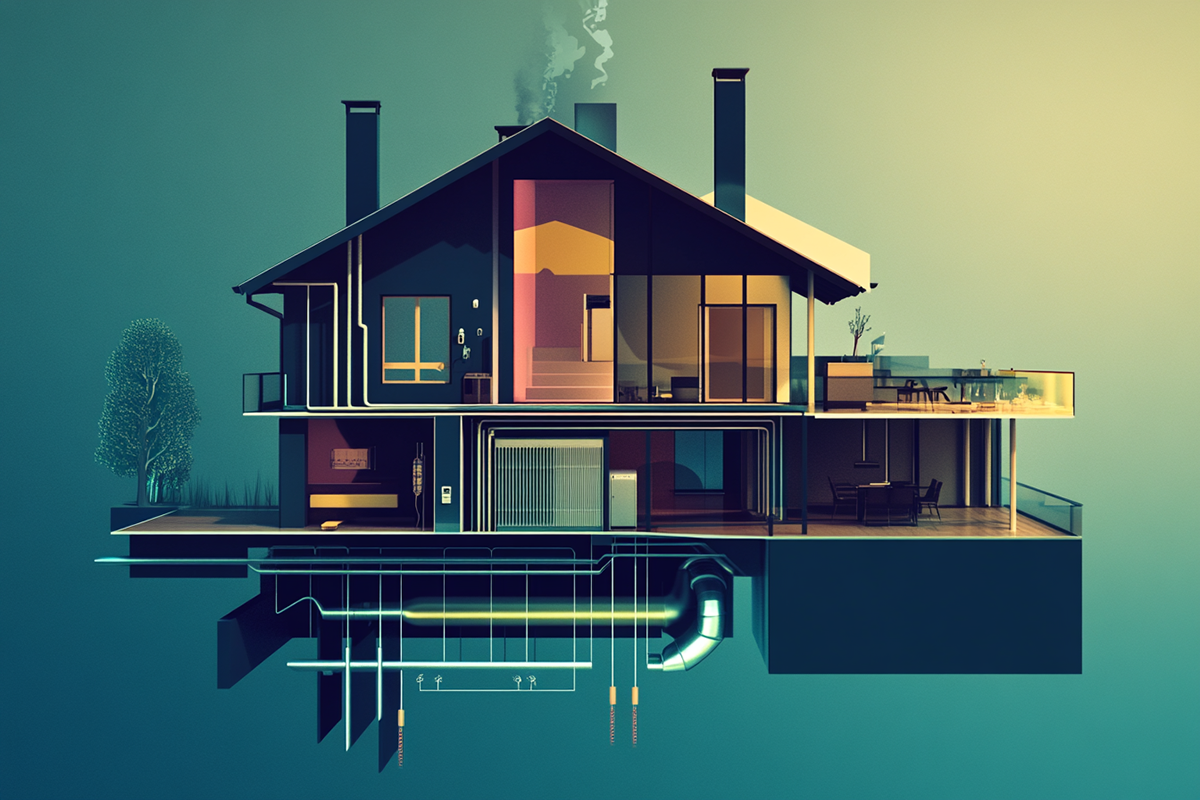
10 practical top ten tips for homeowners: What do you need to consider when installing a heat pump in existing buildings? – Image: Xpert.Digital
Efficient heating made easy: Use expert advice on heat pumps!
Future-proof heating: How heat pumps save costs and protect the environment
Heat pumps are an environmentally friendly, efficient, and future-proof alternative to conventional heating systems. They utilize energy stored in the environment and convert it into usable heat for the home. Properly sized and professionally installed, they offer a sustainable and cost-effective solution for heating buildings. Nevertheless, many homeowners hesitate to switch to heat pumps, fearing high costs or perceiving the technical requirements as too complex. Early consultation with experts can alleviate these concerns and pave the way for a successful installation.
Installing a heat pump may seem complex at first glance – but in reality, it's no more difficult than other heating systems, provided you're well-informed and consult qualified professionals. "Many homeowners shy away from installing a heat pump," explains Dr. Jochen Theloke from the VDI (Association of German Engineers), "because they feel overwhelmed by the technical requirements." However, those who seek advice early on and involve experts like VDI-certified consultants in the planningcan be sure: choosing a heat pump is not only environmentally friendly and sustainable – it also pays off in the long run.
To ensure the optimal installation of a heat pump and to benefit from the advantages of this system in the long term, homeowners should consider a few important points. The following ten practical tips serve as a guide for the successful use of a heat pump in existing buildings.
Before deciding on a heat pump
1. Check compatibility with existing systems
Before opting for a heat pump, it's essential to ensure compatibility with your existing heating system and hot water storage tank. Many older buildings have radiators designed for high flow temperatures, while heat pumps operate more efficiently at lower temperatures. Therefore, replacing old radiators with modern, low-temperature-compatible models may be necessary. Additionally, installing a buffer tank or a hydraulic separator might be required to optimize heat pump operation.
For homeowners who have already invested in smart home technologies, it is important to check whether the heat pump is compatible with the existing system. Additional control and regulation technology may need to be installed.
2. Check building stock and insulation
The efficiency of a heat pump depends significantly on the building's energy efficiency. The better insulated a house is, the more efficiently the heat pump can operate. Therefore, the condition of the insulation in the walls, roof, and windows should be checked before installation. Insufficient insulation means that more energy is required to bring the building to the desired temperature. Potential renovation measures should therefore be considered before installing the heat pump.
3. Perform a heating load calculation
A precise heating load calculation is essential to ensure that the heat pump delivers the required output. This calculation takes into account factors such as living space, the building's year of construction, and its energy efficiency. Only in this way can it be guaranteed that the chosen system is adequately sized and operates neither over- nor undersized.
4. Calculate costs and amortization, and research funding opportunities
Installing a heat pump involves higher initial costs than conventional heating systems – typically between €15,000 and €30,000. However, numerous government subsidy programs are available to financially support the switch to an environmentally friendly heating system. In Germany, up to 35% of the costs can be covered by subsidies; with additional bonuses, this figure can reach up to 70%.
In addition to the purchase price, potential additional costs such as replacing radiators or adapting the electrical infrastructure should also be considered. A specialist can help calculate the amortization period, taking operating costs and energy savings into account.
5. Ensure power supply
Heat pumps require electricity to operate. Therefore, it must be checked whether the existing electrical infrastructure of the house is sufficient to meet the additional electricity demand. In some cases, it may be necessary to install a separate electricity meter for the discounted heat pump electricity.
After deciding on a heat pump
6. Choose the type of heat pump
There are different types of heat pumps: air-to-water, water-to-water, and ground-source (geothermal) heat pumps. Choosing the right system depends on the site conditions and the building's energy requirements. An air-to-water heat pump, for example, is easier to install and doesn't require boreholes or access to a water source like other systems.
Space constraints also play a role: While air/water heat pumps require an outdoor unit, brine/water heat pumps require space for ground probes or ground collectors.
7. Plan the placement of the heat pump
The outdoor unit of an air-to-water heat pump should be carefully positioned – ideally in a location with sufficient distance from neighboring houses to avoid noise pollution. There must also be enough space indoors for the indoor unit and any buffer storage tank.
Especially in densely populated residential areas, care should be taken to minimize the noise generated by the outdoor unit – however, modern devices are already significantly quieter than older models.
8. Coordinate installation work
Only qualified professionals should be hired to install a heat pump – ideally those with VDI certification (Association of German Engineers). These experts possess the necessary know-how and ensure that all components are installed correctly.
In close consultation with the installer, it should also be ensured that all necessary parts are available in time and that no delays occur.
9. Observe noise protection and neighborhood law
Air-to-water heat pumps can produce noise during operation – especially older models, which can reach up to 50 dB (comparable to a refrigerator). However, modern units are significantly quieter; in addition, special sound insulation is available to further reduce noise.
It is advisable to inform neighbors about the planned installation early on – especially in densely populated areas or if it is known that neighbors are sensitive to noise.
10. Ensure smooth operation and maintenance
After installation, it should be checked whether all systems are functioning correctly and are optimally configured. To ensure high efficiency and a long service life of the system in the long term, it is also recommended to conclude a maintenance contract with a specialist company.
Regular maintenance ensures that potential problems can be identified and resolved early – this not only increases the lifespan of the system but also helps to ensure that it always operates efficiently.
Related to this: