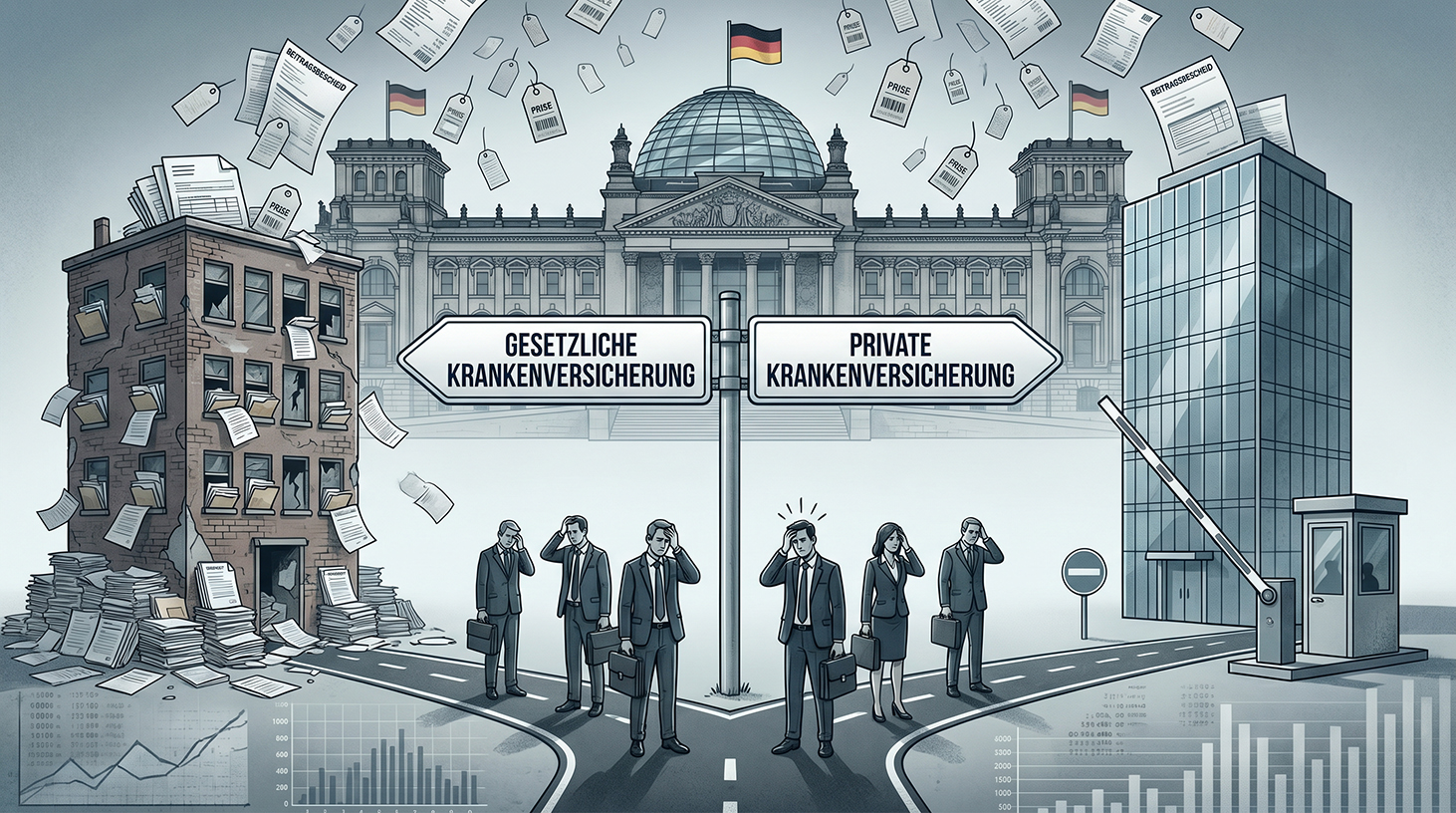
Health insurance shock: Why high earners will soon have to pay hundreds of euros more – Image: Xpert.Digital
Mass exodus to private health insurance expected: How the government is endangering its own healthcare system
Hidden tax increase: What the new contribution assessment ceiling means for your net income
Paymasters of the nation: Why politicians are squandering the trust of high achievers
The planned unscheduled increase in the contribution assessment ceiling for statutory health insurance (GKV) is causing a major stir. For millions of skilled workers and managers, this step means a massive additional burden, which can amount to up to four-figure sums per year. But this is about far more than just a higher deduction from their paychecks: The measure is the unmistakable symptom of a system that plugs financial gaps by ever-deeper raids on the pockets of so-called high earners, instead of tackling genuine, urgently needed structural reforms.
Particularly explosive: The German government is openly counting on a mass exodus of policyholders with this plan. The Ministry of Health itself assumes that up to 100,000 insured individuals could switch to private health insurance to avoid the rising premiums. The following economic analysis demonstrates why this short-sighted fiscal deal will erode the foundations of the welfare state in the long term, permanently destroy the trust of those paying into the system, and why policymakers are knowingly risking fiscal self-harm.
When the logic of the welfare state collapses: Why the new contribution assessment ceiling is backfiring on politicians – Paying more and more, losing trust
When the logic of the welfare state collapses
The current debate surrounding the unscheduled increase in the contribution assessment ceiling for statutory health insurance is more than just a technical detail of social security. It is a symptom of a system under financial pressure, whose political management increasingly prioritizes short-term revenue increases over structural reforms. At the same time, it acts as a magnifying glass on a development that has been gradually unfolding for years: those contributing to the system are expected to pay more, while the system's commitment to benefits is visibly coming under strain.
The German government plans to not only raise the contribution assessment ceiling according to the usual annual adjustments, but also to implement an additional, unscheduled increase. This will significantly raise the maximum basis for calculating contributions to statutory health and long-term care insurance. Depending on the draft legislation, the increase could amount to several hundred euros per month, which translates to a four-figure annual increase for high earners. At the same time, the Federal Ministry of Health itself anticipates that up to 100,000 insured individuals could switch from statutory to private health insurance to avoid the additional financial burden.
Economically, this is a remarkable process: The state openly anticipates that some contributors will leave the system and is nevertheless prepared to pay this price. This reinforces the image of a system in which ever-increasing contributions are made, but services or stability do not increase proportionally. The risks to contribution rates, the scope of benefits, and the long-term stability of statutory health insurance are considerable – and they affect not only high earners, but the entire community of contributors.
Against this backdrop, the question arises whether the planned measure is a rational component for stabilizing the finances of the statutory health insurance system – or whether it constitutes a case of fiscal self-harm, where short-term revenue increases accelerate the long-term erosion of the financial base. Economic analysis suggests that the latter is at least a real risk.
The contribution assessment ceiling: Mechanics of an upper price cap
To understand the scope of the discussion, one must clarify the function of the contribution assessment ceiling in the statutory health insurance system. It is a key lever for specifically influencing revenues and distributional effects.
The contribution assessment ceiling defines the income level up to which a person's gross earnings are used to calculate their statutory health insurance contributions. If someone earns more than this ceiling, no further statutory health insurance contributions are levied on the excess amount. Income above the ceiling is effectively contribution-free. Thus, while statutory health insurance is formally income-proportional, this only applies up to a politically determined maximum – beyond which the system becomes degressive.
For 2026, the contribution assessment ceiling, according to current calculations, will be €69,750 annually or €5,812.50 monthly, up from €66,150 in 2025. This corresponds to a regular increase of around 5 percent, based on general wage growth. However, policymakers are also discussing a further increase of €300 per month, which is not based on the usual adjustments but is explicitly fiscally motivated.
This will result in an additional burden of several billion euros for the affected employees and employers, depending on the calculation method. Calculations by associations and economic research institutes estimate additional contributions in the region of over 4 billion euros per year when health and long-term care insurance are considered together. Employees with incomes close to or above the previous contribution assessment ceiling, who already pay the maximum statutory health insurance contribution, will be particularly affected.
Alongside the contribution assessment ceiling, there is the compulsory insurance threshold, which is the income level above which an employee is even eligible to switch to private health insurance. In 2026, this threshold was €77,400 per year or €6,450 per month, and is therefore higher than the contribution assessment ceiling. This creates a corridor in which individuals are already paying the maximum contribution to the statutory health insurance system but are not yet permitted to switch to private health insurance. The width of this corridor can be used to strategically influence how attractive or unattractive remaining in the system is for high earners.
From an economic perspective, the contribution assessment ceiling functions as a kind of tax base for a specific type of income tax: social security contributions. Any increase in this ceiling raises this tax base. For the state and the social security institutions, this means higher revenues in the short term, without having to increase the nominal contribution rate. For those affected, however, it feels like a hidden tax increase, because even though the percentage remains the same, the contribution in euros rises.
Numbers and magnitudes: Who pays how much more?
In any debate about social policy, it is crucial to understand the scale of the issue. The planned unscheduled increase in the contribution assessment ceiling is not a fringe issue for a small elite, but affects millions of employees.
According to various calculations, the regular increase in the contribution assessment ceiling already affects around 5 to 6 million employees who fall within the relevant income bracket. The additional, politically motivated increase would therefore also affect this group, regardless of whether these individuals make extensive or minimal use of the healthcare system.
The additional burden per capita is calculated by multiplying the difference between the old and new assessment ceilings by the combined contribution rate for statutory health insurance and long-term care insurance. With an unscheduled increase of €300 per month, totaling approximately 21.9 percent (17.7 percent statutory health insurance plus 4.2 percent long-term care insurance), this equates to roughly €65 in additional monthly contributions, or nearly €780 per year for each fully affected individual. Even those earning below the new ceiling but above the old one will experience a proportional increase in their contribution.
Aggregated across all affected parties, additional revenue is projected to be in the range of approximately €2.4 billion; some associations even anticipate figures exceeding €4 billion, depending on the contribution mix and the year. At the same time, according to media reports, the Federal Ministry of Health expects that the migration of high earners to private health insurance could result in revenue losses of €1 to €1.5 billion. This significantly reduces the net benefit of the measure.
This leads to the paradoxical situation that the state takes a measure that generates gross revenue of a few billion euros, while knowingly accepting an erosion of its own financial base. Instead of a stable and predictable revenue structure, a short-term increase in revenue is created, part of which is then lost due to the exodus of precisely those groups who have previously contributed most to financing the measure.
Furthermore, for many affected individuals, statutory health insurance contributions have already risen significantly in recent years. The contribution assessment ceiling increased from €62,100 in 2024 to €66,150 in 2025 and now to €69,750 in 2026. This represents a jump of over €7,000 in annual income subject to contributions within three years. With a contribution rate of over 14 percent for health insurance alone, this already amounts to several hundred euros extra per year before the unscheduled increase even takes effect.
For many high-earning employees, statutory health insurance, long-term care insurance, pension contributions, unemployment insurance, and progressive taxation add up to a total level of contributions that is perceived as massive. The planned measure is then not seen as an isolated step, but as another building block in a pattern of increasing fiscal burden without any discernible return in the form of better benefits, shorter waiting times, or stable contribution rates.
Escape from statutory health insurance: Rational behavior or systemic failure?
The fact that the Ministry of Health itself anticipates up to 100,000 additional switches to private health insurance is economically highly significant. It means nothing less than that the government, in its own projections, assumes that the increased financial burden will trigger a clear decision to leave the private system for a portion of those insured.
Switching to private health insurance is a typical step for high earners, especially younger, healthy employees without large families. They benefit from individually calculated premiums, access to better rates, faster treatment, and sometimes a broader range of services. On the other hand, they forgo the solidarity-based elements of statutory health insurance, such as free family coverage and income-based premiums.
The decision is economically rational when the expected benefits – lower effective contributions, better care, greater planning security – outweigh the risks. Every additional burden on the statutory health insurance system shifts this calculation to the disadvantage of remaining in the solidarity-based system. Those who are already close to the income threshold for mandatory insurance receive an additional incentive to switch to private health insurance before any further potential restrictions take effect.
The key dynamic here is structural: Statutory health insurance tends to lose younger, higher-earning, and generally healthy members, while older, sick, or lower-income groups remain in the system or join it. This worsens the ratio of contributors to beneficiaries and increases the pressure on contribution rates for those who remain. If these contributions continue to rise, the incentive for the next cohort of potential switchers grows – a gradual process that can reinforce itself.
It is unusually open that politicians are pushing through a measure that officially accepts this exodus effect. Normally, attempts are made to minimize or politically conceal negative secondary effects. Here, the opposite is true: the exodus is presented almost as an unavoidable side effect of necessary consolidation.
This represents a largely uncommunicated paradigm shift. The legal system is no longer primarily positioned as an attractive option for all employed individuals, but rather as a mandatory construct for those who do not meet the criteria for opting out. Simultaneously, the conditions for those remaining within the system are repeatedly worsened. From a regulatory perspective, this is a recipe for eroding trust and undermining the system's legitimacy.
Fiscal self-harm? The logic of a short-sighted deal
The central claim being made is that by raising the contribution assessment ceiling unexpectedly, the state is causing itself fiscal harm. This thesis can be structured economically by comparing the short-term revenue effects with the medium- and long-term costs and risks.
In the short term, the measure clearly increases revenue. Every increase in the assessment base, assuming the percentage remains unchanged, theoretically generates additional contributions. On paper, the calculation is simple: more assessed euros multiplied by the contribution rate results in billions of euros in additional revenue. From the perspective of a finance minister or health insurance association, this initially appears attractive, especially in a situation with looming deficits in the statutory health insurance system.
In the medium to long term, however, the composition of the insured population changes. If predominantly high-earning individuals with relatively low healthcare needs leave the system, statutory health insurance funds lose above-average contributors, while expenditures are hardly reduced. This is because those groups that incur high costs—the elderly, the chronically ill, and the socially disadvantaged—usually have neither the option nor the economic incentive to switch to private health insurance.
This reduces the total contribution per average claim within the system. To finance the same level of benefits, the remaining insured individuals must accept either higher contribution rates, higher assessment ceilings, or benefit reductions. Each of these options, in turn, has its own political and economic costs: rising non-wage labor costs, falling net wages, growing resistance from contributors, and the risk that the entire system will be perceived as unfair.
Furthermore, there is a reputational and trust effect, which is particularly important in the economic analysis of social security systems. Social security systems only function if participants trust that the rules will not be arbitrarily shifted to their disadvantage and that the burdens and benefits are in a perceived fair balance. If high earners are repeatedly addressed as a mere source of revenue without any discernible structural reforms, the impression arises that they are primarily viewed as a fiscal resource.
In this sense, one can speak of fiscal self-harm: The state attempts to close the short-term funding gap by placing a heavier burden on precisely those groups whose trust and long-term participation in the system it urgently needs. The exodus it itself predicts is not an external shock, but a direct consequence of its own policies. Thus, the process resembles a company that tries to improve its balance sheet by raising prices so drastically for its best customers that they switch to the competition.
Our EU and German expertise in business development, sales and marketing


Our EU and German expertise in business development, sales and marketing - Image: Xpert.Digital
Industry focus areas: B2B, digitalization (from AI to XR), mechanical engineering, logistics, renewable energies and industry
More information here:
A thematic hub offering insights and expertise:
- Knowledge platform covering global and regional economies, innovation and industry-specific trends
- A collection of analyses, insights, and background information from our key areas of focus
- A place for expertise and information on current developments in business and technology
- A hub for companies seeking information on markets, digitalization, and industry innovations
Contribution increases vs. structural reform: The creeping sell-off of the German healthcare model
Germany as a model: More contributions, more redistribution, less net income
The current debate fits seamlessly into a pattern that has been evident in German tax and social policy for years. The burden of taxes and social security contributions has risen steadily, particularly for middle and higher incomes, while increases in welfare benefits are perceived as rather moderate.
Germany has one of the highest tax burdens on earned income in international comparison. The combination of income tax, solidarity surcharge, and contributions to health, long-term care, pension, and unemployment insurance means that many full-time employees with higher incomes receive significantly less than half of their gross salary as net income. Political initiatives to relieve this group are rare, while new burdens—such as contribution increases or the expansion of the contribution base—are regularly discussed and implemented.
In parallel, the scope of government redistribution programs has increased significantly. Healthcare costs for recipients of basic income support and refugees are largely co-financed through statutory health insurance contributions, instead of being fully covered by tax revenue, as would be more sound from a regulatory perspective. Statutory health insurance funds have criticized this for years as being contrary to the system, because it disproportionately burdens contributors and drives up contribution rates. Nevertheless, these items will apparently not be fundamentally restructured in the current reform package.
What service providers are experiencing is a double effect: On the one hand, the burden is increasing, and on the other hand, service promises are being relativized or made subject to ever more conditions. In health insurance, this is reflected, among other things, in longer waiting times for those with statutory insurance, increasing co-payments, and the gradual shift of certain services to the private supplementary sector.
Raising the contribution assessment ceiling fits this picture: it represents a further decision in favor of higher contributions and more intensive redistribution, without simultaneously addressing the structural drivers of expenditure growth. Cost increases in the healthcare sector are primarily driven by medical advances, demographic change, wage increases in the nursing and healthcare sectors, as well as inefficient structures and bureaucracy. Focusing solely on revenue reduction treats symptoms, not the root causes.
Microeconomics of Decision-Making: 100,000 Rational Steps
The statement that social models don't collapse with a single, dramatic event, but rather through many individual rational decisions, can be readily understood from a microeconomic perspective. Every individual faces a cost-benefit analysis: Is it worthwhile to remain in the statutory health insurance system, or is switching to private health insurance advisable?
For a well-paid employee in their mid-30s with an above-average income, the calculation looks like this: If statutory health insurance contributions rise continuously due to increasing assessment limits and contribution rates, while benefits do not increase at the same rate, private health insurance becomes more attractive. While switching involves risks – especially regarding premium development in old age – those affected often consider these risks manageable.
Politicians often underestimate how sensitive those affected are to such signals. The announcement of an unscheduled increase in the contribution assessment ceiling acts as a marker: it shows that the ceiling is politically flexible and that the current policy cannot be relied upon indefinitely. Those already considering switching providers see this as an additional incentive to take the step now, before further restrictions are imposed.
These numerous individual decisions aggregate into a macroeconomically relevant process. If 100,000 people with comparatively high incomes leave the statutory health insurance system, the financing base changes noticeably. Revenue gaps arise that must be closed either through further contribution increases, higher tax subsidies, or benefit cuts. Each of these adjustments, in turn, creates new incentives for further exodus or political conflicts.
In this way, social models are not static. They gradually erode when the balance between what participants contribute and what they receive is no longer perceived as fair or predictable. In Germany, this process is particularly sensitive because the tax burden is already high, and at the same time, trust in government efficiency and prioritization is eroding.
Distributional effects and issues of justice
Beyond the purely fiscal considerations, the question of distribution is crucial. Who bears the additional burden, and who benefits from it? The official justification is that high earners should contribute more to stabilizing social security. The implicit argument is that this group is financially capable and can therefore be burdened more heavily.
However, the line between "rich" and "high earner" is often blurred in public debate. Many of the affected employees are skilled professionals, middle managers, engineers, or specialists who live in metropolitan areas with high housing costs. They sometimes face high tax burdens, have family responsibilities, and already pay the maximum contribution to several branches of social security. Their actual savings rate—that is, what remains after all fixed costs—is often significantly lower than their gross income would suggest.
The additional burden resulting from the increase in the contribution assessment ceiling thus affects not only a narrow upper class, but a relatively broad upper middle class of the working population. At the same time, structural perverse incentives within the system are hardly addressed: for example, the financing of certain non-insurance-related benefits from contributions instead of taxes, or inefficient structures in administration and pension provision.
Questions of fairness also arise between generations. Those currently employed not only finance the current healthcare system, but also indirectly the promises of a high level of service for the coming decades. If they get the impression that these promises cannot be kept in the future, and at the same time the burdens are already at the limit of what is bearable, the system's acceptance suffers.
From a distributional policy perspective, it could be argued that a more tax-funded basic healthcare system with clear, income-dependent tax surcharges would be more transparent and sounder from a regulatory standpoint. Instead, a complex network of contribution-based and tax-funded elements is currently maintained, in which the burdens are distributed in a way that is difficult to understand and high earners are charged multiple times.
Systemic alternatives: What a genuine reform would have to achieve
Raising the contribution assessment ceiling is essentially a classic revenue-generating measure. It says little about the real problem: the structural imbalance in the statutory health insurance system's finances and the overall efficiency of the healthcare system. An economically sound reform would have to address several issues simultaneously, instead of unilaterally expanding the assessment base.
Key areas of action include:
- Strict separation of non-insurance-related services and genuine health services, with clear tax financing for the former.
- Efficiency gains through digitalization, deregulation and better management of supply pathways, for example through integrated supply models.
- Better incentive systems for prevention and health-conscious behavior that can reduce spending in the long term, rather than just increasing revenue.
- A reform of the fee systems and the sectoral separation of outpatient and inpatient care, which currently leads to perverse incentives and duplicate structures.
- A clearer division of roles between tax-funded basic insurance and contribution-funded supplementary insurance.
For a sustainable reform, it would be sensible to bring the federal government, states, health insurance funds, service providers, and social partners together in a binding framework where not only revenues but, above all, structures are discussed. The current approach of primarily closing deficits through higher contributions and assessment ceilings is not sustainable in the long run because it undermines the acceptance of service providers and increases the migration to private health insurance.
Political Economy: Why the wrong lever is so attractive
Despite these obvious problems, resorting to the contribution assessment ceiling remains politically attractive. There are several reasons for this, which have more to do with political economy than with pure logic.
First, the measure is technically easy to implement and relatively easy to communicate. No complicated structures need to be changed, no complex negotiations with doctors, hospitals, or health insurance companies are required; rather, a legal regulation simply needs to be amended or a law expanded to include a key figure. The fiscal effect is easily quantifiable, and the affected group is limited in number.
Secondly, the burden can be politically sold as a contribution from the "strong," which resonates rhetorically in an environment where social justice is strongly emphasized. The fact that the affected individuals are already among the highest contributors and are also disproportionately burdened in other areas – such as taxes – is often overlooked in the public debate.
Thirdly, the group directly affected is less politically conflict-prone than, for example, pensioners or low-income earners. While well-paid employees are economically important, they are more difficult to mobilize collectively and do not possess the same immediate political clout as other groups. From the perspective of short-sighted politicians, this makes them a comparatively "easy" target group for imposing additional burdens.
This situation leads to a reflexive recourse to the same tools whenever funding gaps arise in the welfare state: higher contribution rates, higher assessment ceilings, and an expansion of income components subject to contributions. In the long run, however, this practice has a corrosive effect on the relationship between those contributing to social security and the state. The willingness to contribute to the solidarity-based financing system should not be taken for granted; it is the result of trust and a perception of fairness.
Perspective of high performers: Between loyalty and exit
From the perspective of high-earning contributors, the situation appears ambivalent. Many are generally willing to contribute above average to financing the welfare state. They themselves benefit from stable institutions, a functioning infrastructure, and an efficient healthcare system. However, the willingness to show solidarity has its limits when it is perceived as one-sided and exploited.
The planned increase in the contribution assessment ceiling is, for this group, another piece in a larger narrative that reduces their role primarily to that of "payers." At the same time, structural problems—such as inefficient spending, non-contribution-funded benefits, or flawed political priorities—are only inadequately addressed.
Switching to private health insurance in this context is not just a financial decision, but also an expression of exit in the political economy sense: those who feel they have no voice and are not fairly considered within the system leave it when the opportunity arises. The more high-achievers take this path, the stronger the signal to policymakers becomes that the existing regulatory logic is reaching its limits.
At the same time, switching to private health insurance is not a realistic option for everyone. Self-employed individuals, older workers, people with pre-existing conditions, or families with specific insurance needs often have good reasons to remain in the statutory health insurance system. For them, policymakers are increasing the burden without offering a genuine exit option. This reinforces the feeling of being trapped in a kind of "coercive system" whose rules are unilaterally adjusted.
A creeping tipping point: Why the current decision is symbolically oversized
Raising the contribution assessment ceiling may seem like a technical detail in international comparison, but in the German context it has immense symbolic significance. It marks the culmination of years of decisions that consistently followed the same path: higher contributions, increased non-wage labor costs, more intensive redistribution, and little willingness to implement structural reforms.
In a situation where the statutory health insurance system is already facing billions in funding shortfalls, where healthcare expenditures are rising faster than revenues in almost all areas, and where demographic trends are simultaneously increasing the pressure, one would expect policymakers to develop a concept that goes beyond mere revenue management. Instead, the focus is once again on a measure that will bring in money in the short term but will ultimately undermine the system's central resource: the trust of its largest contributors.
Whether the projected 100,000 switches to private health insurance actually occur depends on many factors: the specific design of the reform, the communication of the measures, the reactions of private health insurance providers, and the overall economic situation. Crucially, however, this exodus should not be seen as an external shock, but rather as the logical consequence of a policy that primarily views the system as a "contribution machine" for acute budgetary problems.
This is how social models ultimately do collapse: not through a major revolution or an abrupt breakdown, but through numerous individual decisions in which people realize that the system is no longer viable. In this sense, the current debate marks a potential tipping point – not because it immediately plunges the system into crisis, but because it makes visible and intensifies an already ongoing process of erosion.
More honesty, less symbolic politics
From an economic perspective, the planned unscheduled increase in the contribution assessment ceiling for statutory health insurance is a flawed instrument for stabilizing the system. It generates short-term additional revenue, which in the long term could be more than offset by attrition, loss of trust, and increased acceptance problems.
A sustainable path forward for the German healthcare system requires an honest assessment: Which services should be financed through solidarity-based contributions, and which should not? Which costs are rightly covered by contributions, and which belong in the tax-funded sector? How can efficiency potential be realized without sacrificing the quality of care? And how can we ensure that high-earning contributors do not feel primarily viewed as a fiscal resource and less as partners in a solidarity-based system?
As long as these questions are not answered seriously and systematically, raising the contribution assessment ceiling will remain a symbol of political crisis management that focuses solely on the bottom line while ignoring the system's underlying logic. The numerous individual rational decisions made by citizens who defy this will then be no surprise, but rather a rational reflex.