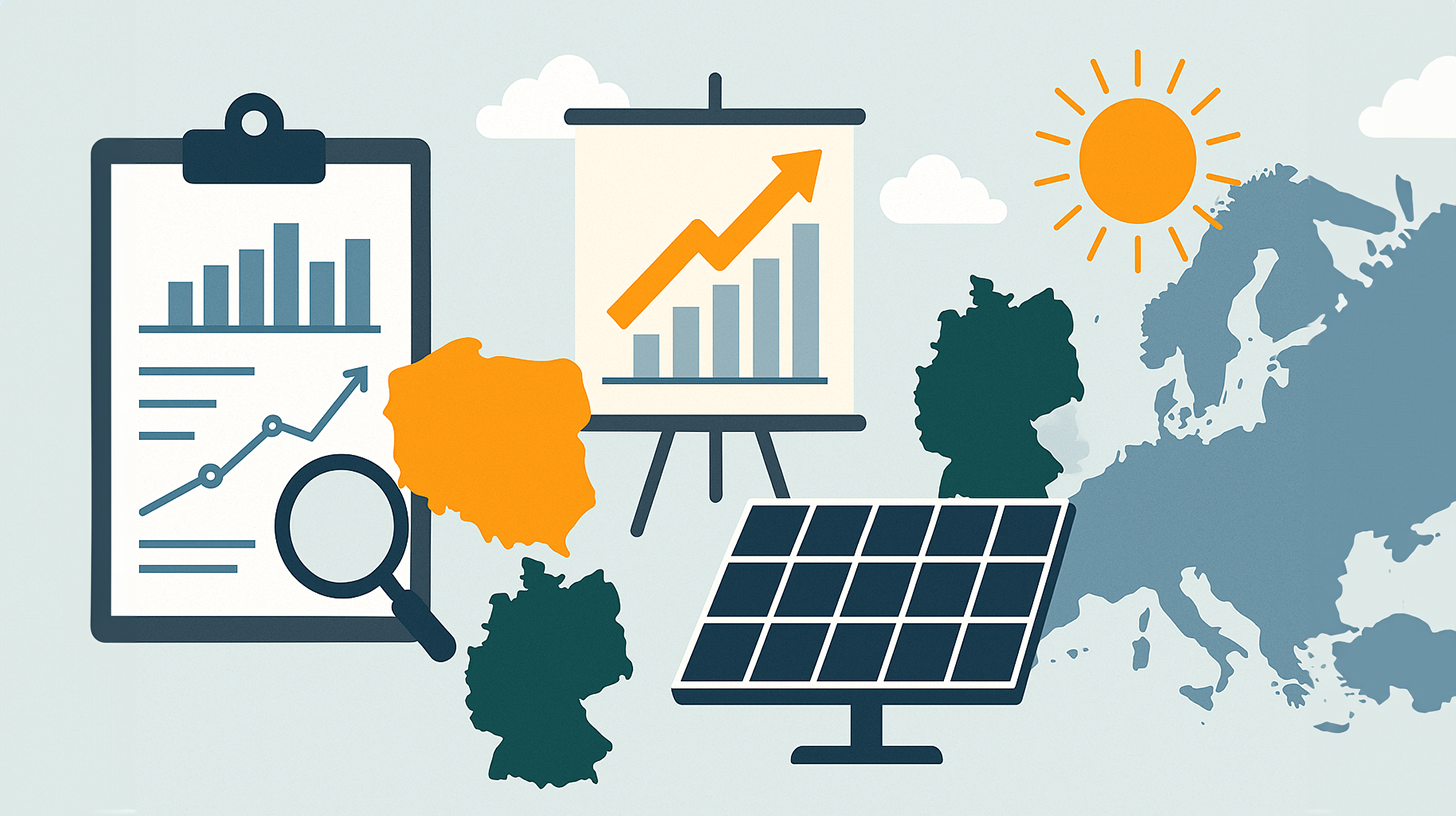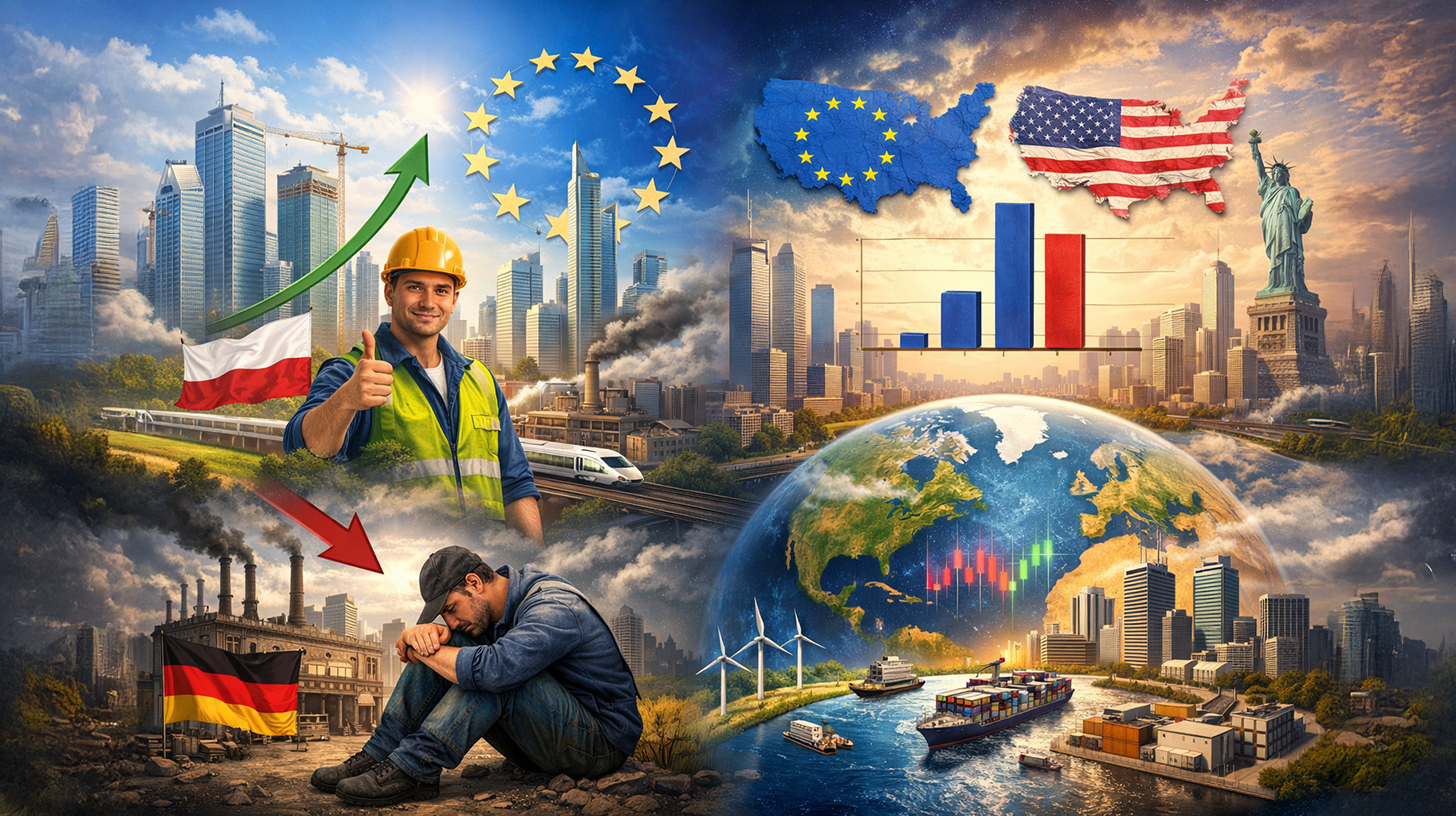
A turning point in European growth: Why Poland is booming while Germany is struggling – Image: Xpert.Digital
EU vs. USA: The real reason for Europe's 70 percent productivity gap
The regional economic dynamics of the European Union and its position in the global structure
With an economic output of US$18.6 trillion, the European Union maintains its position as the world's second-largest economy, but a look at the raw figures masks a fundamental internal shift. While the European single market remains the indispensable backbone of prosperity and stability, a remarkable realignment of economic power centers is taking place beneath the surface. The era in which the Union's growth was evenly distributed or solely driven by the major industrialized nations of the West appears to be over, at least for now.
This is particularly evident in the current "growth gap": Germany, traditionally the economic anchor of the Union, is struggling with stagnation and a slight decline in economic output, while Eastern European states such as Poland, Romania, and Croatia – spurred by EU funds and rising domestic demand – are developing into the continent's new driving forces. At the same time, the transatlantic comparison reveals stark structural deficits: In the race with the USA, Europe lags behind in productivity, digitalization, and post-crisis recovery, burdened by high energy costs and lower technological adaptability.
The following article analyzes the complex mechanics of European economic dynamics. It examines how the single market acts as a buffer in turbulent times, the role of global dependencies on the US and China, and why the EU's competitiveness in the future will depend not only on industry, but also on its symbiosis with the service sector and regional innovation clusters.
Fundamentals of EU economic distribution
With a nominal gross domestic product of approximately US$18.6 trillion, the European Union is the world's second-largest economy, yet it exhibits a remarkable diversity of regional economic performance. Germany dominates with a 23.6 percent share of total EU GDP, followed by France with about 16 percent and Italy with around 12 percent. These three economies together account for more than half of the Union's total economic output.
Economic development in the EU in 2024 was moderate, with average GDP growth of around 0.9 percent, although regional differences were clearly evident. While the eurozone as a whole recorded growth of 0.8 percent, the dynamics varied considerably between member states. Germany, as an economic powerhouse, even experienced a slight decline in economic output of 0.1 percent, which dampened the overall performance of the Union.
Regional growth drivers and economic divergences
Eastern European member states have emerged as notable drivers of growth within the EU. Poland led the way with a projected GDP growth of 3.3 percent for 2024 and an expected 3.6 percent for 2025. Slovakia and Hungary each recorded growth rates of around 2.0 percent, while the Czech Republic experienced more moderate growth of 1.2 percent.
Romania and Croatia particularly benefited from the funds of the NextGeneration EU Corona Recovery Fund and achieved growth rates of around 3.0 percent. These countries demonstrated remarkable economic dynamism, characterized above all by rising real wages, strengthened domestic demand, and successful use of European funding.
Southern European countries like Spain also performed well, with quarterly growth of 0.8 percent in the second quarter of 2024. France grew by 0.3 percent and Italy by 0.2 percent, while Germany was the only major economy to experience a decline. These developments illustrate the different economic cycles and structural conditions within the Union.
The importance of the EU single market versus foreign trade
The European single market plays a central role in the economic performance of the member states. Approximately two-thirds of all goods trade between EU countries takes place within the Union's borders. Intra-EU exports accounted for 64.0 percent of total exports in 2017, while intra-EU imports accounted for 63.8 percent.
For some member states, the importance of the single market reaches even greater dimensions. In eight EU countries, the share of goods exported within the EU in their respective total exports exceeded 75 percent. Slovakia led with a share of 85.7 percent, followed by Luxembourg, the Czech Republic, Hungary, Poland, Romania, Slovenia, and the Netherlands.
Germany, as the EU's largest economy, exported 58.5 percent of its goods to other EU member states and imported 66.0 percent from within the Union. These figures underscore the fundamental importance of European integration for the German economy and illustrate the close interconnections between European economies.
Foreign economic relations and global integration
The USA holds a leading position in the EU's foreign trade. Approximately one-fifth of EU exports go to the United States, making it the most important export market outside Europe. China follows as the second most frequent export destination with about 10.4 percent of EU exports, while China is the leading import destination with 18.7 percent.
These trade relations illustrate the complex global integration of the EU economy. While the single market forms the basis for stability and growth, external trade relations enable access to raw materials, technologies, and additional sales markets. Trade with non-EU countries created approximately 36 million jobs in Europe, underscoring the importance of global interconnectedness for employment and prosperity.
Structural basis of the EU economy
The European economy is based on the service sector to approximately 72 percent, reflecting the modern structure of the Union. This dominance of services is particularly evident in developed regions such as Luxembourg, where the tertiary sector accounts for the largest share of economic output.
The close integration between industry and services is a distinctive characteristic of the European economy. Industrial companies procure a significant amount of specialized services, creating an industry-service network that accounts for between 8.8 and 11.5 percent of total economic value added. This connection contributes substantially to export strength, as approximately 54 percent of all service exports are indirectly routed through industry.
Our EU and German expertise in business development, sales and marketing

Our EU and German expertise in business development, sales and marketing - Image: Xpert.Digital
Industry focus areas: B2B, digitalization (from AI to XR), mechanical engineering, logistics, renewable energies and industry
More information here:
A thematic hub offering insights and expertise:
- Knowledge platform covering global and regional economies, innovation and industry-specific trends
- A collection of analyses, insights, and background information from our key areas of focus
- A place for expertise and information on current developments in business and technology
- A hub for companies seeking information on markets, digitalization, and industry innovations
EU vs. USA: Why Europe is growing stably but less flexibly
Economic stability in international comparison
The EU economy exhibits both strengths and structural challenges compared to other major economies. Following economic crises, the US economy typically recovers faster than the European economy. This was evident both after the financial and economic crisis of 2007/2008 and after the COVID-19 pandemic in 2020.
While the US reached pre-crisis levels as early as 2010 after the financial crisis, it took until 2014 in the EU, not least because of the additional sovereign debt crisis in some Eurozone countries. Even after the COVID-19 pandemic, the US economy surpassed its pre-pandemic level as early as the first quarter of 2021, while the EU only followed suit six months later.
This differing speed of adaptation reflects structural differences. The US ranks higher than most EU countries in many economic competitiveness rankings. Exceptions include Denmark and Ireland, which are considered just as competitive as the US. However, the EU average shows less flexibility, for example in the adaptability of the labor market or in business start-ups.
Challenges of competitiveness
Approximately 70 percent of the difference in per capita GDP between the EU and the US can be attributed to lower productivity in the EU. European companies pay electricity prices that are two to three times higher than in the US, and gas prices that are four to five times higher. These energy cost disadvantages particularly burden energy-intensive industries such as chemicals, metals, and building materials.
The EU is also lagging behind in digitalization. Only 13 percent of EU companies use advanced technologies such as artificial intelligence. At the same time, only about a third of university patents are commercially used, even though the EU is on par with the US and China in terms of the number of patents.
Regional innovation centers and economic clusters
Within the EU, different regional specializations have developed. The northern European countries, especially Scandinavia, demonstrate remarkable economic performance. Norway achieved a GDP per capita of over €100,000 in 2022, making it the second richest country in the European Economic Area after Liechtenstein.
With a research and development intensity of 3.6 percent of GDP, Sweden ranks third among OECD countries. Following the construction of the Öresund Bridge, the transnational metropolitan region of Copenhagen-Malmö has developed into one of Scandinavia's most dynamic economic areas, offering excellent location factors for innovation and international companies.
Foreign trade dependencies and strategic partnerships
The EU has a complex structure of trade dependencies. While China is its most important import partner, these dependencies are developing asymmetrically. As the EU continuously increases its trade share with China, China is reducing its relative dependence on European markets. Whereas in 2007 4.4 percent of Chinese value added was dependent on EU final consumption, today that figure is only 2.2 percent.
This development reflects China's Dual Circulation strategy, which aims to reduce its dependence on foreign countries. At the same time, China is expanding its position as the most important trading partner for many EU countries, especially in Eastern Europe, where German investment and trade relations have traditionally been strong.
The labor market as a stabilizing factor
The European labor market is proving to be an important stabilizing factor. With an employment rate of 75.8 percent among 20- to 64-year-olds, the EU reached a historic high in 2024. The unemployment rate fell to 5.9 percent across the EU as a whole, although structural challenges regarding youth unemployment remain.
Particularly in southern member states such as Spain, Greece, and Italy, youth unemployment is significantly higher than the overall average. These regional disparities reflect differing education systems, labor market structures, and levels of economic development.
Fiscal policy coordination and investment promotion
The EU's cohesion policy plays a vital role in reducing regional development disparities. In 2024, the EIB Group allocated over €38.2 billion to projects in cohesion regions, representing 48 percent of its EU financing. This support is concentrated in regions with a GDP per capita below the EU average.
The different regional categories reflect the range of economic development: less developed regions with a per capita GDP below 75 percent of the EU average, transitional regions between 75 and 100 percent, and more developed regions above 100 percent. This classification forms the basis for targeted investments in infrastructure, education, and innovation.
Future prospects and strategic direction
The economic outlook for the EU is sending mixed signals. The European Commission forecasts GDP growth of 1.5 percent for the EU as a whole and 1.3 percent for the Eurozone for 2025. This recovery will be driven mainly by rising private consumption, while investment and exports will remain weaker.
Geopolitical uncertainties, particularly potential US tariffs and ongoing trade tensions, are weighing on export prospects. The EU must strengthen its competitiveness through investments in innovation, digitalization, and sustainable energy supply in order to remain competitive globally.
The European Commission's Competitiveness Compass strategy aims to close the innovation gap, strengthen start-up ecosystems, and accelerate digital transformation. Particular emphasis is placed on building AI capacity and promoting the commercialization of research results.
Catching up in Eastern Europe: How investments and digitalization are rebalancing the EU
The analysis shows that individual regions of the EU do indeed act as growth drivers, but in different ways and with varying intensity. Eastern European countries such as Poland, the Baltic states, and Southeast European markets are developing above-average growth, while traditional industrial centers like Germany are showing cyclical weaknesses.
The EU single market remains the foundation of the European economy, generating approximately two-thirds of total trade volume. At the same time, the Union is deeply integrated into global value chains, with the USA being its most important export partner and China its most significant importer.
The EU's economic stability proves to be solid in international comparison, but less flexible than the US economy. Structural challenges such as high energy costs, regulatory complexity, and lags in digitalization are hindering its global competitiveness.
The EU's regional diversity represents both a strength and a challenge. While developed regions drive innovation and high-quality services, less developed areas benefit from catch-up effects and European investment programs. This dynamic creates a resilient but complexly coordinated economic system that requires continuous policy adjustments to optimize its global position.
Your global marketing and business development partner
☑️ Our business language is English or German
☑️ NEW: Correspondence in your native language!

Konrad Wolfenstein
I and my team are happy to be available to you as your personal advisor.
You can contact me by filling out the contact form here wolfenstein@xpert.digital:or simply call me at +49 7348 4088 965. My email address is
I'm looking forward to our joint project.
☑️ SME support in strategy, consulting, planning and implementation
☑️ Creation or realignment of the digital strategy and digitization
☑️ Expansion and optimization of international sales processes
☑️ Global & Digital B2B trading platforms
☑️ Pioneer Business Development / Marketing / PR / Trade Fairs
🎯🎯🎯 Benefit from Xpert.Digital's extensive, five-fold expertise in one comprehensive service package | BD, R&D, XR, PR & Digital Visibility Optimization

Benefit from Xpert.Digital's extensive, five-fold expertise in a comprehensive service package | R&D, XR, PR & Digital Visibility Optimization - Image: Xpert.Digital
Xpert.Digital possesses in-depth knowledge across various industries. This allows us to develop tailored strategies precisely aligned with the requirements and challenges of your specific market segment. By continuously analyzing market trends and monitoring industry developments, we can act proactively and offer innovative solutions. The combination of experience and expertise generates added value and provides our clients with a decisive competitive advantage.
More information here: