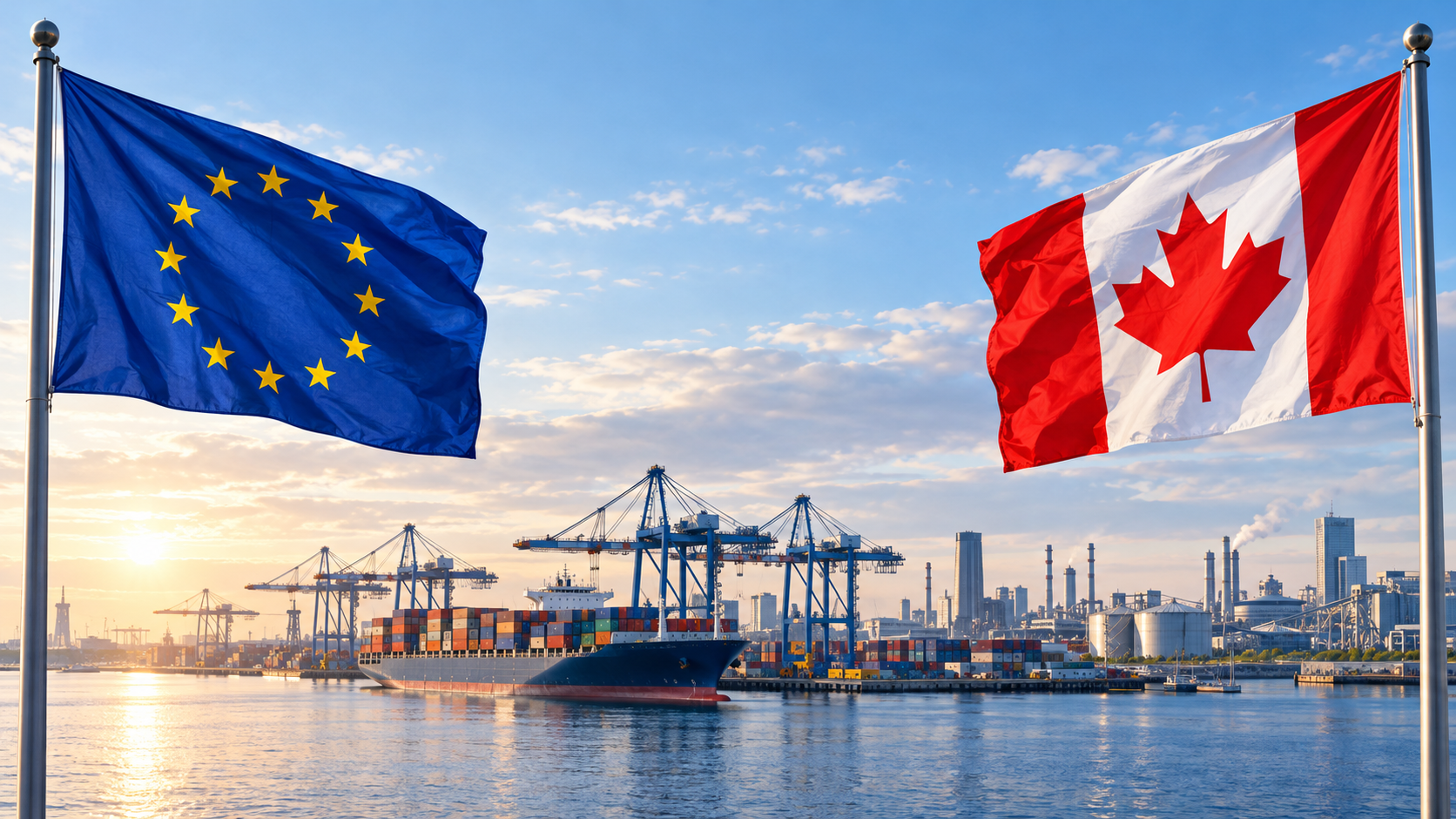
Europe is hindering Canada's special status – and risking a major economic opportunity – Creative image on the topic, with AI: Xpert.Digital
Raw materials, energy, AI: What a closer partnership between the EU and Canada could bring
Canada and the EU are moving closer together – but crucial commitments are missing
EU-Canada partnership: What lies behind the dispute over "membership"
The dispute between the EU and Canada over a possible "associated membership" initially appears to be a diplomatic conflict over a single word. In reality, it is about much more: about how two closely linked economic areas can expand their cooperation while simultaneously reducing their dependence on the US. Trade, investment, critical raw materials, energy, financial markets, and artificial intelligence are all at stake, as are the rules governing how companies will operate across borders in the future.
European heads of state and government have, for the time being, removed the proposed membership title from the draft summit declaration. Individual economic commitments were also weakened. However, this does not mean that the closer partnership is off the table: the EU and Canada intend to further deepen their relations. The crucial question now is whether these political declarations of intent will translate into concrete and reliable agreements. Ultimately, for businesses, the name of a partnership is less important than whether it facilitates investment, stabilizes supply chains, and genuinely improves market access.
Europe deletes one word – and risks missing out on a greater opportunity
The dispute between Canada and the European Union is about far more than a diplomatic designation. Behind the disagreement over associate membership lies the question of how two closely linked economic areas can safeguard their ability to act when their most important common partner is increasingly perceived as an economic source of uncertainty. Energy, critical raw materials, industrial value creation, financial services, and artificial intelligence form the economic basis of a project whose institutional form is yet to be determined.
The preliminary resistance to the special status proposed by EU Commission President Ursula von der Leyen is therefore neither a complete failure of the rapprochement nor a meaningless dispute over words. German Chancellor Friedrich Merz and other European heads of state and government had a politically charged term removed from the draft summit declaration. At the same time, economic commitments were softened. Thus, the dispute concerns both the institutional architecture and the potential economic scope of the cooperation. However, closer partnership remains the explicit goal.
The crucial economic perspective is therefore this: A robust EU-Canadian partnership does not need a prestigious membership title. It needs reliable investment conditions, better market links, and concrete agreements on how both sides will deal with each other in economic crises. Conversely, the legitimate desire for legal clarity must not become a pretext for postponing economically sensible integration indefinitely.
A political vision becomes an institutional stress test
The draft for the EU-Canada summit on October 29 and 30, 2026, in Montreal highlights the difference between political announcement and institutional agreement. Originally, Canada, as an associate member of the Union, was to be involved early in consultations on key policy and regulatory initiatives. The actual scope of this status was to be determined by the 2027 summit.
Following the amendments, the focus is now on Canada's increasingly closer ties with the EU. The revised draft has been accepted by the European side and is to be published at the conclusion of the summit. Therefore, at present, the measures described therein should be treated as planned political agreements, not as fully implemented economic rights.
This distinction is crucial for businesses. A joint declaration can shift expectations, signal political support, and structure further negotiations. However, it replaces neither a legally binding market access rule nor an investment decision. An industrial company can explore a market based on a summit announcement. But it is unlikely to build a multi-billion-dollar production facility simply because both sides are striving for a closer partnership.
Furthermore, the political debate is not over. Von der Leyen continued to use the term publicly after her arrival in Montreal. The Commission President's choice of words and the formulation accepted by the member states are therefore not yet identical. The project remains open, both in its language and in its final form.
A partnership with significant economic resources
The rapprochement is not starting from a blank slate economically. According to Canadian figures, trade in goods and services between the EU and Canada reached approximately 178 billion Canadian dollars in 2025. This made the EU Canada's second-largest trading partner after the United States. This scale demonstrates that deepening relations would not necessarily require creating entirely new economic ties, but could instead build upon existing business relationships.
Investment stocks are even more telling. European direct investment in Canada was estimated at around 219 billion Canadian dollars for 2025. Canadian direct investment in the EU amounted to approximately 315 billion Canadian dollars. Taken together, this results in a reciprocal capital interdependence of around 534 billion Canadian dollars. These figures represent stocks, not annual investment inflows. Therefore, they should not be directly compared with annual trade volumes.
The economic significance of such investments extends beyond the sheer amount of capital. Direct investments link production sites, distribution networks, research institutions, and management decisions. They create an interest in predictable rules because the resources deployed are often tied up long-term.
This starting point argues for deeper ties, but at the same time limits overly optimistic expectations. Canada and the EU don't need to reinvent every economic relationship. The greatest additional benefits are likely to arise where existing connections are hampered by differing regulations, inadequate infrastructure, or political uncertainty.
American dependence cannot be resolved by a summit decision
For Canada, closer ties with Europe are of particular urgency. The United States is not simply one large sales market among many. It forms the central point of reference for numerous Canadian production and supply chains. Geographical proximity, transport links, and historically established business structures cannot be replaced in the short term.
In 2025, 71.7 percent of Canadian merchandise exports went to the USA. The previous year, this figure was 75.9 percent. At the same time, the American share of Canadian merchandise imports fell from 62.3 to 58.8 percent. Statistically, the dependence thus decreased, but remained exceptionally high.
Interpreting this trend requires distinguishing between successful diversification and weaker business with the main partner. Canada's merchandise exports to the US declined by 5.8 percent in 2025. Under such conditions, a decreasing share of American exports does not automatically translate into increased prosperity. It may be partly due to a loss of momentum in a previously crucial sales channel.
The European partnership should therefore not be conceived as a replacement for the United States. A more economically plausible approach is an additional, viable connection that provides Canada with greater room for maneuver. In this context, diversification does not mean the dissolution of North American integration, but rather the reduction of unilateral vulnerability.
Trading figures show movement, but no structural breakthrough yet
Canada's merchandise exports to countries outside the US increased by 17.2 percent in 2025. Total merchandise trade with these countries rose from 484 billion to 553 billion Canadian dollars. This represents a nominal increase of 14.3 percent and indicates a stronger international focus beyond the American market.
However, it would be wrong to interpret these figures solely as the result of new industrial strength or successful geographic diversification. Canada's total merchandise exports declined by 0.2 percent in nominal terms in 2025. Excluding a product group heavily reliant on unrefined gold, the decline was even more pronounced at 3.0 percent. At the same time, exports of this precious metal group increased by 41.7 percent.
This leads to an important analytical limitation. Higher export values can result from price increases without a corresponding increase in industrial value creation or employment. Furthermore, gold price movements can have economic causes other than the establishment of long-term sales relationships for machinery, software, or processed raw materials.
Therefore, the success of EU-Canadian trade should be measured by the composition of trade. The decisive factor would not be solely whether the overall volume increases, but whether more companies export sustainably, higher-value products are developed, and new production and research connections are established.
Why the dispute over the designation is economically relevant
Resistance to associate membership cannot be explained solely by European inertia. The term raises expectations that are not yet met by a clearly defined institutional model. This raises the question for governments of which obligations they are politically willing to agree to before their legal and financial consequences are known.
Regular EU membership, an association agreement, and participation in individual EU programs are distinct constructs. The regular accession route under Article 49 of the EU Treaty is open to European states. Close association with third countries, on the other hand, is generally possible. A generally regulated status as an associated EU member does not yet exist for the Canadian model discussed here.
Economically, this ambiguity poses a problem for shaping expectations. If companies infer easier market access from a political title that is later not granted, poor decisions can result. Conversely, a precise sectoral agreement without a spectacular name can create greater planning certainty.
The member states' objection is therefore objectively understandable. It would only become problematic if the demand for conceptual precision did not lead to concrete negotiations. Legal clarity is a prerequisite for successful integration, not a substitute for it.
Ukraine and Canada need different integration models
Further confusion arises from the fact that associate membership was also discussed for Ukraine. Merz had proposed such an approach in June as a possible intermediate step towards regular EU accession. This involved earlier institutional integration of a European accession candidate.
In Canada, the same concept follows a different logic. The aim is to integrate the country as closely as possible into European policy areas and programs, without thereby preparing for regular accession. While in the Ukrainian case it refers to a transition within an enlargement process, in the Canadian case it is an independent form of permanent cooperation.
The economic requirements differ accordingly. An accession candidate works towards the long-term goal of fully adopting European law and participating in its institutions. A strategic partner, on the other hand, can integrate selected areas without making the same overall political and legal commitment.
This distinction does not imply a ranking of the political value of the two relationships. Rather, it illustrates why a uniform label can be problematic. The more different the integration goals are, the more precisely rights, obligations, and decision-making processes must be defined.
After the tariff reductions, the more difficult integration begins
With CETA, Canada and the EU already have a comprehensive trade agreement, which has been provisionally applied since September 2017. A significant portion of the traditional tariff barriers has already been addressed. Therefore, the additional economic benefits of a closer partnership will not primarily arise from another major round of tariff reductions.
Non-tariff trade barriers are becoming increasingly important. These include differing product requirements, duplicate testing, complicated documentation, divergent approval procedures, and difficult-to-access information. Such obstacles often act like additional fixed costs: a company must overcome them first, regardless of its eventual revenue in the target market.
Small and medium-sized enterprises (SMEs) are particularly sensitive to these costs. A large corporation can finance its own legal, customs, and certification departments. A specialized SME has to solve the same fundamental issues with significantly fewer resources.
A deeper partnership could therefore be particularly effective if it improves practical export capabilities. Mutual recognition of appropriate tests, more transparent requirements, and better-coordinated administrative procedures could achieve more than a new institutional designation. However, recognition presupposes comparable levels of protection and effective monitoring. It must not be confused with a blanket abandonment of safety, environmental, or consumer standards.
Raw material wealth only becomes a strategic strength through processing
Critical raw materials are among the strongest economic arguments for a closer partnership. Canada can open up additional sourcing options for Europe. The EU, in turn, possesses industrial demand, mechanical engineering expertise, financing options, and technological capabilities for further processing.
A distinction must be made between geological deposits and actually available industrial intermediate products. A raw material deposit only has strategic value for a supply chain if extraction, processing, transport, and manufacturing are economically viable. Numerous technical and financial steps lie between a deposit and a European production line.
A partnership that only organizes the import of unprocessed raw materials would therefore remain limited. For Canada, it might generate too little additional value. For Europe, it would not automatically eliminate dependence on processing capacities in other countries.
Coordinated value chains would be more sensible. Canadian projects could be secured through European offtake agreements and equity investments. European companies could supply technology and equipment. Processing stages should be located where energy supply, skilled labor, infrastructure, and cost structure are viable.
The political challenge lies in reconciling economic efficiency with regional expectations. Both sides will seek additional jobs and industrial activity. These interests must be openly negotiated, rather than concealed behind general partnership formulas.
Our EU and German expertise in business development, sales and marketing

Our EU and German expertise in business development, sales and marketing - Image: Xpert.Digital
Industry focus areas: B2B, digitalization (from AI to XR), mechanical engineering, logistics, renewable energies and industry
More information here:
A thematic hub offering insights and expertise:
- Knowledge platform covering global and regional economies, innovation and industry-specific trends
- A collection of analyses, insights, and background information from our key areas of focus
- A place for expertise and information on current developments in business and technology
- A hub for companies seeking information on markets, digitalization, and industry innovations
Liquefied natural gas: Infrastructure or diplomatic emergency program?
Liquefied natural gas is an infrastructure issue, not a diplomatic emergency program
The planned review of additional Canadian liquefied natural gas (LNG) exports to Europe is economically relevant, but should not be confused with short-term availability of delivery volumes. A feasibility study will first determine whether a project could be technically, commercially, and regulatory viable.
For an LNG project to be successful, it's not enough that Canada has gas resources and Europe has demand. Suitable pipeline connections, liquefaction plants, port infrastructure, ships, financing, and reliable long-term sales prospects are also required. The location of the export facility also determines transport routes and competitiveness.
The timing is particularly challenging. New plants must operate at sufficient capacity over extended periods to make high initial investments worthwhile. European climate targets and potential changes in gas consumption, on the other hand, influence the willingness to enter into long-term purchase commitments.
This creates a tension between security of supply and investment risk. Canada needs reliable demand, while Europe wants additional options but as little long-term reliance on fossil fuel infrastructure as possible. Both desires are understandable, but they don't automatically align.
A sound assessment must therefore consider several scenarios: differing gas prices, fluctuating European demand, potential cost overruns, and stricter emissions requirements. Political proximity improves the starting position but does not replace a reliable project cost estimate.
Climate policy can create competitive advantages and generate new friction
Closer coordination on energy and climate protection could bring economic advantages if it makes investments more predictable. Companies benefit if they can record emissions using transparent methods and use the results in both economic areas.
This is especially true for energy-intensive intermediate products. If production processes demonstrably cause fewer emissions, this can create a competitive advantage. However, this requires that differences between actual emission reductions and mere statistical allocations are accurately recorded.
At the same time, distributional conflicts exist. Stricter requirements can increase investment costs or disadvantage existing facilities. Different energy prices and regional supply structures affect competitiveness. A uniform political objective therefore does not mean that all companies bear the same adjustment costs.
A viable partnership would require considering climate protection and industrial policy together. Neither a blanket weakening of European requirements would be sensible, nor would it help to burden Canadian companies with avoidable duplicate assessments. The economic benefit lies in transparent rules, comparable measurement methods, and sufficiently stable investment conditions.
Artificial intelligence combines research strength with industrial demand
In the areas of artificial intelligence and digital technologies, the interests of both sides complement each other. Canada contributes research expertise and technology companies. Europe offers industrial users, research networks, and a large market for specialized solutions.
However, economically relevant collaboration would have to go beyond joint declarations of intent. Research results do not automatically translate into scalable business models. Between a successful model in the laboratory and reliable industrial application lie data preparation, integration, safety testing, financing, and sales.
The integration of AI with specific industrial problems would be particularly interesting. Applications in production planning, quality control, maintenance, logistics, and energy optimization can increase productivity when incorporated into real-world processes. The benefit arises not from the mere availability of a model, but from improved decisions and measurable operational results.
Computing capacity is not an isolated technological problem. It requires electricity, grid connectivity, suitable locations, hardware, and long-term utilization. A partnership should therefore bring together research, energy supply, and industrial application.
Strategic autonomy does not necessarily mean producing every digital component in-house. A more economically realistic approach is to identify critical dependencies, create multiple access options, and strengthen one's own capacity to develop and utilize key technologies.
Financial market integration would be a lever for the real economy
The removal of the explicit goal of more integrated financial markets from the draft is economically significant. Raw material projects, energy plants, digital infrastructure, and industrial production facilities require long-term capital. Political partnerships without adequate financing often fall short of their potential.
The already high levels of direct investment demonstrate that both economic regions are fundamentally capable of investing with each other. Deeper financial cooperation should therefore focus primarily on areas where cross-border financing is unnecessarily expensive, complicated, or legally uncertain.
Better coordinated procedures, more easily accessible information, and more reliable conditions for long-term investments would be conceivable. However, this does not automatically mean that full financial integration would be advisable. Banking supervision, deposit insurance, insolvency law, and investor protection touch upon sensitive public interests.
Financial markets transfer not only capital but also risks. Greater integration can improve financing but also facilitate contagion from crises. Therefore, integration should be differentiated according to functional areas and risk categories.
The economically sound approach would be a targeted improvement in capital mobilization for productive investments. The crucial point is not to generate as many cross-border financial transactions as possible, but to finance viable projects that create additional value.
Economic security must be more than mutual consideration
The weakening of the economic security commitments affects a particularly important part of the project. Originally, stronger mutual preferential treatment was envisioned. Now, the focus is more on limiting the negative impact of one's own actions on the partner.
This difference can be significant in a crisis. A political partnership demonstrates its value not only under normal market conditions, but also when a raw material becomes scarce, supply chains are disrupted, or export restrictions are being considered.
From a company perspective, the crucial question is which information obligations, consultations, and exemptions actually exist. Can a manufacturer learn early on that their intermediate product will be affected by a new regulation? Are there designated contact persons and transition periods? Are legitimate safety interests implemented in such a way as to limit unintended damages?
At the same time, states must not promise themselves unlimited supply guarantees that they cannot fulfill, either politically or practically, in a crisis. Canada and the EU also have a responsibility to ensure the supply of goods to their own populations.
A credible agreement therefore requires tiered commitments. Early information, joint risk analyses, and transparent procedures would be less spectacular than a blanket preferential treatment, but could function more reliably in a crisis.
Security of supply cannot be reduced to raw materials
The planned cooperation on pharmaceuticals and key technologies broadens the perspective beyond traditional industrial policy. Shortages in these areas not only cause economic losses but can also directly impact healthcare systems and public infrastructure.
However, the origin of a finished product alone is not a sufficient measure of security of supply. A drug can be manufactured in Europe or Canada and still depend on an active ingredient or precursor from a single third country. The same applies to technical devices whose critical components originate from concentrated supply chains.
A robust partnership would therefore need to examine multi-layered dependencies. Important factors would include not only direct suppliers, but also intermediate products, production processes, transport routes, and alternatives.
Complete self-sufficiency would be neither realistic nor economically desirable. It would increase costs and could limit innovation. The sensible goal is sufficient resilience: multiple sources of supply, selected reserves, alternative production options, and clear crisis procedures.
The economic benefit here lies partly in avoided losses. Such advantages may not necessarily appear as higher trading volume, but can possess considerable social value through lower default risks.
An economic council is only as good as the problems it solves
The planned economic council could bring companies from both sides closer together. However, such bodies are not an end in themselves. Their usefulness depends on whether they identify concrete obstacles and actually accelerate their resolution.
An effective economic council would need to differentiate between different types of problems. Some obstacles stem from a lack of information, others from technical regulations or conflicting political interests. Not every problem can be solved through better communication.
Furthermore, balanced participation would be important. Large companies usually already have established contacts and legal resources. Medium-sized companies often need support when entering a market for the first time. Without a corresponding focus, a new body could primarily serve to further network those who are already well-connected.
Success should therefore be measured by results: simplified procedures, resolved certification issues, additional collaborations, and actual investments. The number of meetings or the prominence of the participants says little about this.
Transparency would also be economically beneficial. If jointly identified obstacles and progress are documented in a comprehensible manner, more companies can benefit. Otherwise, the Economic Council risks becoming an exclusive discussion forum with limited reach.
New trade links need ports, data, and skilled workers
Closer partnerships will only permanently change trade flows if the logistical infrastructure grows accordingly. Additional trade requires suitable transport capacity, reliable port handling, and efficient connections to the hinterland.
A transatlantic supply chain differs fundamentally from a North American production connection close to the border. Longer transport routes can tie up more capital in inventory and place higher demands on planning and risk management. Not every product previously geared towards the American market can be economically redirected to Europe.
Digital processes can partially mitigate these disadvantages. Reliable information about shipments, standardized documents, and better-coordinated customs procedures facilitate management. However, they do not replace physical infrastructure or sufficiently qualified personnel.
The mobility of skilled workers is also relevant. Joint development projects require engineers, technicians, and scientists who can work temporarily at the partner company. Therefore, educational and research cooperation can be more productive in the long run than an additional trade delegation.
Canada's planned increased participation in European programs should therefore be understood as economic infrastructure. It creates networks, shared experiences, and technological connectivity, the value of which often only becomes apparent over longer periods.
Diversification makes sense, but it's not free
A stronger focus on Europe can make Canada more resilient. However, it also incurs adjustment costs. Companies must change products, acquire new customers, comply with different regulations, and build additional distribution structures.
The same applies to Europe. Companies developing new sources of raw materials or establishing alternative supply chains may initially pay higher prices. These additional costs can be economically justified if they significantly reduce the risk of default. However, they are not automatically a sign of greater efficiency.
This creates a classic insurance dilemma. A more robust supply chain may cost more under normal circumstances, but it limits damage in a crisis. How much additional security is advisable depends on the probability of occurrence and the potential extent of the damage.
Policymakers should therefore neither subsidize every form of diversification nor solely base their decisions on the lowest short-term price. A differentiated assessment is necessary. For interchangeable goods with many suppliers, the security benefit of additional government support may be minimal. For intermediate products that are difficult to replace, it can be significantly higher.
A convincing partnership would take such differences into account and concentrate scarce public funds on particularly relevant bottlenecks.
Trump's pressure increases both the incentive for cooperation and its risk
American politics forms a significant backdrop to the rapprochement. Trade disputes, territorial claims against Canada, and doubts about the reliability of political commitments are altering the risk perception on both sides. Businesses must not only assess prices and demand but also anticipate more abrupt political interventions.
Trump's threats against what he considers a hostile EU-Canadian rapprochement exacerbate this problem. They create a potential conflict of objectives: a partnership is intended to reduce dependencies, but could trigger additional trade tensions in the short term.
This does not mean that Europe and Canada should forgo closer cooperation, nor that potential American reactions would be economically insignificant. A serious approach must consider both sides of the equation.
Precisely for this reason, the partnership should not be staged as a demonstrative counter-movement. Its economic rationale is sound even without confrontational symbolism: reliable supply chains, additional investments, and increased technological cooperation.
At the same time, it would be dangerous to make every independent economic decision dependent on American goodwill. Such an approach would deepen precisely the dependency that the project is intended to reduce. Strategic capability arises from viable alternatives, not from merely avoiding political friction.
By 2027, intentions must translate into verifiable progress
The timeframe leading up to the next summit offers an opportunity to translate an undefined political project into concrete work packages. To this end, it would be sensible to focus on areas where real improvements are possible within a reasonable timeframe.
This includes practical trade facilitation, joint research projects, concrete investment plans, and clearly regulated crisis consultations. Larger infrastructure projects, on the other hand, require longer lead times and should not be burdened with short-term promises of success.
Several criteria would be important for the economic evaluation. First, additional trade would have to be distinguished from mere price and exchange rate effects. Second, announced investments should be considered separately from capital actually disbursed and completed facilities. Third, it would be necessary to examine whether new collaborations extend beyond a few large companies.
Productivity and value creation are equally important. A partnership is not successful simply because more goods cross the Atlantic. It should make companies more competitive, facilitate innovation, and reduce the likelihood of supply disruptions.
The political timetable should not be confused with an automatic economic mechanism. A summit can consolidate decisions. Whether viable projects emerge from this is subsequently determined in companies, government agencies, research institutions, and funding processes.
Membership is dispensable, but economic liability is not
The preliminary rejection of associate membership is a political setback for von der Leyen. However, it is not yet proof that closer EU-Canadian cooperation would have failed economically. An unclear title would have been of little use even if it had remained unchanged in the declaration.
More problematic are the weakened economic commitments. If financing issues, mutual consideration, and crisis mechanisms remain permanently non-binding, the partnership could fall short of its potential. The real test, therefore, lies not in the next wording, but in the quality of the agreements.
The economic conditions are favorable: a substantial volume of trade already exists, high levels of mutual investment, and complementary strengths in resources, technology, and industry. At the same time, geographical distance, infrastructure needs, and differing political interests limit the pace of rapprochement.
A pragmatic perspective therefore combines ambition with institutional precision. Canada will not be able to replace the US in Europe in the short term. Canadian resources will not automatically make the EU independent of other suppliers. However, both sides can broaden their options and thus improve their negotiating position.
The decisive step forward would be a partnership that promises less than a membership title suggests, but delivers more than a non-binding alliance formula would lead one to expect. Economic sovereignty doesn't arise from states simply labeling their relationships as particularly grand. It arises when companies can invest, supply chains become more resilient, and political agreements hold up even under pressure.
🎯🎯🎯 Data-driven B2B industry hub as a quasi-in-house solution


The quasi-in-house solution: How Xpert.Digital closes operational gaps in B2B marketing and sales – Smart Content-Driven Business - Image: Xpert.Digital
Xpert.Digital is a data-driven B2B industry hub led by Konrad Wolfenstein . The company acts as an external, quasi-in-house solution for industrial partners, closing operational gaps in marketing, content, and sales – without requiring additional resources on the client side.
More information here:
Your global marketing and business development partner
☑️ Our business language is English or German
☑️ NEW: Correspondence in your native language!

Konrad Wolfenstein
I and my team are happy to be available to you as your personal advisor.
You can contact me by filling out the contact form here wolfenstein@xpert.digital:or simply call me at +49 7348 4088 965. My email address is
I'm looking forward to our joint project.