


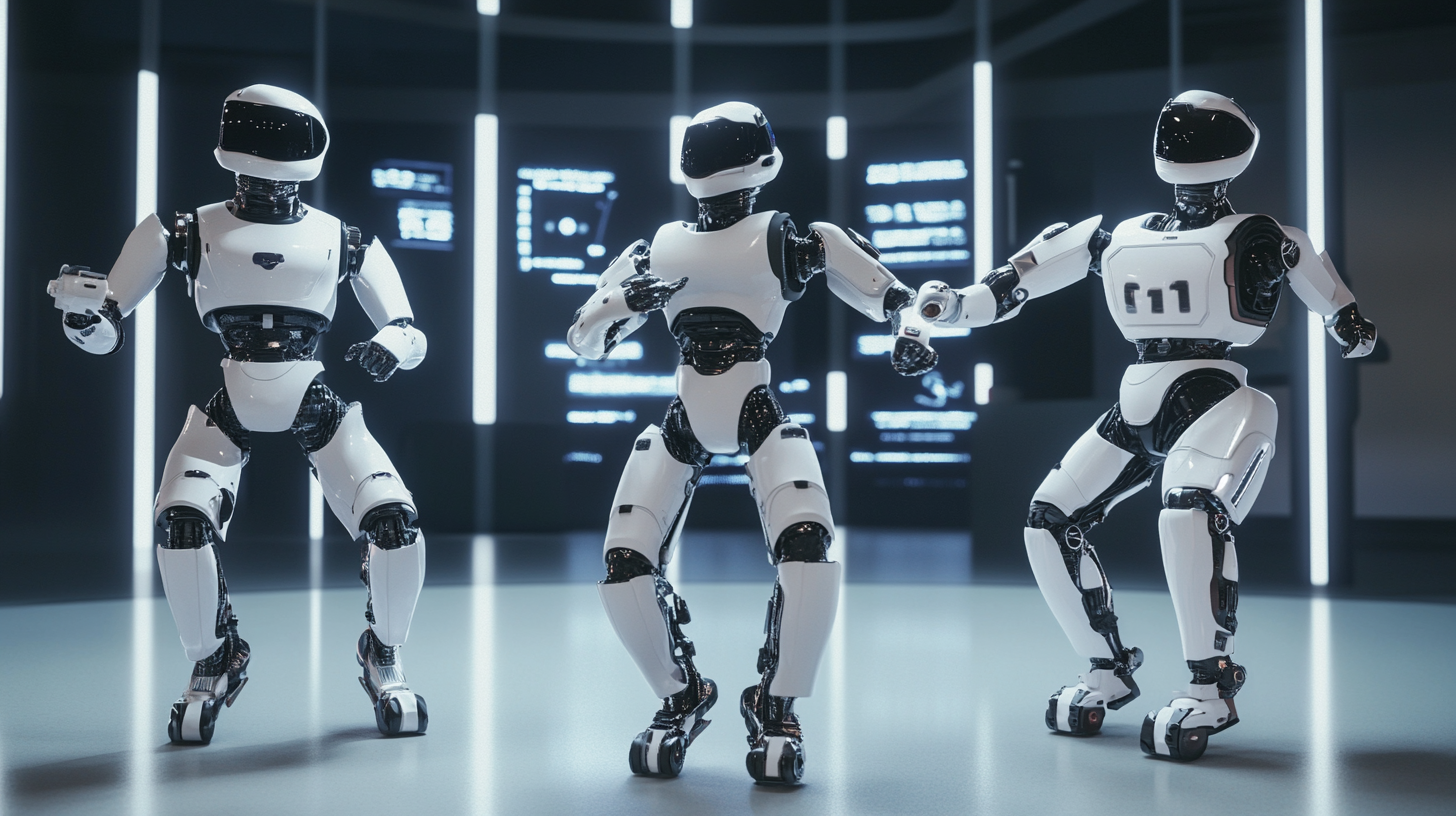
GPT-3 moment for robotics? OpenAI, Figure AI & Co. on the way to mass production – Image: Xpert.Digital
From vision to reality: Humanoid robots conquer industry and everyday life
Global dynamics and AI power: The development of robotics
The rapid development of humanoid robots by companies like OpenAI, Figure AI, and others marks a fundamental shift in the robotics industry. This technological evolution is driven by three key factors: the integration of generative artificial intelligence (AI), strategic industry partnerships, and increasing global competition. Advances in these areas are paving the way for a new generation of intelligent machines that can not only optimize industrial processes but also provide assistance in everyday environments.
OpenAI as a driving force in AI robotics
OpenAI has made its intentions clear with trademark applications for "user-programmable humanoid robots" and the revival of its robotics team under the leadership of Caitlin Kalinowski (formerly of Meta). The company has ambitious plans to develop humanoid robots with custom-designed sensors, proprietary AI chips, and mass production of over one million units. These machines are intended to move and act in dynamic environments with human-like intelligence—a concept that goes far beyond the traditional use of industrial robots.
A key goal of OpenAI is the development of AI-powered robotics that continuously learns through generative models and flexibly adapts to new challenges. While previous robots were primarily programmed for specific tasks, OpenAI aims for a kind of "universal worker" that can adapt to changing conditions without requiring complex reprogramming. This opens up entirely new application possibilities – from logistics and healthcare to private households.
Strategy change at Figure AI: Independence from OpenAI
Figure AI, which originally maintained a close partnership with OpenAI, is now increasingly relying on its own AI models to achieve vertical integration of hardware and software. This decision points to a profound shift in the industry: robotics companies are increasingly investing in domain-specific AI to make their systems more precise and adaptable.
A prime example of this approach is the use of humanoid robots in BMW's production facilities. Here, machines take over physical tasks in car body construction that were previously performed exclusively by humans. Figure AI's independence from OpenAI's AI technology allows it to implement specific optimizations for industrial processes and to strategically promote its own innovative capabilities.
This trend could continue across the entire robotics industry: companies that develop both hardware and customized AI models will be able to provide more powerful and efficient systems. The focus on industrial applications also indicates that humanoid robots will initially be used primarily in production and logistics before gradually penetrating the consumer sector.
Related to this:
3. The “GPT-3 moment” of robotics
According to Nvidia researcher Jim Fan, robotics is on the verge of a breakthrough, comparable to the moment when GPT-3 revolutionized speech AI. Within the next two to three years, powerful robot foundation models could emerge, enabling machines to train in simulated environments through reinforcement learning.
These training methods have already proven promising in initial experiments. One example is the DLR robot Justin, which was able to learn complex tasks using cloud computing. If humanoid robots were to utilize similarly powerful models in the future, this could significantly improve their ability to adapt flexibly to new scenarios. Such a basic model would allow robots to no longer perform only specific tasks, but to act as generalists – a development that could influence all aspects of economic and social life.
Related to this:
Paradigm shift in the robotics industry
From specialized machines to universal helpers
The new humanoid robots from Tesla (Optimus) and Figure AI (Figure 01) are designed to perform a wide range of physical tasks. While previous industrial robots were mostly optimized for a single activity, future models are intended to be universally applicable – from warehouse work to household assistance.
Scaling and mass production
A crucial factor for the market acceptance of humanoid robots is cost reduction. Elon Musk considers a price below $20,000 per unit necessary to make humanoid robots suitable for the mass market. Figure AI is already working with BMW on scaling strategies to significantly reduce production costs.
Global competitive dynamics
While companies from the US and Europe are currently driving technological development, China is aggressively entering the humanoid robotics market. Companies like Unitree (with its G1 model) and UBtech (with Walker S) are developing high-performance humanoid machines and benefiting from China's strong industrial robotics sector. In the near future, China could become a global market leader not only through cost-effective production but also through technological innovation.
Challenges and open questions
Despite the impressive progress, many hurdles remain before humanoid robots can become ubiquitous. Among the biggest challenges are:
- Safety and ethical issues: The increasing autonomy of robots requires clear regulatory frameworks to minimize safety risks and address ethical problems.
- Optimizing data pipelines for AI training: The development of robots that can flexibly adapt to new environments requires large amounts of high-quality training material – an area where there is still much room for optimization.
- Dependence on cloud infrastructure: Many AI-controlled robots require a permanent connection to the cloud for computationally intensive processes. This can not only lead to delays but also pose security risks, especially in critical application areas.
- Societal acceptance: The integration of humanoid robots into everyday life will depend heavily on how they are perceived by the public. While they are already established in industry, reservations may exist in other areas, particularly regarding job losses or data privacy.
The future of humanoid robotics
The robotics industry is on the cusp of a revolution. Generative AI models, humanoid form factors, and strategic industry partnerships are driving rapid development. OpenAI plays a key role in this – not only as a software provider but increasingly as a hardware developer. At the same time, companies like Figure AI are focusing on independence and specialized AI models to offer industry-specific solutions.
Competition between American, European, and Chinese companies will further accelerate the pace of innovation. In the coming years, an entirely new market for humanoid robots could emerge – with profound implications for industry, the service sector, and people's everyday lives. The question is no longer whether humanoid robots will enter our society, but rather how quickly and to what extent.
Related to this:
Your global marketing and business development partner
☑️ Our business language is English or German
☑️ NEW: Correspondence in your native language!

Konrad Wolfenstein
I and my team are happy to be available to you as your personal advisor.
You can contact me by filling out the contact form here wolfenstein@xpert.digital:or simply call me at +49 7348 4088 965. My email address is
I'm looking forward to our joint project.