I/O unveiling: Google is going all in on XR: New smart glasses with Android XR launching soon – Here's what we know – Image: Xpert.Digital
Android XR Smart Glasses: A look at the digital future
Android XR: Google's first smart glasses launch in just a few days – all the info on the I/O announcement
Google is on the verge of a major breakthrough in wearable technology. After years of research and development, the company is expected to officially unveil its new Android XR smart glasses at the upcoming Google I/O 2025. This announcement marks Google's ambitious return to the smart glasses market, nearly a decade and a half after the initial Google Glass project. Presented as a fusion of artificial intelligence and augmented reality, the new smart glasses could become the next big thing in the technology sector.
The teaser: First glimpses into Google's new smart glasses
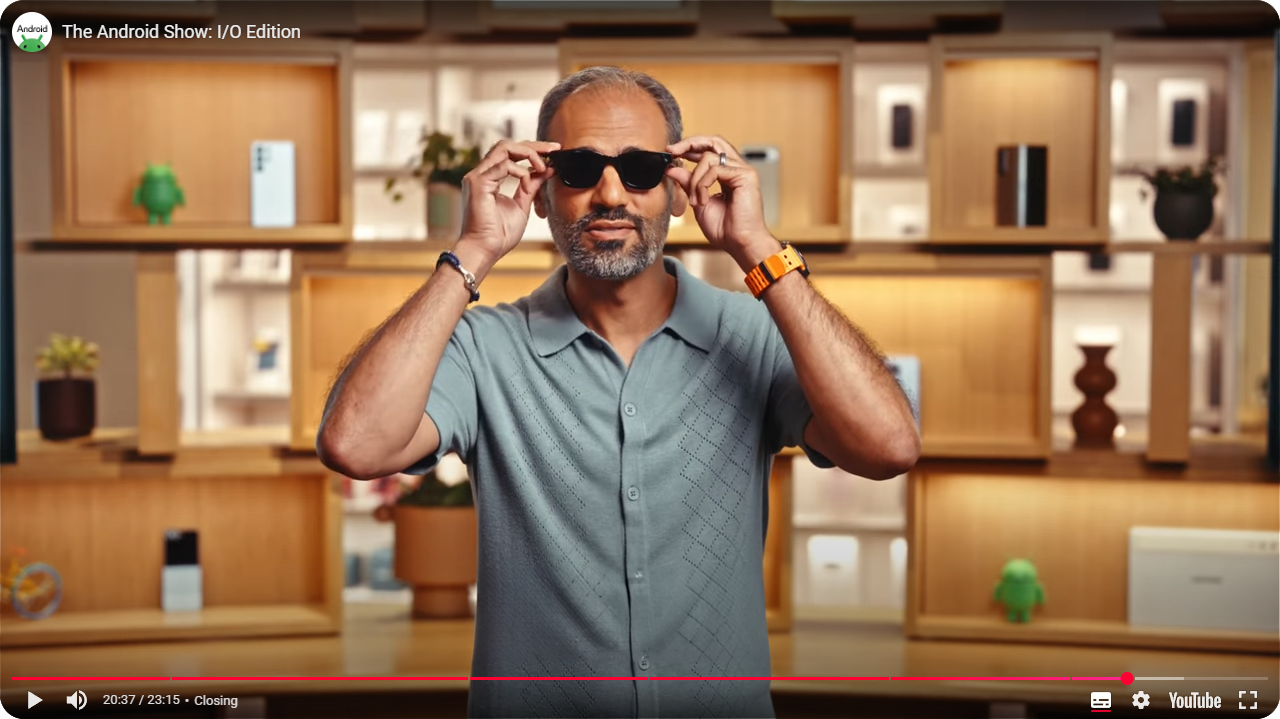
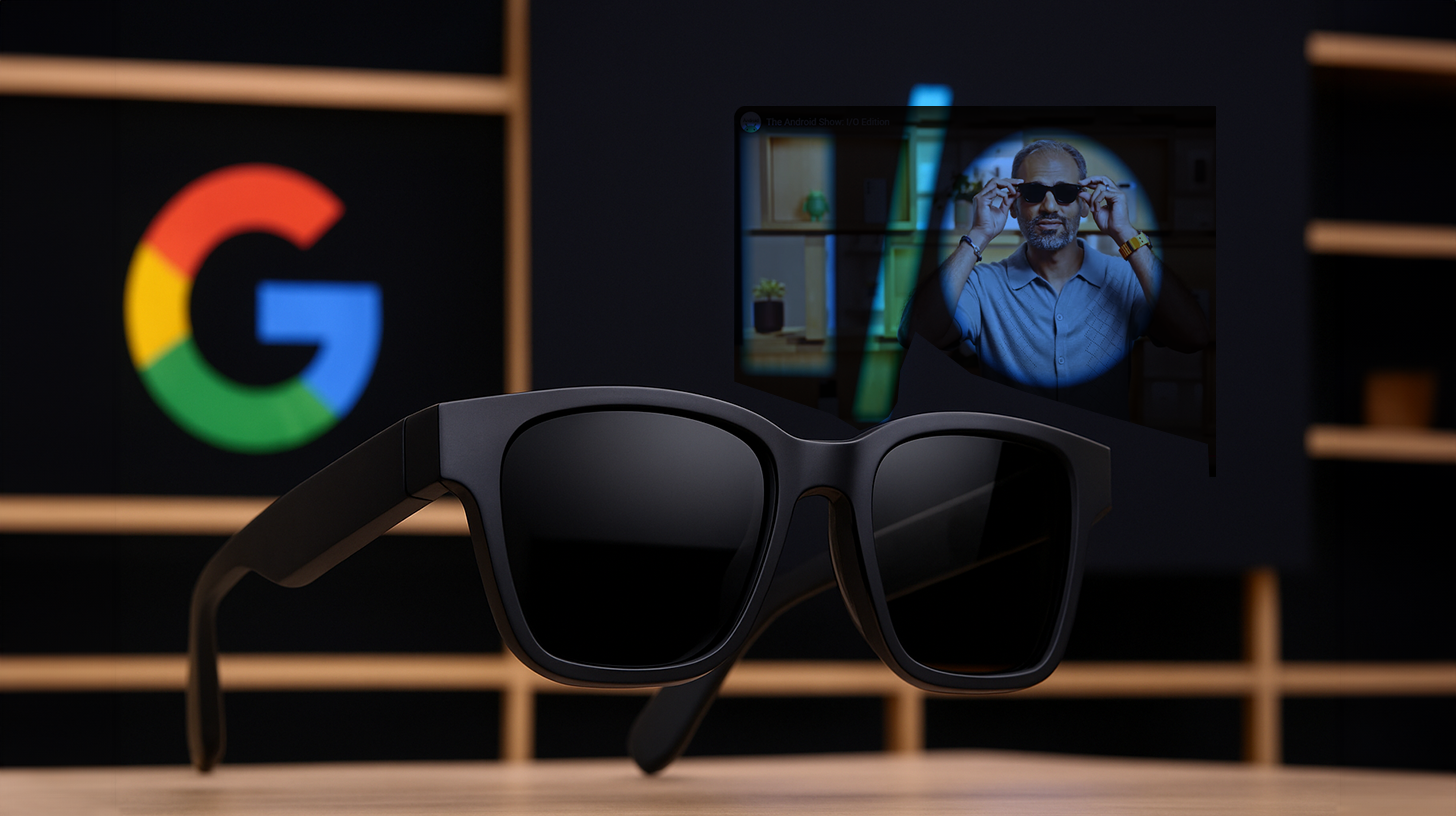
Google has skillfully built anticipation for its new smart glasses. At the close of the recent "Android Show," Android chief Sameer Samat created a surprise moment by pulling a pair of smart sunglasses from his pocket and putting them on. These weren't ordinary sunglasses, but rather a tinted version of the Android XR smart glasses, which run on the new Android XR operating system. Samat announced that attendees of Google I/O 2025 will have the opportunity to try out the new technology themselves.
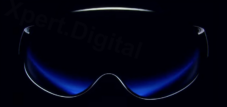
The first publicly visible prototypes show glasses that are virtually indistinguishable from conventional eyeglasses. The design is based on classic eyeglass models, with the technical components discreetly integrated. A camera is visible on the left temple of the glasses in the images released so far. Next to it is presumably an LED indicator, intended to signal to others when photos or videos are being taken – similar to the Ray-Ban Meta Glasses.
Related to this:


The development of the Android XR Smart Glasses
The development of smart glasses is part of Google's long-term strategy. After the commercial failure of Google Glass, the company fundamentally revised its approach and is now focusing on developing discreet, everyday glasses. Google has been working on smart glasses technology for well over a decade and a half and, after this long period, is finally aiming for a successful market entry.
Android XR: The operating system for the next generation
In December 2024, Google officially unveiled Android XR – an operating system specifically designed for Extended Reality (XR). Android XR is conceived as an open, unified platform for XR headsets and smart glasses, building upon Google's years of experience with Android, artificial intelligence, and augmented reality.
The operating system was developed from the ground up for the specific requirements of XR devices and differs from regular Android in several important ways:
Key features of Android XR
– Focus on immersive experiences: Unlike traditional Android, which is designed for 2D screens and touch input, Android XR was developed for immersive 3D environments and interactions.
– Support for specialized hardware: The system is optimized for XR-specific hardware such as head-mounted displays, depth cameras, and motion controllers.
– Alternative input methods: Instead of touchscreens, Android XR relies on hand gestures, eye tracking, and voice control.
– Deep integration of Gemini: Google's AI assistant Gemini is deeply embedded in the operating system and can provide contextual information and manipulate virtual objects based on voice commands.
Features and capabilities of Google Smart Glasses
Google's smart glasses with Android XR are designed to offer a variety of innovative features that simplify everyday tasks and create new ways to interact. Google already showcased some of these features at the TED conference "Humanity Reimagined" in Vancouver.
Gemini Live and AI integration
A key component of the smart glasses will be Gemini Live, Google's AI assistant, which can analyze and understand the surroundings using the built-in camera. The glasses will be constantly available to users, responding to voice commands and capturing the visual environment. Currently, users of Pixel 9 and Samsung Galaxy S25 smartphones can already share their camera via Gemini Live and talk to the AI about what they see – a similar functionality will be integrated into the smart glasses.
Memory function
One particularly interesting feature demonstrated at the TED conference is "Memory." This feature uses the glasses' camera to continuously scan the user's surroundings and "remember" where everyday objects have been placed. In a live demonstration, a Google manager asked, "Do you know where I last put the card?" to which Gemini replied, "The hotel card is to the left of the record," and pointed to the corresponding items on the shelf using the glasses.
Translation and image recognition
The smart glasses are also intended to enable real-time translations of foreign languages. At the TED conference, a live translation from Farsi to English was demonstrated, with the translation appearing as subtitles on the glasses' display. In addition, the glasses can scan text from books and perform image recognition.
Seamless smartphone integration
According to Shahram Izadi, head of Android XR at Google, the glasses are designed to interact seamlessly with the user's smartphone. This enables a lightweight design and access to all phone apps. The integration with the Android ecosystem should allow users to receive notifications and reply to messages without taking their smartphone out of their pocket.
Project “Haean”: The collaboration with Samsung
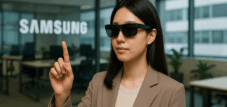
Google's smart glasses initiative is part of a broader strategy to establish Android XR as the leading platform for extended reality. A key component of this strategy is the collaboration with Samsung. Codenamed "Haean," Google and Samsung are jointly developing a smart glasses product that is expected to launch later this year.
Reports indicate the project is in its final stages of development, with features and specifications currently being finalized. There are differing opinions as to whether the first smart glasses will feature a display or whether they will be positioned as a direct competitor to the successful Ray-Ban Meta Glasses, which lack a display and are available starting at $300.
What we can expect from Google I/O 2025
Google I/O 2025 takes place on May 20th and 21st and is expected to provide detailed insights into Google's plans for Android XR and smart glasses. The event will feature live keynotes, developer sessions, and other information.
Demonstration opportunities for visitors
Visitors to Google I/O will have the opportunity to try out the new Android XR smart glasses. This will be the largest public presentation of the smart glasses to date, suggesting that Google wants to increase awareness and interest in this new device category.
Related to this:

Developer support for Android XR
Several developer talks specifically about Android XR will also take place at Google I/O. This underscores Google's efforts to build a vibrant ecosystem of developers and device manufacturers for the new platform. By supporting tools like ARCore, Android Studio, Jetpack Compose, Unity, and OpenXR, Google aims to make it easier for developers to get started creating apps and games for Android XR.
Market launch date
Despite the upcoming comprehensive presentation at Google I/O, it's still uncertain when exactly the smart glasses will be released. Reports suggest that the glasses could potentially be available later this year, particularly in connection with Project "Haean" in cooperation with Samsung.
Conclusion: Google's relaunch in the smart glasses segment
With the Android XR smart glasses, Google is embarking on an ambitious new beginning in the field of wearable technology. After the failure of Google Glass, the company has fundamentally rethought its strategy and is now developing a product that aims to be both technologically advanced and suitable for everyday use.
The integration of Android XR and Gemini Live promises a new way of interacting with digital content and the real world. Features like real-time translation, image recognition, and the memory function could change the way we interact with technology in everyday life.
Google I/O 2025 will reveal how far Google has progressed in the development of smart glasses and what concrete plans the company has for market launch. With the support of Samsung and other partners, Google appears determined to take a leading role in the next generation of wearable technology.
The coming days will be crucial to determine whether Google, with its vision of Android XR Smart Glasses, has truly found the "next big thing" after the smartphone boom of 2007.
Related to this:
Your global marketing and business development partner
☑️ Our business language is English or German
☑️ NEW: Correspondence in your native language!

Konrad Wolfenstein
I and my team are happy to be available to you as your personal advisor.
You can contact me by filling out the contact form here wolfenstein@xpert.digital:or simply call me at +49 7348 4088 965. My email address is
I'm looking forward to our joint project.