
Google Homepage: More traffic through Google Discover? From smartphone to desktop: Benefits for users and publishers – Image: Xpert.Digital
Personalized content on desktop: Google Discover takes off – the web traffic transformation
Google Discover: Successful expansion onto the desktop platform
Google's recent announcement marks a significant turning point for one of the company's most successful mobile features: Google Discover will soon be available on desktop computers. This expansion, officially confirmed at the Google Search Central Live event in Madrid, brings the personalized news feed to larger screens for the first time since its launch in 2018. For website owners, this development could mean a significant increase in traffic, as Google Discover is already the primary source of visitors for many sites on mobile devices – even ahead of traditional search. Initial tests in the US show how the feed is integrated below the search bar on the Google homepage, with interests synchronized between mobile and desktop devices.
Related to this:

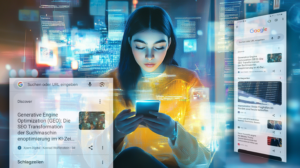
What is Google Discover and its previous significance?
Google Discover is a personalized news feed that automatically suggests relevant content to users based on their interests and web activity. Unlike a traditional search function, users don't need to actively submit a query – the algorithm independently presents articles, videos, and other content that might be of interest to the individual user.
Since its launch in 2018, Google Discover has been available exclusively on mobile devices. Android users typically find the feature on the "zero" home screen – accessed by swiping right from the main screen – or within the Google app. Over the years, Discover has become an exceptionally important source of traffic for many websites. For news portals and content producers in particular, it now represents a more significant source of visitors than traditional Google search.
Its fundamental functionality is based on machine learning: the more data Google collects about a user's interests and online behavior, the more precise the suggested content becomes. This has made Discover one of the core elements of Google's product family on mobile devices.
Operating principle and user experience
The concept behind Google Discover differs fundamentally from the traditional search paradigm. While a search requires the user to actively request information, Discover reverses this principle: The system proactively presents content that it believes might be relevant to the user.
This reversal of information flow has proven extremely effective. Users discover content they might not have actively searched for, but which nevertheless matches their interests. This "discovery" aspect gives the feature its name and embodies a fundamental shift in how people consume information in the digital age.
The official announcement and first insights
The expansion of Google Discover to desktop was officially announced during the Google Search Central Live event in Madrid. There, Google explained its intention to extend Discover to other platforms – specifically to desktop search.
The announcement confirms what many industry observers have long suspected. Initial observations of tests of a desktop version of Google Discover were documented as early as 2023. In fact, according to Google, they have been experimenting with integrating Discover into the desktop homepage for about two years.
The presentation and first screenshots
At the event in Madrid, presentation slides were shown confirming Google's plans. Attendees immediately shared the news on social media platforms. Clara Soteras and Gianluca Fiorelli posted images of the presentation slides on X (formerly Twitter), which illustrated the planned expansion.
A user with the pseudonym "shyam" had already shared a screenshot on Twitter, showing how the Discover feed appears below the search box on Google's homepage. These early glimpses give an idea of what the desktop integration will look like.
Related to this:

Implementation and appearance on the desktop
Google Discover is being integrated into the desktop version of the Google homepage directly below the search bar. Users visiting Google.com will now see personalized articles and news displayed below the search bar.
Initial reports from test users in the US describe receiving a notification in the bottom right corner of the Google homepage with the message: "A new way to explore your interests." After activation, the Discover feed then appears below the search bar.
User guidance and customization options
Unlike the mobile version, there don't currently seem to be extensive options for customizing the desktop feed. However, users can decide whether to leave the feature enabled or disable it immediately upon receiving the first notification.
Important information for users who use both mobile and desktop devices: Interests are synchronized between devices, provided the user is signed in with the same Google account. This means that the personal preferences and interests learned by the system on the smartphone are seamlessly transferred to the desktop.
Significance and impact for various interest groups
The expansion of Google Discover to desktop platforms has far-reaching implications for various stakeholders in the digital ecosystem – from users to content producers to advertisers.
For users
For end users, the integration of Discover on the desktop means an expanded way to discover personalized content. Especially for those who primarily work on a computer, this offers convenient access to relevant news and articles without having to actively search for them.
Synchronizing interests between mobile devices and desktops ensures a consistent user experience across different platforms. This allows users to seamlessly track their preferred topics and interests on all devices.
For publishers and content producers
For website operators, especially news portals and content producers, Discover's desktop integration could be a significant turning point. Since Discover is already "by far the most important traffic source" for many, extending it to desktop users could significantly increase their reach.
Experts believe this expansion could significantly increase website traffic. For publishers who have often struggled with declining visitor numbers in recent years, this is a rare piece of good news from Google. The integration could "generate many new clicks" and offers companies "a new way to reach desktop users with their content.".
Rollout status and open questions
Google has not yet announced the exact timeframe for the nationwide rollout of the Desktop Discover feed. Implementation appears to be phased, with some users in the US already having access to the feature.
It also remains unclear whether and how users will be able to completely disable the Discover feed on the desktop homepage if they wish. While an opt-out option is offered with the initial notification, the long-term configuration options are not yet known.
Geographical distribution
The tests are currently visible primarily in the US. It remains to be seen exactly when the feature will be available in other regions, including Germany and Europe. Google is known for initially testing new features in limited geographic areas before rolling them out globally.
The international rollout will likely depend on the response from early users. If the feature is well-received in the US, a faster global rollout can be expected.
Google's homepage is changing: The integration of Discover on the desktop
The integration of Google Discover into the desktop version of the Google homepage marks a significant development in the company's strategy. After years of focusing on mobile platforms, Google is now extending one of its most successful features to the desktop, underscoring the continued importance of desktop computers in the digital ecosystem.
For users, this development offers more convenient access to personalized content, while publishers and content producers could benefit from potentially higher visitor numbers. Seamless synchronization between mobile and desktop devices promises a cohesive user experience across different platforms.
It remains to be seen how users will react to this change to the familiar Google homepage. While some may appreciate the personalized suggestions, others might find the distraction from their original search intent disruptive. Ultimately, the success of this expansion will depend on whether Google can strike the right balance between useful personalized content and the familiar simplicity of its homepage.
With this development, Google is moving further away from its original core business – pure web search – and strengthening its position as a comprehensive information provider that actively suggests relevant content before users even search for it.
Related to this:
Your global marketing and business development partner
☑️ Our business language is English or German
☑️ NEW: Correspondence in your native language!

Konrad Wolfenstein
I and my team are happy to be available to you as your personal advisor.
You can contact me by filling out the contact form here wolfenstein@xpert.digital:or simply call me at +49 7348 4088 965. My email address is
I'm looking forward to our joint project.