


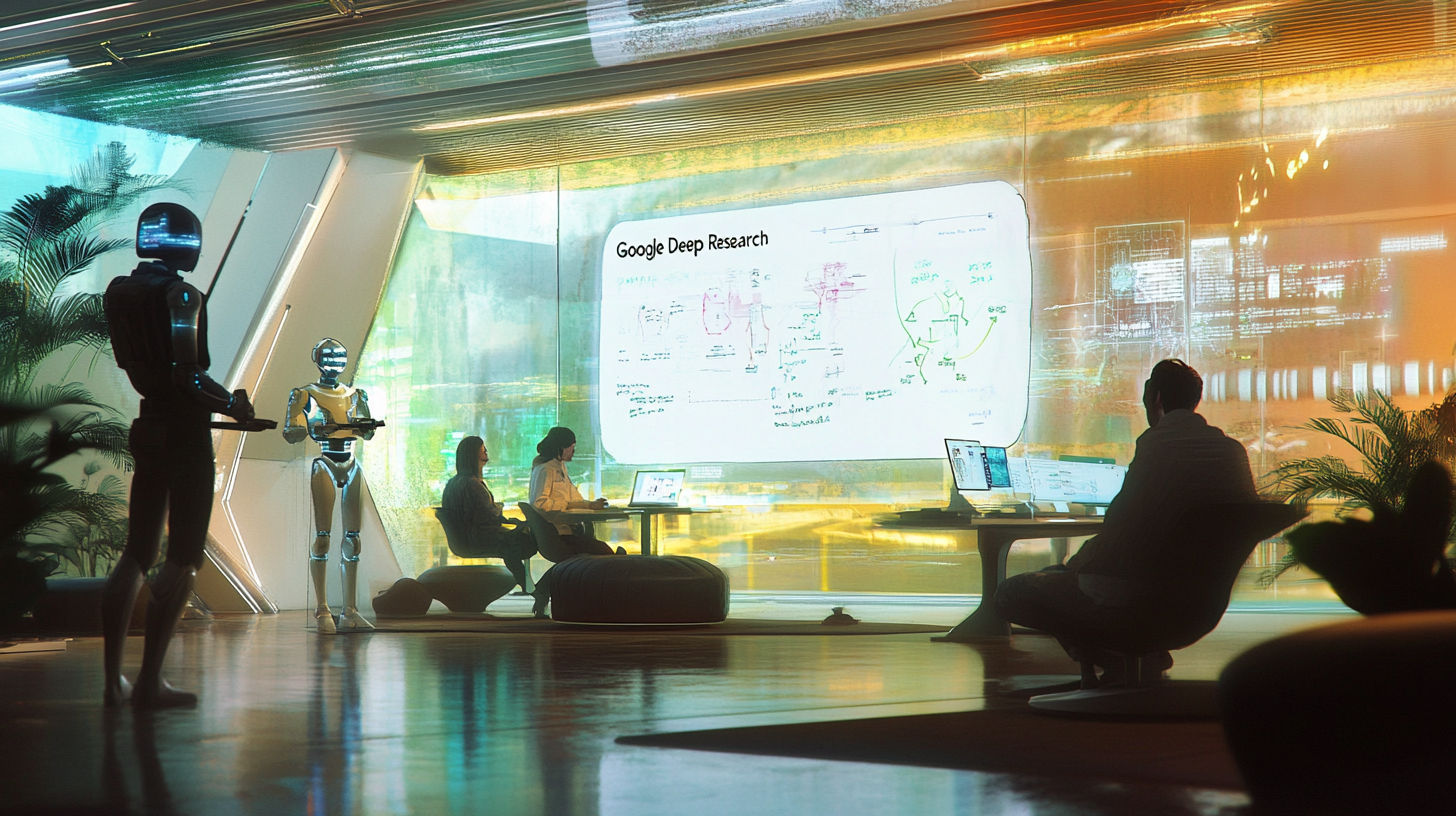
“Google Deep Research”: The silent game-changer behind the end of the old Google? The AI assistant technology that is changing everything? – Image: Xpert.Digital
Google surprises with “Deep Research” – A game changer for users of the Gemini platform?
The announcement of "Deep Research" within the Gemini platform has caused a stir in the tech world. This new feature, exclusive to Gemini Advanced users, is positioned as a personal AI research assistant with the potential to fundamentally change the way we gather and process information. It's more than just another update; it could be the catalyst for a profound transformation of Google itself, or at least the harbinger of one. The question is whether this innovation will propel Google into an exciting new future or undermine the foundations of its past success.
It has been announced that Deep Research aims to simplify the gathering of information on complex topics by creating a structured, multi-stage research plan. This approach goes far beyond traditional search queries. Instead of entering individual search terms and clicking through numerous links, Deep Research promises a systematic process. It analyzes relevant data and ultimately generates a comprehensive report with the key findings, which can be conveniently exported to Google Docs. This could represent a significant time saving and improve the quality of work, particularly for professionals such as academics, journalists, market researchers, and students. One could argue that this is the next logical step in the evolution of information gathering, moving away from passive searching towards active, AI-powered analysis and synthesis.
Alongside Deep Research, a new experimental model version called Gemini 2.0 Flash was also unveiled. This version aims to optimize chat functionalities and improve performance. Although still in the testing phase, this development demonstrates Google's continued spirit of innovation and its drive to push the boundaries of AI-powered interaction. It is important to emphasize, however, that such experimental versions are still under development and, as Google itself points out, "may produce unexpected results." This underscores the complexity of the subject matter and the challenges involved in developing such advanced AI systems.
The introduction of Deep Research and the further development of Gemini in general reflect Google's vision of creating a "helpful personal AI" that acts more proactively and helps users accomplish their tasks more efficiently. This vision goes beyond simply providing search results and aims to create an intelligent tool that assists users with complex thought processes. One could say that Google is trying to move from being an intermediary of information to an active partner in knowledge building.
Related to this:
The revolutionary methodology of Deep Research
Deep research differs from conventional search methods through its highly structured and systematic approach. This comprises several clearly defined phases designed to make information gathering and analysis as efficient and comprehensive as possible.
1. Detailed research planning
Instead of searching for information ad hoc, Deep Research begins by creating a detailed plan. This step includes precisely defining the research question, identifying relevant topics, and determining the methodological approach. This is similar to the careful preparation typical of scientific research projects. The AI analyzes the question and suggests relevant search strategies and information sources.
2. The systematic processing of intermediate steps
Complex research projects often require addressing multiple sub-questions or analyzing various aspects of a topic. Deep Research breaks down the research process into logical intermediate steps and systematically tracks their progress. This ensures a clear structure and prevents important aspects from being overlooked. You could think of it as having an intelligent project manager for your research.
3. The search and analysis of up to 100 relevant sources
A key aspect of deep research is the ability to search and analyze a large number of sources. The figure of "up to 100 relevant sources" suggests a depth and breadth of research that would typically be difficult for a single user to manage. This involves not only finding sources but also intelligently analyzing the content, recognizing patterns and connections, and assessing the credibility of the information. The AI is capable of processing large amounts of text in a short time and filtering out the most relevant information.
4. The creation of a comprehensive report with source citations (implicit)
The final step is generating a report summarizing the key research findings. Although the original text mentions "source citations," it's important to note that Deep Research's current implementation doesn't provide traditional footnotes or bibliographies. Instead, the AI integrates information from various sources in a way that reflects the context and origin of the information, without explicitly citing each individual source. The resulting exportable report in Google Docs thus offers a structured and clear summary of the findings.
This methodical approach makes deep research a potentially invaluable tool for various user groups. Researchers can use it to quickly gain a comprehensive overview of the current state of research or to generate new research ideas. Students can explore complex topics more efficiently and produce higher-quality work. Market analysts can make more informed decisions by analyzing a broader data set.
The potential impact on Google's business model
The introduction of Deep Research presents an interesting paradox: While it has the potential to revolutionize the way we obtain information and strengthen Google's position in the AI age, it could simultaneously challenge Google's traditional business model.
1. The challenge for advertising
Google's primary revenue stream has always been based on advertisements displayed in search results. Deep Research bypasses this traditional search function to some extent by providing users with a comprehensive report directly, eliminating the need to click through numerous websites. If users spend less time on the actual Google search page, this could potentially lead to revenue losses in search engine advertising. The question is how Google will fill this potential gap. Perhaps there will be new forms of monetization within the Gemini platform, or perhaps value creation will shift from pure search advertising to other services.
2. The change in user experience
Deep research fundamentally changes the user experience. Instead of laboriously navigating through numerous websites to find the information they need, users receive a structured and well-presented report. This not only saves time but can also reduce the frustration often associated with searching for information online. However, this could also lead to users spending less time on the Google search page and thus fewer interactions with advertisements. It's a balancing act between providing an excellent user experience and ensuring the profitability of the business model.
3. The change in the “Attention Merchant Model”
Google's traditional business model is partly based on the "attention merchant model," which involves collecting user data to deliver targeted advertising. Deep Research could diminish the importance of this model, as the focus shifts more towards directly providing information and less towards directing attention to specific websites. It's conceivable that Google will increasingly rely on other forms of data analysis and utilization in the future, resulting from the use of AI-powered tools like Deep Research. The data generated during complex research could provide valuable insights into user interests and needs, which could then be used for new services or product development.
Potentials and challenges on the way forward
Deep research holds enormous potential for more efficient and precise information gathering. It could indeed lay the foundation for a new form of scientific work in which AI functions as an integral part of the research process. The ability to quickly and comprehensively analyze and synthesize information could lead to faster progress in science and technology.
However, there are also significant challenges that need to be overcome:
Quality assurance and the risk of misinformation
The reliability of the results generated by Deep Research is crucial. How is it ensured that the AI accesses trustworthy sources and does not spread misinformation? Sophisticated algorithms and mechanisms are needed to validate the information and detect bias. Transparency regarding how the AI arrives at its results will also play a vital role in gaining and maintaining user trust.
The potential neglect of traditional research methods
There is a risk that the convenience of deep research will lead users to place less value on traditional research methods and neglect critical thinking. The ability to independently search for, evaluate, and contextualize information is a crucial skill that should not be replaced by AI. Finding a balance between using AI-powered tools and maintaining traditional skills will be essential.
Linguistic and cultural limitations
The current restriction of Deep Research to English presents a barrier to global use. To reach its full potential, the feature must be made available in other languages and take cultural differences in information gathering into account. Translating algorithms and adapting them to various linguistic nuances are complex tasks that require time and resources.
The competitive landscape and Google's strategic positioning
With the introduction of Deep Research, Google is strategically positioning itself in competition with other major technology companies, particularly OpenAI and its ChatGPT, as well as other providers of AI-powered search tools. The market for AI-powered information processing is highly competitive, and the ability to offer innovative and reliable solutions will be crucial for maintaining or expanding market leadership.
The integration of Deep Research into the Gemini platform could be a pivotal factor in redefining Google's position in the evolving search engine market. While traditional search engines will continue to play a vital role, the trend toward smarter, AI-powered assistants suggests that the future of information gathering will be more interactive and personalized. Google appears determined to be at the forefront of this development.
Overall, Deep Research marks a potential turning point in digital information processing. It's more than just a new feature; it's a sign of Google's ambitions in artificial intelligence and an indicator of how the way we interact with information might change in the future. While the short-term impact on Google's traditional business model remains unclear, Deep Research points to a future where AI will play an increasingly vital role in organizing and analyzing the growing volumes of data that surround us daily. It remains to be seen whether this development truly heralds the "end of the old Google" or, rather, marks the beginning of an exciting new era in which Google reinvents its position as a leading technology company.
Related to this:
We are here for you - Consulting - Planning - Implementation - Project Management
☑️ Our business language is English or German
☑️ NEW: Correspondence in your native language!

Konrad Wolfenstein
I and my team are happy to be available to you as your personal advisor.
You can contact me by filling out the contact form here wolfenstein@xpert.digital:or simply call me at +49 7348 4088 965. My email address is
I'm looking forward to our joint project.