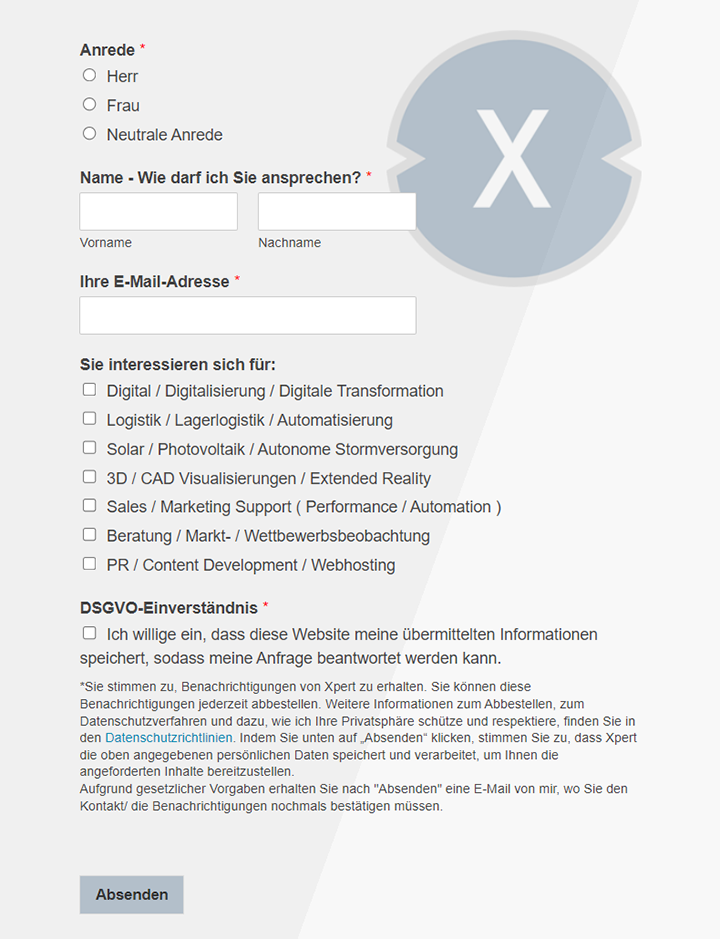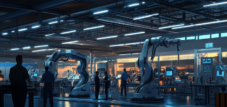
Global warehouse automation: A comparison between the USA, China, and South Korea – in the USA, 80% of warehouses are still manual! – Image: Xpert.Digital
Automation in logistics: How the USA, China and South Korea are shaping the future
Automation has become a key driver of change in the global logistics industry. A growing number of companies are deploying robots, automated guided vehicles (AGVs), artificial intelligence (AI), and networked technologies to make processes more efficient, cost-effective, and flexible. The USA, China, and South Korea are emerging as particularly significant players, shaping the global market in distinct ways. This report provides a comprehensive overview of the level of automation in these three countries, examines the underlying drivers and challenges, and offers a glimpse into future developments.
"The logistics industry is on the cusp of a new era in which automated systems, artificial intelligence, and networked technologies will become indispensable components of modern supply chains." Industry experts use this assessment to summarize the profound structural transformation taking place in warehouses, logistics centers, and transportation. This transformation is not only the result of technological innovations but also reflects changing consumer needs, with an increasing emphasis on fast delivery times, transparency, and sustainability.
At the heart of automation efforts lies the pursuit of increased efficiency and cost reduction. However, achieving these goals requires more than simply deploying new technologies: qualified specialists, appropriate training programs, and the adaptation of existing IT infrastructures are also crucial for robots, autonomous vehicles, and intelligent software systems to reach their full potential. Furthermore, the COVID-19 pandemic has demonstrated the extent to which global companies' supply chains can be disrupted. Automation therefore increasingly offers a way to strengthen resilience in times of crisis and to make work processes more flexible.
The following section provides a detailed analysis and comparison of the three countries USA, China, and South Korea with regard to their level of automation in logistics. Key trends such as e-commerce, AI, robotics, and the role of government support programs and measures are also examined.
Related to this:
Global overview of warehouse automation: USA, China and South Korea
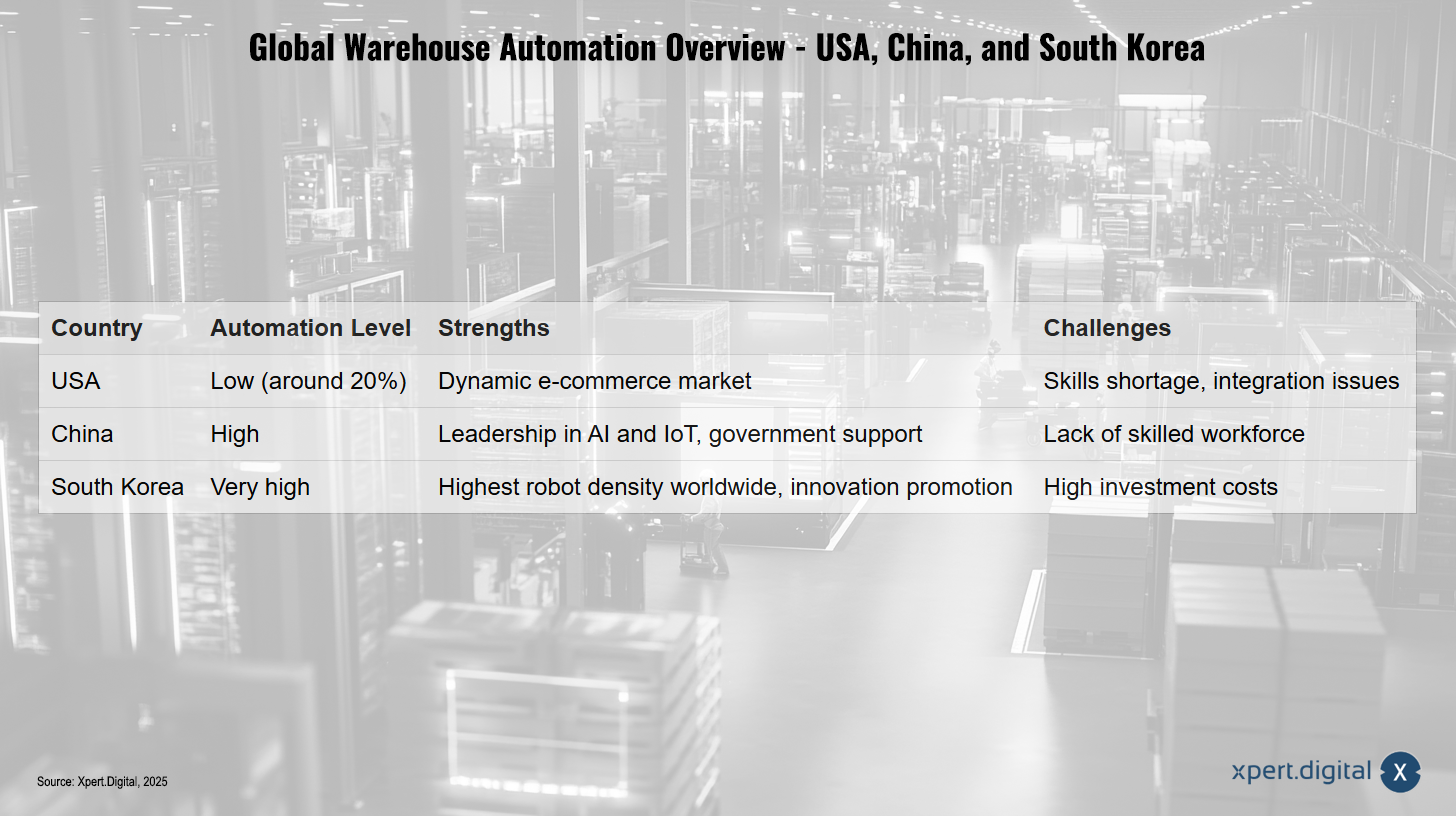
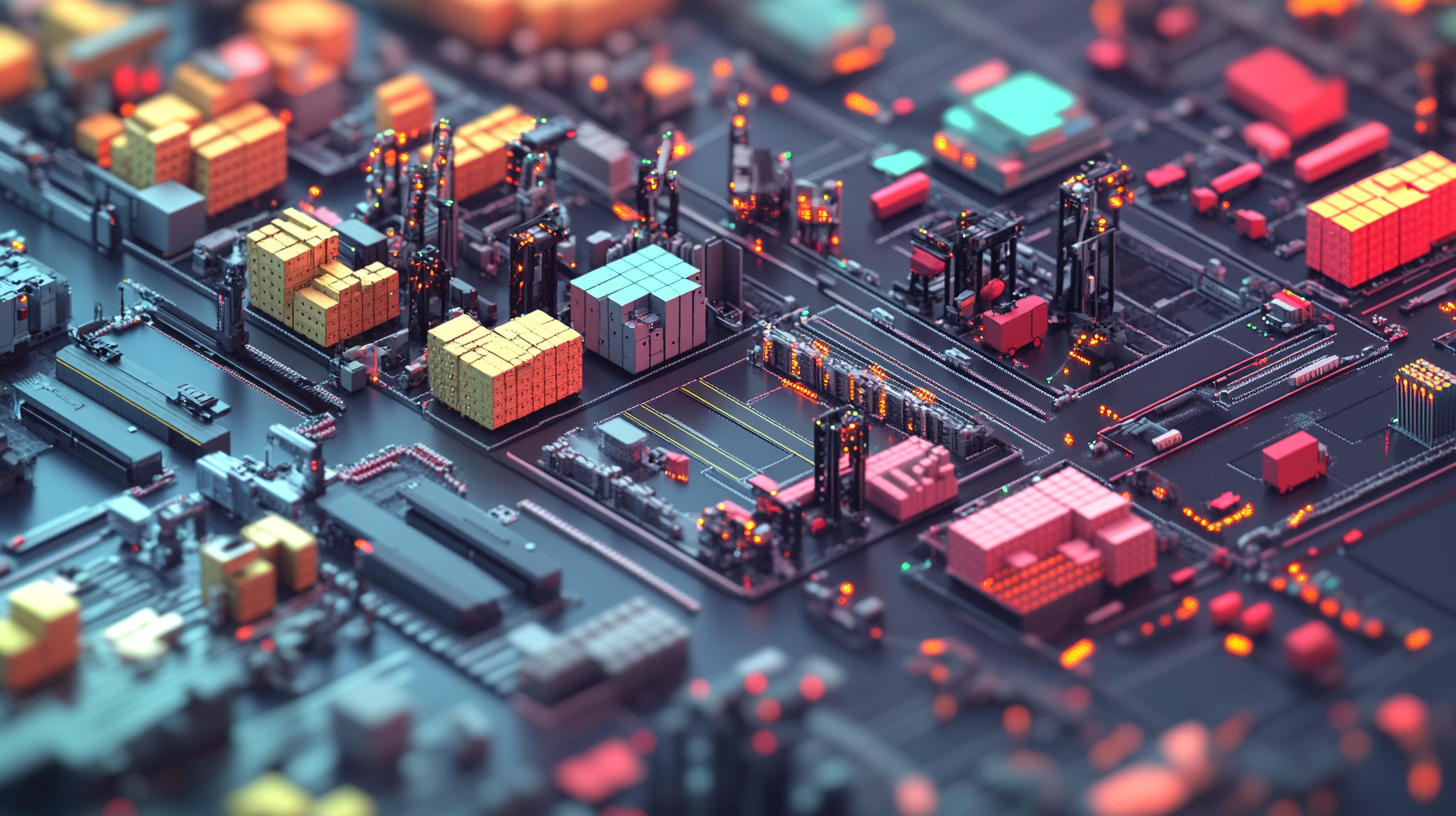
Global Warehouse Automation Overview – USA, China, and South Korea – Image: Xpert.Digital
Level of automation in the USA
While the US is considered a major technology driver, particularly in areas such as software development, cloud computing, and AI research, the level of automation in the logistics sector is still relatively moderate compared to other countries. Numerous logistics companies already use automated solutions in certain areas, such as order picking or receiving, but many warehouses and distribution centers are not yet highly automated across the board.
Estimates suggest that only about 20% of warehouses in the US are automated (80% are manual). According to available data, the US logistics automation market is expected to reach a volume of between $45 billion and $55 billion by 2032. This growth is driven by the increasing importance of e-commerce, the growing demand for more efficient processes, and the use of AI.
A key factor is the integration difficulties that often arise when introducing new technologies. Aligning automated systems with existing IT landscapes can be challenging, requiring companies to factor in high initial investments and long-term planning. "The introduction of automated technologies requires not only capital but also expertise," is a common refrain from industry experts. Often, there is a shortage of sufficiently qualified personnel who can configure, operate, and maintain complex robotic and software systems. Companies are therefore increasingly investing in training programs for their employees, collaborating with universities, or recruiting specialists from other sectors to meet their expertise needs.
At the same time, however, strong growth impulses from the e-commerce sector are impacting the logistics industry. Well-known US companies like Amazon began early on to build highly automated fulfillment centers where robots retrieve goods from the shelves and transport them to the picking stations. The e-commerce boom demands fast delivery times, high flexibility in the flow of goods, and a low error rate in processing, which in turn fuels the trend toward automation.
The USA is also a pioneer in road freight transport: Driver assistance systems that help drivers keep an eye on traffic on long journeys are already widespread. Furthermore, there are pilot projects in which autonomous trucks travel certain sections of the route in convoys. "Automation is revolutionizing truck traffic in the USA," according to many logistics experts, who expect it to lead to, among other things, reduced transport costs and increased safety. Particularly in sparsely populated areas, the widespread introduction of autonomous trucks could lead to a noticeable improvement in logistics processes.
Related to this:
- The pulse of warehouses: A look at the automation challenges in the USA
- From manual labor to high-tech: The transformation of warehouse automation in the USA
Level of automation in China
In recent years, China has become a global hotspot for automation solutions in logistics. "Made in China 2025" is the name of the government program that aims to comprehensively modernize domestic industry and make it a leader in key technologies such as robotics and AI. Indeed, numerous logistics centers now exist in China where robots almost completely handle the movement of goods, with humans primarily performing monitoring functions.
Chinese companies are investing heavily in automation technologies. The market for industrial robots in China is the largest in the world. The logistics automation market in China is projected to reach a volume of US$11,701.2 million by 2030, with a compound annual growth rate of 15.3% between 2024 and 2030.
This development is driven by several factors. Firstly, China is experiencing a sustained e-commerce boom, fueled significantly by companies like Alibaba and JD.com. The high online demand requires efficient, highly automated solutions to handle the massive volume of packages and deliveries. Secondly, rising labor costs in many regions of China make the use of robots more attractive.
Furthermore, the Chinese government is investing heavily in expanding its digital and network infrastructure to promote the use of technologies such as the Internet of Things (IoT) and artificial intelligence (AI). This development enables highly networked systems in which, for example, sensors in warehouses or transport vehicles continuously send data to central platforms. This allows for real-time monitoring of inventory levels, measurement of fill levels, and optimization of routes.
One challenge facing logistics companies in China is the shortage of qualified university graduates in specific fields such as logistics management, robotics, and data analytics. While there are many highly motivated young professionals, formal logistics studies in China do not yet have the decades-long traditions found in some Western countries. Although China's economic rise has led to improvements in its education system, comprehensive training programs are needed to meet the demand for logistics experts.
Nevertheless, China remains the most dynamic economic power in terms of automation, setting global trends. Companies like Cainiao Logistics are building enormous, automated logistics centers both domestically and internationally to expand their networks. At the same time, China is a leader in automated delivery robots for urban areas: in some cities, small vehicles are already autonomously navigating the streets to deliver packages to customers. This trend toward autonomous delivery is expected to increase further in the future and could significantly alleviate congestion in city centers.
Level of automation in South Korea
South Korea is among the global leaders in the use of robots in industry. With the highest robot density in manufacturing worldwide, South Korean companies are consistently relying on automation to address demographic change and rising labor costs. "In a country where the working-age population is shrinking, automation is becoming an essential building block for remaining economically competitive," according to a leading South Korean technology consultant.
South Korea is also increasingly focusing on automation in the logistics sector. Retailers, delivery services, and logistics companies are investing in automated warehousing and order picking systems. The logistics automation market in South Korea is expected to reach a volume of US$3,031.9 million by 2030, with an annual growth rate of 15% between 2024 and 2030.
The government actively promotes innovation in robotics and artificial intelligence. State-of-the-art research centers are working on the next generation of industrial robots, which will be even more precise, flexible, and cost-effective. These developments are also impacting logistics, where automated high-bay warehouses, order picking systems, and driverless transport systems are becoming increasingly prevalent.
A key characteristic of South Korea is the close integration of government, industry, and research, which allows for the rapid implementation of new technologies. Investments are made not only in the development of robots but also in the corresponding infrastructure. For example, large logistics hubs are being built where automated sorting systems separate packages according to region and delivery time. South Korea also plays a pioneering role in the field of smart factories, i.e., comprehensively networked production and logistics.
The high investment costs for automation are a topic of discussion, particularly among small and medium-sized enterprises (SMEs). However, many examples show that the expenditures pay off in the long run because productivity increases and error rates decrease. Meanwhile, South Korean funding programs are specifically supporting SMEs in implementing initial automation projects and building expertise in robotics.
Common trends, differences and comparison
Looking at the three countries together, several overarching trends and commonalities emerge: E-commerce is proving to be a strong driver of automation in all three, as online retail demands high throughput, flexible warehousing, and short delivery times. Furthermore, AI applications are gaining importance: Predictive analytics enables efficient inventory management and the optimization of picking routes.
At the same time, there are significant differences in the state of automation and the framework conditions: The USA possesses a high level of technological expertise, but the introduction of automated systems is progressing more slowly than in China or South Korea. One reason for this may be the shortage of well-trained specialists, another the fact that government funding programs in the USA are not as consistently focused on the automation of logistics as in China.
China, in turn, is heavily investing in modernizing its economy to control wage increases and secure global competitiveness through the use of robotics. The pace of development is enormous, and at the same time, the education system must be adapted to the growing demand for highly specialized workers.
South Korea is focusing on robotics as a solution to demographic change and benefits from close collaboration between government, industry, and research institutions. The country already has a very high robot density, and the technology is increasingly being used not only in manufacturing but also in logistics centers. This makes South Korea a market where innovations can be quickly tested and widely rolled out.
Related to this:
The role of e-commerce: "A driving force for automation"
"E-commerce plays a crucial role in accelerating automation in the logistics industry." This statement reflects a trend that has been emerging for years: Online retail is growing in all three countries – and globally – and is massively impacting the requirements for warehousing, shipping, returns management, and customer service. While it was often sufficient in the past to deliver goods within a few days, companies are now increasingly relying on same-day or even instant delivery services, where deliveries are expected to arrive within hours.
To meet this demand, driverless transport systems and mobile robots are used in the warehouse to automatically assemble incoming orders. Camera systems, sensors, and AI algorithms ensure that required items can be located quickly and that stock can be replenished in real time. In China, it is not uncommon to see huge warehouses where robots lift small storage compartments, bring them to the picking staff, and then put them back in place. These high-speed systems reduce picking times and increase efficiency, making it possible to handle the immense order volume.
Key companies and innovation drivers
In all three countries, there are both regional and global companies playing a pioneering role in logistics automation. Large corporations are focusing on developing their own technologies or collaborating with specialized robotics and software system providers. "Innovation drivers are often those companies that combine advanced technology with innovative business models," explain industry experts.
In the US, these are often established intralogistics companies that have been working on material flow systems for decades. At the same time, a vibrant startup scene is emerging, developing new solutions for robotics, AI, and sensor technology. Particularly noteworthy is the spin-off of technology companies from e-commerce giants, which have set out to further automate their global logistics networks.
In China, tech giants like Alibaba and JD.com act as engines of innovation, investing immense sums in research and development and using entire regions as testbeds for their concepts. The government supports such projects because it sees them as an opportunity to achieve international technological leadership and create new industries.
South Korea boasts not only large, globally operating corporations, but also a vibrant tech scene where young robotics and AI companies are making their mark. These companies often receive government funding and access to pilot factories and testing environments where they can test their prototypes under real-world conditions.
DAIFUKU, a global leader in intralogistics, plays a central role in the development and implementation of automation solutions worldwide. The company is renowned for its innovative material flow systems, which are used in a wide range of industries – from automotive and electronics manufacturing to e-commerce and retail. With its global presence, supported by its own subsidiaries and a dense network of partner companies, DAIFUKU drives the adoption of advanced technologies such as automated guided vehicles (AGVs), intelligent warehouse management systems, and AI-based control solutions. Industry experts emphasize that DAIFUKU sets global standards not only through technological excellence but also through customized solutions tailored to diverse customer needs.
Challenges and opportunities
Automation in logistics offers significant opportunities, but also challenges that concern policymakers, businesses, and society alike. Among the most important potential benefits are:
- Increased efficiency: Automated systems reduce the error rate, increase the speed of processes such as goods receipt, order picking and packaging, and enable more precise planning of resource utilization.
- Cost reduction: The long-term use of robots and automated systems can reduce personnel costs while simultaneously increasing productivity.
- Improved working conditions: Monotonous and physically demanding tasks can be taken over by robots, which increases workplace safety and reduces the risk of accidents.
- Competitiveness: Those who invest in automation early gain a competitive advantage, as lead times are shorter and processes are more efficient.
However, these opportunities are also countered by difficulties:
- High investment costs: Especially for SMEs, the costs for robots, software and the redesign of the warehouse infrastructure are extremely high.
- Shortage of skilled workers: Complex robotic systems require personnel with technical and analytical know-how, which is not always immediately available.
- Integration of new technologies: Bringing together different components – from warehouse management systems to IoT sensors – is complex and requires in-depth IT knowledge.
- Impact on employment: In all countries, the question is how many jobs will be lost to automation and how many new jobs will be created. "Digitalization doesn't just destroy jobs, it also creates new ones," is a common assessment. Nevertheless, appropriate training programs are needed to prepare employees for the new demands.
Impact on the labor market
The use of robotics and automation is having a noticeable impact on the labor market. In the US, there are several examples where logistics centers have actually been able to increase their workforce despite the introduction of automated systems, due to the rising demand for IT specialists and maintenance personnel. At the same time, however, the need for unskilled or semi-skilled workers performing simple, repetitive tasks is decreasing.
China is undergoing a structural transformation, with people shifting from highly manual labor to jobs in the maintenance, monitoring, and control of automated systems. Government agencies and companies are attempting to accelerate this adaptation through incentive programs and retraining initiatives. Nevertheless, a short-term shortage of highly specialized technicians is becoming apparent.
South Korea views automation as a necessary response to its declining working-age population. Robots there frequently take over tasks that might still be performed by humans elsewhere. At the same time, this offers younger professionals the opportunity to specialize in highly skilled fields, such as programming, robotics, or data analysis. This creates jobs that are attractive across national borders and strengthen South Korea's economic position.
Sustainability and future trends
In addition to efficiency and cost considerations, companies are increasingly focusing on sustainability. Automated logistics processes can help reduce waste and optimize energy consumption. For example, warehouse systems can be programmed so that goods only have to travel minimal distances, thus reducing the use of forklifts and the associated CO₂ emissions.
“Sustainability will be a central theme in future logistics,” according to experts. Intelligent systems make it possible to design supply chains in such a way that empty runs are reduced, returns are processed more efficiently, and packaging materials are used responsibly. China, the USA, and South Korea are developing different approaches to meet this challenge. In South Korea, for example, small, electrically powered delivery robots are being increasingly tested for inner-city areas. In China, intensive research is being conducted on drones and other autonomous systems that can deliver goods to remote regions or locations that are difficult to reach by land.
Green logistics concepts are also gaining importance in the USA. The use of alternative drive systems in road freight transport – such as electric or hydrogen trucks – is being promoted in parallel with automation in order to reduce the transport sector's carbon footprint. That automation and sustainability can go hand in hand is also demonstrated in highly automated warehouses, where lighting and air conditioning systems are optimized according to capacity utilization.
Another significant trend emerging in all three countries is the use of artificial intelligence for predictive maintenance. Sensors in robots, conveyor belts, or automated storage systems continuously provide data on the machine's condition. AI algorithms detect signs of wear early, allowing spare parts to be ordered or maintenance intervals to be coordinated before costly breakdowns occur.
Furthermore, a shift is emerging in the field of advanced digital twins: More and more companies are creating virtual models of their warehouses to simulate processes, identify bottlenecks, and implement optimizations before putting them into practice. This enables faster and less risky decision-making, especially when it comes to costly infrastructure projects such as the introduction of new high-bay warehouses or the implementation of autonomous transport systems.
The future of global logistics is automated
Automation in logistics has progressed to varying degrees in the US, China, and South Korea, but all three countries are characterized by a number of similar trends. Key drivers include the ongoing e-commerce boom, rising expectations for delivery speed and quality, and the availability of new technologies such as robotics, AI, and IoT. However, there are significant differences in implementation: While the US possesses considerable technological expertise, China has established a leading position through ambitious government programs and a high rate of investment. South Korea, in turn, boasts a high density of robots and benefits from close cooperation between government, industry, and research institutions.
Related to this:
"The future of global logistics is automated and networked," is a prediction that is gaining increasing acceptance. Especially in times when supply chains are under pressure due to political crises, pandemics, or natural disasters, automated and digitally controlled systems can help increase resilience. However, this also entails the obligation to ensure a sufficient number of qualified specialists who can develop, implement, and operate these systems.
The most exciting developments of the coming years are expected to include the following aspects:
- Further development of autonomous vehicles: In all three countries, intensive research is being conducted on self-driving trucks, which are intended to make freight transport more efficient and safer.
- The introduction of collaborative robots: So-called cobots, which work closely with humans, are expected to be increasingly used in warehouses and distribution centers, partially automating tasks that have previously been manual.
- Increased use of drones and delivery robots: Autonomous small vehicles and drones could become established, especially in urban areas and regions with difficult infrastructure.
- Digitalization and networking: Big data analytics, cloud solutions and IoT technologies are being used even more intensively to control and predict processes in real time.
- Sustainable logistics: Environmental and climate protection are becoming increasingly important, which promotes the use of energy-efficient, resource-saving technology and materials.
At the same time, opportunities exist for global cooperation. Government funding programs, international conferences, and cross-industry bodies could set standards and facilitate the exchange of best practices, for example, regarding software interfaces or security aspects. "Global collaboration is key to fully exploiting the potential of automation," analysts emphasize.
Nevertheless, competition remains fierce, as all three countries strive to gain an edge through technological innovations in logistics. This competition fosters the development of new solutions and accelerates progress in robotics and AI. While the associated challenges—such as social acceptance and labor market issues—should not be underestimated, automation offers enormous potential for businesses and economies.
The USA, China, and South Korea are key players in logistics automation. Each of these countries has its own strengths, leading to different market dynamics. China impresses with its strategic policies and rapid growth, South Korea benefits from its strong robotics expertise and government support, while the USA scores points with its high level of innovation and a thriving startup culture. Ultimately, the coming years will show how each country overcomes its respective challenges and which new technologies prevail in the market. What is clear is that automated processes and integrated digital solutions will fundamentally transform logistics and shape it globally.
LTW Intralogistics Solutions
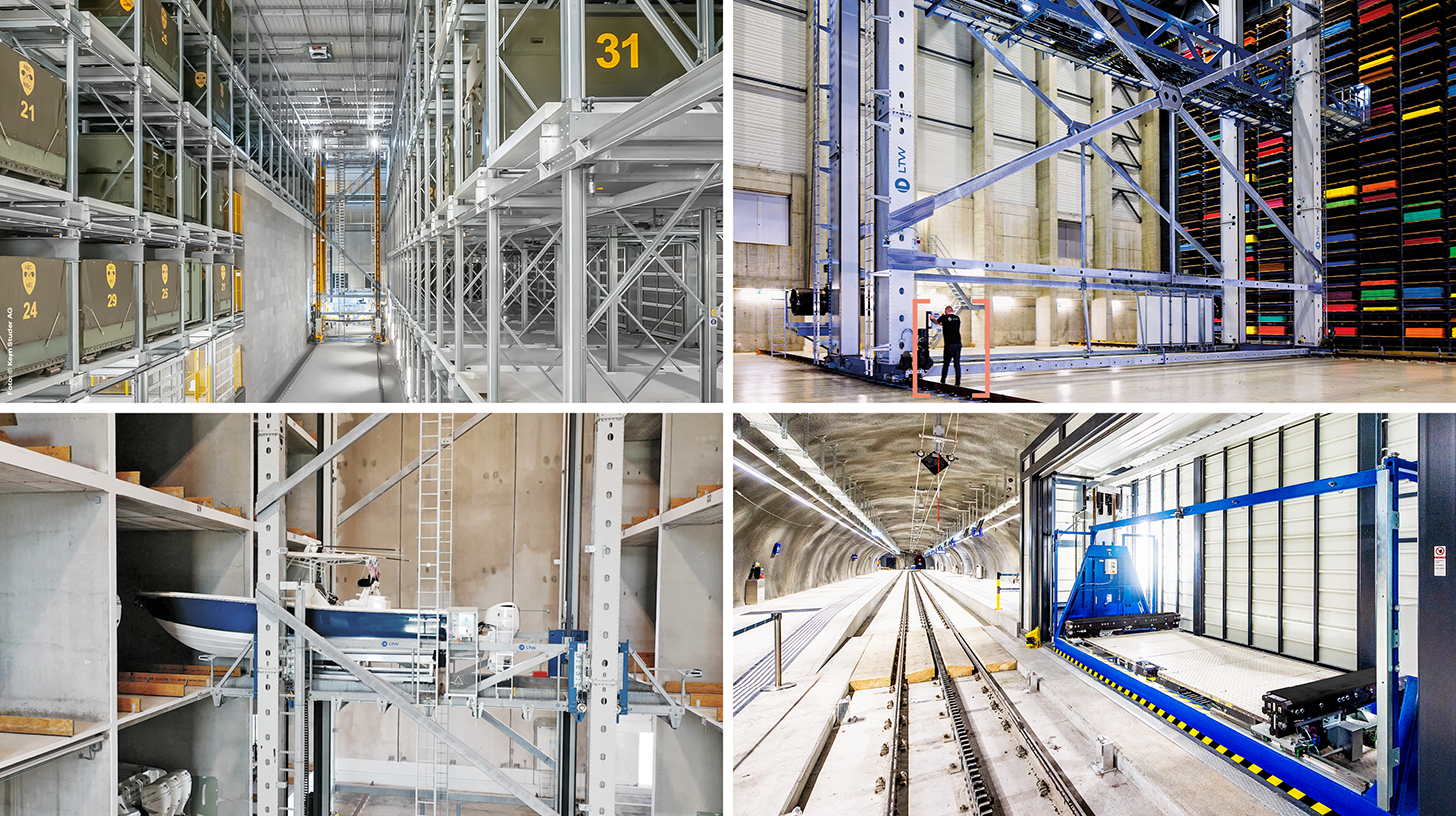
LTW Intralogistics – Engineers of Flow - Image: LTW Intralogistics GmbH
LTW offers its customers not individual components, but integrated complete solutions. Consulting, planning, mechanical and electrotechnical components, control and automation technology, as well as software and service – everything is networked and precisely coordinated.
In-house production of key components is particularly advantageous. This allows for optimal control of quality, supply chains, and interfaces.
LTW stands for reliability, transparency, and collaborative partnership. Loyalty and honesty are firmly anchored in the company's philosophy – a handshake still means something here.
Related to this:
We are here for you - Consulting - Planning - Implementation - Project Management
☑️ SME support in strategy, consulting, planning and implementation
☑️ Creation or realignment of the digital strategy and digitization
☑️ Expansion and optimization of international sales processes
☑️ Global & Digital B2B trading platforms
☑️ Pioneer Business Development

Konrad Wolfenstein
I would be happy to serve as your personal advisor.
You can contact me by filling out the contact form below or simply call me on +49 7348 4088 965 .
I'm looking forward to our joint project.
Write to me


Xpert.Digital - Konrad Wolfenstein
Xpert.Digital is a hub for industry focusing on digitalization, mechanical engineering, logistics/intralogistics and photovoltaics.
With our 360° Business Development solution, we support renowned companies from new business to after-sales.
Market intelligence, smarketing, marketing automation, content development, PR, mail campaigns, personalized social media and lead nurturing are part of our digital tools.
You can find more information at: www.xpert.digital - www.xpert.solar - www.xpert.plus
Keep in touch