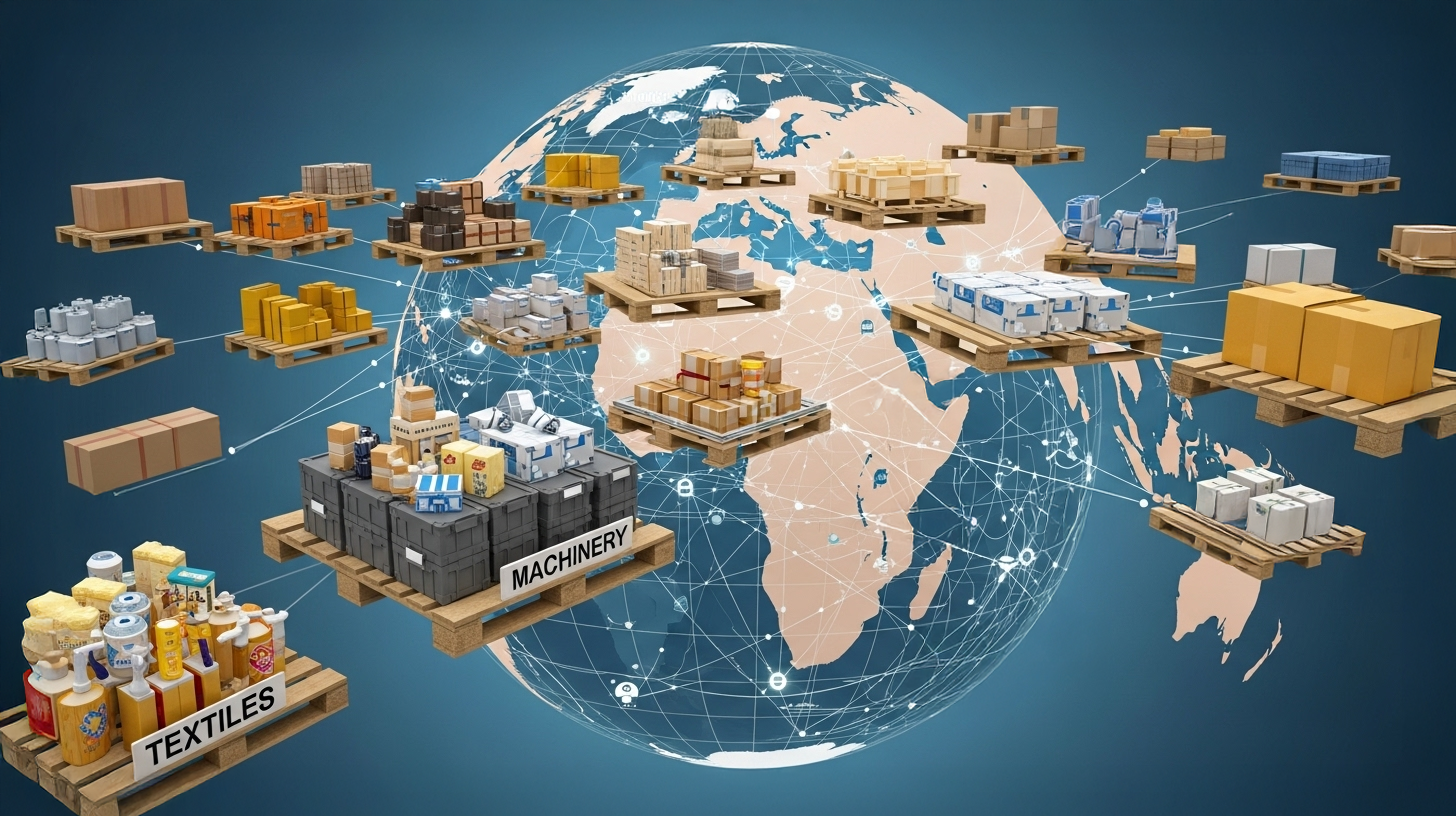
The pallet as the backbone of global trade: A global market analysis of pallet logistics – Image: Xpert.Digital
From weapon of war to high-tech network: The Palette 2.0
### From weapon of war to backbone of global trade: The amazing story of the pallet ### The unsung hero of world trade: How the pallet is revolutionizing e-commerce and the supply chains of the future ### The silent revolution: How smart pallets with sensors and IoT are changing logistics forever ### An underestimated billion-dollar market: Why the future of logistics rests on a simple wooden board ### More than just wood: The secret behind the pallet, the true backbone of e-commerce and world trade ### The unassuming object that keeps our world running: The true importance of the pallet for you and your shopping ###
A multi-billion dollar market on wooden planks: The underestimated logistics innovation
In the complex machinery of global trade, there is an object so ubiquitous and unassuming that its fundamental importance is easily overlooked: the pallet. It is the silent backbone of our modern economy, a simple load carrier made of wood, plastic, or metal, without which the rapid and efficient flow of goods—from groceries in your supermarket to the latest smartphone—would be inconceivable. Yet the history and future of this object are far more fascinating than its modest appearance suggests.
Its journey begins not in a warehouse, but on the battlefields of World War II, where military necessity gave birth to a logistical revolution. The true stroke of genius, however, was not the invention of the platform itself, but its subsequent standardization into the Euro pallet, which created a universal exchange pool and reduced logistics costs in Europe by up to 90%. Today, in the age of global e-commerce, fragile supply chains, and a growing awareness of sustainability, the pallet is on the cusp of its next transformation. It is evolving from a passive wooden board into an intelligent, data-generating hub in the Internet of Things (IoT), promising seamless transparency from producer to end customer.
This comprehensive overview examines the pallet from every angle: from its military origins and the establishment of global standards to the analysis of a multi-billion dollar market and the megatrends like sustainability and automation that will shape its future. Discover why this seemingly simple object is at the heart of the next industrial revolution in logistics and how it will forever change the way we move goods.
The inconspicuous revolution in the transport of goods
In the complex world of global trade, there are objects whose fundamental importance stands in direct contrast to their unassuming appearance. The pallet is one such object. It is flat, rectangular, and often made of simple wood, yet it is undeniably one of the most important inventions in the history of modern logistics. Without this simple load carrier, today's trade, characterized by high speed, efficiency, and scalability, would be inconceivable. Whether food, machinery, pharmaceuticals, or electronics – hardly any shipment today can do without the pallet, which acts as the true backbone of global trade. It is the unsung hero that makes it possible to bundle individual goods into standardized loading units that can be moved, stored, and transported by machine.
The true brilliance of the pallet lies not in its physical form, but in its role as a catalyst for system-wide standardization. It created a universal platform, a common protocol for the physical movement of goods. This standardization enabled the development and efficient use of forklifts, high-bay warehouses, automated conveyor systems, and, today, driverless transport vehicles. Much like the TCP/IP protocol laid the foundation for data exchange on the internet, the pallet established a universal language for the flow of materials. This report analyzes the evolution of this fundamental economic protocol—from its military origins and the establishment of global standards and materials to its current transformation into an intelligent, data-generating asset in the digitized supply chain. It examines the global market dynamics, the driving megatrends such as e-commerce and sustainability, and the technological innovations that will define the future of pallet logistics.
The historical development of the pallet: From war tool to logistics icon
Origins in military needs
The story of the modern pallet, like so many logistical innovations, begins with a military necessity. During World War II, the US Army faced the enormous challenge of transporting and loading vast quantities of equipment, ammunition, and supplies quickly and efficiently over long distances. Manually loading individual crates and sacks was slow, labor-intensive, and inefficient. A method was needed to bundle goods into larger units. The result was a simple wooden platform on which goods could be stacked and moved as a single unit.
This development was inextricably linked to the perfection of another piece of equipment: the forklift truck. Although the first patents for pallet-like platforms, such as Howard T. Hallowell's "Lift Truck Platform," were filed as early as 1924, it was the symbiosis of pallet and forklift that ushered in a new era of mechanized material handling. This combination enabled a completely new level of automation in warehouses, ports, and on the front lines. Loading times could be drastically reduced, which, in the context of war, could mean the difference between victory and defeat. After the war, with the rise of mass production and growing international trade, this efficiency became the engine of economic reconstruction. By the 1950s, millions of pallets were in use worldwide.
The milestone of standardization
The decisive turning point in the history of pallets in Europe occurred in 1961. Until then, pallets existed, but they were often custom-made without standardized dimensions, which hampered cross-border transport. To solve this problem, several European railway companies joined forces under the umbrella of the Union of International Railways (UIC) and signed a contract for a standardized, exchangeable pallet: the Europool pallet, known today as the Euro pallet.
The standard dimensions of 1200 x 800 mm were a strategic decision aimed at optimizing the loading space of railway wagons at the time. This standardization ensured that exactly two pallets could fit crosswise or three lengthwise into the transport vehicles, thus maximizing cargo space utilization. However, the true revolution lay not only in the dimensions themselves, but in the system built around them: the European Pallet Pool (EPP). This system was based on the principle of "exchange instead of purchase." Instead of the costly and time-consuming process of returning empty pallets to the sender after a delivery, they could simply be exchanged for equivalent empty pallets at transshipment points. This exchange system, now firmly established primarily in Germany, France, Austria, and the Benelux countries, reduced loading times by up to 90% compared to the pre-pallet era and significantly lowered logistics costs. It created an open standard that fostered an entire economic ecosystem and laid the foundation for today's European logistics.
The role of organizations and the establishment of norms
Maintaining such a successful open standard requires a robust governance structure for quality assurance and rule-making. Originally, the pallet exchange pool was managed by the UIC member railways themselves. In the 1970s, Deutsche Bundesbahn transferred its trademark rights to symbols such as "DB", "EUR in an oval", and "EPAL" to the "Gütegemeinschaft Paletten" (Pallet Quality Association), the predecessor of today's European Pallet Association e.V. (EPAL).
EPAL was founded in 1991 and for many years acted as a service provider for the "EUR in an Oval" brand, responsible for quality assurance, licensing manufacturers and repair shops, and conducting independent audits. This centralized oversight was crucial to ensuring the high quality and interchangeability of pallets within the pool. However, in 2012, the collaboration between EPAL and the trademark holder of the "EUR in an Oval" brand, the Rail Cargo Group (RCG), came to an end. Since then, the two brands have existed in parallel as competitors within the open European pallet exchange pool. This development illustrates the typical challenges faced by successful standards throughout their evolution – from establishment and scaling to governance conflicts and competition. Nevertheless, the Euro pallet, whether under the EPAL or EUR brand, remains the undisputed backbone of European freight transport.
Global pallet landscape: A typology of load carriers
The world of pallets is far more diverse than it initially appears. Over decades, different standards and materials have become established depending on the geographical region, industrial requirements, and logistical needs. This global pallet landscape is the physical reflection of historical trade routes and regional economic developments. The absence of a single, universal global standard is not a failure, but rather the result of these organically grown, fragmented development paths. This fragmentation, however, creates a persistent challenge in global logistics—a kind of "translation cost" in the form of re-palletizing or inefficient container loading—which in turn drives the market for flexible logistics services and global pooling providers.
Geographical standards in comparison
The dimensions of a pallet are its defining characteristic, as they determine its compatibility with the entire logistics infrastructure – from forklifts and racking systems to truck loading areas and sea containers.
Europe
The European single market is dominated by the Euro pallet (EUR/EPAL 1) measuring 1200 x 800 mm. It is the core of the European pallet exchange system. It is complemented by the so-called industrial pallet (EUR 2) measuring 1200 x 1000 mm, which is widely used in certain industries and in the United Kingdom.
North America
The de facto standard in the USA and Canada is the GMA (Grocery Manufacturers Association) pallet with inch dimensions of 48″ x 40″, which is approximately 1219 x 1016 mm. It is the predominant pallet in the North American food and consumer goods sector.
Asia-Pacific
Square pallets are widely used in Asia because they are ideally suited for loading ISO shipping containers. The standard in Japan and South Korea is the 1100 x 1100 mm pallet. The 1140 x 1140 mm pallet has also become established for container transport. In Australia, the 1160 x 1160 mm pallet is the common standard.
ISO standards
The International Organization for Standardization (ISO) attempted to create a global framework with the ISO 6780 standard by recognizing six globally used pallet formats as international standards. These include the European industrial pallet (1200 x 1000 mm), the Euro pallet (1200 x 800 mm), and the North American GMA pallet (1219 x 1016 mm). However, this is more of a recognition of existing regional standards than the creation of a new, unified global standard.
The following table provides an overview of the most important global pallet standards and highlights the regional differences, which represent a key challenge for intercontinental trade.
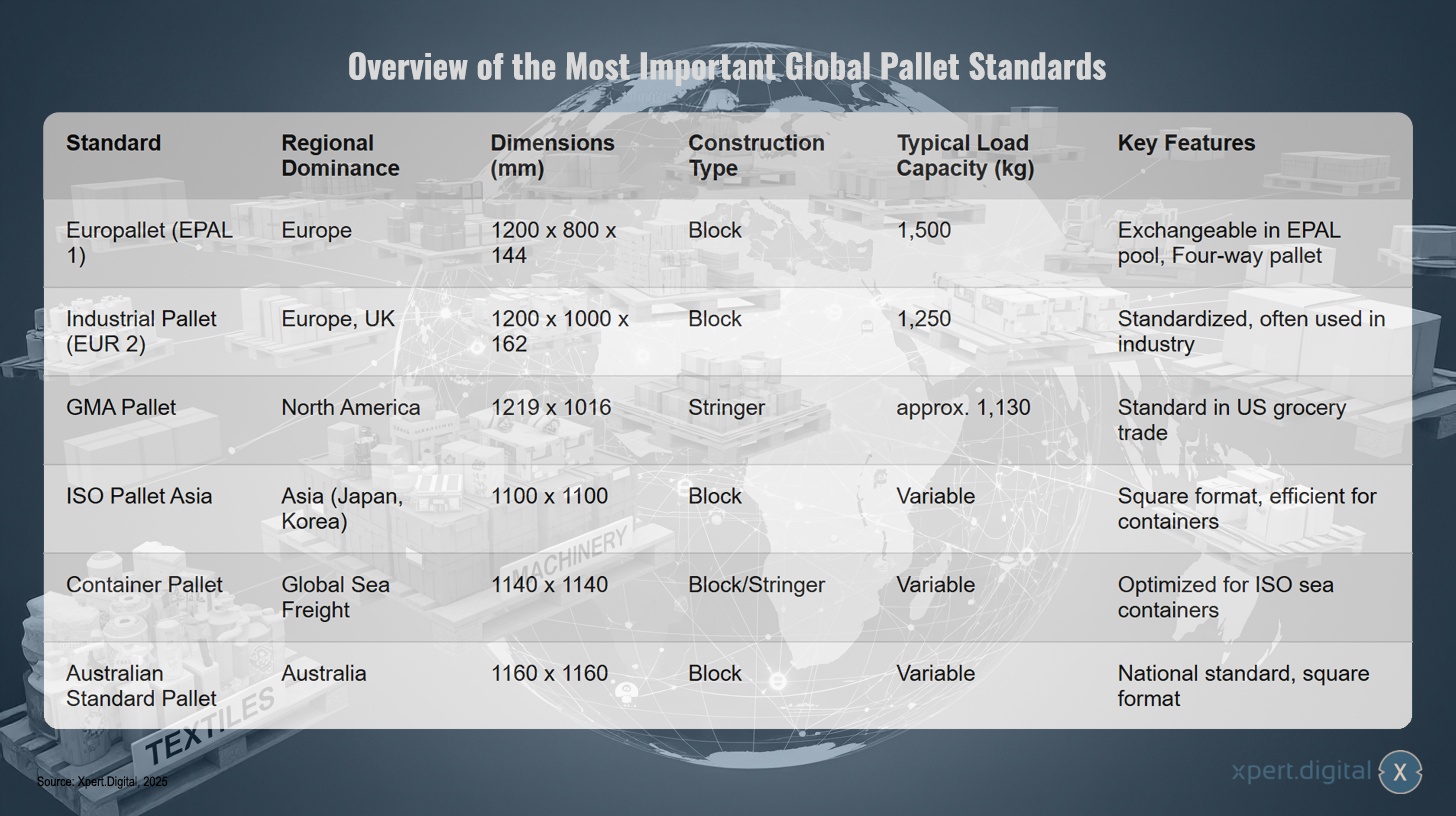
Overview of the most important global pallet standards – Image: Xpert.Digital
Pallet standards are an important aspect of the global logistics and shipping industry. The various standards differ in their dimensions, construction types, and load-bearing capacities depending on the region and intended use.
In Europe, the Euro pallet (EPAL 1) with dimensions of 1200 x 800 mm and a load capacity of 1,500 kg and the industrial pallet (EUR 2) with 1200 x 1000 mm and a load capacity of 1,250 kg are dominant. These pallets are available in the EPAL exchange system and are widely used in industry and logistics.
In North America, the GMA pallet, measuring 1219 x 1016 mm and with a load capacity of approximately 1,130 kg, is the standard type, particularly in the food industry. Asian countries such as Japan and Korea use a square ISO pallet measuring 1100 x 1100 mm, which is especially efficient for container logistics.
A container pallet measuring 1140 x 1140 mm was developed for global sea transport, fitting optimally into ISO shipping containers. Australia uses its own national standard with a square pallet measuring 1160 x 1160 mm.
These different pallet standards illustrate the regional characteristics in the international logistics and shipping industry.
Material diversity and their applications
The choice of material is crucial for the properties, cost, and application of a pallet. Each material offers a unique profile of advantages and disadvantages.
Wood
With a market share of over 90%, wood remains the dominant material. It is cost-effective, robust, easy to repair, and comes from a renewable resource. A typical wooden pallet can remain in circulation for up to 10 years with regular repairs. Its main disadvantage is its susceptibility to moisture, mold, and pests, which is why heat treatment according to the ISPM 15 standard is mandatory for international shipping.
plastic
Plastic pallets are becoming increasingly important. They are extremely durable, weather-resistant, dimensionally stable, and hygienic, as they are easy to clean and do not absorb moisture. These properties make them the ideal choice for the food and pharmaceutical industries. Their dimensional accuracy also makes them perfect for use in automated storage systems. The disadvantages are higher purchase costs and the fact that they are manufactured from fossil fuels, although their long lifespan and high recyclability improve their environmental footprint.
Pressed wood (INKA pallets)
These pallets are formed from sawmill residue and wood chips under high pressure and heat. They are lightweight, cost-effective, and can be nested inside each other, saving up to 70% space during storage and empty transport. Because the manufacturing process kills pests, they are inherently ISPM-15 compliant and therefore perfectly suited for export, especially air freight. However, their load-bearing capacity is lower than that of solid wood or plastic pallets.
metal
Steel or aluminum pallets are used for extremely heavy loads or in special high-bay warehouses, for example in the automotive or metal industries. They are virtually indestructible, but also very heavy and expensive.
Corrugated cardboard/cardboard
As an ultra-lightweight and cost-effective disposable solution, corrugated cardboard pallets are ideal for air freight, where every kilogram counts. They are environmentally friendly and easy to recycle, but offer limited load-bearing capacity and are susceptible to moisture.
Composite materials
The future of pallet materials may lie in composite materials such as wood-plastic composites (WPC), which combine the advantages of wood and plastic. Innovative approaches that utilize agricultural waste such as coconut shells or banana fibers are also being researched to develop even more sustainable and high-performance pallets.
Constructive and Functional Classification
Besides geography and material, pallets can also be distinguished by their construction and intended use.
Block vs. skid pallets (stringer)
This is a fundamental difference in design. Block pallets, like the Euro pallet, use nine individual blocks that connect the top and bottom decks. This allows for true four-way access, meaning they can be picked up from all four sides with forklifts and pallet jacks, offering maximum handling flexibility.
Stringer pallets, the standard in North America, use two to four continuous longitudinal beams (skids) instead. They are often only accessible from two sides unless the skids are notched to allow (limited) four-way access.
Reusable vs. disposable pallets
Reusable pallets are robustly constructed and designed for multiple uses in an exchange or pooling system, such as the Euro pallet or chemical pallets.
Disposable pallets are designed for single transport. They are lighter and less expensive to build, but depending on their quality, they can be reused several times; however, they are not part of an official exchange system.
Special pallets
For specific requirements, a wide variety of special designs are available. These include chemical pallets (CP pallets), which are available in nine standardized sizes (CP1 to CP9) for the chemical industry. Display pallets, such as the Düsseldorf half pallet (800 x 600 mm), are used for product presentation directly at the point of sale. Drum pallets are often square (e.g., 1200 x 1200 mm) and designed for transporting four drums. Wire mesh containers are robust steel frame constructions based on pallets, which are also exchangeable within the European pallet pool and are suitable for loose or irregularly shaped goods.

Xpert.Plus Warehouse Optimization - High-bay warehouses and pallet warehouses: Consulting and planning
The future of goods flows: The triumph of intelligent load carriers
The global pallet market: figures, data and growth forecasts
The global pallet market is a direct indicator of worldwide economic activity. Its growth reflects the increase in global trade, the expansion of e-commerce, and ongoing industrialization. Market data analysis reveals robust growth characterized by increasing diversification and specialization. A remarkable trend is emerging: while the majority of the market by volume remains dominated by cost-effective, standard wooden pallets, the primary drivers of revenue and profit growth are increasingly shifting toward specialized, high-performance segments. These include plastic pallets for the pharmaceutical industry, pallets optimized for automation, and integrated smart pallet solutions. This shift indicates a strategic transformation in which pallet manufacturers are evolving from mere raw material suppliers to providers of specialized logistics solutions.
Current market size and growth forecasts
Estimates of the global market size vary depending on the research institute, but remain consistent. For 2024/2025, the market value is estimated at between USD 73 billion and USD 98 billion. Future forecasts are consistently positive. By 2030-2034, the market volume is expected to increase to between USD 101 billion and USD 130 billion. This corresponds to a stable compound annual growth rate (CAGR) of 5.3% to 7.25%.
The following table summarizes the forecasts of leading market research companies and provides a consolidated view of the expected market development.
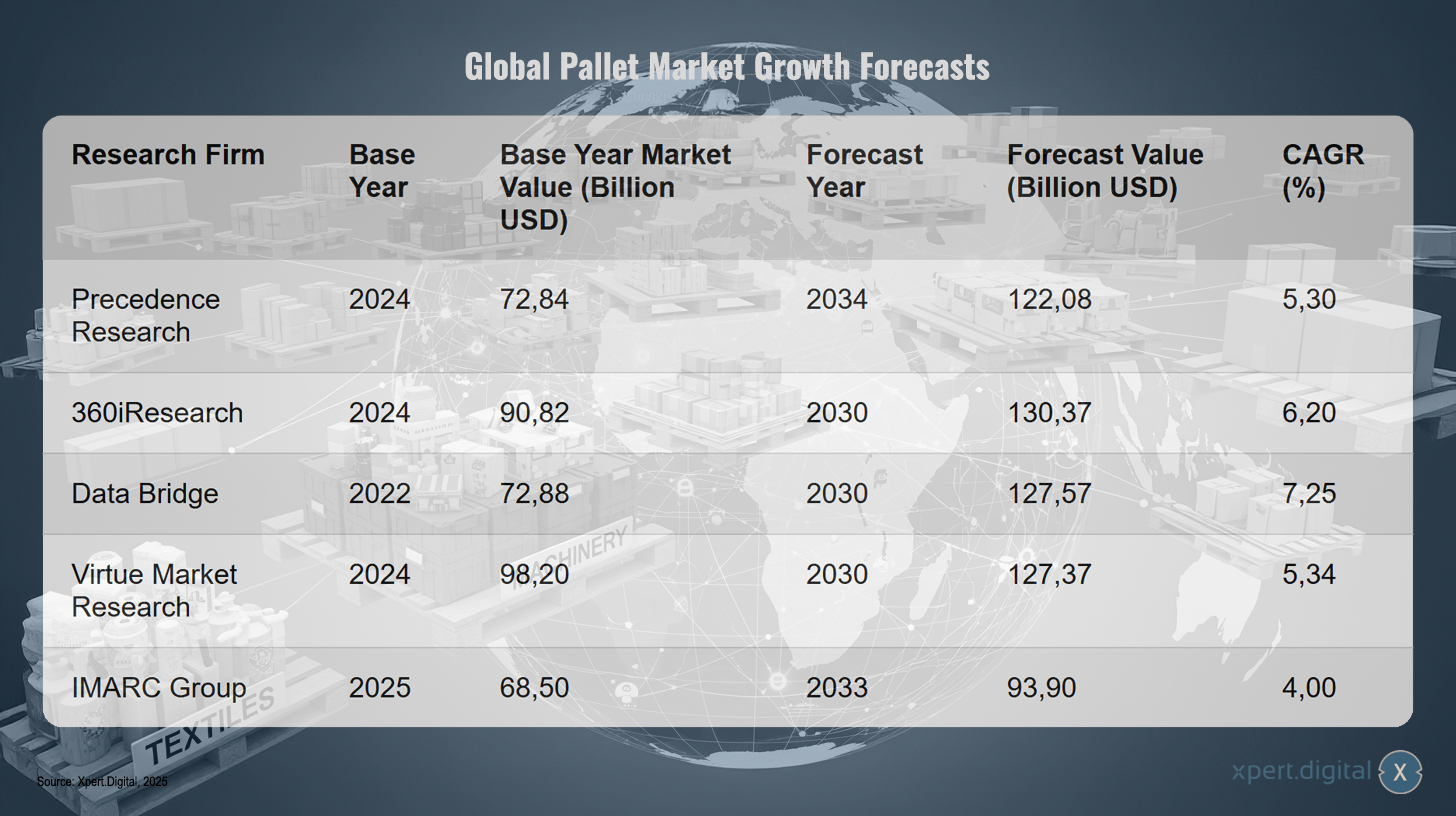
Growth forecasts for the global pallet market – Image: Xpert.Digital
The global pallet market shows stable growth potential in various forecasts. Several research companies have examined the market's development for the coming years and present interesting perspectives.
Precedence Research, for example, expects the market value to increase from USD 72.84 billion in 2024 to USD 122.08 billion in 2034, representing a compound annual growth rate (CAGR) of 5.30%. 360iResearch forecasts an increase from USD 90.82 billion in 2024 to USD 130.37 billion in 2030, with a CAGR of 6.20%.
Data Bridge projects even more dynamic growth with a CAGR of 7.25% and a market value increase from USD 72.88 billion in 2022 to USD 127.57 billion in 2030. Virtue Market Research expects similar figures with a CAGR of 5.34%.
The most conservative forecast comes from IMARC Group, which predicts an increase from USD 68.50 billion in 2025 to USD 93.90 billion in 2033 with a CAGR of 4.00%.
Despite slight differences in the forecasts, everything points to steady and robust growth in the global pallet market in the coming years.
Market segmentation by material
The choice of materials remains a crucial factor for the market structure, with a clear trend towards higher-quality and more sustainable materials emerging.
Wood
Wooden pallets, with a market share of 60% to 70%, still represent the largest segment. Their cost-efficiency and established infrastructure secure their dominance, particularly in general freight transport.
plastic
The plastics segment is the market's growth engine. With a projected annual growth rate of over 7%, it is growing significantly faster than the overall market. Demand is driven by stringent hygiene requirements in the food and pharmaceutical industries, as well as the need for precisely dimensioned pallets for automated systems. Its market share currently stands at approximately 25%.
Metals and composite materials
These materials serve niche markets. Metal pallets are used for heavy loads, while composite materials and corrugated cardboard are gaining importance, especially in air freight and export.
Market segmentation by end-user industry
The demand for pallets is driven by various industries, although the growth dynamics differ between sectors.
Dominant sectors
The food and beverage, logistics and warehousing, and general manufacturing industries are the largest consumers of pallets. They form the basis of the market and ensure a stable volume of demand.
Growth sectors
The fastest-growing demand comes from the pharmaceutical and healthcare sector, with a projected CAGR of over 8%. Strict hygiene regulations, the need for an unbroken cold chain, and the requirement for traceability are driving the demand for high-quality plastic and smart pallets in this sector. Retail and e-commerce are also significant growth drivers due to their rapid expansion and high turnover rates.
Regional market analysis
Global demand is geographically unevenly distributed, with emerging markets exhibiting the highest growth rates.
Asia-Pacific
This region is both the largest and fastest-growing pallet market in the world. With a market share of over 45% and a projected growth rate of over 6.4% per year, it is the global engine of growth. Rapid industrialization, the strong export orientation of countries like China, and the expansion of e-commerce in India are driving demand.
North America
As the second largest market with a value of over USD 27 billion, North America benefits from a highly developed logistics infrastructure, high e-commerce penetration and the trend towards reshoring, i.e. the relocation of production facilities back to the US.
Europe
Europe is a mature and highly standardized market, accounting for approximately 30% of the global market. Growth here is driven less by volume than by quality and innovation. A strong focus on sustainability, the dominance of pallet pooling systems, and the increasing automation of logistics characterize the market.
Megatrends as drivers of change in pallet logistics
The pallet industry is at a turning point, driven by global megatrends that are redefining the foundations of trade and logistics. The digitalization of commerce, the realignment of global supply chains, and the unstoppable advance of sustainability are not isolated phenomena. They converge, creating a powerful dynamic that places new demands on the simple load carrier. At the intersection of these three forces, the pallet pooling model positions itself as a logical and future-oriented solution. It offers the flexibility required for e-commerce, the controllability for resilient regional supply chains, and the circularity demanded by a sustainable economy. The growth of this model is therefore not just a trend, but an inevitable consequence of global transformation.
The e-commerce revolution and urban logistics
The explosive growth of online retail has fundamentally changed the logistics landscape and is one of the strongest drivers of the pallet market. Compared to brick-and-mortar retail, e-commerce requires roughly three times the amount of logistics space, resulting in an enormous demand for pallets for storage, order picking, and transport. The dynamics of online business place specific demands on logistics: faster lead times, a greater variety of products to be transported, and increasingly complex last-mile delivery.
This leads to an increasing demand for different pallet types. Huge, highly automated fulfillment centers require robust, dimensionally accurate, and durable pallets that interact seamlessly with robotics and conveyor systems. At the same time, supplying urban businesses or preparing for last-mile delivery to the end customer often necessitates smaller formats such as half pallets or display pallets, which allow for more flexible handling in confined urban spaces. The challenges of urban logistics, such as traffic congestion and limited loading zones, further intensify the need for efficient, quickly reversible loading units.
Globalization, resilience and nearshoring
Pallets are the foundation of globalized supply chains. Their standardization, even if it varies regionally, is what enables the efficient handling of goods across continents. However, recent global crises, from the COVID-19 pandemic to geopolitical conflicts, have exposed the vulnerability of long and complex supply chains. Supply bottlenecks, skyrocketing freight costs, and political uncertainties have led many companies to rethink their strategies.
The trend is toward greater resilience through the regionalization and nearshoring of supply chains, i.e., the relocation of production and procurement activities to geographically closer locations than sales markets. This development has a direct impact on pallet logistics. Shorter, more controlled delivery routes make the return and reuse of pallets significantly more attractive from both an economic and logistical perspective. Instead of shipping pallets across oceans, they can circulate in regional cycles, further strengthening the demand for robust reusable systems and pallet pooling models.
Sustainability and circular economy
Sustainability has evolved from a niche topic to a key business driver, propelled by regulatory pressure and consumer demand. The pallet industry is playing a pioneering role in this development.
Pallet pooling as a circular economy model
The business model of companies like CHEP, LPR, and iGPS represents the circular economy in its purest form. Customers rent pallets instead of owning them. The pooling provider manages the entire lifecycle: delivery, collection of empty pallets, inspection, repair, and re-establishment in the cycle. This system drastically reduces waste because pallets are used and repaired to their maximum extent. Furthermore, optimized pallet flow management minimizes empty runs, which lowers CO2 emissions and increases efficiency.
Recycling and reuse
The durability and repairability of pallets are key sustainability aspects. A wooden pallet, with proper care and repair, can last up to ten years. In the USA, over 95% of wooden pallets are recovered at the end of their life cycle and either repaired, recycled into new pallets, or processed into other wood products such as mulch or biomass. Plastic pallets are also extremely durable and can be melted down and molded into new pallets at the end of their life cycle, enabling a closed-loop material cycle.
Regulation and certification
Environmental regulations are becoming an increasingly important factor. The new EU Packaging Regulation (PPWR) sets ambitious targets for reducing packaging waste, mandates reuse quotas for transport packaging, and requires a minimum percentage of recycled material in new plastic packaging. This regulation will increase the pressure on companies to switch from single-use to reusable systems such as pallet pooling. At the same time, sustainability certifications such as the Forest Stewardship Council (FSC) are gaining in importance. The FSC label guarantees that the wood used for wooden pallets comes from responsibly managed forests and offers companies a way to demonstrate their sustainable sourcing.
🔄📈 B2B trading platform support – Strategic planning and support for export and the global economy with Xpert.Digital 💡


B2B trading platforms - Strategic planning and support with Xpert.Digital - Image: Xpert.Digital
Business-to-business (B2B) trading platforms have become a critical component of global trade dynamics and thus a driving force for exports and global economic development. These platforms offer significant advantages to companies of all sizes, especially SMEs—small and medium-sized enterprises—which are often considered the backbone of the German economy. In a world where digital technologies are increasingly prominent, the ability to adapt and integrate is crucial for success in global competition.
More information here:
From wooden board to high-tech carrier: The pallet 4.0
Technological transformation: The future of the palette is intelligent
The fourth industrial revolution is even impacting the humble wooden pallet. Driven by advances in sensors, robotics, and artificial intelligence, the pallet is undergoing a profound transformation. It is evolving from a passive load carrier to an active, intelligent hub in the Internet of Things (IoT). This technological metamorphosis is closely linked to another trend: warehouse automation. The increasing prevalence of automated guided vehicles (AGVs) and palletizing robots is placing new, stringent demands on the precision and quality of pallets. Robots are less fault-tolerant than humans; they require consistent, dimensionally accurate, and reliable load carriers to operate efficiently. This requirement is driving the evolution of the physical pallet itself and favoring the use of high-quality plastic or composite pallets that meet these criteria. A symbiosis is emerging: automation requires better pallets, and better, intelligent pallets enable a higher level of automation.
Digitalization of the supply chain: The intelligent pallet
The concept of the "smart pallet" is the core of digitalization in pallet logistics. Through the integration of IoT technologies, pallets become active information carriers, enabling unprecedented transparency in the supply chain.
Technology and Functionality
Smart pallets are equipped with a variety of sensors, including RFID chips, GPS modules, and low-power Bluetooth trackers. For example, the European Pallet Association (EPAL) and the Fraunhofer Institute for Material Flow and Logistics (IML) are collaborating on the development of such smart EPAL pallets. These sensors transmit real-time data about the pallet's condition and position to a cloud platform.
Data collection and use
The collected data goes far beyond simple location tracking. Sensors can monitor critical parameters such as temperature and humidity, which is crucial for maintaining the cold chain of food and pharmaceuticals. Vibration and tilt sensors register improper handling or accidents, allowing damaged goods to be identified early. This comprehensive monitoring enables proactive quality assurance, reduces shrinkage and theft, and optimizes inventory management, as the location and condition of each item are known at all times.
Automation in the warehouse
Alongside the digitization of the pallet itself, automation is revolutionizing physical processes in the warehouse. Pallets are the central link that enables automated systems to handle the goods.
Automated guided vehicles (AGVs)
Also known as Automated Guided Vehicles (AGVs) or Autonomous Mobile Robots (AMRs), these vehicles handle internal pallet transport. They autonomously move pallets from goods receiving to storage locations, between production lines, or to shipping docks. Navigation is achieved using various technologies, from traditional wire-guided systems to modern methods such as laser navigation, camera-based visual guidance (machine vision), or 2D/3D mapping, where the robot creates a virtual map of its environment. The use of AGVs relieves employees of repetitive transport tasks, increases process reliability, and operates around the clock with consistent efficiency.
Robots for palletizing and depalletizing
Manually stacking boxes onto pallets (palletizing) and unloading them (depalletizing) are physically demanding and monotonous tasks. Industrial robots, and increasingly collaborative robots (cobots), are automating these processes. Equipped with specialized grippers and advanced 3D vision systems, these robots can precisely and quickly place products on or remove them from pallets. They optimize the stacking pattern for maximum stability and space utilization and can also handle complex tasks such as creating mixed pallets for retail. This not only increases speed and efficiency but also significantly improves ergonomics and workplace safety.
Material innovation
Technological transformation is also driving the development of new materials that better meet the requirements of modern logistics.
Wood-Plastic Composites (WPC)
These composite materials combine wood fibers with plastics to unite the positive properties of both materials: the cost-efficiency and sustainability of wood with the durability and weather resistance of plastic.
Bio-based and biodegradable materials
The long-term vision is the development of pallets made from entirely sustainable sources. Research focuses on bio-based plastics derived from renewable raw materials such as cornstarch, as well as composite materials made from agricultural waste products. Materials from hemp fibers, coconut shells, or even banana plants are being tested as potential raw materials for the next generation of environmentally friendly pallets. These innovations aim to create pallets that are biodegradable at the end of their life cycle, thus completely closing the material loop.
Current challenges and strategic solutions
Despite positive growth prospects and technological advancements, the pallet industry faces significant challenges that threaten its stability and profitability. Volatility in commodity markets, an industry-wide skills shortage, and increasing geopolitical risks are creating a complex and uncertain operating environment. These converging challenges have fundamentally altered the strategic importance of pallet management. What was once a purely operational procurement task—buying a simple load carrier at the lowest price—has evolved into a C-level strategic necessity. The COVID-19 pandemic vividly demonstrated how a shortage of pallets can cripple entire supply chains. Consequently, the focus is no longer solely on cost minimization, but on risk management and ensuring supply chain resilience. Companies must now develop sophisticated strategies that include supplier diversification, alternative materials, and investment in pallet pooling to safeguard their business continuity.
Volatility of commodity markets
The cost structure of wooden pallets is largely determined by the price of wood, which can account for up to 80% of the total cost. However, the timber market is extremely volatile and influenced by a multitude of factors. Demand in the construction sector, particularly in residential construction, competes directly with the pallet industry for lower-grade timber. Natural disasters such as forest fires or floods can create short-term shortages of timber, while trade tariffs and other political decisions affect international timber prices.
The COVID-19 pandemic dramatically exacerbated this volatility. A surge in demand, driven by the e-commerce boom and DIY projects, collided with disrupted supply chains and reduced production capacity at sawmills. The result was record-high timber prices and an acute shortage of pallets, leading to significant delivery delays and cost increases across the economy. This experience has starkly highlighted the vulnerability of supply chains heavily reliant on a single raw material.
Skilled worker shortage in production and logistics
The pallet industry, like the entire logistics and manufacturing sector, is suffering from an acute labor shortage. An aging workforce, difficulties in attracting young talent for physically demanding jobs, and increased competition for labor are leading to vacancies in pallet production, warehouses, and truck transport.
This shortage drives up labor costs and limits production capacity, thus restricting delivery capabilities. In response, companies are increasingly investing in automation. Automated nailing machines, stacking and sorting robots, and conveyor systems are being used in production facilities to reduce reliance on manual labor and increase efficiency. At the same time, innovative recruitment strategies are being tested, such as collaborating with refugee placement agencies or using temporary staffing firms to meet personnel needs.
Geopolitical risks
Globalization has led to highly efficient, but also vulnerable, supply chains. Geopolitical events such as trade wars, the imposition of tariffs, sanctions, or military conflicts can abruptly disrupt these chains. Such events directly impact the pallet industry by increasing the cost or blocking access to raw materials, jeopardizing vital transport routes like the Suez Canal, and enhancing overall economic uncertainty.
These risks are a key driver of the trend toward nearshoring and the regionalization of supply chains. Companies are seeking to reduce their dependence on distant and politically unstable regions by shifting their production and sourcing closer to their home markets. For the pallet industry, this means a potential shift in demand toward local and regional manufacturers and a strengthening of circular economy models within these shorter supply chains.
Competition through palletless systems
Although pallets are dominant, they are not without competition. So-called palletless handling systems, especially slip sheets, represent a serious alternative in certain applications. Slip sheets are thin sheets of plastic or reinforced cardboard that are placed under the load unit instead of a pallet.
Their main advantages are significantly lower costs, a fraction of the weight, and minimal space requirements, which is particularly beneficial for maximizing the utilization of sea containers and in air freight. They also do not require ISPM 15 treatment for export. However, the crucial disadvantage is that handling them requires special forklift attachments, known as push-pull devices, which are not universally available. Furthermore, they offer less structural protection for goods than a robust pallet. For these reasons, slip sheets remain a niche solution for specific, often closed supply chains, and do not pose a universal threat to the dominance of pallets.
The vision of a fully autonomous supply chain
The future of logistics, and thus of pallets, is defined by the convergence of the trends analyzed in this report: digitalization, automation, sustainability, and the realignment of global supply chains. These forces are shaping a vision in which the supply chain becomes a largely autonomous, self-organizing, and intelligent system. In this future ecosystem, the pallet will not only maintain its central role but will even expand it. It will transform from a simple, passive load carrier into an active, intelligent data hub—the indispensable link between the physical world of goods and the digital world of information.
The long-term market forecast extending beyond 2030 indicates continued, stable growth, accompanied by a qualitative transformation. The market will further diversify, with a wide range of highly specialized, intelligent, and sustainable load carriers seamlessly integrated into a global, digitally networked logistics system. The vision of the "lights-out warehouse"—a fully automated warehouse operating without human lighting or presence—is becoming a reality. In these facilities, intelligent software platforms will orchestrate entire fleets of autonomous robots. These robots will manage the entire material flow: from automatically unloading and depalletizing incoming goods and storing them in high-density, automated storage systems to picking and building perfectly optimized, store-ready mixed pallets for shipment.
For companies that want to remain competitive in this future environment, a strategic rethink is essential. Pallets can no longer be viewed as a mere cost factor to be minimized. Instead, they must be understood as a strategic asset that actively contributes to value creation, risk reduction, and increased efficiency. Investing in intelligent, automatable, and sustainable pallet solutions will become a crucial factor in building resilient, transparent, and highly efficient supply chains of the future. The humble pallet that once sparked the first industrial revolution in logistics is now at the heart of the next.
We are here for you - Consulting - Planning - Implementation - Project Management
☑️ SME support in strategy, consulting, planning and implementation
☑️ Creation or realignment of the digital strategy and digitization
☑️ Expansion and optimization of international sales processes
☑️ Global & Digital B2B trading platforms
☑️ Pioneer Business Development

Konrad Wolfenstein
I would be happy to serve as your personal advisor.
You can contact me by filling out the contact form below or simply call me on +49 7348 4088 965 .
I'm looking forward to our joint project.
Write to me


Xpert.Digital - Konrad Wolfenstein
Xpert.Digital is a hub for industry focusing on digitalization, mechanical engineering, logistics/intralogistics and photovoltaics.
With our 360° Business Development solution, we support renowned companies from new business to after-sales.
Market intelligence, smarketing, marketing automation, content development, PR, mail campaigns, personalized social media and lead nurturing are part of our digital tools.
You can find more information at: www.xpert.digital - www.xpert.solar - www.xpert.plus
Keep in touch