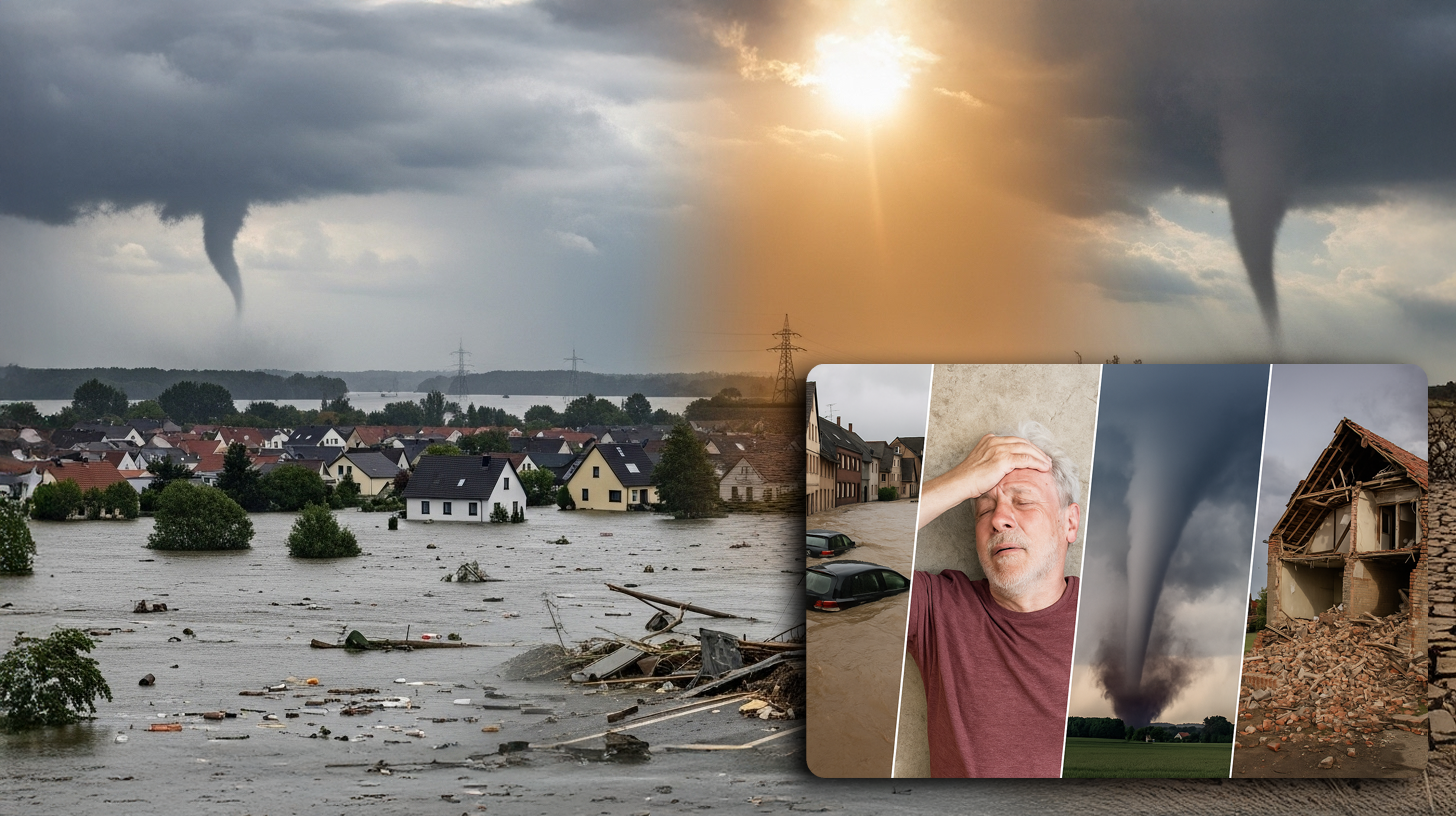
Floods, heat deaths, tornadoes and billions in damages: Germany's new crisis reality is here – Image: Xpert.Digital
Severe weather disasters and natural disasters in Germany
The danger is growing: Which natural disasters are most likely in your region?
Germany is in a permanent state of crisis – what feels like a sensation to many is becoming a disturbing certainty thanks to the hard facts of recent years. The images of the devastating floods in the Ahr Valley in 2021 are still deeply etched in the collective memory, but they are no longer a tragic isolated incident. The recent once-in-a-century floods in southern Germany, the dramatic Christmas floods of 2023/24, and a steadily growing list of extreme weather events demonstrate that nature is striking more frequently and with ever greater force.
These events are not random whims of nature, but alarming symptoms of a profound transformation. The climate crisis is hitting Germany with full force and manifesting itself in a new, threatening normality. From torrential rains and deadly heat waves to a record number of tornadoes and devastating forest fires – the statistics paint a grim picture and document the massive financial damage and tragic loss of life with shocking figures. This overview of recent natural disasters and severe weather events in Germany not only reveals the extent of the destruction, but also underscores the urgent need to prepare for a future in which extremes become the norm.
Current flood disasters 2024-2025
Floods in Southern Germany 2024
The most severe weather event in recent history occurred from May 30 to June 4, 2024. Bavaria and Baden-Württemberg were particularly affected, with a Vb weather pattern leading to extreme rainfall. Within four days, widespread rainfall of 100 to 200 millimeters, and locally even 300 millimeters, fell. These rainfall amounts reached statistical recurrence intervals of more than 100 years and resulted in once-in-a-century floods on several rivers.
The consequences were devastating: At least six people lost their lives, more than 15 Bavarian districts declared a state of emergency, and thousands had to be evacuated. Insured losses in Bavaria and Baden-Württemberg alone amounted to approximately €1.6 billion each.
Christmas floods 2023/2024
From December 2023 to January 2024, 18 days of continuous rainfall led to severe flooding. Saxony-Anhalt and Lower Saxony along the Elbe, Weser, and Ems rivers were particularly affected. Nearly 7,000 people had to be evacuated, and nine people died.
The Ahr Valley flood disaster of 2021
The worst natural disaster since the Hamburg storm surge of 1962 occurred on July 14th and 15th, 2021. The low-pressure system "Bernd" brought torrential rain: Within 24 hours, 100 to 150 liters per square meter fell in parts of Rhineland-Palatinate and North Rhine-Westphalia.
The disaster claimed over 180 lives, 135 of them in the Ahr Valley. The financial damage is estimated at over 40 billion euros – the greatest damage ever caused by a natural disaster in Germany. In the Ahr Valley, over 9,000 buildings were destroyed or severely damaged, and 17,000 people lost all their possessions.
🎯🎯🎯 Benefit from Xpert.Digital's extensive, five-fold expertise in one comprehensive service package | BD, R&D, XR, PR & Digital Visibility Optimization

Benefit from Xpert.Digital's extensive, five-fold expertise in a comprehensive service package | R&D, XR, PR & Digital Visibility Optimization - Image: Xpert.Digital
Xpert.Digital possesses in-depth knowledge across various industries. This allows us to develop tailored strategies precisely aligned with the requirements and challenges of your specific market segment. By continuously analyzing market trends and monitoring industry developments, we can act proactively and offer innovative solutions. The combination of experience and expertise generates added value and provides our clients with a decisive competitive advantage.
More information here:
€5.7 billion in weather damage: Who bears the costs?
Extreme weather and climate change 2024
Record heat
2024 was the warmest year in Germany since records began in 1881. The average temperature was 10.9 degrees Celsius – 0.3 degrees higher than the previous record year of 2023. Spring 2024, in particular, was the warmest since 1881.
Heat deaths
The Robert Koch Institute (RKI) estimates that around 2,800 people died in Germany as a result of heat in 2024, compared to around 3,100 in 2023. By comparison, there were approximately 8,500 heat-related deaths in the record-breaking summer of 2018.
Insured damages
Extreme weather events caused insured losses of €5.7 billion in 2024. Of this, €2.6 billion was attributable to heavy rain and flooding – €1 billion more than the long-term average.
Tornadoes in Germany
Record year 2024
By the end of 2024, 32 tornadoes had been confirmed, the highest number in years. The strongest tornado, with an IF2 strength, struck southern Lower Saxony on June 18. In Hagen, a tornado tore off the church steeple roof on May 29.
Tornado season 2025
Thirteen tornadoes had already been confirmed by mid-June 2025. The strongest occurred on June 7th in Donaustetten near Ulm, with wind speeds of up to 220 km/h (IF2 strength).
Forest fires
Record year 2025
2025 developed into the most devastating year for forest fires since records began in 1975. By July, 4,931 hectares of forest had already burned – more than in the previous record year of 2022 (4,293 hectares). The Saarland (68% of its land area), Rhineland-Palatinate (56%), Brandenburg (54%), and Saxony-Anhalt (55%) are particularly at risk.
2024 as a year of contrast
In contrast, 2024 was a relatively fire-free year with only 334 hectares of forest burned. The often damp weather prevented larger fires.
Other natural hazards
earthquake
Germany regularly experiences minor to moderate earthquakes, especially in the Cologne Lowland, the Swabian Alb, and the southern Rhine Graben. The last stronger earthquake occurred on June 27, 2024, near Schopfheim with a magnitude of 4.2 – the strongest in Baden-Württemberg since 2009.
Freezing rain and snow chaos
In January 2024, dangerous weather conditions with freezing rain led to significant traffic disruptions. Bavaria, Baden-Württemberg, Rhineland-Palatinate, and Hesse were particularly affected, with extreme black ice conditions.
Long-term trend
Natural hazard statistics show that Germany experienced a total of 92 disasters between 1990 and 2024. Storms were the most frequent, followed by floods and extreme temperatures. However, most fatalities were caused by heat – the 2003 heat wave alone claimed over 9,000 lives.
The climate crisis is exacerbating these trends: extreme weather events are becoming more frequent, more intense, and causing ever greater damage. Germany is warming faster than the global average – by 1.8 degrees Celsius since pre-industrial times.
Consulting - Planning - Implementation

Markus Becker
I would be happy to serve as your personal advisor.
Head of Business Development
Chairman SME Connect Defense Working Group
Consulting - Planning - Implementation
Konrad Wolfenstein
I would be happy to serve as your personal advisor.
You can contact me at wolfenstein∂xpert.digital or
Just call me on +49 7348 4088 965 .