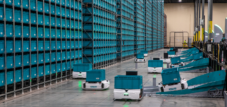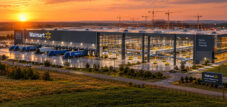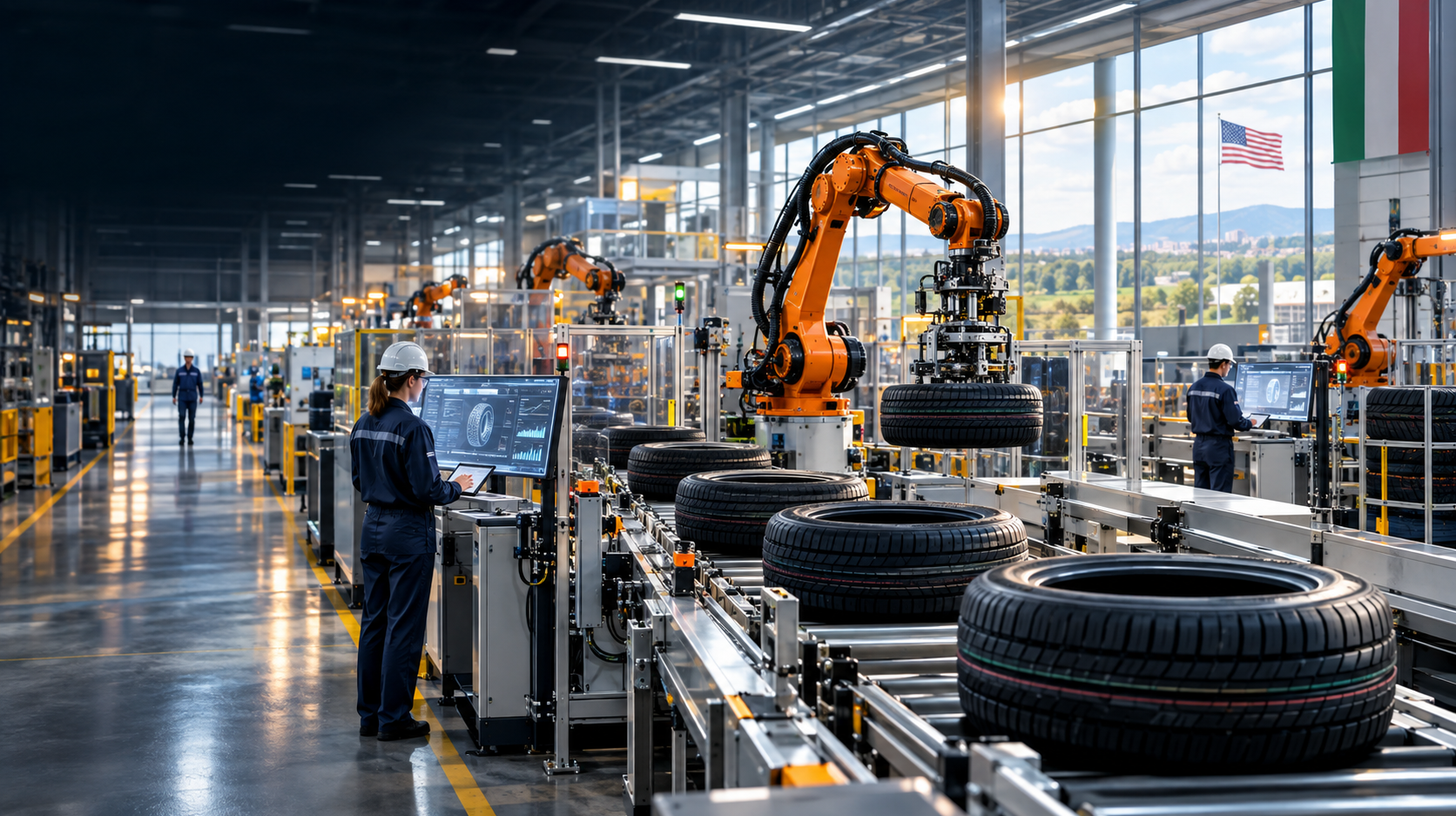
USA: How Pirelli is transforming tire production with its new factory in Georgia – Creative image on the topic, created with AI: Xpert.Digital
Pirelli is focusing on automation: 1,000 new jobs in a digital factory
Local for Local: Pirelli's answer to geopolitical challenges in tire production
The Cyber Tyre: Pirelli's step into the digital future of the tire industry
Pirelli, a leading tire manufacturer, is planning a significant expansion into the US market with an investment of approximately one billion euros. Starting in 2027, the plant in Rome, Georgia, will be expanded to reach an annual capacity of around six million passenger car tires by 2033. This decision is not just a factory expansion, but also a strategic response to the challenges of the global economy, characterized by protectionism, geopolitical tensions, and supply chain risks. Pirelli aims to relocate its production closer to the American market to ensure regulatory certainty and shorter delivery times. The company will not rely on mass production, but will instead create a highly automated factory specializing in premium, high-performance, and connected tires. With this initiative, Pirelli intends not only to strengthen its market position in the crucial US market, but also to meet future challenges and fulfill the demands for innovative, technologically differentiated products. The investment in Georgia could therefore not only change the production landscape in North America, but also serve as an example for European industry of how to operate successfully in a changing global economy.
Six million tires against protectionism, supply chain risks and China's influence
Pirelli is planning the largest industrial expansion in its recent history in the United States. Around one billion euros will be invested starting in 2027 in the expansion of its plant in Rome, Georgia. By 2033, the plant is expected to have an annual capacity of approximately six million passenger car tires. Compared to the current production of around 400,000 units, this represents not just an increase in size, but a fundamental transformation of the site: a specialized, relatively small production facility will be transformed into a highly automated industrial center for premium, high-performance, and connected tires. Approximately 1,000 new jobs are anticipated.
The scale is remarkable. The investment volume equates to roughly €167 per unit of planned annual capacity. Relating this investment to the approximately 5.6 million additional tires yields a value of nearly €179 per additional annual capacity. This simple ratio is not a unit cost calculation, as buildings, facilities, digitalization, product launches, and infrastructure are used over many years. However, it illustrates that Pirelli is not aiming for cheap mass production. The company is building a platform for products whose economic value stems from specialization, technical integration, high manufacturing quality, and a strong position in the premium segment.
This project is therefore more than just a factory expansion. It's a response to a global economy where tariffs, geopolitical rivalries, technology regulation, and supply chain risks increasingly determine where companies are allowed, able, and even obligated to produce. Pirelli is shifting the focus of its US supply closer to the sales market and combining this move with a technological leap. The crucial question isn't whether six million tires can be manufactured in Georgia. The crucial question is whether Pirelli will thereby achieve sustainably higher margins, shorter supply chains, regulatory certainty, and a technological edge that justifies the significant capital commitment.
The US market justifies the large investment
The United States is not a typical market for tire manufacturers. According to Pirelli, the US accounts for approximately 40 percent of the global volume of its high-value segment, which includes larger rim dimensions, technically sophisticated original equipment products, special applications, and high-quality replacement tires. Therefore, companies aiming for global leadership in this segment cannot rely solely on exports to serve the American market. Proximity to the market becomes a strategic production factor.
The overall US tire market is both large and relatively stable. Around 338.9 million tires are expected to be shipped in 2026. Of these, approximately 223.3 million will be replacement tires for passenger cars, while around 41.6 million are intended for original equipment. The remaining volume is distributed among tires for light commercial vehicles and trucks. The replacement market thus clearly dominates. This structure is attractive because it reduces dependence on short-term vehicle production. Tires wear out regardless of whether the new car market is booming or sluggish. Mileage, vehicle stock, fleet age, and replacement cycles stabilize demand.
Pirelli, however, doesn't intend to push six million just any tires into a market of almost 339 million units. The company is focusing on the high-value, premium segment of the market. By 2025, the group will generate 79 percent of its revenue from high-value products, up from 76 percent the previous year. This shift is central to its investment strategy. A premium manufacturer doesn't have to compete on price alone, but rather on vehicle approvals, performance, brand impact, digital features, and the ability to efficiently produce many technically differentiated variants.
With a capacity of six million units, the plant would represent just under 1.8 percent of total US sales volume in 2026. Even considering only passenger car tires, this share would remain manageable. However, its significance is considerably greater in the relevant premium segment. The capacity is therefore ambitious, but not necessarily market-distorting. It can primarily replace imports, meet additional demand, and increase Pirelli's share of large rim sizes as well as high-quality original equipment and replacement tires.
A small factory is transformed into an industrial hub
The Rome plant began operations in 2002 and was initially designed for approximately 400,000 tires per year. It embodies a production philosophy that prioritizes technological flexibility over maximum output. The expansion to six million units fundamentally alters this role, increasing capacity fifteenfold. This transforms the plant from a specialized technological site into an industrial core of the company's North American strategy.
The expansion will take place in two distinct but complementary phases. The first phase will involve the introduction and expansion of the latest generation of the Modular Integrated Robotized System, or MIRS. Starting in 2028, capacity will gradually increase, eventually reaching three million tires annually. MIRS organizes production in compact, modular, and highly robotized units. Product design and industrial implementation are closely integrated digitally. This is particularly valuable when manufacturing numerous tire sizes and specifications in smaller batches.
The second phase envisions fully automated conventional production with an additional annual capacity of three million tires. The term "conventional" should not be confused with traditional, labor-intensive production. It refers to a process architecture designed for higher volumes, utilizing modern automation. Pirelli is thus combining two production logics: highly flexible robotics for complex, high-value products and scalable automation for higher-volume premium tire lines.
This combination reduces a typical investment risk. While a purely large-scale production factory would be cost-efficient, it could become inflexible when faced with rapid model changes, new rim sizes, or customer-specific requirements. Conversely, a purely modular, specialized production facility might not be optimal for high volumes. The two-stage concept allows for a better balance between demand, product variety, and the level of automation. Furthermore, Pirelli can ramp up capacity over several years instead of launching the entire volume at once.
Automation here does not contradict the creation of new jobs
At first glance, it seems contradictory that a largely automated factory requires approximately 1,000 additional employees. In fact, automation changes the demand for labor, but it doesn't eliminate it. A highly digitized tire factory requires fewer manual steps per unit, but at the same time, it needs skilled workers for maintenance, process control, quality assurance, data analysis, logistics, energy supply, sensor technology, software, laboratory work, and the industrialization of new products.
The first expansion phase with MIRS is expected to be particularly capital- and technology-intensive. The greater employment impact is anticipated with the second production phase and ramp-up starting in 2029. The site currently employs just over 200 people. The announced new jobs would therefore significantly increase its regional presence. This will not only create direct employment for Rome and the surrounding Floyd County, but also generate additional demand for technical service providers, construction companies, logistics companies, suppliers, educational institutions, and local consumer goods companies.
The quality of jobs is economically crucial. A factory with robotics and networked products requires different qualifications than a traditional tire manufacturer. This increases the demands on vocational schools, technical colleges, and in-house training programs. If qualification programs are established early enough, the location can develop a sustainable industrial competence cluster. If this fails, shortages of mechatronics engineers, electronics technicians, engineers, and automation specialists are likely, which can drive up wages and start-up costs.
This investment also demonstrates why the common juxtaposition of automation and employment is too simplistic. Without robotics, a high-value factory in the US might not be economically competitive. Automation is therefore more of a prerequisite for job creation than an obstacle to it. However, it does shift the distribution: fewer simple, routine tasks and more technically demanding roles emerge. For the region, this presents both an opportunity and a challenge in terms of education and labor market policy.
Local for local is becoming the new insurance policy
Pirelli's strategy follows the principle of "local for local": products should be manufactured, wherever possible, in the region where they are sold. Previously, such regionalization was often seen as foregoing global economies of scale. Today, it is increasingly seen as insurance against political and logistical disruptions. Those who import tires from Europe, Asia, Mexico, or South America into the USA bear risks associated with exchange rates, freight, customs, ports, and transit times. A local factory can mitigate these uncertainties.
The current trade situation is intensifying the pressure to act. Tire imports from several Asian production countries are subject to additional tariffs in the US, as well as, in some cases, anti-dumping and countervailing measures. The specific burdens vary depending on the country of origin, manufacturer, and product category. For a premium supplier, the uncertainty surrounding future regulations is already problematic, as vehicle programs and production facilities are planned many years in advance. Local manufacturing does not eliminate all risks, but it does reduce the immediate dependence on import regimes.
Logistics also favor Georgia. Tires are bulky products with an unfavorable ratio between transport volume and value, even if premium tires command higher prices. Long transport routes tie up inventory, lengthen response times, and make it difficult to adapt to regional demand fluctuations. US production enables shorter delivery times to vehicle manufacturers and distribution centers. It can also reduce safety stock, provided raw materials and intermediate products are reliably available.
Local for local, however, does not mean complete self-sufficiency. Natural rubber, certain chemicals, textiles, steel cord, electronic components, and machinery remain integrated into international supply chains. The plant is relocating the point of value creation, not the entire raw material base. Resilience, therefore, only arises if Pirelli diversifies not only final production but also procurement, supplier structure, inventory, and transport routes. The strategic advantage lies less in complete independence than in better control of critical interfaces.
The Cyber Tyre turns rubber into a digital product
The most technologically interesting part of the project is the planned production of the Cyber Tyre. This involves connecting sensors within the tire to proprietary software and algorithms. The system captures data directly at the contact point between the vehicle and the road, processes it, and transmits relevant information to the vehicle's electronics in real time. This allows the tire to transform from a passive wear part into an active component of the vehicle's dynamics and safety architecture.
The economic value doesn't stem solely from the sensor itself. Crucially, it's capable of reliably interpreting raw measurement data and translating it into usable information for braking, stability, traction, and driver assistance systems. A vehicle can then more accurately assess the tire type, the development of grip, temperature, load, and wear, and the prevailing road conditions. This additional layer of data can be particularly relevant for high-performance vehicles, electric cars, and automated driving functions.
This opens up a new dimension of competition for Pirelli. With a traditional tire, compound, carcass, tread pattern, durability, noise, and rolling resistance are the key differentiating factors. With a connected tire, software, data quality, system integration, cybersecurity, and collaborations with vehicle manufacturers are added to the mix. This increases development costs, but also the barriers to entry. A competitor must not only build a good tire, but also master the hardware and software across the entire vehicle lifecycle.
US production is important from both a regulatory and commercial perspective. Connected vehicle components are increasingly subject to safety and origin regulations. Following changes in its management, Pirelli has obtained the necessary US approval to market the system. Manufacturing in Georgia strengthens its credibility as a locally produced technology partner and facilitates collaboration with American vehicle manufacturers. At the same time, market success remains dependent on whether manufacturers integrate the technology more extensively and whether customers are willing to pay for the added benefits.
Premiumization instead of fighting for the cheapest tire
Pirelli's financial figures demonstrate why the company focuses on high value. In 2025, the company generated revenue of approximately €6.78 billion. Despite negative currency effects, reported revenue remained almost stable, while organic growth reached 4.2 percent. Adjusted operating profit rose to approximately €1.08 billion, with the corresponding margin increasing to 16 percent. Net profit grew to approximately €531 million.
These figures provide a solid foundation for the US project. One billion euros corresponds to approximately 14.8 percent of the projected annual revenue in 2025 and roughly 92 percent of the adjusted operating profit at that time. Spread over seven years, however, the program is considerably more sustainable than the total sum initially suggests. On average, it would equate to around 143 million euros per year, although the actual use of funds is likely to be uneven.
Pirelli emphasizes that the ratio of investments to revenue is expected to remain essentially at current levels between 2027 and 2033, and that group-wide liquidity generation is to be protected. This suggests that the US program will partially replace other investments or be offset by growth and efficiency gains. For investors, this is an important commitment, but not a guarantee. Large projects can become more expensive due to construction costs, skills shortages, delayed plant acceptance, product launches, or changes in demand.
The return on investment therefore depends heavily on the product mix. If the plant were to primarily produce interchangeable standard tires, securing a return on investment would be more difficult given intense price competition. Higher revenues and stronger customer loyalty are possible with homologated premium tires, large dimensions, special applications, and connected products. Pirelli's strategy is logical: The company is not using automation to compete against Asian mass producers in the low-price segment, but rather to manufacture high-quality variants locally and with reproducible quality.
Your intralogistics experts

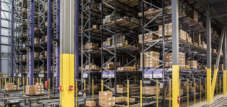
Consulting, planning and implementation of complete solutions for high-bay warehouses and automated storage systems - Image: Xpert.Digital
More information here:
Georgia as a new production site for premium tires
Gradual capacity planning protects against overinvestment
Every major investment in additional capacity carries the risk that demand will fall short of expectations. This risk is particularly relevant for Pirelli because the planned final capacity far exceeds the current production level in Rome. Therefore, a phased expansion makes sense not only technically, but also financially. It creates decision points at which the pace and scope can be adjusted to market developments, customer orders, and regulatory requirements.
The first capacity phase of three million tires is based on modular robotics and is scheduled to begin operation in 2028. Modularity facilitates phased installation and use. The second phase, with an additional three million units, is likely to depend more heavily on guaranteed demand and the utilization of the first phase. Although the target date is 2033, the multi-year timeframe allows for flexibility in scheduling.
For profitability, capacity utilization is more important than nominal capacity. Tire factories incur high fixed costs for buildings, equipment, energy infrastructure, maintenance, and skilled personnel. If volume remains low, these costs are spread across too few units. Conversely, if the plant operates near its optimal capacity utilization and produces high-margin variants, the operational leverage improves significantly. Pirelli must therefore integrate vehicle manufacturer programs, aftermarket channels, and regional distribution early on.
One advantage lies in the size of the US aftermarket. Even if new car production fluctuates or individual original equipment programs are postponed, a broad sales channel remains. On the other hand, replacement customers demand a high degree of variant availability, strong brand communication, and an efficient dealer network. Flexible production in Rome can become a competitive advantage here if Pirelli can economically produce small and medium-sized series without lengthy changeover times.
Georgia gains an anchor for its industrial policy
For Georgia, the project represents an industrial policy success. The state has positioned itself over the years as a hub for automotive production, batteries, logistics, and international investment. Pirelli's expansion adds a technologically sophisticated component to the automotive value chain to this profile. Its location in the southeastern United States provides access to growing metropolitan areas, vehicle manufacturing plants, highways, rail networks, and the region's ports.
The 1,000 direct jobs are only part of the effect. Construction investments, local services, maintenance, supply chains, and additional consumer spending generate further regional added value. At the same time, the tax base increases. However, such multiplier effects should not be mechanically overestimated. Their actual magnitude depends on how many intermediate goods and services originate in the region, whether employees live locally, and the extent to which profits and specialized services flow out of Georgia.
The site also faces challenges. A plant of this size requires energy, water, transport infrastructure, and sufficient housing for additional employees. Truck traffic and industrial land use can create local conflicts. If public funds are used for infrastructure or economic incentives, the long-term benefits must outweigh the fiscal costs. Transparent targets for employment, wages, training, and investment progress are therefore more important than mere gross projections.
In the long term, the greatest benefit may lie in the knowledge base. If Pirelli consolidates research, process development, data expertise, and supplier qualification at the site, it will create more than just a production facility. Rome could become a North American hub for smart tires. If, on the other hand, the sophisticated development remains primarily in Europe and Georgia is limited to executing predefined processes, the regional technological impact would be less significant. The quality of the features is therefore just as important as their quantity.
Governance has gone from a marginal issue to a factor of production
The investment decision was not unanimous. Board members Zhang Haitao, Xi Xiaohong, and Wang Kun voted against the program. These dissenting votes must be seen against the backdrop of ownership and governance conflicts at Pirelli. The Chinese state-owned company Sinochem holds a significant stake, while Italian shareholders and the government in Rome want to limit Chinese influence. The dispute is not merely internal to the company, because the United States is rigorously monitoring Chinese control, software, and hardware in connected vehicle technologies.
In 2026, Italy used its so-called "golden power" to restrict Sinochem's influence. The number of board members Sinochem could appoint was limited, top management positions were excluded, and access to sensitive information was restricted. These measures were intended to distance Pirelli from Chinese state control and secure access to the US market. The fact that the multi-billion-dollar project was subsequently approved demonstrates how closely ownership structure and industrial strategy are now intertwined.
The dissenting voices could stem from several motives: doubts about the investment amount and return, differing priorities regarding regional capital allocation, or resistance to a strategy that further diminishes the influence of the major Chinese shareholder. Without detailed explanations, it would be speculative to pinpoint a single cause. What is clear, however, is that the investment sets a geopolitical course. Pirelli is tying capital, technology, and growth more closely to the US and, in return, must ensure corporate governance that is acceptable to American regulators.
In parallel, the group structure is being streamlined. The previous central function of the Corporate General Manager is being eliminated, and Francesco Tanzi is leaving this role. Such a reorganization can shorten decision-making processes and clarify responsibilities. However, it also entails transitional risks, particularly during the preparation of a complex major project. Governance is therefore not an abstract topic for general meetings, but directly impacts approvals, technology transfer, financing, and operational implementation.
Pirelli intensifies competition in the premium segment
With this expansion, Pirelli is putting pressure on established competitors who already have larger production networks in North America. The attack is not primarily based on volume, but rather on combining premium positioning, local production, and digital tire technology. Competitors must decide whether to accelerate their own intelligent tire systems, build more high-value capacity in the US, or counter more effectively through price and distribution.
For vehicle manufacturers, the selection of local suppliers for technically demanding tires is expanding. This can reduce procurement risks, but it also increases the demands on Pirelli. Original equipment programs require years of development work, precise specifications, zero-defect processes, and guaranteed delivery capability. A local plant improves the prerequisites, but it doesn't eliminate the need for close development relationships. Pirelli must prove that the new capacity is not only modern, but also reliable in everyday series production.
In the replacement market, labeling a product as "Made in the USA" could strengthen brand perception. This is especially true in a political climate where origin and industrial employment are given greater consideration. However, the effect should not be overestimated. Purchasing decisions still depend on price, mileage, safety, availability, dealer recommendations, and brand trust. Local production is an additional selling point, but not a substitute for product performance.
The greater strategic leverage may lie in data and system integration. If cyber-tire functionalities are tightly integrated into vehicle platforms, a closer bond can develop between tire manufacturers and automakers. Such relationships make it more difficult to switch suppliers and can support follow-up business in the replacement market, provided that replacement tires must fully incorporate the digital functionalities. This shifts competition from individual rubber components to an integrated mobility system.
Raw materials, energy and skilled workers remain the weak points
As compelling as the strategic logic may seem, the implementation risks are very real. Tire production is resource- and energy-intensive. Natural and synthetic rubber, carbon black, silica, steel, textiles, and specialty chemicals are subject to price and supply fluctuations. Local final assembly does not automatically protect against global raw material crises. Pirelli must combine long-term supplier relationships, alternative sources of supply, and efficient material utilization.
Energy prices and grid stability also influence costs. While automation increases productivity and can reduce waste, it requires a reliable power supply. Additional costs include process heat, compressed air, cooling, and digital infrastructure. Investments in energy efficiency, load management, and, where applicable, on-site renewable energy generation can reduce operating costs and the carbon footprint. However, these require additional capital and careful coordination with the production ramp-up.
Another risk is the labor market. The announced 1,000 jobs must be filled in a region that is simultaneously competing with other industrial sites for skilled technical workers. High employee turnover or insufficient qualifications could delay the ramp-up. Early cooperation with educational institutions, paid training programs, and attractive career paths are therefore not merely supplementary social measures, but rather an integral part of securing the investment.
Finally, there is a technological acceptance risk. Connected tires must function reliably for years under heat, cold, vibration, humidity, and high acceleration forces. Software integration, data access, updates, and cybersecurity must be clearly regulated between tire manufacturers, vehicle manufacturers, and suppliers. Even a few failures could damage trust and raise liability issues. The economic success of the cyber tire therefore requires robust digital processes as well as excellent rubber technology.
Electromobility increases the demand for specialized tires
The electrification of the vehicle fleet is changing the demands placed on tires. Electric vehicles are often heavier due to their batteries, place high demands on grip and wear due to their instantly available torque, and make tire noise more noticeable in the passenger compartment. At the same time, low rolling resistance is important because it affects the vehicle's range. These conflicting objectives increase development costs and favor suppliers who can optimize materials, construction, and digital data together.
For Pirelli, this development aligns with its high-value strategy. Large rim dimensions, high-performance vehicles, and manufacturer-specific approvals are areas where technical differentiation is rewarded. The Georgia plant can produce closer to American development centers and vehicle factories. Faster prototype production and industrialization potentially shorten the time between vehicle development and series production launch.
Connected tires can offer additional benefits in electric vehicles. More precise information about condition, load, and grip supports the control of the drive system and chassis. In the future, data can also be used for maintenance planning, fleet management, and range models. However, not every technically feasible function automatically translates into a viable business model. Vehicle manufacturers will carefully examine whether the sensor technology and software justify the costs, complexity, and warranty risks.
The transition to electromobility is also not linear. In the US, demand and regulations vary significantly by state and vehicle class. Pirelli should therefore not limit the new factory to a single powertrain path. The advantage of a flexible plant lies precisely in being able to produce tires for combustion engines, hybrids, and electric vehicles on shared equipment and to adjust the mix accordingly.
The plan only works with consistent operational discipline
The investment is strategically sound, but its success doesn't automatically follow from market size. Pirelli must simultaneously meet four conditions. First, the company needs sufficient, secure demand in the premium segment. Second, the ramp-up must succeed without major quality or cost issues. Third, governance and regulatory access must remain stable in the long term. Fourth, the technological differentiation must translate into higher revenues, market share, or customer loyalty.
Financially, the project is supported by Pirelli's adjusted operating margin of 16 percent and significantly improved free cash flow before dividends in 2025. However, the long commitment until 2033 is a drawback. Tariffs, vehicle technologies, ownership structures, and the economic climate can all change significantly in seven years. This is precisely why a phased implementation makes sense. It allows for learning from the initial modules and tying further expenditures to actual orders.
A key performance indicator will not only be the number of units produced, but also the value per tire. If volume, high-value share, and margin all increase simultaneously, the plant is fulfilling its strategic role. Conversely, if only quantity grows while price pressure or start-up costs negatively impact profitability, the plant would tie up capital without sufficiently strengthening the group. Equally important are the reject rate, energy consumption, on-time delivery, plant availability, and the number of locally industrialized products.
Pirelli should therefore manage the site as an integrated system: product development, customer programs, production, suppliers, staff training, and digital security must be planned together. The biggest mistake would be to treat the investment as a purely construction and machinery project. A smart tire factory doesn't become intelligent through robots alone, but through consistent data, clear processes, and rapid decision-making.
America's factory becomes a test for Europe's industrial groups
Pirelli's move has implications beyond the tire industry. European industrial companies are increasingly faced with the choice of whether to continue serving the US market from distant plants or to tie up more capital directly in North America. The advantages of local production lie in market access, political acceptance, speed of delivery, and proximity to the currency. The disadvantages are high initial investments, parallel production capacities, and the risk that national industrial policies will fragment global corporate structures.
Pirelli is clearly opting for regionalization. The company is accepting higher capital commitments to secure a strategic market. This logic is likely to be repeated in industries where products are politically sensitive, transport-intensive, or closely linked to digital technology. Globalization is not disappearing; it is transforming from a focus on centralized cost optimization to a network of regional production and development centers.
The Georgia site embodies this new order. European expertise, American manufacturing, global raw materials, digital vehicle architectures, and geopolitical ownership issues converge in a single project. This transforms a tire factory into a stage for industrial policy. Economic value is generated not only on the assembly line but also through regulatory trustworthiness and the ability to embed technology within politically acceptable structures.
For Pirelli, this multi-billion-euro investment is therefore both an offensive growth strategy and a defensive safeguard. It is offensive because the company aims to gain market share and scale new technologies in the world's most important high-value market. It is defensive because tariffs, supply chain risks, and governance conflicts make the current supply approach vulnerable. This dual logic explains why the project can be worthwhile despite the high costs.
The true value is not in six million tires
The nominal capacity of six million tires is the most visible figure, but not the core of the decision. The true value of the project lies in the option to meet demand more quickly, integrate products more closely with vehicle platforms, and reduce political trade risks. With this investment, Pirelli is not just buying machinery and buildings, but also greater operational capability in its most important premium market.
The outlook is therefore fundamentally positive, but subject to clear conditions. The market is large enough, the premium segment is experiencing structural growth, existing financial resources appear sufficient, and the phased expansion limits the risk of overcapacity. At the same time, the strategic narrative must not obscure the fact that a 15-fold increase in capacity is operationally demanding. Skilled workers, suppliers, permits, energy, product approvals, and quality must be synchronized over several years.
The combination of local production and technological differentiation is particularly compelling. Simply copying existing standard capacity to the US would have protected Pirelli from tariffs, but would not have created a lasting competitive advantage. MIRS, automated premium manufacturing, and Cyber Tyre give the project greater strategic value. They make it possible to offset the higher costs of a US location through flexibility, quality, and more valuable products.
The greatest remaining risk lies less in the tire market than at the intersection of geopolitics and corporate governance. Pirelli must consistently demonstrate that sensitive, networked technology is managed independently, securely, and in compliance with regulations. If it succeeds, Rome could become a model for how a European industrial group can grow in an age of fragmented markets. If it fails, even a technically excellent factory could suffer from political uncertainty.
Pirelli's billion-dollar gamble is therefore neither blind nor risk-free. It is a calculated response to a changing global economy. The production target is six million tires. The real goal, however, is strategic dominance in the American market. This is precisely what will determine by 2033 whether the Georgia plant becomes a new engine of growth or a costly symbol of industrial overambition.
Your global marketing and business development partner
☑️ Our business language is English or German
☑️ NEW: Correspondence in your native language!

Konrad Wolfenstein
I and my team are happy to be available to you as your personal advisor.
You can contact me by filling out the contact form here wolfenstein@xpert.digital:or simply call me at +49 7348 4088 965. My email address is
I'm looking forward to our joint project.