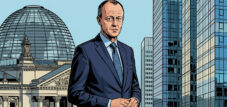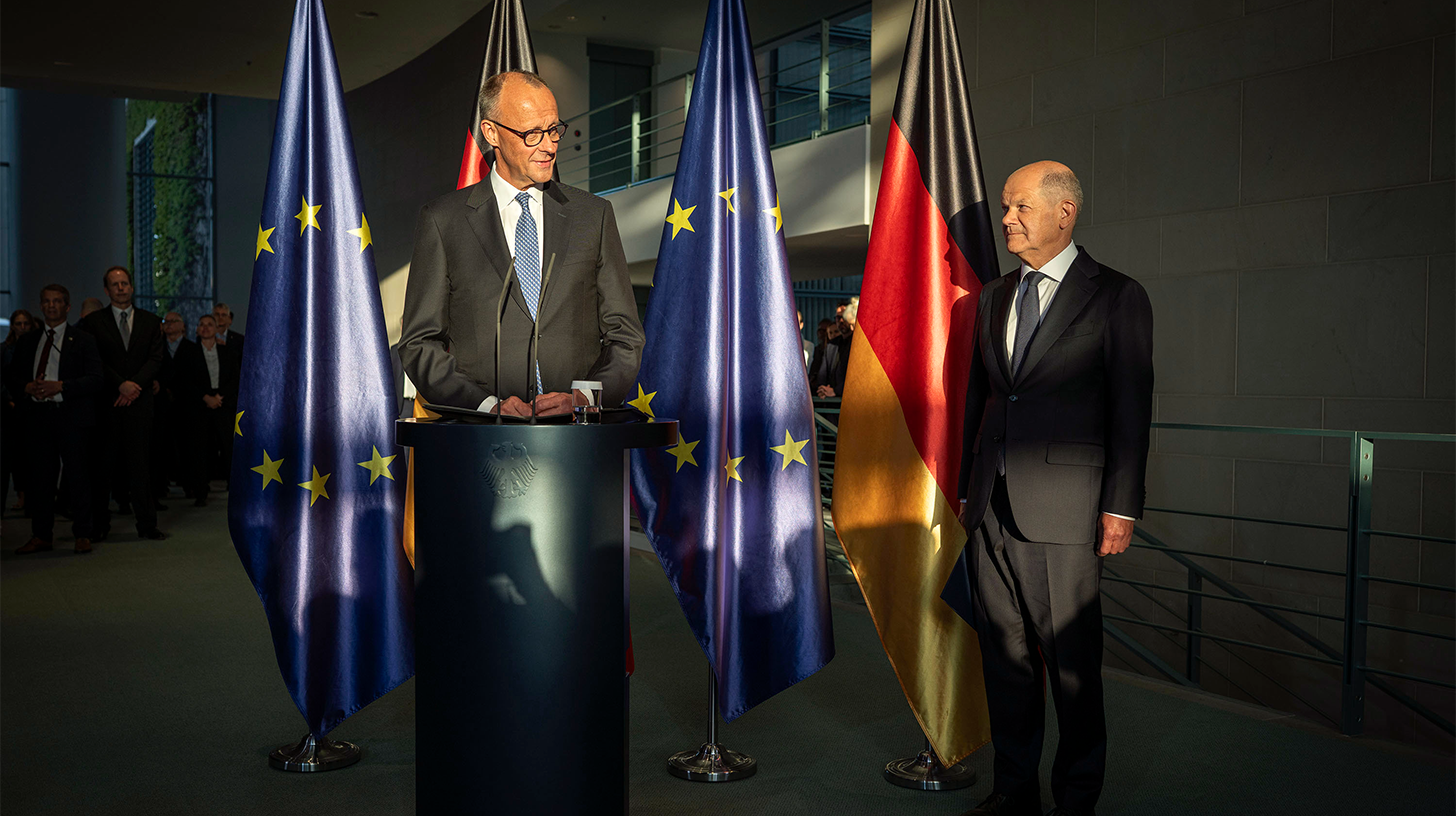
At the handover ceremony, Merz thanked his predecessor for his work: "You kept Germany on course during this time." He said that Scholz had delivered "one of the truly great government statements" by a German Chancellor after the Russian offensive in February 2022. With the term "turning point," he coined a phrase that has been adopted in many languages. Scholz also made the right decisions during the coronavirus pandemic. Chancellor Merz concluded his speech: "So, here we go. I'm looking forward to the new challenge." – Image: German Federal Government/Marvin Ibo Güngör
Chancellor Merz after 200 days: What really remained of the big promises
Interim assessment of a government caught between expectation and reality
On May 6, 2025, Friedrich Merz was elected the tenth Chancellor of the Federal Republic of Germany in the second round of voting with 325 votes. Following his historic defeat in the first round – a first in post-war German history – the black-red coalition of the CDU/CSU and SPD entered a legislative period with 328 members of parliament, a period marked by high expectations. Nearly eight months later, shortly before Christmas 2025, the assessment is mixed: substantial policy decisions stand alongside dashed hopes, and foreign policy successes contrast with domestic weaknesses.
Related to this:

Economic policy: Setting the course with delayed effects
The immediate investment program as the core element
The Merz government has launched the largest corporate tax reform in two decades with the so-called "growth booster." The package, passed by the Bundestag and Bundesrat in June 2025, comprises three key elements:
Declining balance depreciation
From July 2025 to January 2028, companies can claim up to 30 percent of the acquisition costs for new investments as a tax deduction in the first year. This exceptionally generous regulation is intended to make investments in machinery, equipment, and furnishings more attractive and to provide short-term liquidity.
Corporate tax reduction
From 2028, corporate tax will be gradually reduced from the current 15 percent to 10 percent by 2032. The total tax burden for companies will thus decrease from almost 30 percent to around 25 percent – a rate that is competitive by international standards.
Reinvestment tax rate
For self-employed individuals and partnerships, the tax rate for retained earnings will be gradually reduced from 29.8 to 25 percent.
These measures have sent initial positive signals. According to the ifo index, economic sentiment is showing a slight improvement. Chancellor Merz has repeatedly emphasized in speeches: "We are already observing an improvement in sentiment." However, experts remain cautious. The chief economist of LBBW rates the coalition agreement at 2.5 out of a possible 4 points and warns against "costly windfall gains" instead of genuine additional investments.
The 500 billion euro special fund: Historic infrastructure offensive
Arguably the most far-reaching fiscal policy decision of the Merz era is the constitutional amendment, passed in March 2025 with a two-thirds majority, to create a special fund for infrastructure and climate neutrality. With a volume of 500 billion euros over twelve years – financed by loans and exempt from the debt brake – this represents the largest investment offensive in the history of the Federal Republic.
The funds are distributed across three pillars: €300 billion for federal investments in transport infrastructure, digitalization, education, housing, and energy infrastructure; €100 billion for states and municipalities according to the Königstein Key; and an additional €100 billion for the Climate and Transformation Fund. Around €37 billion from the special fund was already disbursed in 2025, and €58 billion is earmarked for 2026.
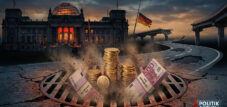
Chancellor Merz justifies this about-face in debt policy – during the election campaign he had vehemently defended the debt brake – with the changed threat landscape: "We naturally want to maintain the welfare state. But we also want to keep it functioning effectively." However, the sobering reality shows that the federal government's net new debt will rise to €143 billion in 2025, more than 3 percent of GDP, and will settle between 3.5 and 4 percent of GDP.
Energy policy: Promises and reality
The gap between announcements and implementation is particularly evident when it comes to energy costs – a key campaign issue. The government has abolished the gas storage levy and reduced network charges. Energy-intensive companies benefit from permanently reduced electricity taxes. Relief measures of approximately €10 billion have been announced for 2026.
The originally promised reduction in electricity tax for private households was scrapped by Finance Minister Lars Klingbeil – deemed "unaffordable." Jörg Dittrich, president of the German Confederation of Skilled Crafts, speaks of "massive disappointment": "It's in the coalition agreement, in the immediate action plan, and then they find out it's not financially feasible. Corrective action is needed.".
Reducing bureaucracy: More rhetoric than substance
The promise to reduce bureaucracy by 25 percent has so far remained largely unfulfilled. Specifically, the abolition of the material flow balance in agriculture (saving €18 million annually) and the repeal of the supply chain law have been implemented. However, the abolition of the receipt obligation, promised in the coalition agreement, is still pending, even though, according to trade associations, it would "cost no money.".
The German Association for Small and Medium-Sized Businesses (BVMW) has issued a "yellow card" for the first 100 days: "Germany's competitiveness continues to decline even 100 days after the government took office." Businesses are missing tangible relief from the still high energy and labor costs.
Migration policy: Significant decline with question marks
Asylum numbers are falling significantly
In migration policy, Chancellor Merz can point to the strongest successes of his term in office – at least at first glance. From January to November 2025, 106,298 initial asylum applications were submitted, a decrease of 51 percent compared to the same period of the previous year (216,861 initial applications). The total number of asylum applications (including subsequent applications) fell to 157,436.
Chancellor Merz sees this as proof that the "migration turnaround" is working: "We are already seeing the effect: Illegal migration is down by 20 percent in Europe, and by as much as 50 percent in Germany." He explicitly thanks Interior Minister Alexander Dobrindt (CSU) for his "courage in making swift decisions.".
The German government has implemented several measures: increased border controls with more than 10,000 rejections since May, the suspension of family reunification for those granted subsidiary protection, the abolition of accelerated naturalization, and the expansion of the list of safe countries of origin. An initial group of criminals has been deported to Afghanistan, and further flights "to Afghanistan and also to Syria" have been announced.
Critical assessment of the figures
However, the interpretation of these figures is controversial. Germany recorded more than 100,000 asylum seekers in 2025 for the 13th consecutive year. Furthermore, the Federal Office for Migration and Refugees points out that international factors – particularly the changed situation in Syria – have significantly contributed to the decline. Almost 16 percent of first-time applicants never even crossed the border, as these were primarily children under one year old born in Germany.
Dublin transfers remain a weak point: By the end of November, only 5,112 people had actually been transferred to other EU countries – a vanishingly small proportion compared to the total number of asylum seekers who entered via safe third countries. The Bavarian Broadcasting Corporation (BR) concludes: "Returns remain a weak point.".
A survey by the Tagesspiegel newspaper nevertheless shows that 76 percent of Germans support the government's goal of reducing the influx of asylum seekers. Public support for this course of action is therefore present – the question remains whether the measures are having a structural effect or whether the figures are primarily due to external factors.
Defense policy: A turning point in practice
Historical increase in spending
In defense policy, the Merz government is consistently continuing and even intensifying the "turning point" begun under Scholz. At the NATO summit in The Hague, it was decided to spend 3.5 percent of gross domestic product on defense and an additional 1.5 percent on infrastructure by 2029 – a total of 5 percent of GDP. This is a historic figure.
Chancellor Merz clearly states the objective: "We want to make the Bundeswehr the strongest conventional army in Europe." The motto: "We want to be able to defend ourselves so that we don't have to defend ourselves." The new amendment to the Basic Law makes it possible to exempt defense spending exceeding one percent of GDP from the debt brake.
Structural reforms
In addition to increased funding, structural improvements were initiated. The Planning and Procurement Acceleration Act is intended to shorten the notoriously slow processes in arms procurement. A National Security Council was established within the Federal Chancellery to consolidate all information and coordinate across departments in crisis situations. The "Operations Plan Germany" was developed to strengthen national and collective defense.
Defense Minister Boris Pistorius emphasizes that the Bundeswehr is "in the midst" of aligning itself with national and alliance defense. However, he cautions that the goal has not yet been achieved and that the necessary increase in equipment and personnel must be implemented quickly. A voluntary military service has been announced, but will initially be based on voluntary participation.
Social policy: Harsh cuts and expensive compromises
Pension package: Chancellor's majority narrowly achieved
Pension policy became one of the biggest domestic political tests for Chancellor Merz. On December 5, 2025, the Bundestag passed the controversial pension package with 319 votes in favor – three more than the required majority of 316. It aims to stabilize the pension level at 48 percent until 2031 and maintain it at that level beyond that. In addition, all children, regardless of their year of birth, will be credited with three pension points towards the mothers' pension.
The road to this point was fraught with difficulties. Young members of the CDU/CSU parliamentary group, particularly the Young Union, vehemently rejected the package, criticizing its "costs in the hundreds of billions." In a preliminary vote, around 15 CDU/CSU MPs voted against the proposal. Merz himself campaigned for the package at the Young Union's "Germany Day" event, but received little applause. He pointed to a comprehensive pension commission planned for mid-2027, which is intended to reform the entire old-age security system.
The pension package is accompanied by the introduction of an "active pension" from 2026, which is intended to make working longer and earning additional income in old age more attractive.
Citizen's income reform: Harsh sanctions, minimal savings
In October 2025, the coalition committee decided to transform the citizen's income into a "basic income guarantee." The reform drastically tightens sanctions: Missing an appointment at the job center results in an immediate 30 percent reduction, a second 30 percent reduction, and a third complete cessation of payments – including housing assistance.
In the future, protected assets will be tied to lifetime achievements, and waiting periods will be eliminated. Labor Minister Bärbel Bas (SPD) confidently announces: "Those who do not actively cooperate will have a difficult time. We will tighten the sanctions to the limits of constitutional law.".
Merz initially promised substantial savings. Labor Minister Bas cited the figure of 100,000 additional jobs in the labor market, which would mean "well over a billion euros in savings." However, the first draft from the Labor Ministry reveals sobering figures: "No significant savings" are to be expected. Instead, high implementation costs will arise due to the considerably more complex control and sanction procedures – critics are calling it a "bureaucratic monster.".
The social dimension is explosive. The Paritätische Wohlfahrtsverband (a German umbrella organization for social welfare associations) already determined in April 2025 that the standard benefit rate of €563 is at the subsistence level and would need to be raised to over €800 to prevent poverty. A 30 percent cut effectively means social misery. The magazine Jacobin warns that the reform is a "gift to the AfD" in the election campaign, as older workers could end up on welfare after losing their jobs or receive no support at all.
Housing construction: Ambitious plans, limited success
In the area of housing construction, the government relied on an amendment to the building code that allows municipalities to issue building permits even without a development plan – the so-called "housing construction turbo". Paragraph 246e, internally nicknamed "the crowbar", is initially intended to apply until 2027 and reduce bureaucratic hurdles.
In the first quarter of 2025, permits were issued for 55,400 new apartments – an increase of 3.4 percent compared to the same period of the previous year, with a particularly strong growth of 15.3 percent for single-family homes. Axel Gedaschko, President of the German Association of Housing Companies, is optimistic: "By 2027, around 350,000 apartments could be built per year again – and by 2029, 400,000.".
Chancellor Merz promises "record funding for social housing." In an appearance before the construction industry, he specified that the federal government will invest €23.5 billion by 2029, a figure that will increase significantly through co-financing from the states. The rent control law has been extended.
Critics, particularly the Greens, warn of a "deceptive package" and fear higher rents and construction costs as a result of the relaxed regulations. The DIW Berlin also cautions that the €500 billion special fund for infrastructure will "fizzle out" if structural reforms of municipalities and their financing are not implemented simultaneously.
Our EU and German expertise in business development, sales and marketing
Our EU and German expertise in business development, sales and marketing - Image: Xpert.Digital
Industry focus areas: B2B, digitalization (from AI to XR), mechanical engineering, logistics, renewable energies and industry
More information here:
A thematic hub offering insights and expertise:
- Knowledge platform covering global and regional economies, innovation and industry-specific trends
- A collection of analyses, insights, and background information from our key areas of focus
- A place for expertise and information on current developments in business and technology
- A hub for companies seeking information on markets, digitalization, and industry innovations
Historic collapse in polls: Why Germans no longer trust their new chancellor
AfD ahead of the CDU/CSU: Has Friedrich Merz's biggest campaign promise already failed?
Foreign policy: Germany's return as a European actor
EU leadership and support for Ukraine
Foreign policy is the area where Chancellor Merz can claim his most significant successes. "Germany is once again a reliable partner in Europe and the world," he declared after 100 days in office. Political scientist Albrecht von Lucke confirms: Despite an overall lackluster record in foreign policy, Merz has "developed into a strong force in Europe.".
Germany played a central role in the Ukraine conflict in December 2025. The Ukraine negotiations in Berlin, moderated by Merz, were considered a success. The fact that Berlin, and not Paris, became the venue for this diplomatic event signals a shift in the balance of power in Europe. "Gone are the days when such summits took place exclusively at the Élysée Palace," commented the Handelsblatt.
Merz is vehemently advocating for the use of frozen Russian state assets – amounting to over €200 billion according to the EU Commission. In a government statement in December, he emphasized that these funds would "finance the Ukrainian army for at least two more years." At the EU summit in December, an agreement was reached on €90 billion for Ukraine – a compromise that fell short of Merz's demands but is nevertheless considered a partial success.
Mercosur agreement and European capacity to act
Merz was unsuccessful in other foreign policy projects. He was unable to push through the Mercosur free trade agreement between the EU and South American states, despite months of personal lobbying with Emmanuel Macron. Even regarding the full mobilization of Russian assets, he only achieved a "bridging solution" at the EU summit.
The Handelsblatt newspaper soberly observes: "The outcome of the EU summit is good, but falls short of the expectations raised by Merz. A pattern that runs through his chancellorship." The chancellor himself attempted to frame the results positively: "Europe has grasped the gravity of the situation and has delivered a demonstration of its sovereignty.".
Historian Michael Wolffsohn nevertheless acknowledges Merz's role: "It is of paramount importance that Chancellor Merz achieved an internationally coordinated action. First in Berlin and then in Brussels." The fact that Ukraine is being helped is "significantly more important" than the question of financing.
Digitalization and state modernization: Structures created, impact uncertain
New Digital Ministry as a sign
The establishment of the Federal Ministry for Digital Affairs and Public Sector Modernization under the non-partisan manager Karsten Wildberger was an unusual step. The ministry combines strategic foresight, digital administration, IT security, and sovereign cloud solutions. According to observers, the decision to appoint a manager with no political affiliation as minister demonstrates that "for this mammoth task, Merz is relying on practical experience rather than a party career.".
In October 2025, the German Federal Cabinet adopted a "modernization agenda" with approximately 80 measures aimed at increasing efficiency, citizen engagement, and digitalization. Chancellor Merz announced: "We aspire to return to the forefront.".
In December 2025, the federal and state governments adopted the "Federal Modernization Agenda" with over 200 concrete measures. It streamlines the state, accelerates processes, and establishes uniform digital standards. Key elements include the elimination of duplicate structures, the development of a common "D-Stack" as a digital operating system, the "once-only principle" for data entry, and the EUDI wallet for ID cards on smartphones.
Merz emphasized: "The Federal Modernization Agenda is an important building block of the urgently needed state reforms." The crucial factor now is "its consistent implementation.".
The effects remain to be seen
So far, these are primarily structural policy decisions. Concrete improvements in the daily lives of citizens and businesses are not yet noticeable. The digitalization expert from basecamp summarizes: The new cabinet, "with its broadly positioned Federal Ministry of Health and Social Affairs (BMDS) and clearly expressed political will, has a good chance of bringing about a genuine boost in digitalization. The crucial factor will be whether the new competencies can also be translated into concrete progress and tangible modernization.".
Climate policy: A commitment with reservations
Commitment to climate goals, but low priority
In climate policy, Chancellor Merz is sending mixed signals. In his first policy statement, he clearly committed himself to the German, European, and international climate targets. The goal of climate neutrality by 2045 was even enshrined in the Basic Law (Germany's constitution) through the establishment of a special fund.
At the same time, Merz described wind power as a "transitional technology" that could be "dismantled one day" because wind turbines are "ugly." Instead, he is betting on nuclear fusion as the technology of the future. Climate researcher Ottmar Edenhofer from the Potsdam Institute for Climate Impact Research disagrees: Nuclear fusion will not arrive quickly enough to achieve climate neutrality by the middle of the century. Renewable energies, especially wind power, play a "crucial role.".
The monitoring report on the energy transition in December 2025 shows that the expansion of renewable energies is "on the right track," but that "considerable challenges" remain regarding security of supply, grid infrastructure, and energy efficiency. The expert commission warns: "The next ten to fifteen years will determine whether Germany becomes climate-neutral, competitive, and energy-sovereign.".
Germanwatch criticizes Merz's government statement for leaving it unclear how the goals of climate protection, industrial preservation, and competitiveness are to be achieved. "Affordable energy prices in Germany can only be achieved with renewable energies." The FDP accuses Merz of continuing Robert Habeck's subsidy policies instead of integrating renewable energies into the market.
Poll results and public perception: Lowest point after seven months
Personal satisfaction levels are at rock bottom
The public assessment of Chancellor Merz is sobering. In December 2025, only 25 percent of Germans were satisfied with his performance – while 73 percent were dissatisfied. By comparison, in June 2025, just one month after he took office, satisfaction was still at 43 percent. After 100 days in office, his approval ratings were already "far behind those of Scholz and Angela Merkel after their first 100 days.".
The infratest dimap survey for the ARD-DeutschlandTREND in August 2025 shows a "significant decline" in personal approval ratings to 32 percent (minus 10 percentage points). Only 29 percent now see him as a good crisis manager.
Union and AfD in a race
The party polls paint a worrying picture for the government. In December 2025, the CDU/CSU (24 percent) and the AfD (26 percent) were virtually neck and neck, with the AfD even leading in some polls. Merz's central campaign promise to "keep the AfD in check" has failed. The Süddeutsche Zeitung states: "The AfD has even overtaken the CDU/CSU.".
The SPD is languishing at 13-14 percent, the Greens at 11-13 percent, and the Left Party surprisingly at 10-11 percent. Politically explosive: even a renewed coalition between the CDU/CSU and SPD would no longer have a parliamentary majority in some polls.
Coalition in crisis judgment
Cooperation within the CDU/CSU-SPD coalition is rated as "(rather) poor" by 56 percent of those surveyed, while only 14 percent see it as "(rather) good". Particularly striking: Even among CDU/CSU voters, only 51 percent believe that the CDU/CSU-SPD coalition works well together; 42 percent of CDU/CSU voters and 40 percent of SPD voters rate the coalition poorly.
Sixty percent of Germans believe the government has so far passed "too few reforms." Britta Haßelmann, parliamentary leader of the Green Party, speaks of "chaos" and "lack of leadership": "Constant announcements, weeks of infighting, shaky majorities – this is not what a fresh start looks like.".
Broken campaign promises: Erosion of credibility
Debt brake and fiscal policy
The biggest broken promise is the about-face on the debt brake. During the election campaign, Merz repeatedly promised to defend the debt brake. After the election, he decided on "the biggest debt orgy of all time," as FDP state chairman Hans-Ulrich Rülke put it.
Merz himself rejects the accusation of deceiving voters: "I take the accusation seriously, but I consider it unjustified." He has not ruled out talks about amending the Basic Law. "If we do it, we must supplement the debt brake in such a way that we can then actually enable additional investments in our future – and that is what we are doing.".
More disappointed expectations
The list of broken or delayed promises is long:
- Electricity tax cut for citizens: Rejected by Finance Minister Klingbeil as "not financially feasible"
- Nuclear power return: Cancelled after the election
- Heating law and combustion engine ban: Not withdrawn despite promises
- Mothers' pension: Coming two years later than announced
- Receipt obligation: Not yet abolished despite coalition agreement
AfD leader Alice Weidel sums up the opposition: "A return to nuclear power, promised before the election, then canceled. The same applies to the abolition of the heating law and the ban on combustion engines." Weidel also accuses Merz of not keeping his promises regarding migration policy, even though the numbers are declining.
Union parliamentary group vice-chairman Thorsten Frei admits: “Politics begins with looking at reality. This reality is that the CDU and CSU are dependent on a coalition partner and therefore had to make compromises compared to their election program.”.
Internal coalition tensions: Weak leadership or the art of compromise?
Communication deficits
After just 100 days, coalition leaders admitted to communication problems. Jens Spahn, head of the CDU/CSU parliamentary group, said: "There's still room for improvement." Matthias Miersch, head of the SPD parliamentary group, added: "Aside from the core issues and shared goals, things haven't worked well in some areas. This often overshadows the substantive successes in the public perception. This urgently needs to change.".
The dispute over the pension reform package brought the coalition to the brink of collapse. There was speculation about a minority government. The Young Union and parts of the parliamentary group openly opposed the Chancellor. Merz had to repeatedly campaign for the package and received little applause for it.
Time management and priorities
Political scientist Albrecht von Lucke diagnoses Merz as "very inexperienced in handling power." The black-red coalition failed to initiate the "turnaround." A "united and determined government"—the hope after the collapse of the traffic light coalition—is "not the case.".
Merz himself speaks of an "autumn of reforms" and emphasizes: "Now things are happening very quickly." The opposition sees things differently. AfD leader Weidel and Tino Chrupalla say: "Merz has turned the promised autumn of reforms into an autumn of empty words." Left Party parliamentary group leader Reichinnek laments "unlimited investments in armaments and tax breaks for large corporations," while the situation is different when it comes to education, climate protection, and healthcare.
Economic reality: Recession and structural crisis
Economic weakness persists
Despite all the measures taken, the economic situation remains tense. Germany is threatened with a recession for the fourth year in a row. The number of corporate insolvencies remains high, and unemployment has reached the three million mark.
Experts predict only about one percent growth for 2026 – too little to solve the structural problems. Vice Chancellor Lars Klingbeil, however, remains optimistic: the billions from the debt package could finally be invested next year, and an economic recovery is in sight.
Associations are demanding more
The German Association for Small and Medium-Sized Businesses (BVMW) warns: "If Chancellor Merz doesn't keep his promises in the coalition agreement, it will create uncertainty, which will not encourage companies to invest." The association cites reducing bureaucracy and addressing the ongoing burden of high energy and labor costs as the most urgent areas for action.
The German Retail Federation (HDE) warns: "The federal government has correctly identified the pressing problems, but has not yet implemented these measures in concrete terms during these first 100 days." These measures include a reduction in electricity tax, a reduction in social security contributions, and steps against unfair competition from online platforms based in third countries.
Ambivalent balance between setting a course and ineffectiveness
After almost eight months in office, Friedrich Merz presents himself as a Chancellor of contrasts. His term in office can be categorized into four areas:
Substantial policy decisions with delayed effects
The €500 billion special fund for infrastructure, the corporate tax reform, and the defense spending are historic decisions. They create long-term potential, but their effects are not yet noticeable. The economy continues to stagnate, and economic data remains weak.
Foreign policy successes under European leadership
Under Merz, Germany has regained a more visible presence in Europe. The Ukraine negotiations in Berlin, the clear stance on Russian assets, and the positioning as a reliable partner mark a departure from the Scholz era. However, even here, successes often fall short of expectations – Mercosur failed, and the EU summit resulted only in compromises.
Domestic weakness and broken promises
The about-face on the debt brake, the lack of a reduction in electricity taxes for citizens, unfulfilled promises regarding nuclear power and heating legislation, and the high costs of pension and social policies have damaged Merz's credibility. His approval ratings are at a historic low, and the AfD is ahead of the CDU/CSU in the polls.
Questionable leadership and communication
The coalition appears divided, communicates poorly, and delivers slowly. Merz himself is described as "inexperienced in handling power." The "autumn of reforms" largely failed to materialize; 60 percent of Germans believe too few reforms have been enacted.
The Eurotopics analysis after 100 days sums it up perfectly: “Fewer migrants, more economic growth, more economical yet secure social systems, perfect infrastructure – all without new debt. The Chancellor has hardly been able or willing to deliver any of this so far.” The Süddeutsche Zeitung concludes: “There is hardly any sign of the former will to reform. Instead of cutting back the welfare state, the government is cementing an increasingly dilapidated system and, in the process, accumulating a gigantic mountain of debt.”.
Chancellor Merz himself is striking a defiant tone: "A start has been made. Germany is once again a reliable partner. We have initiated the economic turnaround and adapted the migration policy of recent years." Whether this self-assessment reflects reality, or whether it remains mere announcements without substantial effect, will become clear in the coming months. One thing is certain: the patience of citizens and businesses is waning, and the time for excuses is running out.
Your global marketing and business development partner
☑️ Our business language is English or German
☑️ NEW: Correspondence in your native language!

Konrad Wolfenstein
I and my team are happy to be available to you as your personal advisor.
You can contact me by filling out the contact form here wolfenstein@xpert.digital:or simply call me at +49 7348 4088 965. My email address is
I'm looking forward to our joint project.
☑️ SME support in strategy, consulting, planning and implementation
☑️ Creation or realignment of the digital strategy and digitization
☑️ Expansion and optimization of international sales processes
☑️ Global & Digital B2B trading platforms
☑️ Pioneer Business Development / Marketing / PR / Trade Fairs
🎯🎯🎯 Benefit from Xpert.Digital's extensive, five-fold expertise in one comprehensive service package | BD, R&D, XR, PR & Digital Visibility Optimization

Benefit from Xpert.Digital's extensive, five-fold expertise in a comprehensive service package | R&D, XR, PR & Digital Visibility Optimization - Image: Xpert.Digital
Xpert.Digital possesses in-depth knowledge across various industries. This allows us to develop tailored strategies precisely aligned with the requirements and challenges of your specific market segment. By continuously analyzing market trends and monitoring industry developments, we can act proactively and offer innovative solutions. The combination of experience and expertise generates added value and provides our clients with a decisive competitive advantage.
More information here: