Multifunctional use of foreign language AI for media such as real-time communication – Image: Xpert.Digital
🌐🔝 Foundation for international expansion: How SMEs conquer new markets with multilingualism and foreign language AI
🤖🌐 Artificial intelligence and foreign languages: A key for SMEs to global expansion
The decision to orient a small or medium-sized enterprise (SME) towards international markets is a significant strategic move. Access to new customers, expanded market presence, and the creation of new revenue streams sound promising. However, these opportunities also bring challenges that should not be underestimated. One of the biggest hurdles is the need to adapt communication and marketing to the respective national language and cultural characteristics of the target markets.
Globalization presents companies with the challenge of making their websites, product descriptions, marketing materials, and customer services multilingual. This involves not only translating texts word for word, but also localizing them—that is, adapting them to the specific cultural and linguistic characteristics of the target market. For many SMEs, this can seem like an almost insurmountable obstacle. However, thanks to advances in artificial intelligence (AI), solutions are now available that significantly ease this challenge while remaining cost-effective.
🌐 The role of artificial intelligence in language localization
The implementation of AI-powered language tools offers SMEs a way to translate their content efficiently and accurately into different languages. Modern AI systems have made enormous strides and have evolved far beyond simple translation aids. They are now able to understand nuances, recognize context, and translate content in a way that is authentic and engaging for the target market.
These systems can be used in various areas, such as translating websites, automatically generating multilingual product descriptions, or processing customer inquiries in the respective local language. Integrating such technologies allows companies to expand quickly and easily into new markets without having to tie up extensive personnel resources.
🤖 Simplicity of implementation
A key advantage of AI-based speech tools is their ease of implementation. Many of these systems are designed as plug-and-play solutions that integrate seamlessly into existing business infrastructures. This means that SMEs don't need to make large investments in new IT systems or require specialized personnel to operate the technologies.
Modern AI solutions are user-friendly and require minimal training. Many providers also offer cloud-based solutions that allow for easy scalability. This means companies can start small and expand their usage as needed and as they grow. This flexible approach significantly reduces risk and initial investment, which is particularly beneficial for smaller businesses.
💸 Cost savings and increased efficiency
Besides their ease of implementation, AI-based language tools also offer significant cost advantages. Traditionally, companies had to either build their own departments for translations and localization or hire external agencies. Both approaches are expensive and time-consuming. Furthermore, they require continuous monitoring and quality control.
AI solutions, on the other hand, can automate many of these tasks. This saves not only time but also money. Because the technologies are constantly evolving, they continuously improve and learn from mistakes, which increases the quality of translations over time. This allows companies to ensure that their content remains consistently high-quality without incurring ongoing high costs.
🔧 No maintenance required
Another key advantage of AI-powered speech solutions is their low maintenance requirements. Once implemented, they require little to no manual upkeep. The systems are capable of updating themselves and adapting to new requirements. This ensures the technology always remains state-of-the-art without requiring any additional effort from the company.
This also means that companies can react flexibly to market changes. For example, if a company wants to expand into a new market, the system can simply be extended to include the corresponding language without requiring extensive adjustments. This enables a quick and efficient response to new business opportunities.
✨ Quality and accuracy
For a long time, one of the biggest reservations about automated translations was the concern about quality and accuracy. However, the latest developments in artificial intelligence have largely alleviated these concerns. AI-based translation systems work with neural networks that are capable of processing large amounts of data and learning from examples. This allows them to correctly translate even complex sentence structures and specialized terminology.
Another highlight is these systems' ability to understand context. They don't just analyze the text itself, but also consider the entire context to produce the most precise and meaningful translation possible. The result is translations that are not only accurate, but also sound natural and fluent.
🛠️ Real-world examples
Many SMEs have already successfully implemented AI-based language solutions and are reaping the benefits. One example is a medium-sized online retailer that initially offered its products only in Germany. By implementing AI-powered translation software, the company was able to have its website and product descriptions translated quickly and cost-effectively into multiple languages. Within just a few months, the retailer was able to significantly increase its sales in new markets.
Another example is Xpert.Digital itself. Thanks to an AI-based solution, all topics of the industry hub can be published simultaneously in different languages. This enabled a rapid market entry and continues to give us a competitive advantage.
🤖 The future of AI in the field of language
Developments in artificial intelligence are progressing rapidly, and applications in the field of language are becoming increasingly sophisticated. In the future, such systems could support not only translation and localization but also the creation of content in various languages. For example, AI-powered editorial systems that automatically generate texts in multiple languages or intelligent chatbots capable of handling customer inquiries in any desired language are conceivable.
For SMEs, this means they will continue to have access to high-performance, cost-effective, and easy-to-implement solutions to advance their internationalization strategies. This will further lower the barriers to entering new markets while increasing the chances of global success.
🌍 Multilingualism and localization
The use of artificial intelligence to support multilingualism and localization is a valuable opportunity for small and medium-sized enterprises (SMEs) to realize their international ambitions. Easy implementation, significant cost savings, and low maintenance make AI-based language solutions an attractive option for businesses of all sizes. These technologies allow SMEs to expand their reach while ensuring their messages are accurate and authentic in every market. The future looks promising, and those who familiarize themselves with these technologies early on will have a competitive edge in tomorrow's globalized economy.
📣 Similar topics
- 🤖 Artificial Intelligence: The Key to Global Expansion
- 🌐 Grow internationally with ease
- 💡 AI-based language tools for SMEs
- 📈 Opening up new markets through multilingualism
- 🌍 Global expansion made easy
- 🚀 Efficient market adaptation with AI
- 🔊 Engaging communication worldwide
- 🤖 Automated translations for SMEs
- 💬 Cultural adaptation made easy
- 📉 Cost reduction through AI-based solutions
#️⃣ Hashtags: #ArtificialIntelligence #Multilingualism #GlobalExpansion #SMEs #Internationalization
🌍 Business: The power of language in customer loyalty
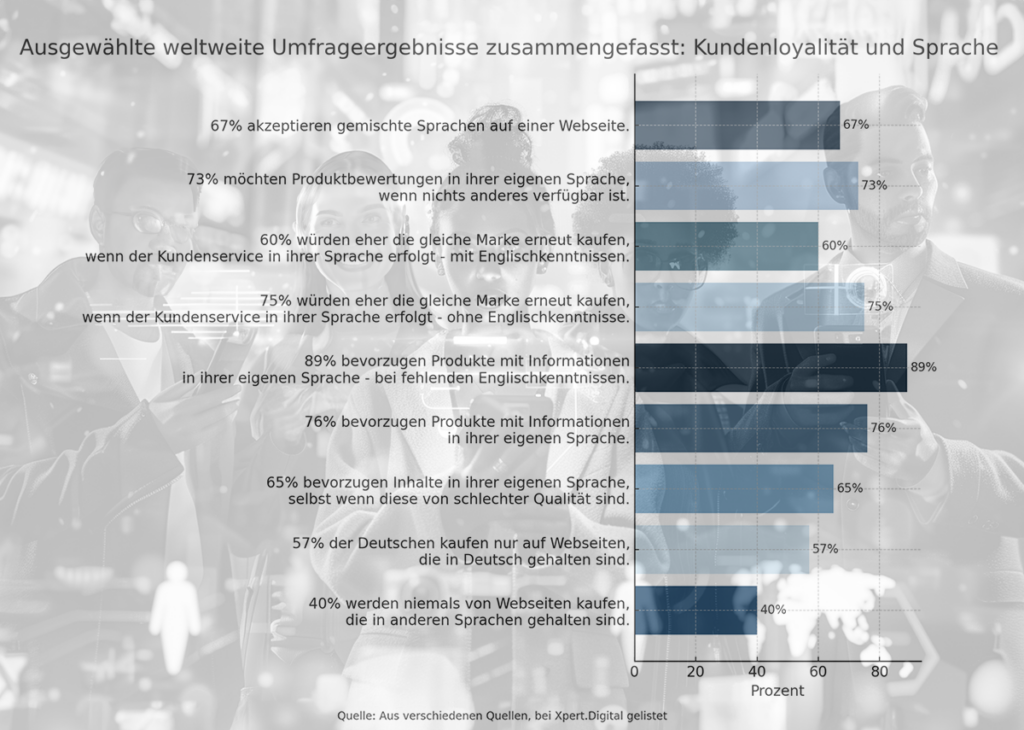
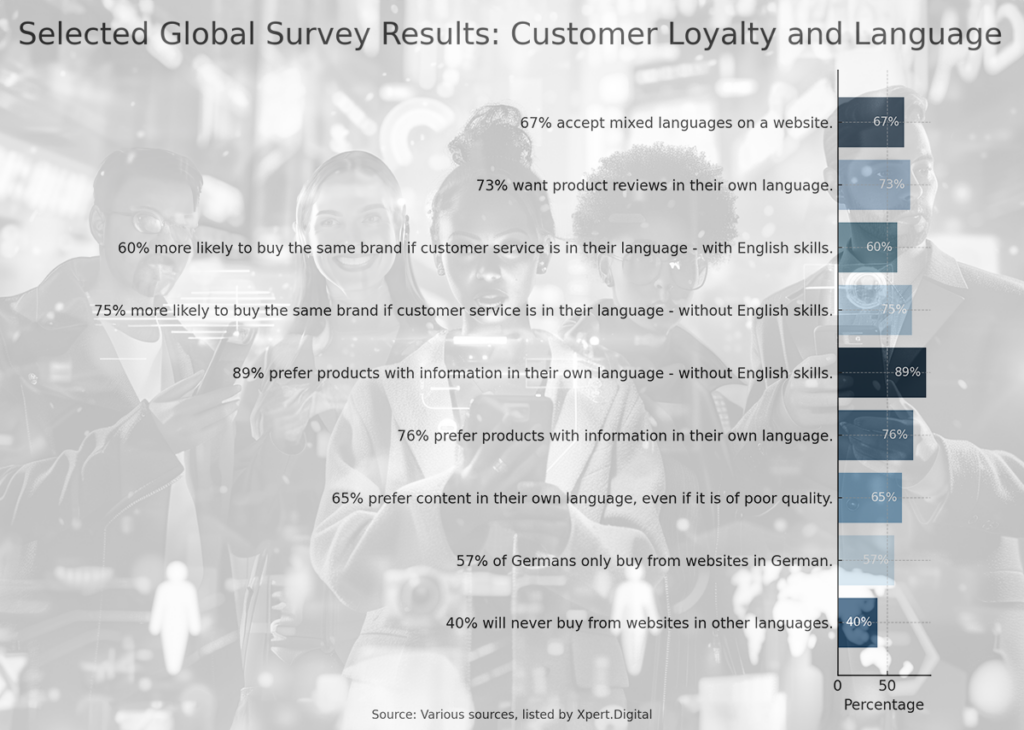
The figures that emerge in the discussion about customer loyalty and language impressively illustrate how strongly language influences the decisions and preferences of consumers.
More information here:
🔄📈 B2B trading platform support – Strategic planning and support for export and the global economy with Xpert.Digital 💡


B2B trading platforms - Strategic planning and support with Xpert.Digital - Image: Xpert.Digital
Business-to-business (B2B) trading platforms have become a critical component of global trade dynamics and thus a driving force for exports and global economic development. These platforms offer significant advantages to companies of all sizes, especially SMEs—small and medium-sized enterprises—which are often considered the backbone of the German economy. In a world where digital technologies are increasingly prominent, the ability to adapt and integrate is crucial for success in global competition.
More information here:
🧩🚀 Foreign Language AI – Artificial Intelligence in the world of languages on Xpert.Digital – Currently available for over 18 languages worldwide

Foreign Language AI – Artificial Intelligence in the World of Languages on Xpert.Digital – Image: Xpert.Digital
Developments in the fields of AI and machine translation exemplify the profound transformation that technology can bring about in our daily lives and professional activities. It is a rapidly advancing field, driven by human curiosity and the desire to improve understanding and exchange across linguistic and cultural boundaries. In this dynamic research area, technological innovations, linguistic understanding, and intercultural competence combine to create tools that enrich and simplify our lives in a globally interconnected world.
More information here:
[/lightweight-accordion]
🗝️🌱📈 Multilingualism as a strategic priority: A key to growth and sustainability
🚀🌱 Multilingual skills
In today's globalized world, multilingualism has become of central importance. It is far more than just the ability to speak several languages; it is a strategic priority, a key driver of growth, and an indispensable factor for sustainability in businesses and societies. This text examines the diverse benefits of multilingualism and demonstrates how it can serve as an engine for sustainable growth in various contexts.
🌐 Multilingualism as a strategic priority
In a globally networked economy, the ability to communicate in multiple languages has become a strategic priority for companies. Organizations that foster multilingual teams and structures can not only strengthen their competitiveness in international markets but also increase their innovative capacity. Multilingualism makes it possible to bridge cultural differences and better respond to the needs and expectations of customers in different regions.
A company that considers multilingualism as part of its strategic direction opens itself up to new markets and target groups. It can adapt its products and services to different cultural contexts and thus appeal to a broader customer base. This leads not only to increased sales but also to stronger customer loyalty and satisfaction.
🚀 Growth driver: Multilingualism
Multilingualism directly impacts a company's growth. In an increasingly globalized market environment, companies with linguistic and cultural diversity can respond more quickly and effectively to international expansion opportunities. The ability to communicate in multiple languages significantly facilitates business operations in new markets. It enables a better understanding of local market conditions, compliance with legal requirements, and the development of a successful market entry strategy.
Furthermore, multilingualism fosters internal collaboration and knowledge sharing within a company. Teams capable of working in multiple languages can collaborate more effectively and develop innovative solutions. This linguistic diversity leads to a broader perspective and a deeper understanding of global trends and developments, which in turn strengthens the company's innovative capacity.
Multilingualism is not only a tool for accessing new markets, but also a key factor in attracting talent. In a globalized job market, companies are increasingly seeking employees who are multilingual and possess cultural competence. These skills are crucial for success in a multicultural work environment and for positioning the company in international competition.
🌍 Sustainability through multilingualism
In addition to its economic advantages, multilingualism also contributes to social and environmental sustainability. Companies that promote multilingualism make an important contribution to preserving and fostering linguistic diversity. This is a crucial aspect of cultural sustainability, as languages are an essential part of the cultural heritage and identity of communities.
By promoting multilingualism, companies can help support linguistic minorities and preserve their cultural traditions. This is especially important in regions where languages are threatened with extinction. Companies that actively contribute to the preservation and promotion of languages send a strong signal of social responsibility and cultural diversity.
Furthermore, multilingualism enables better communication and collaboration in international projects aimed at environmental sustainability. In global initiatives to combat climate change or promote sustainable development, the ability to communicate across linguistic and cultural boundaries is crucial. Multilingual teams can work together more effectively and ensure that projects meet the needs and expectations of the communities involved.
🎓 Challenges and opportunities of multilingualism
Despite the numerous advantages of multilingualism, companies and societies face certain challenges when creating a multilingual environment. One of the biggest challenges is establishing an inclusive work culture where all languages and cultures are respected and promoted. This requires targeted training and programs to raise awareness of the importance of multilingualism and develop intercultural competence.
Another challenge lies in meeting the technical and logistical requirements associated with supporting multiple languages. This can include, for example, providing multilingual documents, websites, and communication tools. Companies must ensure that their employees have access to the necessary resources and tools to work effectively in a multilingual environment.
Nevertheless, the opportunities offered by multilingualism far outweigh the challenges. Companies that proactively address the promotion of multilingualism can not only increase their global competitiveness but also make a positive contribution to social and environmental sustainability.
💼 Multilingualism as an integral part of the corporate strategy
In a world where cultural and linguistic diversity is becoming increasingly important, multilingualism should be considered an integral part of corporate strategy. It is not only a means of improving internal and external communication, but also a key to fostering innovation, growth, and sustainability.
Companies that recognize the importance of multilingualism and actively invest in its promotion will be more successful in the long run. They will be able to tap into new markets, attract and retain talent, and at the same time make a positive contribution to the global community.
The importance of multilingualism will continue to grow in the future as the world becomes increasingly interconnected and the demand for multicultural and multilingual skills increases. It is up to companies to capitalize on this development and consider multilingualism a strategic priority that not only offers short-term benefits but also leads to sustainable growth and success in the long run.
🌟 Using multilingualism as an opportunity
Multilingualism is far more than just a linguistic skill; it is a strategic tool that can help companies position themselves successfully in a globalized world. It contributes to overcoming cultural barriers, fostering innovation, and ensuring sustainable growth. Companies that recognize and actively promote the advantages of multilingualism will be able to increase their competitiveness while simultaneously making a positive contribution to the global community.
Multilingualism is therefore not only a strategic priority, but also a key driver of growth and sustainability. Companies should seize this opportunity to strengthen their global presence, attract talent, and achieve long-term success. In an increasingly interconnected world, the ability to communicate in multiple languages is becoming a crucial success factor for companies that want to thrive in a dynamic and competitive environment.
📣 Similar topics
- 🌍 Multilingualism as a key to global success
- 🚀 Linguistic diversity as a growth driver
- ♻️ Multilingualism for sustainable development
- 🧩 Multiculturalism as a strategic priority
- ✨ Opportunities and challenges of multilingualism
- 🌐 Language skills and entrepreneurial success
- 📊 Multilingualism in international competition
- 🏆 Multilingualism and talent acquisition
- 🌱 Cultural diversity and corporate strategy
- 💡 Innovation through multilingualism
#️⃣ Hashtags: #Multilingualism #Sustainability #Growth #Innovation #CulturalDiversity
We are here for you - Consulting - Planning - Implementation - Project Management
☑️ SME support in strategy, consulting, planning and implementation
☑️ Creation or realignment of the digital strategy and digitization
☑️ Expansion and optimization of international sales processes
☑️ Global & Digital B2B trading platforms
☑️ Pioneer Business Development

Konrad Wolfenstein
I would be happy to serve as your personal advisor.
You can contact me by filling out the contact form below or simply call me on +49 7348 4088 965 .
I'm looking forward to our joint project.
Write to me


Xpert.Digital - Konrad Wolfenstein
Xpert.Digital is a hub for industry focusing on digitalization, mechanical engineering, logistics/intralogistics and photovoltaics.
With our 360° Business Development solution, we support renowned companies from new business to after-sales.
Market intelligence, smarketing, marketing automation, content development, PR, mail campaigns, personalized social media and lead nurturing are part of our digital tools.
You can find more information at: www.xpert.digital - www.xpert.solar - www.xpert.plus
Keep in touch