
Lufthansa Flight VR | Virtual Reality on its way to the mainstream: The importance of extended reality on Lufthansa flights – Creative image: Xpert.Digital
4,000 users convinced: Virtual Reality conquers the skies
From niche to mainstream: Meta Quest 3 VR tested on long-haul flights
The deployment of MetaQuest 3 on Lufthansa's long-haul flights represents a significant step in the commercial use of virtual reality technology. With nearly 4,000 passengers already using this technology, the question arises: Does this development mark the transition of VR from a niche product to a mainstream medium?
Related to this:


The Lufthansa meta-partnership: A milestone for VR
The collaboration between Lufthansa and Meta represents a significant development in the field of in-flight entertainment. As part of a pilot program, Lufthansa is equipping selected flights with Meta Quest 3 headsets, which are made available to passengers in the Allegris Business Class Suite. The offering includes various entertainment options such as movies on virtual screens, virtual tours of new destinations, interactive games like Connect Four and chess, as well as meditation exercises for relaxation.
Remarkably, the user statistics are already very promising: Almost 4,000 travelers have used the service so far, and according to Bjoern Becker, Program Lead Future Intercontinental Experience at the Lufthansa Group, the feedback has been consistently positive. This high acceptance rate indicates a growing willingness to use VR technology in everyday situations.
The collaboration with Cupra is particularly innovative, resulting in the first in-flight test drive app. Passengers can virtually configure the Cupra Tavascan electric car and take a test drive through the streets of Barcelona. For this service, Lufthansa, Meta, and the developer MSM.Digital received the APEX Award 2025 for best in-flight entertainment.
Technological developments as enablers
A key factor that made the use of VR on flights possible is the development of "Travel Mode" for MetaQuest 2 and Quest 3. This experimental feature, available since 2024, specifically adapts the algorithms to the movements of an aircraft. This technological adjustment ensures a stable VR experience – even when the user is looking out of the aircraft window.
The Travel Mode is currently optimized only for airplanes, but Meta plans to extend support to other modes of transport such as trains. It's worth noting that this feature wasn't developed exclusively for the Lufthansa partnership, but is available to all Quest 2 and Quest 3 owners in the Experimental Features menu. This demonstrates Meta's strategy of promoting VR use in everyday situations and thereby reaching a wider user base.
Historical perspective: VR in aviation
This current development is not the first attempt to establish VR in aviation. As early as 2015, the Australian airline Qantas tested the use of Samsung Gear VR for first-class passengers. Other airlines such as Air France, Iberia, British Airways, and Singapore Airlines also experimented with VR headset pilot programs, all of which were subsequently discontinued.
Lufthansa itself has a long history with virtual reality. As early as 2014, the company integrated VR into various business processes and released a VR app for Google Cardboard in 2017. The use of VR in pilot training has been particularly successful, where the technology is used to prepare for cross-country flights and has demonstrably led to a 15% performance increase among student pilots.
The crucial difference to previous VR applications in aviation lies in the advanced technology of the Meta Quest 3, which offers not only pure VR but also mixed reality, as well as in the special adaptation to the movements of the aircraft through the Travel Mode.
Related to this:

Market development and future prospects
Current market trends indicate exponential growth in the VR sector. The VR market was valued at USD 16.32 billion in 2024 and is projected to grow from USD 20.83 billion in 2025 to an impressive USD 123.06 billion by 2032, with an expected compound annual growth rate (CAGR) of 28.9%.
Meta plans to expand the service to other airlines and routes in the near future. The success of the partnership with Lufthansa serves as a blueprint for future collaborations in the field of immersive in-flight entertainment.
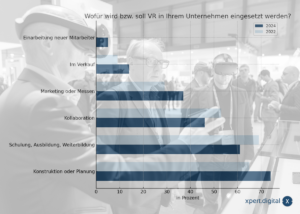
Beyond aviation, VR is being used in various industries, including training, engineering, maintenance, marketing, design, and simulations. This versatility is further evidence of the growing mainstream acceptance of VR technology.
Virtual Reality above the clouds: Lufthansa shows the future
The use of VR headsets on Lufthansa flights indicates increasing acceptance of the technology, albeit with limitations. It should be noted that the service is currently limited to business class, which does not reflect typical mainstream usage.
Nevertheless, several factors point towards the mainstream:
- The positive response from almost 4,000 passengers to Lufthansa's VR offering
- The projected market growth will reach over USD 123 billion by 2032
- The continuous development of the technology with specific adaptations for different usage scenarios
- The expansion of applications beyond pure entertainment to include training, education, and professional applications
From niche to trend: VR with Meta Quest 3 on Lufthansa flights
The deployment of MetaQuest 3 on Lufthansa flights represents a significant milestone for VR in the mainstream, albeit with some limitations. The high number of users and the positive feedback indicate increasing acceptance of the technology. Continuous technological advancements, projected market growth, and diverse applications support the thesis that VR is on its way to transitioning from a niche product to a mainstream medium.
Although we cannot yet speak of full mainstream adoption, this development clearly shows a trend in that direction. The spread of VR in an everyday context like air travel marks an important step on this path and could, in retrospect, be considered one of the defining moments in the history of virtual reality.
Related to this:
Your global marketing and business development partner
☑️ Our business language is English or German
☑️ NEW: Correspondence in your native language!

Konrad Wolfenstein
I and my team are happy to be available to you as your personal advisor.
You can contact me by filling out the contact form here wolfenstein@xpert.digital:or simply call me at +49 7348 4088 965. My email address is
I'm looking forward to our joint project.