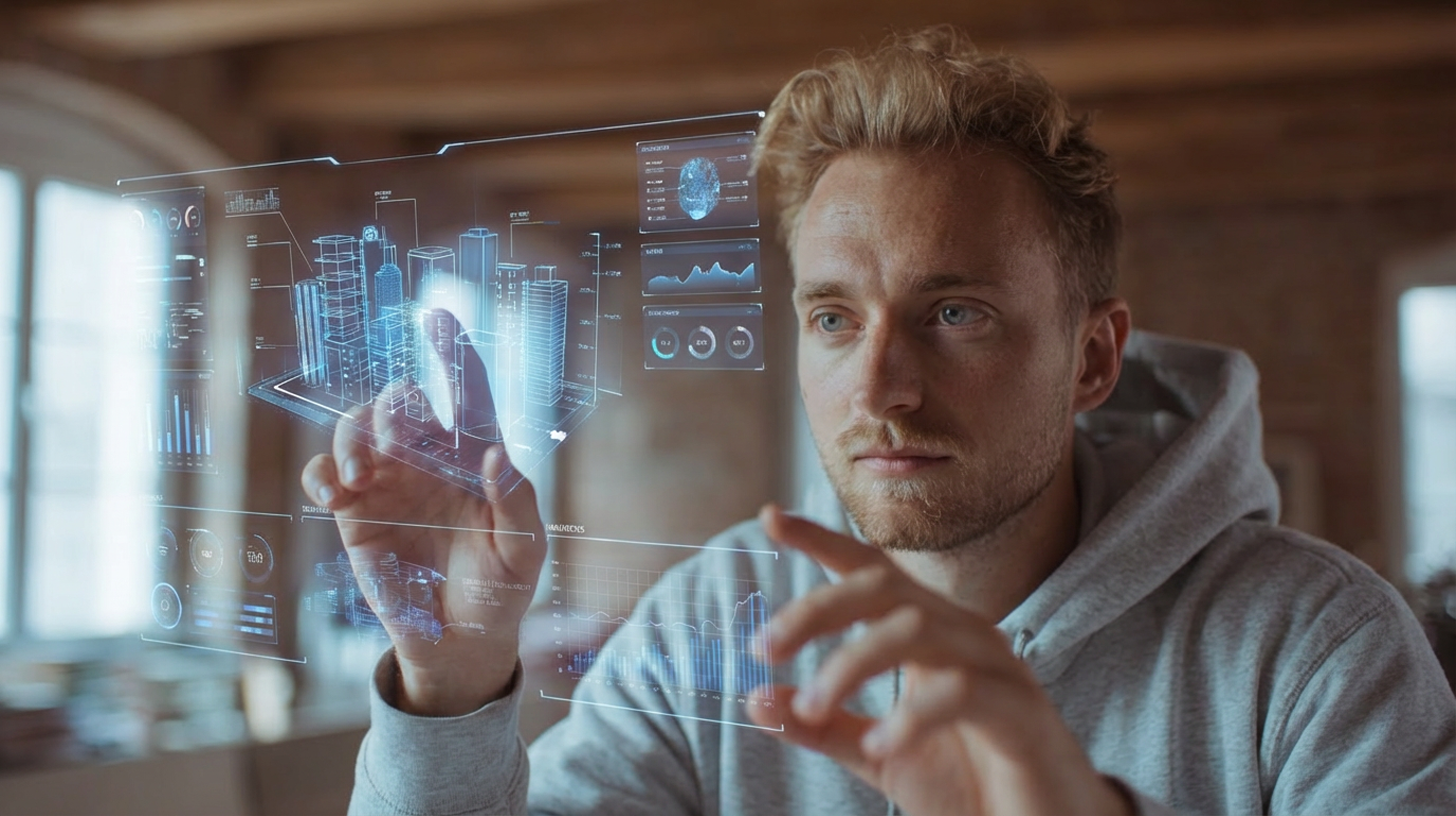
“EyeReal” display: AI technology makes 3D glasses obsolete – How China plans to crack the third dimension with standard hardware – Creative image: Xpert.Digital
Beyond the hype: A critical analysis of the “EyeReal” display revolution
The end of the flat world: Researchers solve the biggest problem in display history
Do you remember the hype surrounding 3D televisions in the early 2010s? It was the post-Avatar era, when the industry promised to bring the cinematic experience into our living rooms. But the revolution never materialized. Bulky glasses, headaches, and a lack of content quickly caused the technology to fade into obscurity. Since then, 3D in the home entertainment sector has been considered dead land—or at best, a niche market for VR headsets, which, however, isolate the user from their surroundings.
But now a publication by renowned Chinese research institutions, including Fudan University, in the journal "Nature" a stir. Their approach, called "EyeReal," promises nothing less than squaring the circle: a holographic-looking, crystal-clear 3D experience that works entirely without glasses (autostereoscopic) and without exotic, unaffordable special lenses.
Is this the long-awaited "iPhone moment" for our screens?
This analysis looks behind the scenes of the article's publication in "Nature." We not only examine how artificial intelligence and standard hardware are being used to push the boundaries of physics, but also ask the crucial economic questions: Does the model make financial sense if the costs are shifted from manufacturing to electricity consumption? Can this technology compete with Apple's "spatial computing"? And are we ready for a future where our monitor requires more computing power than our computer?
The end of the flat world: How AI is democratizing the third dimension
Or: Why the screen as we know it is facing its biggest disruption since color.
In the history of consumer electronics, few technologies have been declared dead so often, yet have returned so stubbornly, as the 3D display. From the anaglyph red-green glasses of the 1950s to the failed 3D TV hype of the early 2010s, the barrier has always been the same: the necessity of wearing glasses and the physiological strain on the user. The recent publication in Nature by the Chinese research team from Fudan University and the Shanghai AI Laboratory potentially marks an economic and technological turning point—a so-called "iPhone moment" for spatial representation.
The paradigm shift: "New technology makes 3D glasses obsolete"
The economic significance of "EyeReal" lies not primarily in the display of 3D content itself, but in the radical reduction of the marginal costs of immersion. Previous autostereoscopic systems (i.e., glasses-free 3D) were characterized by extremely high hardware requirements (CAPEX). Systems like the Sony Spatial Reality Display use expensive, microscopically manufactured lenticular lenses on the panel to refract light. These lenses must be physically laminated perfectly onto the pixel matrix – a highly complex manufacturing step that reduces the yield rate in the factory and massively increases the final price.
The approach described here reverses this logic: Instead of expensive specialized optics, "commodity hardware" is used – that is, commercially available components. The intelligence of the system moves from the physical lens to the algorithm. The system uses standard LCD panel stacks (often three superimposed layers in research prototypes) to modulate the light field purely optically and digitally.
The underlying economic principle is the substitution of hardware with compute. Instead of investing in expensive production lines for specialized lenses, the load is shifted to the GPU (graphics processing unit) and AI models. Since the cost of computing power (according to Moore's Law or Huang's Law in the AI age) tends to fall faster than the cost of precise optical manufacturing, this approach is deflationary in the long run. It enables scaling into the mass market, something that remained impossible for purely physical lens systems.
The AI calculates an individual image for each eye (view synthesis) and optimizes the light field to eliminate interference patterns (moiré effects) and ghosting (the overlapping of images for the left and right eye). This happens in real time at 50 Hz, which requires enormous computing power but drastically reduces the physical barrier to the end user.
Previously limited options: Historical legacies and overcoming the "space bandwidth" dilemma
To understand the significance of this innovation, one must consider the fundamental economic problem of previous 3D displays: the so-called "Space Bandwidth Product" (SBP). In display economics, bandwidth (number of pixels) is a scarce resource.
With classic automultiscopic displays (like the Nintendo 3DS or early Philips prototypes), the screen's available resolution is divided into different viewing angles by lenses. A 4K monitor intended to display 10 perspectives simultaneously effectively offers only a fraction of the resolution per perspective. The result has been an economically unattractive trade-off: either one accepts a pixelated image (low utility) or one needs extremely expensive 8K or 16K panels (high price) to achieve acceptable sharpness. Furthermore, the "sweet spot"—the area in which the 3D effect works—was extremely narrow. If the user moved just a few centimeters to the side, the image would break down.
Holographic approaches, often referred to as the "holy grail," fail economically due to scalability issues. True holography requires light modulators with pixel sizes in the nanometer range (comparable to the wavelength of light). Such displays can be manufactured in the lab at postage stamp size, but the cost of a desktop-sized monitor would run into the millions. No industrial process exists that can economically produce this pixel density on large surfaces ("yield").
The Chinese research group circumvents this SBP dilemma through dynamic optimization. Instead of calculating the light field for all possible positions in space simultaneously (which wastes 99% of computing power since no one is sitting there), the system tracks the eyes and generates only the light field that is precisely needed at that location. From an economic perspective, this represents a 10- to 100-fold increase in the efficiency of the resource "light information." The system delivers "just-in-time" pixels instead of "just-in-case" pixels.
🗒️ Xpert.Digital: A pioneer in the field of Extended and Augmented Reality

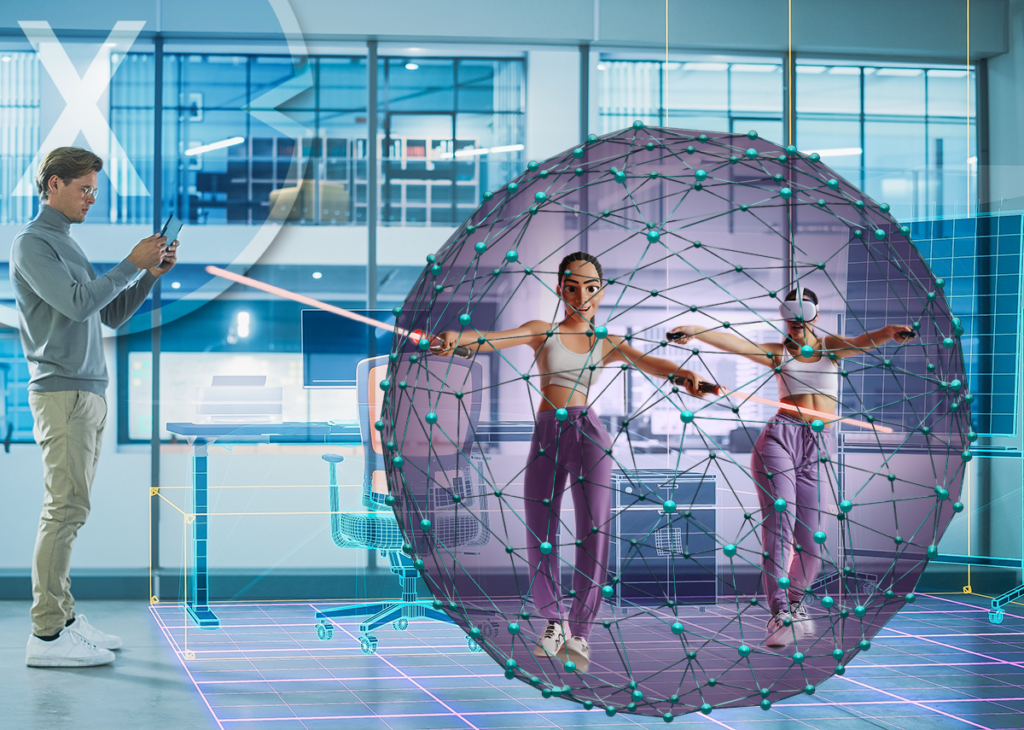
Finding the right Metaverse agency, planning office, or consulting firm - Image: Xpert.Digital
🗒️ Finding the right Metaverse agency, planning office, or consulting firm – Search and search: Top Ten Tips for Consulting & Planning
More information here:
Energy consumption vs. innovation: Does EyeReal have a future despite the brightness trap?
No special hardware required: Decoupling specialized manufacturing
The statement "no special hardware" needs to be considered more carefully. A more accurate statement would be: "No exotic manufacturing technology." As described in the Nature study, the system often uses stacks of commercially available LCD panels. These panels are mass-produced and available at rock-bottom prices in China (the world's leading manufacturer of LCDs).
The economic implications are enormous: The barrier to entry for display manufacturers is decreasing. Companies like BOE or TCL no longer need to build new factories to glue lenses onto glass. They can use existing production lines and simply assemble the panels in a new housing ("stacking"). The value creation component shifts drastically from the hardware component (panel) to the software component (AI algorithm and drivers).
Eye tracking is now a commodity. Simple webcams and efficient neural networks can determine head positions in milliseconds. A viewing angle of over 100° is crucial for the product's social acceptance. Earlier displays forced users into a rigid posture (the "head-in-a-vis" effect). A 100° angle allows for natural movement at the desk.
This opens up the market for professional applications beyond pure entertainment:
1. Medicine: Surgeons can view CT scans in three dimensions without having to wear sterile glasses.
2. CAD/Design: Engineers can see components three-dimensionally, which reduces the error rate when interpreting 2D plans as 3D objects (cost savings in prototyping).
3. Remote Work: Video conferences with true depth ("telepresence") could reduce cognitive fatigue ("zoom fatigue"), as the brain processes spatial signals more naturally than flat images.
The hidden costs: energy, compute, and the brightness trap
Despite the euphoria, an objective analysis cannot ignore the negative externalities and hidden costs. While the "EyeReal" approach is cheaper to purchase in terms of hardware, it shifts the costs to operation (OPEX).
First: Energy inefficiency.
When multiple LCD panels are stacked, as in many of these research setups, their light transmission increases significantly. A standard LCD often only transmits 5–10% of the backlight light (due to polarizing filters, color filters, and the liquid crystal matrix). Stacking three such panels reduces transmission to parts per thousand. To still produce a bright image, the backlight must shine at extremely high intensity. This leads to massively increased power consumption and considerable heat generation. An “EyeReal” monitor could consume many times the energy of an OLED screen during operation. In an era of rising energy prices and stringent EU ecodesign regulations, this is a significant market barrier.
Secondly: The "hidden compute tax."
The promise of a "standard monitor" conceals the fact that the source device (the PC) must be anything but standard. To render two perspectives in Full HD at 50Hz while simultaneously running an AI model for real-time light field optimization, a powerful dedicated graphics card (GPU) is required (comparable to an NVIDIA RTX 4070 or higher). While the monitor itself may be inexpensive, the total cost of ownership increases significantly due to the necessary workstation. This currently limits the market to prosumers and B2B customers; the average laptop user is left out until these AI models can be calculated more efficiently using dedicated NPUs (Neural Processing Units).
Market strategy classification: Clash of ecosystems
We are in the midst of a battle for dominance in spatial computing. On one side are headset manufacturers (Apple with the Vision Pro, Meta with the Quest) who focus on total immersion through isolation ("face computing"). On the other side are technologies like EyeReal, which enable social immersion without wearables.
From an economic perspective, the screen-based approach has a decisive advantage: low friction costs. Putting on a headset is a conscious action, often perceived as bothersome. A screen is simply "there." If the technology works as seamlessly as described, it could establish itself as the standard for desktop workstations, while headsets remain niche products for VR gaming or highly specialized simulations.
China is positioning itself strategically with this research. While the US (Silicon Valley) dominates the headset market and its operating systems, China is targeting the evolution of display hardware – a sector in which the country already holds a hegemonic position thanks to its manufacturing capabilities. Should this technology prevail, it would cement China's transformation from the "world's workshop" to the "innovation leader in display technology."
Energy consumption vs. computing power: Why EyeReal is the future of displays despite bottlenecks
“EyeReal” is more than a technical curiosity; it is proof of the power of computational photography applied to displays. By replacing physical complexity with algorithmic intelligence, the marginal cost of 3D rendering theoretically drops to the level of a standard monitor plus a powerful chip.
The risks remain, however: the high energy consumption due to the light absorption of the panel stacks and the insatiable demand for computing power are the new bottlenecks. But from an economic perspective, these problems are solvable (chips are becoming more efficient, LEDs brighter), while the physical limitations of lenses and holograms are static. We are probably not on the verge of an immediate revolution in the living room, but rather a renaissance of depth in the professional workplace. The dream of the holodeck is moving a step closer – not through new physics, but through improved mathematics.
Your global marketing and business development partner
☑️ Our business language is English or German
☑️ NEW: Correspondence in your native language!

Konrad Wolfenstein
I and my team are happy to be available to you as your personal advisor.
You can contact me by filling out the contact form here wolfenstein@xpert.digital:or simply call me at +49 7348 4088 965. My email address is
I'm looking forward to our joint project.
☑️ SME support in strategy, consulting, planning and implementation
☑️ Creation or realignment of the digital strategy and digitization
☑️ Expansion and optimization of international sales processes
☑️ Global & Digital B2B trading platforms
☑️ Pioneer Business Development / Marketing / PR / Trade Fairs
🎯🎯🎯 Benefit from Xpert.Digital's extensive, five-fold expertise in one comprehensive service package | BD, R&D, XR, PR & Digital Visibility Optimization

Benefit from Xpert.Digital's extensive, five-fold expertise in a comprehensive service package | R&D, XR, PR & Digital Visibility Optimization - Image: Xpert.Digital
Xpert.Digital possesses in-depth knowledge across various industries. This allows us to develop tailored strategies precisely aligned with the requirements and challenges of your specific market segment. By continuously analyzing market trends and monitoring industry developments, we can act proactively and offer innovative solutions. The combination of experience and expertise generates added value and provides our clients with a decisive competitive advantage.
More information here: