


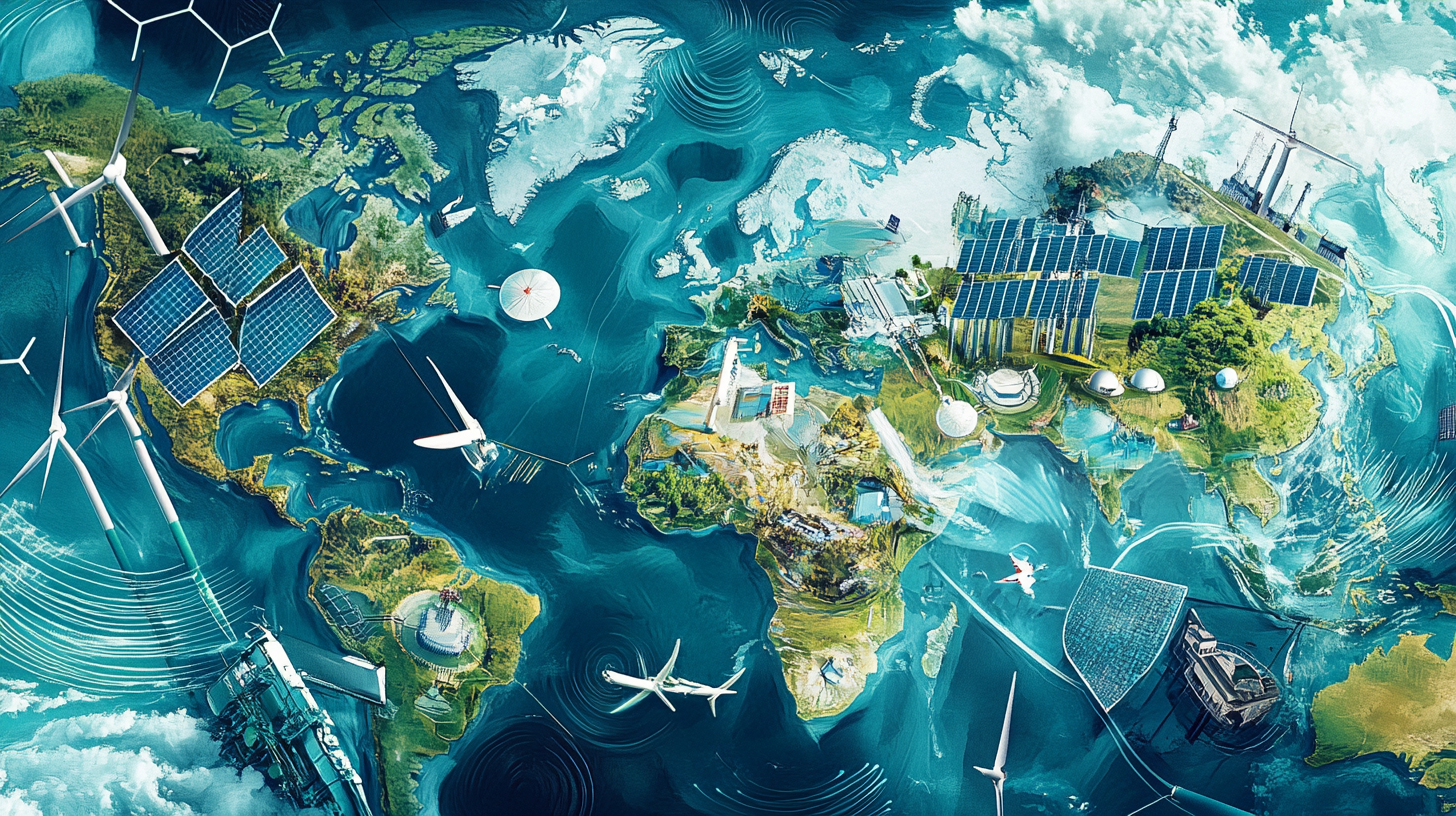
China, USA, Europe & Co. – How differently industrialized nations are driving the expansion of renewable energies worldwide – Image: Xpert.Digital
Energy transition in a global comparison: Why some countries are pulling ahead in the expansion of renewable energies - A background analysis
Renewable energies worldwide: A comprehensive look at successes, strategies and challenges
The share of renewable energies in the global energy and electricity mix has been steadily increasing for years and has become a key issue for many countries in curbing climate change, reducing dependence on fossil fuels, and ensuring a stable long-term energy supply. This comprehensive study examines in detail the developments, strategies, and goals of various countries regarding the expansion of renewable energies. The focus is on China, the USA, Japan, and Europe, with a specific analysis of individual European countries such as Germany, France, Spain, and Italy. Furthermore, key factors responsible for the significant differences in the shares of renewable energies are explained in detail, and an outlook on future prospects is provided. This text aims not only to trace current developments but also to illustrate the challenges and opportunities associated with the expansion of renewable energies.
This analysis is based on generally accepted facts and trends, without citing specific sources or footnotes. The aim is to provide a clear and coherent presentation that also raises awareness of the complexity of the global transition to renewable energies. The electricity sector is not the only factor considered. Aspects of the heating and transportation sectors, technological advances in areas such as green hydrogen and storage technologies, as well as political, economic, and social frameworks are also taken into account.
Related to this:
Fundamentals and Methodology
A meaningful examination of the topic of renewable energies generally begins with thorough data collection and a comparison of country- or region-specific indicators. For example, the percentage share of renewable energies in the overall energy or electricity mix is often analyzed to quantify the progress of individual countries. It is important to distinguish between different aspects: Gross electricity generation, gross electricity consumption, and total energy consumption (i.e., not only electricity but also heat and fuels) can each have varying proportions. Furthermore, countries that achieve a high share of renewable energy in their electricity mix may still be more reliant on fossil fuels in the transport or heating sectors.
In specific countries where hydropower traditionally plays a major role, the share of renewable energies in the electricity mix can be above average. Conversely, countries with extensive nuclear power capacity may have a lower overall CO₂ balance in the electricity sector, but also less incentive to massively expand wind or solar energy as long as nuclear power plants remain largely online. A country's geographical advantages also play a role, such as regions with high levels of sunshine or strong, consistent winds. "We are at a turning point where geopolitical interests, climate protection, and economic development converge," is a common refrain in political reports emphasizing the rapid transformation of the energy sector.
This comprehensive analysis summarizes the key findings for a global comparison of renewable energies. It is followed by country-specific insights that reveal where trendsetters and laggards stand in the global race for a clean energy future.
China and its role as a pioneer
In recent years, China has become a world leader in the expansion of renewable energies. This is partly due to the enormous demand for energy driven by the country's strong economic growth and industrialization. "China is investing in green technologies like almost no other country," Chinese government officials often state when summarizing the national investment programs for wind and solar energy. The expansion is proceeding at an impressively rapid pace and on a scale that is unparalleled worldwide.
Wind and solar power are central to China's energy strategy. China now boasts the largest installed capacity for both technologies and is also massively expanding its hydropower capacity. This is driven by the desire to reduce coal consumption, which has contributed significantly to air pollution in major cities like Beijing, Shanghai, and Guangzhou over the past decades. Although the extraction and combustion of fossil fuels still account for a large portion of China's energy supply, the share of renewable energies in the country's electricity generation has steadily increased.
In addition to electricity generation, the country has set ambitious goals to advance renewable energies in other sectors. Projects for the integration of green hydrogen are in the planning stages to decarbonize industrial processes and, in the long term, even parts of the transportation sector. At the same time, China is expanding its production capacities for solar cells and wind turbines so significantly that it can not only meet its own needs but also assume a leading position in global trade. The government is pursuing a clear course: "Our aim is to make China the global hub for climate-friendly innovations." This official statement reveals the dual benefit for China: reducing its own emissions and seizing economic opportunities in the growing international market for renewable energies.
Is the USA on its way to becoming a green energy nation?
Historically, the United States is one of the leading industrial nations, whose energy production was long heavily reliant on oil, natural gas, and coal. In recent years, however, a noticeable structural shift has taken place: individual states such as California, Texas, Iowa, and New York are making targeted efforts to expand wind and solar energy and have, in some cases, enacted ambitious regulatory laws. While fossil fuels still play a significant role in the national electricity mix, the share of renewable sources has steadily increased. The landscape in some regions is visibly changing, for example, due to extensive wind farms in Texas or the growing number of solar installations in California's desert regions and on city rooftops.
However, with the new US president, it is uncertain whether this trend will continue unabated. Observers point out that a change in strategy in the White House could slow down or even halt the progress made so far in the field of renewable energies. While the stated intention has been to promote research and development to modernize the energy sector and make the highly fragmented and outdated power grid fit for variable renewable energy sources, future government policy could be more focused on conservative energy sources and immediate economic interests, thus hindering rather than advancing new projects.
Energy storage plays a crucial role in the transformation: it is intended to compensate for fluctuations in wind and solar power generation, thereby stabilizing the grid. Furthermore, hydrogen is increasingly coming into focus as a key technology. "Green hydrogen" offers a way to make emission-free electricity usable in sectors that have previously relied heavily on fossil fuels, thus reducing CO₂ emissions. However, it remains to be seen to what extent this potential can be fully realized under the new leadership in the White House.
Many municipalities, states, and companies are likely to continue down the current path, precisely because they anticipate long-term competitive advantages from renewable energies. However, it remains to be seen whether all federal programs will be available to the same extent in the future and whether tax incentives or subsidies will continue to support the large-scale transformation. Thus, despite all the progress made so far, the development of the American energy market appears to be under renewed scrutiny.
Related to this:
Japan: Between renewable energies and nuclear power
Following the Fukushima nuclear disaster in 2011, Japan was compelled to make fundamental changes to its energy policy. Public skepticism towards nuclear power grew significantly, while at the same time the safety of existing reactors was reviewed and some were shut down. "The Fukushima disaster has heightened our awareness of alternative energies," was a frequently expressed guiding principle in the following years. In practice, the country has now seen a significant boost in solar and wind power projects, supported by government incentive programs.
Nevertheless, Japan has not completely phased out nuclear power. Instead, it is striving to achieve a more balanced energy mix. Renewable energy sources are to be significantly expanded, while a certain number of nuclear power plants will remain in operation to mitigate concerns about energy shortages and potential import dependencies. Technological advances in solar energy are considerable in Japan, as the country boasts a highly developed industry that manufactures and continuously improves high-performance photovoltaic (PV) systems. At the same time, the motto is: "Every kilowatt of energy efficiency saves us fossil fuels and emissions." Accordingly, in addition to expanding renewable energy sources, the Japanese government is also pushing for strict benchmarks for energy efficiency in industry and commerce.
The complexity of Japanese energy policy is evident in the simultaneous efforts to integrate renewable energies into a widely fragmented, islanded grid. Unlike large, contiguous countries, Japan has numerous individual power grids, some of which have historically differing structures. New concepts for grid stability, energy storage, and load management are therefore critical for the safe integration of high solar and wind power outputs.
Europe: A continent in the energy transition
For many years, Europe has played a pioneering role in expanding renewable energies and implementing binding climate targets. The European Union has formulated the political goal of gradually increasing the share of renewable energies and promotes common strategies, standards, and support mechanisms for its member states. "We want to be a climate leader and create the framework to achieve climate neutrality by 2050," is a goal often heard in EU documents.
However, the differences within Europe are considerable. Some countries rely heavily on hydropower, others on wind or solar. The role of nuclear energy also varies: France, for example, generates a large portion of its electricity from nuclear power, while countries like Germany are beginning to gradually phase out this technology. The share of renewable energies is steadily increasing on average across the continent, but is still far from replacing all fossil fuels. Furthermore, there is still a long way to go before a largely decarbonized heating and transportation infrastructure is achieved.
The EU is constantly working on new guidelines to, for example, accelerate permitting processes for solar and wind farms and to set specific expansion targets for member states. Key components also include emissions trading and CO₂ pricing, which are intended to make fossil fuels more expensive and thus help renewable energies become more competitive.
Germany: Pioneer and engine of innovation
Germany is often the best-known example of a comprehensive energy transition in Europe. Since the introduction of the Renewable Energy Sources Act (EEG), wind power, solar energy, and biomass have been massively expanded. "The EEG triggered a revolution in the energy sector," was a common narrative in political debates during the 2000s and 2010s. At the same time, Germany repeatedly increased its expansion targets and remained undeterred by setbacks and debates surrounding subsidy costs. This expansion in Germany has fostered a rapid pace of innovation: never before have there been so many engineering and research activities in the field of renewable energy technologies as since the beginning of the energy transition.
Significant portions of Germany's electricity mix now come from renewable sources. A growing number of photovoltaic systems adorn rooftops, fields, and even former industrial sites. Onshore and offshore wind farms generate large quantities of clean electricity, particularly in the north and east of the country. However, the question of grid infrastructure remains crucial: since wind is strongest along the coast, while the greatest electricity demand lies in the more southerly, industrialized regions, the grid needs to be reinforced in the south.
New technologies and sectors are increasingly coming into focus: "We need a massive expansion in the transport and heating sectors as well, otherwise we won't achieve the climate targets," say some German environmental organizations. Furthermore, the role of green hydrogen as a storage and transport medium is highly valued. The project to produce hydrogen through electrolysis using renewable electricity and distribute it via pipelines or by blending it into the natural gas network could, in the medium term, lead to significant emission reductions in industry, shipping, heavy goods transport, and other sectors.
France: Nuclear energy versus renewables
France has traditionally been characterized by a strong reliance on nuclear power in its energy mix. Most of the country's nuclear power plants were built in the 1970s and 1980s to strengthen national energy independence. Today, France is striving not to abandon this path entirely, but to integrate more renewable energy sources. "We believe that nuclear power and renewable energies go hand in hand," according to summaries from French energy authorities.
The share of renewable energy in France's electricity mix has increased in recent years, with hydropower contributing a significant portion thanks to the country's geography. Solar and wind power have also gained importance. At the same time, extensive programs are being developed to promote the energy-efficient renovation of buildings, thereby reducing heating demand and phasing out fossil fuels. France aims to consistently advance the expansion of renewable energy by 2030, while always maintaining nuclear power as a stabilizing resource.
One of the reasons for this strategy lies in the favorable CO₂ balance of nuclear power, even though it is controversial whether the risks and costs of long-term operation of aging reactors are proportionate. Politically, public support for this issue is far higher in France than, for example, in Germany or Austria, due to the country's long history of nuclear power. Nevertheless, the French government is working to build large wind and solar farms and reduce bureaucratic hurdles to their expansion.
Spain: Sun, wind and ambitious goals
Spain is among the pioneers of solar energy in Europe, primarily due to its excellent climate. "We have one of the largest solar energy potentials in Europe, and we want to make the best possible use of it," emphasize Spanish energy authorities. At the same time, large wind farms have been built in recent years, especially in regions with high wind speeds. As a result, Spain has a high share of renewable energy in its electricity generation compared to other European countries.
In addition to electricity production, the country is increasingly focusing on the heating sector. Heat pumps and solar thermal systems are being used more extensively, particularly for hot water and heating support in residential buildings. In the transport sector, plans for the coming years include major investments in electromobility, rail, and bus infrastructure. Beyond this sector coupling, Spain is pursuing strategic energy efficiency plans to reduce overall per capita energy consumption.
In its action plans, the Spanish government frequently emphasizes the importance of a socially responsible transformation: "The energy transition must leave no one behind." Therefore, when expanding renewable energies, care is taken to stimulate economic activity in structurally weak regions, create jobs in manufacturing and assembly, and build regional value chains.
Italy: Diverse forms of renewable energy
Italy has been relying on hydropower for years and has numerous power plants in the Alpine north and other mountainous regions that cover part of the national electricity supply. Wind and solar power are also playing an increasingly important role: solar installations are being used more extensively in the sunny south and on the islands, while wind turbines are being deployed in mountain ranges and along the coast. "Our country has extraordinary potential in all forms of renewable energy," Italian energy policymakers regularly emphasize.
In addition to these well-known forms of energy, Italy has further priorities such as geothermal energy. In some regions of the country, particularly in Tuscany, subsurface heat from volcanically active zones is being harnessed for electricity generation and heating. Furthermore, initial projects are testing tidal or wave energy off the Italian coast. Italy is also investing in energy-efficient building renovation programs and offers incentives to households that invest in solar panels, heat pumps, or other efficient systems. This is creating a diverse portfolio of renewable energy sources, which aims to reduce fossil fuel consumption and increase energy security in the long term.
Factors that explain differences between countries
The aforementioned differences in the share of renewable energies and the speed of their expansion can be attributed to various variables. A key factor is geographical conditions. Countries with reliable and strong winds, abundant sunshine, or large hydropower potential naturally benefit from lower costs and simpler project implementation. Other factors are political in nature: governments that define ambitious support models, feed-in tariffs, or strict regulations for fossil fuels create an environment in which renewable sources can grow more rapidly.
Economic conditions are also significant: If countries can build a strong export economy around renewable technologies – for example, through the production of wind turbines, solar panels, or battery storage systems – this creates an additional driver for expansion. "The market for green technologies is growing rapidly, and we want to consolidate our role in it," is a common refrain in countries trying to position themselves as a new industrial nation for cleaner energy. Public acceptance should also not be underestimated. Protests against onshore wind turbines or solar installations on large agricultural areas can significantly delay progress in certain regions.
Technological innovations also play a crucial role: batteries, pumped-storage power plants, hydrogen electrolyzers, and other storage technologies are constantly being developed, making renewable energies more flexible in their application. Furthermore, the transport and heating sectors in many countries still rely on fossil fuels. Only when electricity from renewable sources is made available to these sectors can the energy transition truly succeed. "We must link all sectors together so that the energy transition evolves from individual measures into a network of smart solutions," is a frequently heard appeal from experts who advocate for an integrated approach.
National and regional goals
Many countries have set official expansion targets for renewable energies, which are regularly updated over time. China, for example, aims to steadily increase the share of renewable energies in its electricity mix and replace a large portion of its fossil fuel capacity by mid-century. The USA has similar ambitions and relies heavily on incentives, such as tax breaks and subsidies, to make the green transition more attractive. Japan focuses on a balance between expanding renewable energy sources and maintaining a smaller number of nuclear power plants to guarantee security of supply.
In Europe, member states have committed themselves, as part of the EU climate strategy, to achieving a significantly higher share of renewable energies by 2030. Some countries, such as Austria and Denmark, are so ambitious in their national policies that they are aiming for a share of almost 100 percent in the electricity sector. Germany has defined various intermediate steps to achieve annually increasing expansion targets, while France is focusing on a combination of renewable energies and modern nuclear power. Spain and Italy are closely linking their expansion plans with energy efficiency measures in order to simultaneously reduce energy consumption and promote the transition to e-mobility.
All these goals are closely linked to climate policy. "We must not lose sight of climate change," is a common refrain, as the expansion of renewable energies is a key means of reducing greenhouse gas emissions. Many countries now enshrine this priority in their national energy and climate plans to define the path to a climate-neutral economy over several decades.
Increasing importance of new technologies
An exciting development in the context of renewable energies is the growing importance of innovations that go beyond wind and solar power. Green hydrogen, produced from renewable electricity via electrolysis, can serve as a long-term replacement for fossil fuels, especially in sectors that are difficult to electrify. Examples include heavy transport, shipping, and certain industrial processes. The appeal of this technology lies in the fact that hydrogen can be stored, transported, and, in the future, used in fuel cells, thus achieving a significant decoupling from location-specific production sites.
In parallel, new storage systems such as large-scale batteries offer an opportunity to balance peak production in wind and solar power. This allows for the mitigation of load surges in the grid and the bridging of periods of low wind and solar output. Storage capacity plays a crucial role, particularly in regions with fluctuating power generation. Some countries are also investing in research into alternative technologies such as tidal, wave, or osmotic power plants, which are currently only being used in pilot projects. "The next generation of clean energy sources is already waiting to be developed," proclaim research institutes that receive subsidies for their projects.
Many countries lack a suitable network infrastructure.
Despite the overall positive development, challenges remain. Many countries lack a suitable grid infrastructure to ensure the transport of large amounts of renewable electricity between regions. Planning and permitting new transmission lines often encounters public acceptance issues. Many citizens fear visual intrusions on the landscape or are concerned about environmental consequences. Financial costs also remain a concern: While prices for solar panels and wind turbines have tended to fall, expansion remains capital-intensive. Support mechanisms are often needed to finance these investments, which in turn leads to debates about electricity prices and social justice.
At the international level, the geopolitical situation should not be underestimated. While the rapid expansion of renewable energies can reduce dependence on oil and gas imports, it also creates new dependencies, for example, on raw materials such as lithium, cobalt, and rare earth elements, which are essential for battery and solar technologies. "The energy transition requires a new perspective on global supply chains," warn ministries of economics and trade, which are urging strategic partnerships and recycling concepts. At the same time, the shift to clean energy sources creates potential for economic growth, technological innovation, and new jobs, particularly in skilled trades, research, and manufacturing.
The global trend towards renewable energies is unmistakable.
China, Japan, and Europe – all are investing heavily in wind power, solar energy, and other renewable technologies. The differences in the actual share achieved are sometimes considerable, due to geographical, political, economic, and social factors. While China is demonstrating with gigantic projects how quickly an industrialized nation can advance the expansion of renewable energies, the USA is increasingly relying on a combination of tax incentives, research, and the entrepreneurial pioneering spirit of individual states. Japan is attempting to find a balance between renewable energies and the judicious use of nuclear power in order to manage the consequences of the Fukushima disaster without jeopardizing security of supply. In Europe, member states are developing common goals and strategies, but are pursuing their own paths due to their differing starting points. Germany is known for its determined expansion of wind and solar energy, France is sticking with nuclear power while simultaneously integrating more renewables, Spain benefits from abundant sunshine and wind, and Italy from its geographical diversity and potential geothermal energy.
Everywhere, the expansion of renewable energies is linked to ambitious climate protection goals and far-reaching plans for the future. Grid modernization, storage technologies, green hydrogen, and more efficient electricity applications in transport and heating are just a few examples of how the sectors can be more closely integrated. At the same time, ensuring social acceptance and political stability is crucial. Acceptance issues, cost debates, supply chain bottlenecks, and the question of securing baseload capability through flexible reserve capacities are concerns for almost all nations striving for a comprehensive transformation of their energy systems.
Nevertheless, the shift in momentum towards renewable technologies is palpable. "There's no going back to the old energy system," say industry experts, who emphasize the increasing competitiveness of green energy. It's a fact that in many regions, the pure generation costs for wind and solar power are already competitive. Future innovations will further contribute to developing even more cost-effective, efficient, and intelligent solutions.
International cooperation plays a central role. Since climate change knows no borders, the exchange of experience regarding political frameworks, technical concepts, and forms of public participation is invaluable. Last but not least, global events such as geopolitical tensions demonstrate that energy security is a crucial factor for the stability of entire economies and societies. Renewable energies can enable long-term independence and predictable cost structures, provided the necessary infrastructure – from power lines to hydrogen pipelines – is rapidly implemented.
In conclusion, it can be stated that all the countries and regions studied aim to benefit from a growing share of renewable energies. The strategies pursued are diverse, adapted to national conditions, and result in varying expansion rates. The understanding that fossil fuels are finite and harmful to the climate is a common denominator that is increasingly unifying energy policies. Numerous forecasts predict that this trend will only intensify in the coming decades. New, groundbreaking technologies, investment initiatives in green infrastructure, and political measures for greater climate protection will, in combination, accelerate progress.
This brings this discussion to a close. In summary, we see a world undergoing an energy transition: China is advancing its economic and technological influence in the field of renewable energies, the USA is focusing on innovation and federal dynamism, Japan is managing the balancing act between nuclear power and alternative energies, and Europe is promoting a collective transformation with different national priorities. It remains an exciting challenge to see how these individual developments will coalesce into a sustainable and globally balanced energy system. But one thing seems certain: Renewable energies will continue to gain importance and will fundamentally change the way we generate and consume energy worldwide.
Related to this:
- Surprise? Where heat pumps are in demand: Top 10 including China and the USA – These countries are driving the heat pump market forward
- Is 2% economic growth acceptable? At what point does the economy start to "boom"? A comparison between the USA, China, the EU, Japan, South Korea, India, and others.