GenAI: Market researchers and experts predict that 30% of generative AI projects will be abandoned by the end of 2025 – Image: Xpert.Digital
🚀 Challenges and potential of GenAI projects from a business perspective
The challenges and potential of generative AI (GenAI) projects from a business perspective. The key message is that approximately 30% of GenAI projects could be discontinued by the end of 2025, primarily due to poor data quality, inadequate risk controls, rising costs, and unclear business value.
🚀🌐 Expectations and hurdles in GenAI projects
Market researchers and experts predict that at least 30% of generative AI projects will fail by the end of 2025. These projects are under immense pressure to deliver measurable success, as executives who reacted to last year's hype are growing increasingly impatient. Despite the enthusiasm for GenAI, many organizations are struggling to realize the anticipated value of this technology. As Rita Sallam of Gartner notes, "After last year's hype, executives are impatient to see returns on GenAI investments, but organizations are struggling to prove and realize the value. As the scale of initiatives expands, the financial burdens of developing and implementing GenAI models are becoming increasingly apparent."
💰⚖️ The cost-benefit question
One of the biggest challenges in implementing GenAI is justifying the substantial investment required. These investments are often difficult to translate directly into financial benefits, making it challenging for organizations to clearly determine the return on investment (ROI). Many companies are using GenAI to fundamentally transform their business models and unlock new business opportunities. However, these transformation processes are costly, ranging from $5 million to $20 million.
The cost structure of GenAI projects varies considerably depending on the use case and strategic approach. Rita Sallam emphasizes: "Unfortunately, there's no one-size-fits-all solution for GenAI, and costs aren't as predictable as with other technologies." Companies must decide whether to focus on disruptive market innovations or prefer a more conservative approach of improving existing processes. Both approaches have different impacts on costs, risk, variability, and strategic outcomes.
🛡️📊 Investment strategy and risk assessment
Regardless of the chosen strategy, research shows that GenAI requires a long-term mindset. Organizations investing in GenAI often need more patience, as financial returns are not immediately apparent. Historically, many CFOs have been hesitant to make investments today to generate indirect value in the future. This reluctance can lead to prioritizing short-term tactical results over long-term strategic goals, potentially undermining an organization's long-term innovative capacity.
❓💡 Is investing in GenAI even worthwhile?
This is a question many companies are asking themselves, as they are cautious given the high costs and risks. Nevertheless, there are encouraging reports from early adopters across various industries. According to a survey of 822 business leaders conducted between September and November 2023, respondents reported an average revenue increase of 15.8%, cost savings of 15.2%, and a productivity increase of 22.6% through the use of GenAI. However, these results are highly dependent on specific use cases, employee skills, and organizational structure.

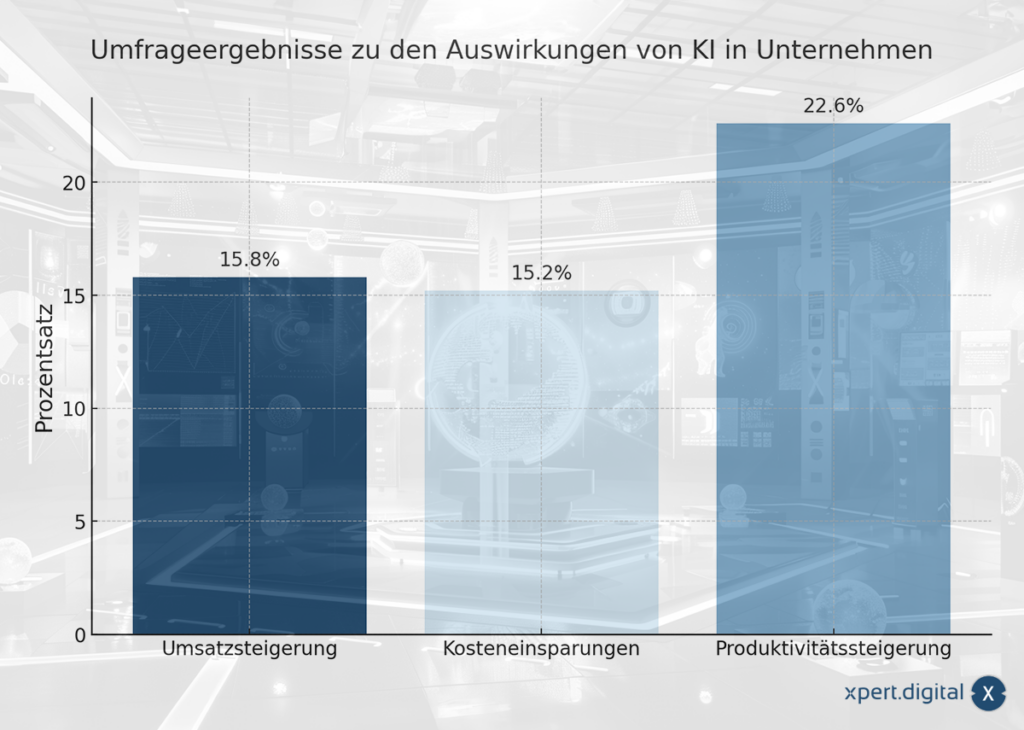
Survey results on the impact of AI in companies – Image: Xpert.Digital
“This data serves as valuable reference points for assessing the business value resulting from GenAI business model innovation,” explains Sallam. However, estimating the precise business value remains a challenge, as the benefits are often company-, role-, and application-specific and do not manifest immediately. This time lag can diminish the perceived benefits, although the long-term potential remains.
📈📝 Business impact and ROI calculation
A key aspect for companies integrating GenAI into their business models is accurately calculating the business impact and future value potential. Analyzing total costs and expected ROI is crucial for making informed decisions about further investments. "If business results meet or exceed expectations, this offers the opportunity to expand investments by scaling GenAI innovations and usage to a broader user base or implementing them in additional business areas," explains Sallam.
However, should the results fall short of expectations, organizations may need to consider alternative innovation scenarios. This requires a strategic realignment and a careful allocation of resources to determine the best path forward.
⚖️🎯 The balance between opportunities and risks
Investing in generative AI presents both significant opportunities and considerable risks. Success hinges on an organization's ability to recognize the long-term business value and align it with the initial investment costs. While technological advancements are progressing rapidly, the challenge remains of translating this progress into sustainable financial success. Organizations that are prepared to invest in the future while developing flexible and adaptable strategies have the best chance of benefiting from GenAI.
📣 Similar topics
- 📣 GenAI: Challenge and potential for companies
- 📊 Investment costs and ROI: Is GenAI worthwhile?
- 📉 The reality behind the GenAI hype: Data quality as a stumbling block
- 📈 Strategic planning for long-term GenAI success
- 🛡️ Risk management in GenAI projects: A must
- 💡 Insights and lessons learned from early GenAI users
- ⚠️ Data quality and cost control: GenAI pitfalls
- 🚀 GenAI Innovation Strategies: Maximizing Opportunities, Minimizing Risks
- 🔍 Business value of GenAI: A complicated calculation
- 🏆 GenAI Projects: From Initial Investments to Long-Term Success
#️⃣ Hashtags: #GenAI #DataQuality #ROI #Investment #BusinessValue
Our recommendation: 🌍 Limitless reach 🔗 Connected 🌐 Multilingual 💪 Sales power: 💡 Authentic with strategy 🚀 Innovation meets 🧠 Intuition

From local to global: SMEs conquer the world market with a clever strategy - Image: Xpert.Digital
In an era where a company's digital presence determines its success, the challenge lies in creating an authentic, personalized, and far-reaching presence. Xpert.Digital offers an innovative solution that positions itself as the intersection of an industry hub, a blog, and a brand ambassador. It combines the advantages of communication and sales channels in a single platform and enables publication in 18 different languages. Cooperation with partner portals and the ability to publish articles on Google News and a press distribution list with approximately 8,000 journalists and readers maximize the reach and visibility of the content. This represents a crucial factor in external sales and marketing (SMarketing).
More information here:
🌟 Microsoft's success strategy in enterprise AI
🔍 Analyses and growth figures from Microsoft 365 Copilot
Microsoft has established itself as the biggest beneficiary of investments in enterprise AI. In particular, its product Microsoft 365 Copilot, an AI-powered tool to support Office applications, is enjoying increasing popularity and adoption. Compared to the previous quarter, Microsoft saw an impressive increase of over 60% in Microsoft 365 Copilot customers, while the number of daily active users even doubled. These remarkable growth rates are a strong indicator of the reliability and added value the tool offers its users. Further evidence of its success is the fact that the majority of companies that have implemented Microsoft 365 Copilot are expanding their licensing agreements and purchasing additional seats for their employees. This not only demonstrates companies' confidence in the technology but also the increasing reliance on AI-powered solutions in the modern workplace.
📉 Influences on market and budget allocation
Interestingly, current market observations indicate that the growing AI budgets are partly coming at the expense of investments in hardware and, to a lesser extent, software. Nevertheless, a significant portion of AI spending can be considered an additional investment, highlighting the potential for further growth in this sector.
🌍 Future prospects for global AI investments
The outlook for future global AI spending is promising. S&P Global forecasts that global investments in AI will increase at an average annual growth rate of over 20% through 2028. This would mean that AI spending would account for 14% of total global IT spending by 2028, compared to just 6% in 2023. This anticipated growth is a clear indicator of the increasing importance of AI technologies in corporate strategy and IT infrastructure.
However, it is noted that growth rates will not be uniform. Much of the investment is concentrated in the hands of a relatively small number of companies, particularly hyperscale data center operators who, due to their enormous computing capacity and global reach, are able to implement AI solutions at scale. This concentration of spending, however, also carries risks, especially for small and medium-sized enterprises (SMEs), which may struggle to keep pace in this rapidly evolving market.
🔄 Dynamics and challenges of new AI models
Another interesting aspect is the dynamic created by the rapid development of new AI models and products. Companies often face the challenge of making decisions in a rapidly changing landscape, which in many cases leads to a kind of "decision paralysis." This uncertainty is exacerbated by the lack of proven reference architectures and clear use cases, causing many companies to delay their AI projects. However, S&P Global anticipates that this period of uncertainty will not last. From 2025 onward, a significant number of AI projects are expected to be implemented, which could provide a further boost to the market.
🏢 Impact on business decisions
Many companies understandably have concerns about implementing AI projects. The technology is evolving so rapidly that it's difficult to keep up with the latest developments. Furthermore, there's the risk of investing in a solution that might quickly become obsolete. This uncertainty can lead companies to hesitate before making significant investments in AI until they are certain that their chosen technology is sustainable in the long term.
Nevertheless, current trends show that companies that invest in AI early and implement corresponding projects can gain a significant competitive advantage. The opportunity to increase operational efficiencies, automate processes, and unlock new business opportunities through the use of AI is a strong argument for early adoption of the technology.
⚙️ Impact of AI on the world of work
Another point that cannot be overlooked is the impact of AI on the world of work. While some industries are already heavily affected by automation and AI, many other sectors are still at the beginning of this development. Companies must prepare for the fact that AI will not only change the way they work, but also which skills and competencies will be in demand in the future. Building AI expertise and integrating AI into corporate strategy will be crucial for remaining competitive in the changing world of work.
💼 Microsoft's pioneering role
With its Microsoft 365 Copilot product, Microsoft has taken a significant step toward the future, establishing itself as a pioneer in enterprise AI. The increasing number of users and high customer loyalty attest to the product's quality and value. At the same time, S&P Global's forecast indicates that global spending on AI will continue to rise sharply, despite the challenges along the way. Companies that embrace AI early on could reap substantial long-term benefits, while others may fall behind. It will be exciting to see how the market develops in the coming years and what new innovations the future holds.
📣 Similar topics
- 🔍 Microsoft's breakthrough in enterprise AI
- 🚀 Microsoft 365 Copilot: The new Office hero
- 📊 Success figures of the Microsoft 365 Copilot
- 🔧 Companies expand AI licenses
- 💰 Growing budgets for AI investments
- 🌍 Global AI Growth Forecasts
- ⚖️ Challenges for small and medium-sized enterprises due to AI
- 🧠 New AI models demand fast decisions
- 📅 S&P Global: AI projects from 2025
- 🤖 AI and the future of work
#️⃣ Hashtags: #AI #Microsoft #Microsoft365Copilot #CorporateStrategy #FutureOfWork
We are here for you - Consulting - Planning - Implementation - Project Management
☑️ SME support in strategy, consulting, planning and implementation
☑️ Creation or realignment of the digital strategy and digitization
☑️ Expansion and optimization of international sales processes
☑️ Global & Digital B2B trading platforms
☑️ Pioneer Business Development

Konrad Wolfenstein
I would be happy to serve as your personal advisor.
You can contact me by filling out the contact form below or simply call me on +49 7348 4088 965 .
I'm looking forward to our joint project.
Write to me


Xpert.Digital - Konrad Wolfenstein
Xpert.Digital is a hub for industry focusing on digitalization, mechanical engineering, logistics/intralogistics and photovoltaics.
With our 360° Business Development solution, we support renowned companies from new business to after-sales.
Market intelligence, smarketing, marketing automation, content development, PR, mail campaigns, personalized social media and lead nurturing are part of our digital tools.
You can find more information at: www.xpert.digital - www.xpert.solar - www.xpert.plus
Keep in touch