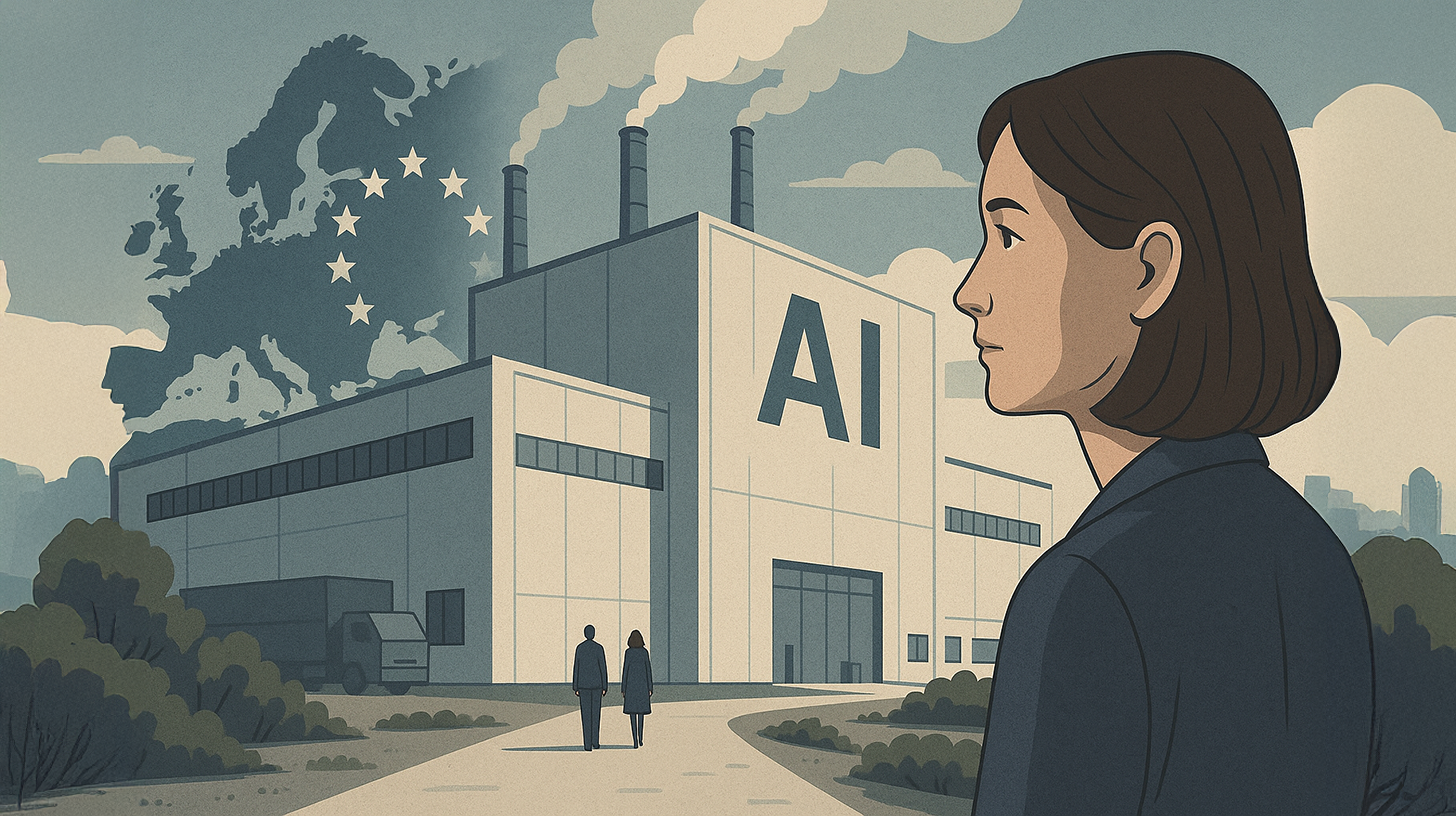
Europe's strategic path in AI development: Pragmatism instead of a technology race – Commentary on Eva Maydell (Member of the European Parliament) – Image: Xpert.Digital
EU expert warns: Europe's hunt for super AI is a misguided path – this is the alternative
Reality instead of race – gigafactories instead of hype: The pragmatic AI approach that sets Europe apart from the USA and China
The debate surrounding Europe's role in the global race for artificial intelligence has taken a significant turn with the statement by Bulgarian MEP Eva Maydell . Her position highlights a strategic approach that positions Europe not as a laggard in the technological race, but as a pioneer for practical and value-oriented AI development.
Eva Maydell's vision for Europe
Eva Maydell, who played a key role in shaping European AI policy as one of the leading negotiators of the EU AI Law and the Chip Law, holds a nuanced position on the European AI strategy. As a member of the European Parliament's Committee on Industry, Research and Energy and a proven expert in digital innovation, she brings years of experience in technology policy.
Their core thesis is both pragmatic and visionary: Europe should not pursue the illusory goal of developing a European alternative to ChatGPT or winning the race for superintelligence. Instead, the continent should focus on developing AI tools that can actually be used by European companies and industries and deliver measurable benefits.
According to Eva Maydell, our focus should be on:
- Developing specialized niche AI models that specifically meet business requirements – instead of participating in the global race.
- Building a robust infrastructure with powerful computing capacities, stable connectivity and human-centered AI rule sets.
- Ensure that AI remains a tool – it should support humans, not replace them.
The reality of AI adoption in Europe
The latest figures on AI adoption in Europe clearly support Maydell's argument. Despite the media hype surrounding artificial intelligence, the data paints a sobering picture: only 13.5 percent of European companies will have adopted at least one AI technology by 2024. This low adoption rate reveals a significant gap between technological possibilities and practical implementation in business.
This discrepancy becomes particularly clear when looking at company size. While large companies with over 250 employees achieve an adoption rate of over 40 percent, only about 12 percent of small and medium-sized enterprises (SMEs) use AI technologies. These figures are especially relevant because SMEs form the backbone of the European economy and account for 90 percent of all companies in Europe.
The sectoral distribution of AI usage reveals further interesting patterns. The information and communication sector leads with an adoption rate of 48.7 percent, followed by professional, scientific, and technical services at 30.5 percent. In all other economic sectors, the usage rate is significantly below 16 percent, highlighting the limited penetration of AI technologies in the wider economy.
Obstacles to AI adoption
The reasons for the hesitant adoption of AI are multifaceted and systematic. Companies face significant barriers that hinder successful implementation. The complexity and high costs of AI implementation present insurmountable obstacles, especially for smaller companies.
A shortage of qualified AI specialists further complicates the situation. Many companies lack the necessary expertise to successfully implement and operate AI systems. Moreover, there is often a lack of clear use cases that demonstrate the concrete benefits of AI for specific business processes.
Regulatory uncertainty, particularly regarding the implementation of the EU AI law, also contributes to the reluctance to adopt AI. Companies are hesitant to invest in technologies whose regulatory frameworks are not yet fully clarified.
The European approach: Specialization instead of generalization
Maydell's proposal to focus on niche AI models aligns with the strengths and needs of the European economy. Instead of trying to compete with the large technology companies from the US and China in the field of general AI, Europe should leverage its industrial expertise and regulatory know-how to develop specialized AI solutions.
This strategy offers several advantages. Specialized AI models require significantly less computing power and investment than general-purpose models, making them more accessible to European companies. At the same time, they can be more precisely tailored to the specific requirements of particular industries and use cases.
The European market offers numerous opportunities for such specialized applications. In sectors such as precision agriculture, automotive repair, healthcare, and manufacturing, AI solutions can be developed that solve specific problems and deliver measurable improvements.
Infrastructure and computing capacities
A key component of the European AI strategy is the development of a robust infrastructure. The AI Continent Action Plan, presented in April 2025, envisions the creation of a network of AI factories based on Europe's leading supercomputers. These factories will support EU-based AI startups, industry, and researchers in developing AI models and applications.
The planned AI gigafactories, equipped with approximately 100,000 state-of-the-art AI chips, are expected to quadruple current chip production capacity. These facilities will not only enable the development of complex AI models but also strengthen Europe's strategic autonomy in key industrial and scientific sectors.
The InvestAI initiative aims to mobilize €20 billion in private investment to build up to five AI gigafactories across the EU. In parallel, a Cloud and AI Development Act is proposed to stimulate private investment in cloud computing and data centers.
Human-centered AI development
A key aspect of Maydell's vision is the emphasis on human-centered AI development. She underscores that AI should be a tool that serves humanity, not replaces it. This philosophy reflects European values and differs significantly from other approaches that primarily focus on technological dominance.
The human-centered approach means, specifically, that AI systems should be developed to complement and enhance human capabilities, rather than replacing them. This requires careful design of human-machine interaction and ensuring that humans always retain control over important decisions.
A new dimension of digital transformation with 'Managed AI' (Artificial Intelligence) - Platform & B2B solution | Xpert Consulting


A new dimension of digital transformation with 'Managed AI' (Artificial Intelligence) – Platform & B2B solution | Xpert Consulting - Image: Xpert.Digital
Here you will learn how your company can implement customized AI solutions quickly, securely and without high entry barriers.
A managed AI platform is your all-inclusive, worry-free solution for artificial intelligence. Instead of dealing with complex technology, expensive infrastructure, and lengthy development processes, you receive a ready-made solution tailored to your needs from a specialized partner – often within just a few days.
The key advantages at a glance:
⚡ Rapid implementation: From idea to ready-to-use application in days, not months. We deliver practical solutions that create immediate added value.
🔒 Maximum data security: Your sensitive data stays with you. We guarantee secure and compliant processing without sharing data with third parties.
💸 No financial risk: You only pay for results. High upfront investments in hardware, software, or personnel are completely eliminated.
🎯 Focus on your core business: Concentrate on what you do best. We take care of the entire technical implementation, operation, and maintenance of your AI solution.
📈 Future-proof & scalable: Your AI grows with you. We ensure continuous optimization and scalability, and flexibly adapt the models to new requirements.
More information here:
EU AI Law: How trust enables innovation
Regulatory framework and trust
The EU AI law, in whose development Maydell played a key role, embodies the European approach to trustworthy AI. The law is based on a risk-based approach that categorizes AI systems into four groups: unacceptable risk, high risk, limited risk, and minimal risk.
This differentiated approach makes it possible to foster innovation while ensuring appropriate safeguards. AI systems with unacceptable risks, such as technologies for social evaluation or cognitive behavioral manipulation, are completely prohibited. High-risk systems are subject to strict requirements, including risk management, transparency, and human oversight.
Implementing the AI law requires close cooperation between companies, regulators, and other stakeholders. Clear definitions and examples of AI risk categories are essential to ensure companies can comply with the regulations.
Education and skills development
A critical success factor for Europe's AI strategy is the development of corresponding skills within the population and the workforce. Maydell emphasizes the need to make AI competence a basic skill, comparable to reading, writing, and arithmetic.
Most young Europeans use AI daily, but few learn how it works, what risks it poses, or how its development can be influenced. This education gap must be closed to ensure that the next generation possesses the skills required for an AI-driven future.
The planned AI Competence Academy, the Talent Pool, and the MSCA Choose Europe programs are all intended to attract top-tier AI professionals to Europe while simultaneously developing local talent in areas such as generative AI. These efforts will not only reverse the brain drain but also create legal migration pathways for non-EU experts.
Economic prospects and productivity increase
Research by the McKinsey Global Institute estimates that generative AI could help Europe achieve an annual productivity growth rate of up to 3 percent by 2030. This forecast underscores the enormous economic potential of AI technologies when successfully implemented.
Recent studies already show positive effects of AI adoption on productivity. 90 percent of European AI users report productivity increases, and 75 percent state that AI has changed the way they work. These results demonstrate the practical potential of AI technologies beyond the technological hype.
For small and medium-sized enterprises (SMEs), which form the backbone of the European economy, successful AI adoption is particularly important. Studies show that 39 percent of SMEs now use AI applications, an increase of 26 percent in 2024. Specifically, 26 percent use generative AI, an increase of 18 percent in the previous year.
Sector-specific applications
The focus on sector-specific AI applications reflects Europe's strength in various industries. In healthcare, AI systems can help improve diagnoses and personalize treatments. In manufacturing, they can optimize production processes and improve quality control.
AI offers unique opportunities in the areas of sustainable development and climate protection. German initiatives such as the "AI Lighthouses for Environment, Climate, Nature and Resources" demonstrate how AI can be used to solve environmental problems. With a funding volume of 40 million euros, the program supports application-oriented research projects in areas such as energy efficiency, resource efficiency, and biodiversity conservation.
International cooperation and strategic partnerships
Europe's AI strategy benefits from international cooperation, particularly with like-minded democratic partners. Maydell's role in the Delegation for relations with Japan and the US underscores the importance of such partnerships. These collaborations enable the exchange of best practices, the joint development of standards, and the coordination of regulatory approaches.
Collaboration is particularly important given the global nature of AI development and deployment. European startups are often forced to partner with US technology companies to access the necessary complementary services. Instead of hindering these collaborations, Europe should facilitate them while simultaneously building its own capacity.
Data access and quality
A key component of successful AI applications is access to high-quality data. The planned Data Union strategy, scheduled for introduction in 2025, will support these efforts by establishing a single market for data. This will make it easier for companies and researchers to scale AI solutions across borders while respecting EU data protection standards.
Data labs within AI factories are intended to collect and curate datasets from various sources, thus creating the foundation for AI training and experimentation. This infrastructure will be particularly important for the development of specialized AI models that rely on high-quality, domain-specific data.
Financing and investments
Financing AI innovation remains a key challenge for Europe. The continent is experiencing a funding gap in AI investments, requiring improved access to financing, better venture capital support, and stronger public-private partnerships.
The InvestAI initiative and other financing mechanisms aim to close this gap. At the same time, it is important to promote the development of European venture capital and private equity markets to create sustainable sources of funding for AI startups.
AI Gigafactories vs. Efficient Mini-Models: Europe's Strategic Dilemma
Despite ambitious plans, Europe's AI strategy faces significant challenges. Critics argue that the focus on building massive computing infrastructure through AI gigafactories may not align with emerging trends toward smaller, cost-effective AI models. European startups, inspired by the success of DeepSeek, are already implementing training techniques that achieve efficiency without extensive computing power.
The regulatory complexity of the planned AI law could stifle innovation. Overly broad definitions of "high-risk" and "general-purpose AI" could slow down European companies and research institutions – especially given intense global competition.
Maydell's vision: Value-oriented AI for citizens and businesses
The future of European AI development depends on successfully balancing innovation and regulation. Maydell's vision of pragmatic, value-driven AI development offers a roadmap for this balancing act. Europe can certainly succeed without winning the global AI race by creating technologies that are accessible, implementable, and transparent, and that align with the continent's democratic values.
Success will ultimately be measured by whether European companies and citizens can benefit from AI developments. This requires a continuous adaptation of strategies to changing technological and economic conditions, as well as close cooperation between all stakeholders.
The coming years will be crucial for realizing this vision. Europe faces the challenge of using its regulatory leadership to develop a new form of technological sovereignty – one that is not based on raw computing power or market dominance, but on the ability to develop and deploy AI technologies that serve humanity and drive societal progress.
Your AI transformation, AI integration and AI platform industry expert
☑️ Our business language is English or German
☑️ NEW: Correspondence in your native language!

Konrad Wolfenstein
I and my team are happy to be available to you as your personal advisor.
You can contact me by filling out the contact form here wolfenstein@xpert.digital:or simply call me at +49 7348 4088 965. My email address is
I'm looking forward to our joint project.