

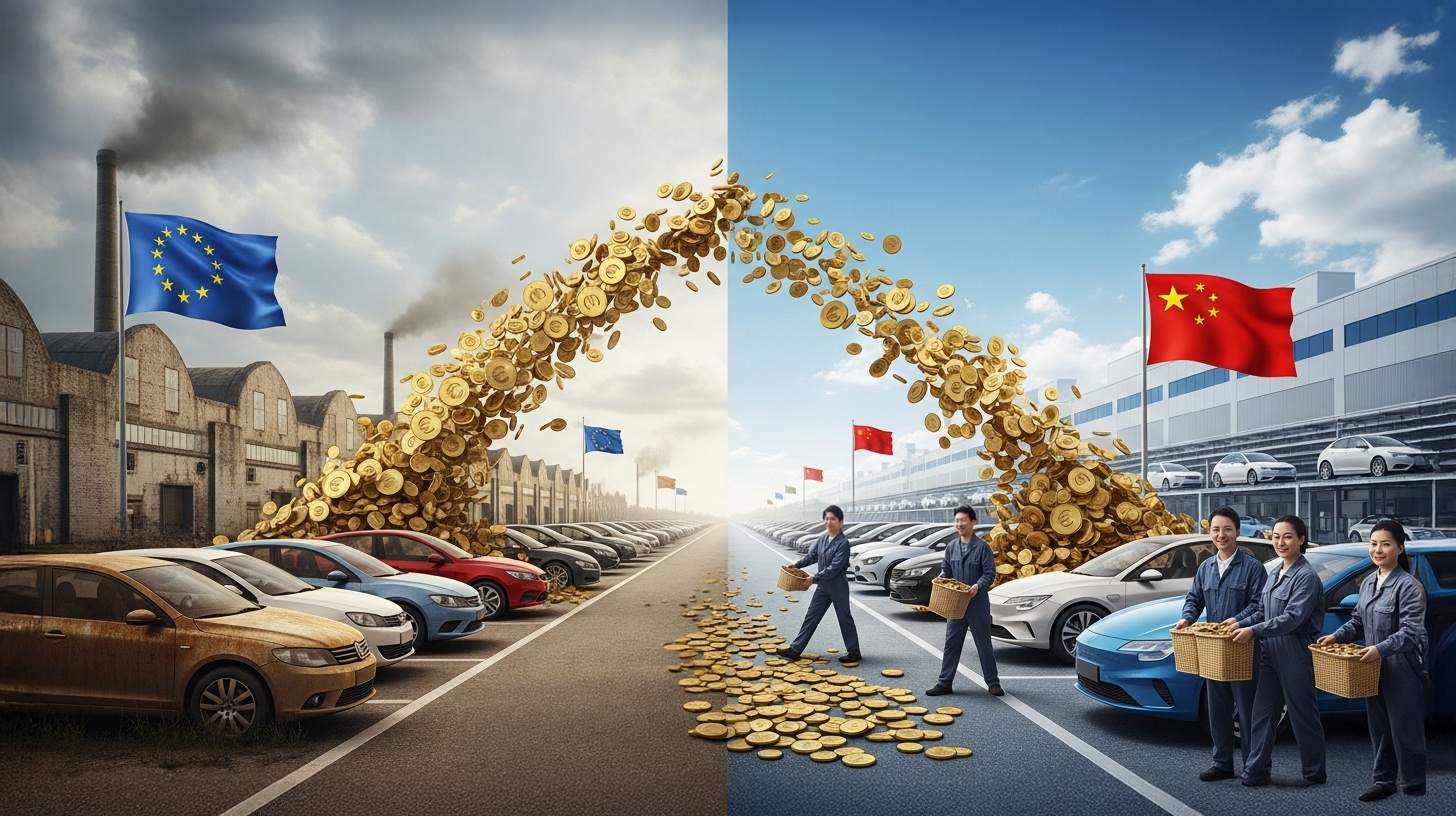
Car crisis | Europe's naive generosity and subsidy madness: Europe pays, China collects – Image: Xpert.Digital
Industrial self-defense: Why not another cent should flow to foreign corporations
Purchase incentives only for "Made in Europe"! Stop subsidizing China!
1. Europe must finally take a stand against industrial competition to prevent valuable taxpayer money from flowing abroad. A crucial instrument for this would be so-called "local content" clauses. Specifically, this would mean that government purchase incentives for electric cars would only be granted for vehicles that are demonstrably manufactured in Europe. Otherwise, we are directly financing our own subsidies to China's economic competition instead of strengthening domestic industry and jobs.
Don't be intimidated: Europe must not back down in the face of China's hypocritical retaliatory tariffs and sanctimonious WTO complaints. Fair trade is not a one-way street
2. Europe must resolutely counter the systematic and unfair competition resulting from China's massive state subsidies. While Beijing circumvents WTO rules with direct aid worth billions and legal tax loopholes, our markets are flooded with dumping prices and domestic companies are driven into ruin.
Related to this:


Why is the automotive industry in such a deep crisis?
What is the extent of the current crisis in the German automotive industry?
Within a very short time, radical announcements like Bosch's plan to cut around 13,000 more jobs in Germany alone by 2030 have alarmed not only employees but also politicians and the public. This job reduction comes on top of ongoing cuts, most recently 11,600 jobs worldwide at Bosch in its mobility division. In total, the known reductions amount to over 22,000 jobs at Bosch in Germany. The developments at Bosch are merely representative of an entire industry: According to an EY analysis, the German automotive industry lost over 50,000 jobs in just twelve months – a decline of almost seven percent of total employment in the sector – and no other branch of industry was hit harder. Overall, more than 100,000 jobs disappeared across the industry during the same period.
Why is the situation escalating so dramatically right now?
The situation is compounded by the interplay of various factors. The shift to electromobility, a slump in demand, intensified international competition, particularly from China, rising energy prices, and political uncertainties are creating a strain described as a "perfect storm." The transformation of the industry—technological, structural, and financial—is exacerbated by external shocks and regulatory uncertainties, hitting suppliers and locations with previously stable employment particularly hard.
Causes: Perfect storm due to internal and external factors
Slump in demand and structural change: Why is the order situation so bad and demand collapsing both domestically and abroad?
On the one hand, global car production figures are stagnating, and in Europe, many manufacturers are even experiencing a decline in sales volumes. Following the end of the environmental bonus for electric cars, demand in Germany, particularly among private buyers, has plummeted. While at the beginning of the decade one in four cars was an electric vehicle, this share fell to around 17 to 19 percent in 2024. Industry representatives complain that, after the discontinuation of government subsidies, buyer interest has collapsed more abruptly than anticipated by policymakers and industry. Although plug-in hybrids are gaining some registrations, the total number of vehicles on the road is increasing more slowly than originally predicted.
Is e-mobility actually reducing business for established players like Bosch?
Yes, because the overall value creation in electromobility is lower. Electric motors, batteries, and power electronics replace a large part of the complex engine manufacturing and supply chain for combustion engines. Services, service revenues, and aftermarket potential are shifting further toward software and digital offerings. In addition, Chinese suppliers are bringing innovative, software-centric technologies of high quality to market at "China speed," thereby gaining market share at the expense of traditional German suppliers.
Chinese competition as a sustainable game-changer: How great is the influence of Chinese companies, and what is their market share?
The state-subsidized rise of Chinese industry is overwhelming. In China itself, around 70 percent of vehicle registrations are for domestic brands. The market share of German manufacturers has fallen from over 25 percent (2019) to about 18 percent (2024).
China is producing with enormous overcapacity: While around 24 million vehicles were sold in 2024, industry analyses indicate that its factories could produce up to 50 million annually. This overcapacity translates into cheap exports on global markets. Many of these cars are technologically at least on par with their competitors, and often even leading the way in digitalization, connectivity, comfort, and autonomous driving. Innovation cycles are shorter, the products more customer-oriented, and generally more affordable.
Is the problem simply price competition?
No, there's also the structural weakness in the pace of innovation in Germany. While Chinese manufacturers can develop a new vehicle to market maturity in just one to two years, German companies often need almost twice as long. There's also a clear lag compared to China and the USA in digitalization, infotainment, software services, and autonomous driving functions.
Energy prices and Germany as a production location: What role do energy prices and the regulatory environment play in the worsening of the crisis?
Almost all experts highlight Germany's structurally higher energy prices as a significant competitive disadvantage. According to various analyses, energy costs for car production per vehicle in Europe will range from €800 to €1,200 in 2024–2025 – many times higher than in China or the USA. Particularly energy-intensive suppliers are facing additional cost pressures, and it is foreseeable that production will relocate from the country or investments will be postponed. A number of location decisions for new plants, especially in battery cell production, are now being made against Germany for cost reasons.
Related to this:
What other regulatory frameworks are hindering the industry?
The criticism is directed primarily at what many stakeholders consider to be overly one-sided and technology-independent regulation. The one-sided focus on full electrification and the planned phase-out of combustion engines from 2035 onwards is forcing some manufacturers to adjust their portfolios, even though the market is not yet ready or interim solutions such as hybrid or hydrogen technology could offer advantages. Added to this are high bureaucratic requirements, burdens imposed by fleet emission limits, an overall cumbersome investment incentive system, and unclear prospects for longer-term framework conditions.
Further shocks: Trump tariffs and the threat of protectionism – Why are US import tariffs and changes in trade relations suddenly playing such a major role?
New 25 percent US tariffs on European vehicles, and especially on key auto parts, represent a direct attack on the export-oriented business model of German manufacturers, as the US is their most important market outside of Europe. At the same time, the demands on regional and local production are increasing: Companies wanting to sell in the US must generate as much added value as possible locally – as explicitly required by the US Inflation Reduction Act. Similar "local content" rules are now being discussed in Europe, for example, as a prerequisite for purchase incentives, specifically to prevent taxpayer money from being diverted to Asia.
Is European industrial policy a self-inflicted problem or a necessary defensive measure?
Opinions are divided. While some representatives consider the swift introduction of "local content" requirements to be the only option, others warn against renewed protectionism and counter that innovation and competitiveness do not arise from isolation. One thing is clear: without industrial policy countermeasures, Europe will continue to lose market share.
Our global industry and economic expertise in business development, sales and marketing

Our global industry and economic expertise in business development, sales and marketing - Image: Xpert.Digital
Industry focus areas: B2B, digitalization (from AI to XR), mechanical engineering, logistics, renewable energies and industry
More information here:
A thematic hub offering insights and expertise:
- Knowledge platform covering global and regional economies, innovation and industry-specific trends
- A collection of analyses, insights, and background information from our key areas of focus
- A place for expertise and information on current developments in business and technology
- A hub for companies seeking information on markets, digitalization, and industry innovations
Made in China 2.0: How subsidies are putting pressure on Europe's automotive industry
Consequences: Domino effect, risk to business location and loss of trust
How do these developments affect the daily lives of employees and companies?
Job losses are already massive and, according to forecasts and studies, will continue. Many medium-sized suppliers and locations in economically disadvantaged regions see their existence threatened by the relocation of value chains and the margin pressure exerted by OEMs. Expert estimates suggest that up to 100,000 jobs could be lost across the entire supplier sector by 2030, and a wave of bankruptcies among medium-sized and smaller suppliers cannot be ruled out.
Which areas of the automotive industry are being hit particularly hard?
The hardest hit are the traditional component manufacturers for combustion engines and mechanical engineering. But massive cutbacks are also being seen in the Power Solutions and Electrified Motion sectors. The locations in southern Germany, such as Stuttgart-Feuerbach, Schwieberdingen, and Waiblingen, as well as Bühl and Homburg, are at the heart of the restructuring.
Related to this:
Role of e-mobility and charging infrastructure
What role does the ramp-up of electromobility play, and what is the state of the charging infrastructure?
The political and media focus on the shift to e-mobility is enormous, but there are many obstacles: After the end of purchase incentives, demand for electric cars initially plummeted, only stabilizing somewhat from 2025 onwards. The German government has set itself the goal of providing around one million charging points in Germany by 2030 – so far (August 2025) there are around 170,000 public charging points, of which almost 40,000 are fast-charging points. However, many charging points are currently underutilized, and the expansion of the charging infrastructure is significantly outpacing the increase in vehicle sales. This creates a two-sided dilemma: On the one hand, the expansion of the charging infrastructure is seen as crucial for the success of the transformation, while on the other hand, there is currently a lack of demand incentives from purchase premiums or tax breaks.
How many new BEV registrations are there currently, and how many are planned for the coming years?
In the first half of 2025, around 250,000 new electric cars were registered in Germany, representing almost 18 percent of all new registrations. For the full year, experts anticipate more than half a million new battery-electric cars and up to 800,000 electric vehicles in total. Forecasts predict that by 2030, eleven million battery electric vehicles (BEVs) could be on German roads.
Criticism of regulation and technology choice
Is the crisis partly "homegrown"?
Yes, many voices from business and politics see the overall situation exacerbated by Germany's and Europe's unique approach. A strong one-sidedness in regulation and innovation promotion, coupled with high taxes, levies, and administrative burdens, has weakened the industry's adaptability. Many other countries, such as China, the USA, and Japan, are taking a technology-neutral approach and continue to allow multiple drive concepts. In Germany and Europe, the commitment to a single drive technology is viewed by many stakeholders as a mistake that has cost valuable time for transformation and innovation.
What demands are being made of politicians?
A comprehensive reform of social security systems, a reduction in bureaucracy, targeted location promotion, and proactive support for innovation projects related to digitalization, battery production, and charging infrastructure are being demanded. Furthermore, tax frameworks should be adjusted, and "local content" clauses should be introduced for subsidized vehicles. Policymakers should not dictate technological pathways but rather set CO₂ targets and enable open competition – innovation and market decisions should then respond accordingly.
A key point is also the demand for a European industrial policy approach: Europe must learn to defend itself against unfair competition from China and other regions through regulatory and industrial policy measures, for example by linking tax money for purchase premiums to production sites in the EU.
Political failure: Inaction despite recognizable problems
Has German politics failed in the looming crisis of the automotive industry?
Criticism of German politics is clear and multifaceted. As was the case during the coronavirus pandemic, a pattern of political incompetence is evident: Instead of acting early and decisively, politicians reacted to China's systematic subsidy policy with a shrug and a kind of "I don't care" attitude. While the Chinese government, with its "Made in China 2025" strategy, has been strategically promoting key industries with massive state aid for over a decade, thereby creating overcapacities that are now flooding global markets, the German response (and that of the entire EU) remained half-hearted and uncoordinated.
Policymakers failed to develop effective countermeasures in a timely manner. Instead of a clear industrial policy response to the Chinese challenge, there were years of only academic discussions about WTO rules and multilateral solutions, while German companies lost market share. Only after the damage had already been done were hesitant steps such as anti-dumping duties on Chinese electric cars introduced – far too late and with insufficient effect.
What parallels exist with the Corona policies, and how does the political vacuum of responsibility manifest itself?
Similar to the situation during the coronavirus pandemic, a characteristic pattern is emerging: Politicians make decisions without adequately assessing the consequences, then hastily correct them when the negative effects become apparent, and subsequently refuse to take responsibility for the resulting damage. In the case of COVID-19, lockdown measures led to massive economic disruptions, the effects of which are still being felt today and have weakened the competitiveness of German companies.
The automotive industry repeated this pattern: First, electric mobility was massively promoted with purchase incentives, without providing sufficient charging infrastructure or considering the impact on domestic industry. Then, the subsidies were abruptly stopped, leading to a collapse in demand. At the same time, foreign manufacturers, especially Chinese ones, primarily benefited from German taxpayers' money, while domestic industry came under pressure to transform.
The majority of citizens have lost faith in the problem-solving abilities of Germany's top politicians. According to representative surveys, three-quarters of Germans do not see any politician they trust to resolve the automotive crisis. This lack of confidence reflects a political system that wavers between ideological goals and economic realities, without developing clear, long-term strategies.
Furthermore, politicians refuse to take responsibility for their poor decisions. Instead of an honest analysis of their own mistakes, they shift the blame to external factors such as Chinese competition or unforeseen market developments. This refusal to act prevents necessary corrections and reinforces the public's feeling that the political class is detached from economic reality.
The systematic fight against subsidies: Europe must act against China's unfair competition
What dimensions do Chinese state subsidies reach and why do they pose a fundamental threat to fair competition?
Europe must also take decisive action against China's systematic state subsidies for export-oriented Chinese companies, which constitute blatant unfair competition. The scale of this state-sponsored market distortion is alarming: According to recent studies by the Kiel Institute for the World Economy, direct industrial subsidies in China alone amounted to approximately €221 billion in 2019 – equivalent to 1.73 percent of China's gross domestic product, four times higher than in Germany or the USA. This is in addition to hidden subsidies through subsidized intermediate goods, preferential access to critical raw materials, forced technology transfer, and the systematic preferential treatment of domestic companies in public procurement procedures.
Particularly insidious is the fact that since 2023, China has increasingly used tax loopholes to circumvent WTO rules. While direct subsidies are prohibited under WTO law, tax breaks are not covered by these regulations – a loophole that China systematically exploits. In 2023, Chinese companies received four times as many tax refunds as ten years prior, which has the same effect as prohibited subsidies but is formally legal. These government interventions allow Chinese manufacturers to offer their products at dumping prices on global markets, thereby creating enormous overcapacities – in the automotive industry alone, Chinese factories can produce 50 million vehicles, while only 24 million were sold in 2024.
The impact on European companies is devastating: 64 percent of German firms facing Chinese competition report losses in market share, and 75 percent report lower profits. A quarter of all German companies face significant challenges due to subsidized Chinese competition. The EU has therefore been entirely justified in imposing definitive countervailing duties of up to 38.3 percent on Chinese electric vehicles and further anti-dumping measures against subsidized Chinese steel products, solar panels, and other strategic goods.
China is responding to these legitimate protective measures with brazen retaliatory tariffs – ranging from 15.6 to 62.4 percent on European pork – and hypocritically complaining to the WTO about the EU measures, while itself massively violating WTO rules. This hypocrisy reveals the true face of Chinese economic policy: concealing systematic rule violations while simultaneously criticizing others for their legitimate countermeasures.
Related to this:
- China's industry is faltering – Fifth month of negative growth – Questions and answers on the current economic situation
- Ticking time bombs in Asia: Why China's hidden debts, among other things, threaten us all
What needs to be done now?
What must business and politics do to turn the situation around?
The answer is multifaceted:
On the one hand, rapid reforms in social and labor market policy are crucial, for example in skills development and retraining, so that employees can move from shrinking sectors to emerging segments. At the same time, a technology-neutral, long-term reliable industrial policy is needed that attracts investment and does not willfully weaken Germany's export-oriented structure. Finding the right balance between regulation, innovation promotion, cost-conscious location policies, and international competitiveness is the key task.
What is needed is:
- Accelerated expansion of public and private charging infrastructure
- Competitive energy prices and targeted promotion of energy efficiency as well as in-house energy generation
- Innovation promotion in the areas of digitalization, software, batteries, alternative drives and sustainable production
- A reduction in the tax and contribution burden, especially for manufacturing companies
- A pragmatic approach to CO₂ targets and flexible fleet limits
- An initiative to develop robust European value chains
- Promoting diversification on both the sales and procurement sides
- A targeted European initiative for more local content, especially for eligible vehicles
- Europe must finally take decisive action against the systematic and unfair competition resulting from China's massive state subsidies
Related to this:

The atmosphere is tense, the challenges are enormous – yet many experts emphasize that transformation is at the heart of the industry's identity. If innovation, location attractiveness, and climate protection can be successfully combined, the automotive industry in Germany and Europe will retain its leading international role. If this fails, further job losses, a gradual decline in importance, and the demise of entire production sites are imminent.
The automotive industry is currently undergoing an unprecedented upheaval. External shocks and internal failures are exacerbating each other. In this "perfect storm," fundamental questions are being raised about the future direction of the entire sector. The coming years will show whether adaptation and transformation succeed – or whether Germany will definitively lose its long-standing leading role in this crucial industrial sector.
Your global marketing and business development partner
☑️ Our business language is English or German
☑️ NEW: Correspondence in your native language!

Konrad Wolfenstein
I and my team are happy to be available to you as your personal advisor.
You can contact me by filling out the contact form here wolfenstein@xpert.digital:or simply call me at +49 7348 4088 965. My email address is
I'm looking forward to our joint project.
☑️ SME support in strategy, consulting, planning and implementation
☑️ Creation or realignment of the digital strategy and digitization
☑️ Expansion and optimization of international sales processes
☑️ Global & Digital B2B trading platforms
☑️ Pioneer Business Development / Marketing / PR / Trade Fairs
🔄📈 B2B trading platform support – Strategic planning and support for export and the global economy with Xpert.Digital 💡


B2B trading platforms - Strategic planning and support with Xpert.Digital - Image: Xpert.Digital
Business-to-business (B2B) trading platforms have become a critical component of global trade dynamics and thus a driving force for exports and global economic development. These platforms offer significant advantages to companies of all sizes, especially SMEs—small and medium-sized enterprises—which are often considered the backbone of the German economy. In a world where digital technologies are increasingly prominent, the ability to adapt and integrate is crucial for success in global competition.
More information here: