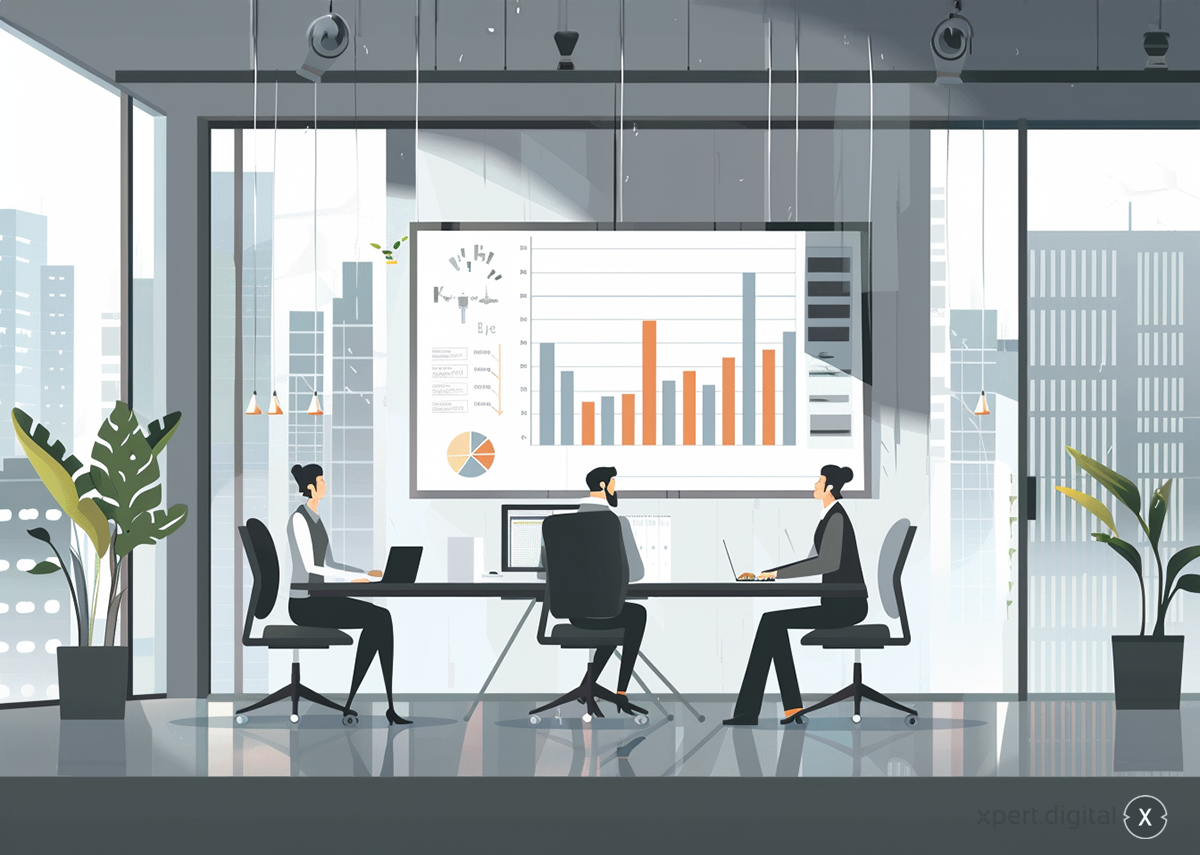
What do SMEs and startups have in common, and what is the difference between established entrepreneurs and startups? – Image: Xpert.Digital
📈🚀 What do SMEs and start-ups have in common, and what is the difference between entrepreneurs and start-ups?
🌱🌍 Indeed, the question is absolutely valid and important for developing a fundamental understanding of the different forms of entrepreneurship. Many people confuse the terms or use them in the wrong context, even though they have different meanings. Such questions help to create clarity and avoid misunderstandings – so, on the contrary, they are very valuable.
✨🔍 SMEs and start-ups: Similarities and differences
Small and medium-sized enterprises (SMEs) and startups play a crucial role in the economy, both nationally and internationally. Despite some overlap, there are significant differences between these two types of businesses, reflected in how they are founded, managed, and developed. The distinction between entrepreneurs and startups also often causes confusion. This text examines the similarities, differences, and respective challenges faced by SMEs and startups.
🏷️ Definitions: What are SMEs and start-ups?
Before we discuss similarities and differences, it's important to define the terms. SMEs are companies that do not exceed a certain size in terms of employee numbers and revenue. In the European Union, companies with up to 249 employees and a maximum annual revenue of €50 million are considered SMEs. These companies form the backbone of the European economy, representing over 99% of all businesses.
Start-ups, on the other hand, are young, innovative companies, often operating in technology or growth sectors, that aim for rapid expansion. The term "start-up" refers less to the company's size and more to its growth orientation and the often disruptive nature of its business idea. Start-ups are geared towards transforming existing markets or creating entirely new ones through new products, services, or business models.
🤝 Similarities between SMEs and start-ups
Despite their different focuses, SMEs and start-ups also have many things in common:
1. Entrepreneurial risk
Both SMEs and startups are characterized by entrepreneurial risk. Whether it's a traditional craft business or a tech startup, both must face competitive pressure, financial risks, and market fluctuations. This risk is usually borne by the founder or managing director alone or with a small group of partners.
2. Creativity and Innovation
Even though SMEs don't always experience the same pressure to innovate as startups, they are often forced to react creatively and flexibly to market changes. Many SMEs have developed innovations over the years that have shaped their niche markets. Startups, on the other hand, are usually defined by disruptive innovations that can fundamentally alter existing market structures.
3. Resource efficiency
SMEs and start-ups typically have to manage with limited financial and human resources. They are often forced to operate efficiently and find creative solutions to achieve their goals. This fosters a culture of problem-solving and flexibility that is often not as prevalent in large corporations.
👥 Differences between SMEs and start-ups
Despite these similarities, there are significant differences between SMEs and start-ups, which become apparent both in the founding phase and in the further development of the company:
1. Goal and growth strategy
SMEs and startups differ significantly in their growth strategies. SMEs are generally geared towards long-term survival and pursuing a sustainable business model. Their goal is often stable and consistent growth without taking overly risky steps. Management typically has a long-term plan aimed at preserving the company for generations to come.
Start-ups, on the other hand, usually pursue an aggressive growth strategy designed for rapid scalability. They often seek external capital to quickly expand their business and gain market share. Their goal is to grow significantly within a short period, often with the intention of later selling the company or taking it public.
2. Financing
Another key difference lies in financing. SMEs often finance themselves through traditional methods such as bank loans or the founders' own capital. Since their growth is often more moderate, they can afford to rely on stable and conservative financing models.
Start-ups, on the other hand, are heavily reliant on venture capital. They often specifically seek out investors willing to invest large sums to promote the company's rapid growth. However, these investors also expect a correspondingly high return, which increases the pressure on start-ups to achieve rapid success.
3. Corporate Culture
The culture in SMEs is often more traditional and stable. It is usually based on long-standing company values that are passed down through generations. SMEs are often family-run businesses where relationships with employees and customers play a major role.
In contrast, startups have a more dynamic and flexible corporate culture. Flat hierarchies, high pressure to innovate, and the constant search for new markets and technologies characterize the daily work routine. Startups are often distinguished by an experimental and less hierarchical structure, in which employees have considerable autonomy.
🆚 Business founders vs. start-ups: What's the difference?
Another frequently misunderstood point is the difference between an entrepreneur and a start-up. Both terms are often used synonymously, although they describe different aspects of entrepreneurship.
1. Start-up founders
An entrepreneur is someone who starts a new business. This can range from a small craft business to a retail store to a medium-sized company. The main goal of an entrepreneur is to develop a viable business model and operate the company for the long term. Self-employment and independence are often paramount, rather than rapid growth or disruptive innovations.
2. Start-up founders
In contrast, startup founders aim from the outset to grow rapidly and scale their companies quickly. Often, this is driven by an innovative business idea with the potential to revolutionize existing markets. Startup founders are willing to take higher risks to achieve rapid success and actively seek investors prepared to finance this growth.
3. Different motivations
Another difference lies in the founders' motivations. Entrepreneurs often want to retain control over their own company and build a stable business for the long term. They are less interested in rapid growth and instead focus on establishing their company in an existing market.
Start-up founders, on the other hand, often have the vision of building a large company in a short time, which can either be sold or taken public. They strive to gain market share quickly and are prepared to take high risks to achieve their ambitious growth targets.
📊 Challenges and opportunities for SMEs and start-ups
Both SMEs and start-ups face significant challenges, but also opportunities. In today's globalized and digitalized world, both types of companies must be innovative and adapt to constantly changing market conditions.
1. Challenges for SMEs
SMEs often face the challenge of competing with larger rivals with limited resources. They must establish themselves in niche markets while simultaneously ensuring their financial stability. Furthermore, SMEs often struggle to find and retain qualified staff, as larger companies can often offer more attractive salaries and career prospects.
2. Challenges for start-ups
Start-ups, on the other hand, face intense pressure to grow quickly and become profitable. Their dependence on external capital can force founders to make risky decisions. The high level of competition in many innovative markets also presents a constant challenge. Start-ups often have to compete against established players with significantly greater resources.
3. Opportunities for SMEs and start-ups
Despite these challenges, both types of companies offer numerous opportunities. SMEs can score points through their flexibility and customer focus by offering tailored solutions and personalized service. They can establish themselves in niche markets where larger companies often operate less agilely.
Start-ups have the opportunity to tap into new markets or fundamentally change existing market structures through their innovative strength and disruptive approach. If they are successful, they can grow exponentially within a short time and become large, globally operating companies.
📝 Business structures face major challenges
SMEs and startups are two distinct but equally important pillars of the economy. While SMEs focus on stability and long-term growth, startups pursue an aggressive growth strategy and strive for rapid success. Both types of businesses face significant challenges but also offer unique opportunities for founders and entrepreneurs. The main difference between established businesses and startups lies in their growth orientation and the associated risks and opportunities.
📣 Similar topics
- 🚀 SMEs vs. Start-ups: A comparison
- 📊 Growth and financing: SMEs and start-ups in focus
- 📚 Definitions and differences: SMEs and start-ups
- ⚙️ Corporate Cultures: Stability vs. Dynamics
- 💡 Innovation and creativity in SMEs and start-ups
- 🌱 Entrepreneurs vs. Start-ups: What makes the difference?
- 🔍 Challenges and opportunities for SMEs and start-ups
- 💼 SMEs and start-ups: Risk and resource efficiency
- 🌟 Similarities and differences between SMEs and start-ups
- 📈 Growth strategies compared: SMEs and start-ups
#️⃣ Hashtags: #CompanyComparison #SMEsvsStartups #Innovation #Entrepreneurship #GrowthStrategies
We are here for you - Consulting - Planning - Implementation - Project Management
☑️ Start-up and industry expert, here with its own Xpert.Digital industry hub featuring over 2,500 specialist articles

Konrad Wolfenstein
I would be happy to serve as your personal advisor.
You can contact me by filling out the contact form below or simply call me on +49 7348 4088 965 .
I'm looking forward to our joint project.
Write to me


Xpert.Digital - Konrad Wolfenstein
Xpert.Digital is a hub for industry focusing on digitalization, mechanical engineering, logistics/intralogistics and photovoltaics.
With our 360° Business Development solution, we support renowned companies from new business to after-sales.
Market intelligence, smarketing, marketing automation, content development, PR, mail campaigns, personalized social media and lead nurturing are part of our digital tools.
You can find more information at: www.xpert.digital - www.xpert.solar - www.xpert.plus
Keep in touch